


…
Many legal teams struggle with gaps in their legal tools, whether it is contract management, board management, or matter management. Legal teams invest in a document platform to centralize contracts, clauses, and workflows. Everything happens in one place, from drafting to reviewing and approving, until a document needs a signature.
At that point, third-party integrations typically take over; documents move between platforms, and the audit trail may be split across platforms, depending on the integration.
This is why your legal tools should come with an integrated e-signature system built in.
Why “just add a signing tool” became the default
Electronic signature tools existed before most CLMs, Board Management, or Entity management tools did. Teams relied on them as a quick fix, and that habit stuck. Today, many organizations still pay for a separate signing solution subscription, despite having a solid contract management tool that serves as a repository, template library, among many other functions.
Third-party signature integrations became the norm because no one has questioned whether this still holds true today. There are multiple downsides to this way of working, the main ones relating to your data processing and the audit trail.
What happens to your data when using third-party signing providers
This is a less visible problem: when a document moves to an external signing tool, it is processed by that provider’s infrastructure. Even briefly, this may mean that the data is processed in the external provider’s environment, which can create additional data-governance considerations:
- Additional third-party risk: according to Verizon’s 2025 Data Breach Investigations Report, the share of breaches involving a third party doubled in a single year, from 15% to 30%.
- Time lost: switching to a separate platform, logging into another account, and chasing the audit trail manually adds up fast.
- Tracking gets trickier: the entire contract lifecycle no longer lives in one place. The Certificate of Completion is not always automatic, so proof of signature often has to be retrieved manually.
For NDAs, board resolutions, and client contracts, the last point is worth a second look.
What to look for in legal software with an integrated signature system
If signature is properly integrated into a platform, the setup should be largely invisible. No activation steps, no separate subscription, no admin overhead to get started. It should be there when you need it.
1. Included by default, no activation required
A well-integrated signature feature does not require a dedicated onboarding step. With the current connection-hub model, e-signature requires a configured provider account. The document record remains in DiliTrust throughout the contract management workflow, while signing is handled through the selected provider.
2. SES for everyday signing
Simple Electronic Signature (SES) is the baseline level defined within the eIDAS framework, so your built-in signature solution should support it. SES may be sufficient for many routine documents, such as NDAs and supplier agreements, but the appropriate signature level for employment contracts, board resolutions, and other documents depends on the document, jurisdiction, and applicable legal formalities. A signature solution that supports SES can cover many routine signing workflows, making it an important capability for legal software with e-signature.
3. Adaptable and customizable for specific use cases
Although SES may be sufficient for many routine documents, some documents may require a higher level of assurance. Advanced Electronic Signatures (AES) may be appropriate for certain regulated activities, higher-risk transactions, or specific jurisdictional requirements. A properly designed setup should support these requirements by connecting to third-party providers that offer the required signature level and authentication method when needed, rather than treating AES as the default for every signing workflow.
The result is a single platform that connects to providers offering SES and AES for different use cases, with DiliTrust Sign planned as the native signature option.
4. Flexible authentication per signer
Not all documents carry the same risk level, and not all signers are in the same context. Depending on the provider and module, available authentication options may include secure email links or one-time passwords (OTPs) by SMS when an extra layer of verification is needed. Configuration requirements also depend on the selected provider and module.
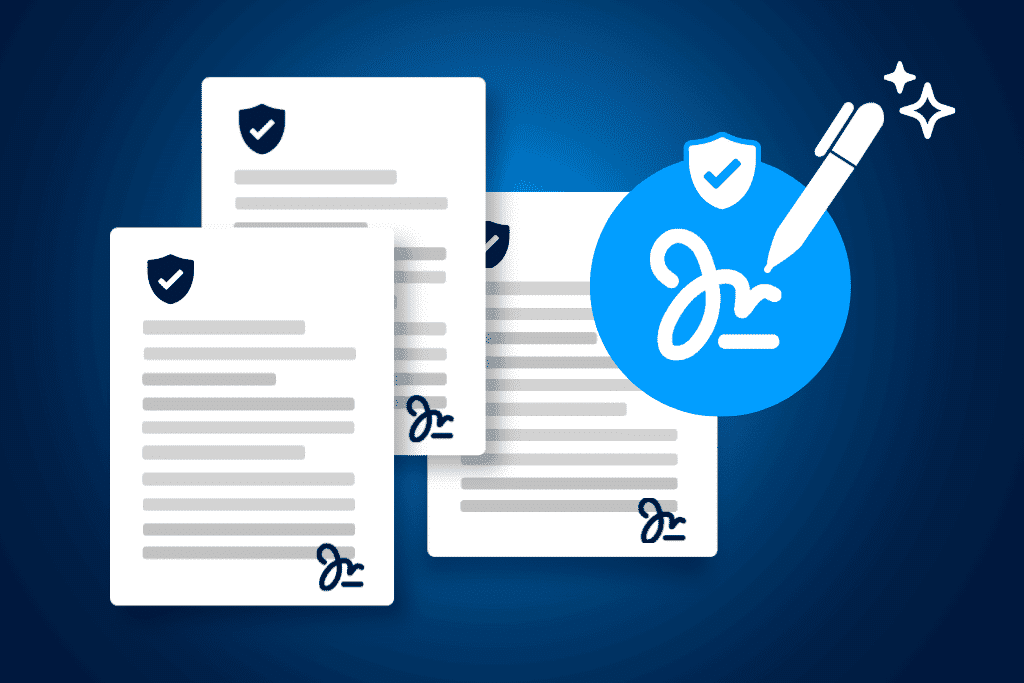
DiliTrust Sign, your native e-signature companion
Experience the full signing workflow without leaving your Board Portal, CLM or Entity Management platforms.
Use cases where integrated signatures matter
When your legal software connects to an e-signature provider and is properly configured, the workflow is straightforward. A team member opens a document, assigns signers, sets the signing order if needed, and sends it for signature. The document record remains in the platform throughout the contract management workflow, while the signing process is handled through the selected provider. Depending on the provider and module, signing status, automated reminders, and storage of the signed document and signature certificate may be available.
Signing a board resolution with external directors
A board resolution typically involves multiple signers, including people outside the organization. Board management software with an integrated e-signature solution can provide the security and speed needed:
- The corporate secretary opens the document directly in the platform and selects it for signature.
- Add each director as a signer and set a sequential signing order if governance rules require it.
- Each director receives a secure link by email, where supported by the selected provider, without needing to create an account or complete additional setup.
- Track signing progress in real time, where supported by the provider and module.
- Once the last signature is collected, the Certificate of Completion is generated automatically and stored alongside the signed document.
For a document involving multiple stakeholders across different organizations, keeping the process connected can reduce the coordination burden that often slows board resolutions.
Sending an NDA to an external partner
NDAs are among the most common contract types. They involve external parties and and are often managed under tight deadlines. If your CLM software connects to an e-signature provider, the workflow may look as follows:
- Assign the external party as a signer directly from the document.
- Choose an available authentication method and send the request for signature.
- Depending on the provider, the external party may be able to click the link, review the document, and sign without creating an account.
- The signed NDA and available signing records may be synchronized back to the contract record.
When turnaround time is the priority, reducing the need to exchange files manually or follow up on PDF attachments can make a difference.
Make integrated signature systems part of the legal workflow
A legal software platform should connect drafting, approval, and signature workflows while keeping relevant records accessible in one place. The current connection-hub model supports connections to providers offering SES and AES, while DiliTrust Sign is planned as the native signature option. The result can be a clearer audit trail, less administrative work, and a signing process that fits the legal work already underway, depending on the provider and module.
Frequently asked questions about integrated signature systems
How should legal teams decide between native SES and AES for different documents?
Start with the document type and jurisdiction. SES is often sufficient for routine documents, while employment contracts, board resolutions, and regulated documents may require a higher level of assurance. Check local requirements before choosing AES.
What happens to the audit trail when a contract moves from a CLM to a third-party signing provider?
The audit trail may be split between the CLM and the signing provider. Depending on the provider and module, signing timestamps, certificates, and signed documents may be synchronized with the original contract record.
How can legal teams collect signatures from external directors or partners without moving documents between platforms?
Depending on the provider, external signers can receive an email link and sign in their browser without creating an account or installing software. The contract record can remain in the legal platform while signing is handled through the configured provider.