


Your counterparty sends over a 60-page MSA, drafted entirely in their favor. Legal review is due in three days. The commercial team is already asking when it will be signed. You have one shot to push back on the right clauses, protect your company’s position, and still get the deal done.
This is what contract negotiation looks like in practice: not a boardroom handshake but a race against the clock with real legal and financial stakes. Done well, it is one of the most consequential capabilities an in-house legal team can develop. Done poorly, the risk compounds quietly for the life of every agreement.
What Is Contract Negotiation?
Contract negotiation is the process by which two or more parties agree on the terms of a contract: reviewing, revising, and finalizing language before signature. It begins with the first exchange of a draft and ends with an executed agreement both sides will be held to.
Contract negotiation: The structured back-and-forth process through which contracting parties align on the legal and commercial terms of an agreement before it is signed and becomes binding.
For in-house counsel, contract negotiation is rarely a single conversation. It is a multi-step workflow: reviewing counterparty paper, identifying deviations from internal standards, marking up provisions, exchanging revised drafts, managing stakeholder approvals, and maintaining a defensible record of every decision made along the way.
Why Contract Negotiation Is a Legal Priority
Contract negotiation directly determines the legal and financial risk your organization carries for the life of every agreement. World Commerce & Contracting research estimates that organizations experience average contract value erosion of 8.6% annually as a result of poor contract management, including missed renewals, overlooked obligations, and unfavorable terms.
When a liability clause is broader than your standard position, or a termination right favors only the counterparty, those provisions stay in force for the duration of the agreement. Every year the contract runs, the exposure compounds.
For the General Counsel, this is more than a legal risk; it is a business case. A legal department that negotiates with precision and speed, using standardized positions, documented fallbacks, and auditable decisions, operates as a strategic asset rather than a bottleneck.
How to Negotiate a Contract: The 5 Stages
Effective contract negotiation follows five sequential stages: preparation, opening, bargaining, drafting and review, and closing. Moving through each stage deliberately is the difference between a deal that closes cleanly and one that stalls, restarts, or creates post-signature problems.

Stage 1: Preparation and Planning
Preparation is the most important stage of contract negotiation, but often skipped. Before any draft is exchanged, identify your preferred positions for each key clause, define your fallback positions, and know your walkaway terms.
If you are reviewing third-party paper, map every provision against your internal standards before the negotiation begins. Build a negotiation playbook for your most frequent contract types: NDAs, MSAs, SaaS agreements, lease agreements, vendor contracts.
Negotiation playbook: A structured document that codifies a legal team’s preferred clause language, acceptable fallback positions, and non-negotiable walkaway terms for each contract type, used to standardize and accelerate the negotiation process.
A well-built playbook pays off on every future negotiation. The work is done once; the standards apply consistently.
Stage 2: Opening and Dialogue
The opening stage establishes tone and anchors the negotiation. Present your positions clearly and early. In-house counsel who table preferred positions first, before reacting to the other side, consistently reach outcomes closer to those positions than those who wait. Frame every pushback around business rationale. Counterparties respond better to “our standard indemnification cap aligns with our insurance coverage” than to “legal requires this.” Listen carefully: what the other side resists hardest often signals where their real risk exposure lies.
Frame every push-back around business rationale. Counterparties respond better to “our standard indemnification cap aligns with our insurance coverage” than to “legal requires this.” Listen carefully: what the other side resists hardest often signals where their real risk exposure lies.
Stage 3: Bargaining and Concessions
The bargaining stage is where priority positions are protected and lower-stakes provisions are traded. Concessions are inevitable in any commercial negotiation. The goal is not to win every point; it is to preserve what matters most while offering movement on provisions with lower business impact.
BATNA (Best Alternative to a Negotiated Agreement): The outcome a party would pursue if the current negotiation fails. Knowing your BATNA before bargaining begins prevents accepting terms that are worse than your alternative, and gives you the standing to walk away when necessary.
Make concessions strategically and sequentially, not all at once. Your BATNA sets the floor. If the deal cannot close without accepting terms that breach your internal standards, walking away is often the right decision.
Stage 4: Drafting and Review
In the drafting stage, agreed positions are converted into binding contract language. Whoever controls the draft controls the framing. Work from your paper where possible. If the counterparty insists on their template, mark it up thoroughly. Every deviation from your standard position should be visible, explained, and tracked.
Redlining: The process of marking up a contract draft with proposed changes, typically using track changes in Microsoft Word. Each side redlines the other’s draft until language is agreed. The term originates from the practice of annotating paper contracts in red ink.
Internal review at the drafting stage is critical. Legal must flag what changed, why, and what was accepted, with a clear record of who approved each position. That documentation is essential if a dispute arises months or years after execution.
Stage 5: Closing and Execution
The closing stage moves the agreed contract through final approval, signature, and storage. Closing is not the end of the process. It is the handoff to post-signature obligation management. Every executed agreement should land in a central, searchable repository with key metadata extracted and deadlines actively tracked.
Which Contract Terms Are Most Often Negotiated?
The clauses most frequently negotiated in commercial contracts are those that define financial exposure, performance obligations, and exit rights. In-house counsel should prioritize these provisions in most negotiations:
| Clause | Why It Matters |
|---|---|
| Scope of Work | Defines precisely what is owed: vagueness creates disputes |
| Pricing & Payment Terms | Payment timing, late penalties, and escalation rights |
| Liability Cap | Sets your maximum exposure; align with your insurance coverage |
| Indemnification | Who covers losses and under what circumstances: often drafted broadly |
| IP Ownership | Critical in vendor, consulting, and technology contracts |
| Termination Rights | For cause, for convenience, notice periods, and consequences |
| Confidentiality / NDA | What is protected, for how long, and what exceptions apply |
| Force Majeure | Events that excuse non-performance, increasingly litigated |
| Governing Law | Which jurisdiction resolves disputes: matters for enforcement |
What Contract Negotiation Strategies Work Best?
The most effective contract negotiation strategies are anchoring early, separating positions from interests, packaging issues together, and documenting every agreed deviation. There is no universal playbook for tactics. Every deal and counterparty is different, but these approaches apply consistently across commercial negotiations.
What Are the Most Common Contract Negotiation Pitfalls?
The most common contract negotiation pitfalls are version chaos, over-negotiation, misaligned internal stakeholders, missed deadlines, and reviewing third-party paper without a systematic approach. Each is avoidable with the right process.
How Does Technology Change the Contract Negotiation Process?
CLM (Contract Lifecycle Management) technology can speed up contract negotiation by reducing manual clause-by-clause review with AI-powered deviation detection against pre-approved playbooks. Instead of relying on individual counsel to recall preferred positions for every clause type, standards are codified in the system and applied consistently to every incoming agreement.
Contract Lifecycle Management (CLM): An enterprise software platform that manages contracts from request and drafting through negotiation, approval, signature, storage, obligations, and renewal within a single, structured system.
Manual contract review has a hard ceiling. When you are managing dozens of active negotiations across different business lines, geographies, and contract types, the ability to systematically identify deviations from your standards quickly becomes the deciding factor between a legal team that leads deals and one that delays them.
Still tracking contract redlines over email?
There is a better way to manage versions, review cycles, and counterparty edit.
What Features Should a Contract Negotiation Tool Have?
The most impactful features for the contract negotiation stage are AI clause review against playbooks, version-controlled editing in Microsoft Word, secure external review workflows, a clause library, and a full audit trail. Here is what each capability delivers in practice:
- AI-powered clause review against playbooks: automatically flags deviations from preferred positions, ranked by risk level, before counsel opens the document
- Track changes in Microsoft Word: editing in a familiar environment, with full version history and real-time collaboration across internal and external reviewers
- Secure external review workflow: counterparties can review, comment, and return revised versions without requiring platform credentials
- Clause library: pre-approved language counsel can insert directly at the point of negotiation
- Full version history with comparison: every draft version stored and comparable, with a timestamped record of what changed, by whom, and when
- Audit trail: a complete action log for regulatory compliance and post-signature dispute defense
For in-house legal teams managing high volumes of third-party paper, DiliTrust CLM brings structure and consistency to the negotiation phase.
Risk Detector: DiliTrust’s AI contract review engine. It scans incoming agreements against predefined playbooks, flags deviations by risk level, and surfaces a plain-language explanation and specific redlining guidance for each flagged clause, so counsel can go directly to the provisions that matter most.
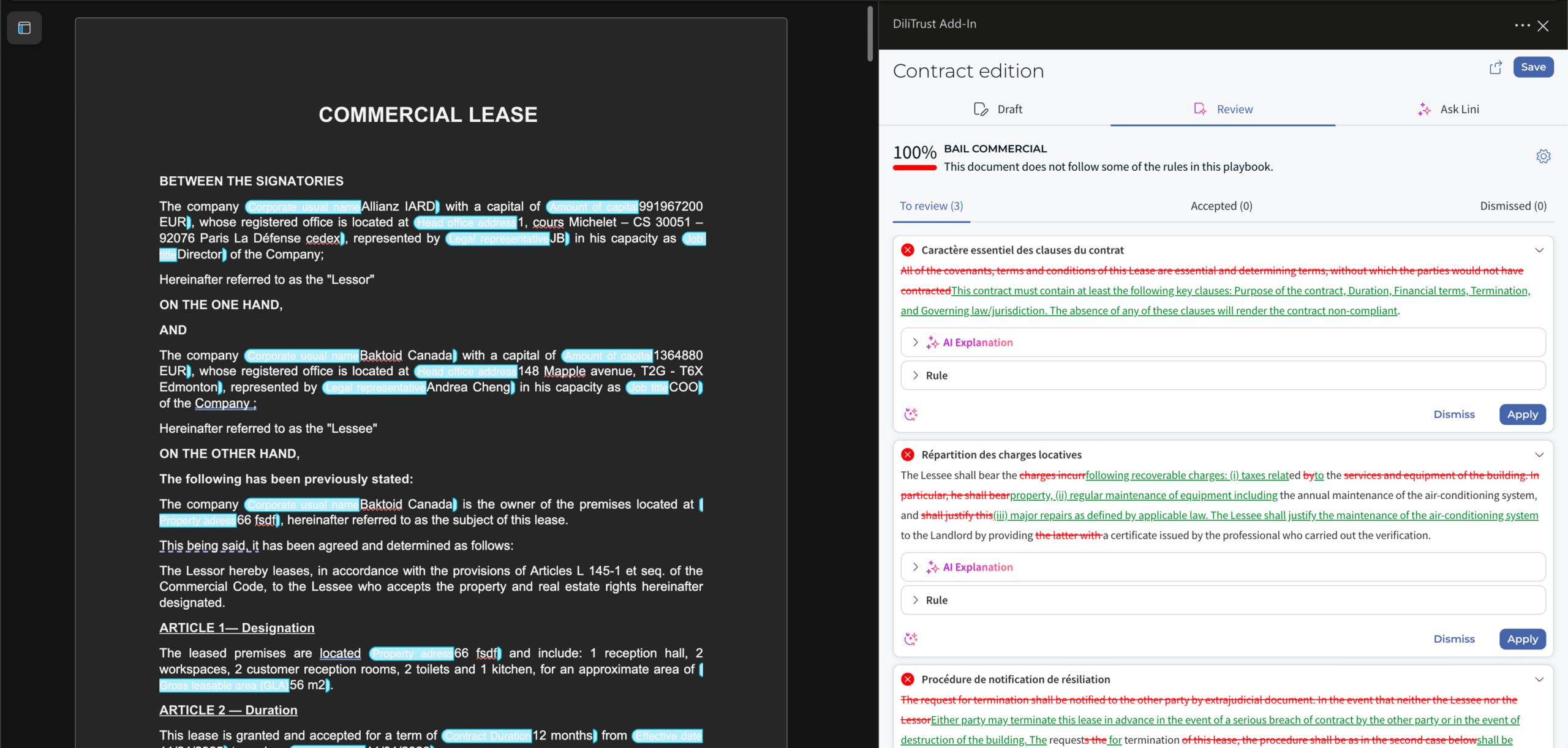
Risk Detector can reduce the need for a full manual read-through. Counsel reviews what the AI has flagged, with context on why each clause is problematic and what the preferred alternative language looks like.
Collaborative Editing in DiliTrust CLM allows counsel and counterparties to work in Microsoft Word simultaneously. Access is managed securely, new counterparty versions are automatically ingested back into the platform, and every change is timestamped and attributed. Once negotiations close, the executed contract moves directly into the searchable repository, with AI-extracted metadata, key dates, and obligation reminders already in place.
The outcome: legal teams that process more agreements, with greater consistency, without losing visibility over what was agreed and why.
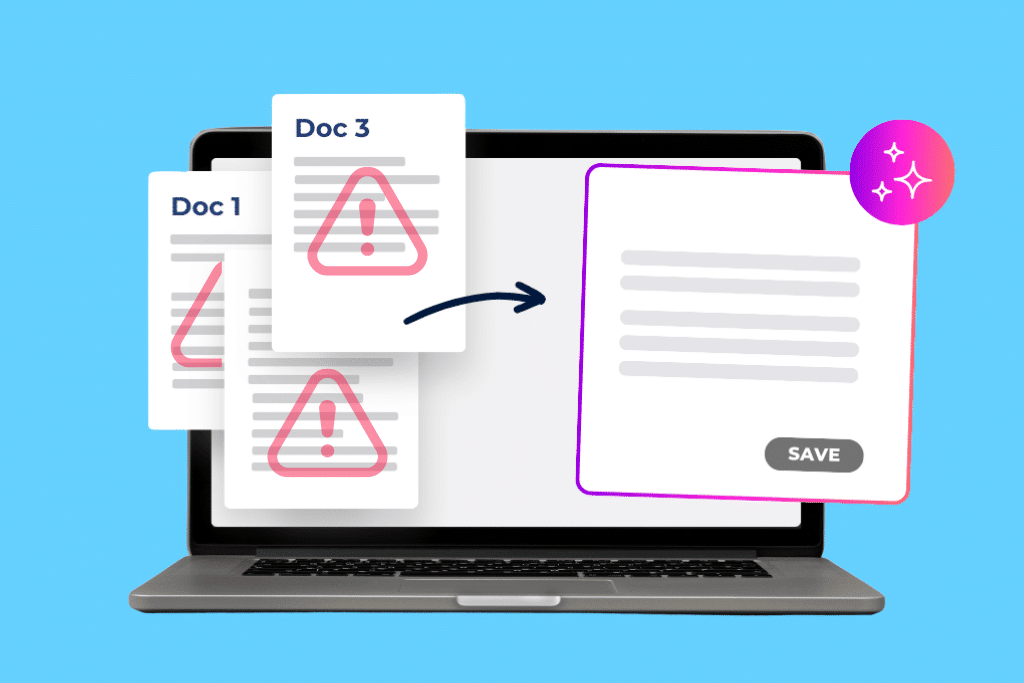
Struggling to catch every high-risk clause under deadline pressure?
DiliTrust’s Risk Detector automatically flags non-compliant clauses against your internal playbooks and suggests compliant alternatives in real time. No more manual line-by-line review.
Contract Negotiation Best Practices: A Quick Reference
The following checklist summarizes what high-performing in-house legal teams do before, during, and after every contract negotiation:
- Define preferred, fallback, and walkaway positions before any negotiation starts
- Build playbooks for your highest-volume contract types: start with NDAs: high volume, well-defined risk, and quick results
- Work from your own paper where possible; controlling the draft means controlling the framing
- Align commercial, legal, and finance before any counterparty conversation: never negotiate against your own team
- Track every deviation from your standard position with a documented rationale
- Use a version-controlled workspace; email attachments create version risk and break the audit trail
- Set internal milestones for each review cycle; do not let negotiations expand indefinitely
- Store every executed contract centrally with key metadata extracted and deadlines actively monitored
Frequently Asked Questions About Contract Negotiation
What is contract negotiation?
Contract negotiation is the process by which two or more parties agree on the terms of a contract before signature. It involves reviewing draft language, identifying provisions that need to change, exchanging revised versions, and reaching final agreement on terms both sides accept. For in-house legal teams, it also includes managing internal approvals, maintaining version control, and documenting every agreed deviation from standard positions.
What is the difference between contract negotiation and contract drafting?
Drafting is the act of writing contract language. Negotiation is the process of agreeing on that language with the other party. In practice, the two overlap because each exchange of revised drafts is part of the negotiation. However, strategy, stakeholder alignment, and preparation are distinct from drafting skill and require separate attention before any document is exchanged.
How long does contract negotiation typically take?
Most commercial contracts negotiate in one to four weeks. Enterprise agreements and transactions in regulated industries can take months. The most effective way to reduce cycle time is a well-prepared playbook and a clear internal approval process, so counsel is not chasing sign-off during active negotiation.
How does AI help with contract negotiation?
AI accelerates contract negotiation by automating the identification of clause deviations from pre-approved playbooks, so counsel does not have to review every provision from scratch. In DiliTrust CLM, Risk Detector scans incoming third-party agreements, flags problematic clauses by risk level, provides plain-language explanations, and surfaces specific redlining guidance.
Playbook-driven clause review, real-time collaboration, full audit trail, in one platform.
See what your negotiation process looks like with DiliTrust.