



Most contract problems don’t show up at signature. They show up months later. The notice period has passed, the renewal date was buried in a PDF on a shared drive, and the person who negotiated the deal has moved on.
Intelligent contract management closes that gap by turning contracts into data your teams can search, track and act on. Below: what it means, which capabilities matter, and how legal teams can start without rebuilding everything at once.
Key takeaways
- Intelligent contract management uses software, including AI, to extract, track and analyze the information inside contracts across their full lifecycle.
- Poor contracting erodes an average of 8.6% of contract value, according to World Commerce & Contracting.
- The core capabilities are AI data extraction, playbook-based review, search across clauses, rule-based alerts and portfolio reporting.
- AI works best when your standards are written down first. A review tool can only flag deviations from a playbook that exists.
- Start with one painful workflow, such as supplier renewals, then expand once you can measure results.
What is intelligent contract management?
Intelligent contract management is the use of software, including AI, to capture, track and analyze the information inside contracts from drafting to renewal. It treats clauses, dates and obligations as structured data. Teams can then search that data, get alerts from it and report on it.
Traditional contract management stores the document. Intelligent contract management reads it.
| Aspect | Traditional contract management | Intelligent contract management |
|---|---|---|
| Storage | Folders, shared drives, email | Central repository with structured contract data |
| Data entry | Typed in by hand | AI extracts key data, a person validates it |
| Search | File names and keywords | Search across content, attributes and clauses |
| Review | Line-by-line reading | Clauses checked against your playbook |
| Deadlines | Calendar reminders set manually | Rules that calculate notice dates automatically |
| Reporting | Spreadsheet exports | Dashboards and plain-language questions |
What “intelligent contract solutions” usually covers
The term is used loosely. In practice, it points to one of three types of tool:
- CLM platforms with AI built in, covering drafting, approval, signature, storage and renewal
- Contract analysis tools that extract, classify and summarize contract data
- Playbook-based review tools that compare incoming contracts against your approved positions
It doesn’t mean blockchain “smart contracts”, which are self-executing code. And a basic e-signature or storage tool isn’t intelligent contract management on its own: it digitizes the file, not the decisions around it.
Legal usually leads the project. But procurement, finance and sales feel the results first, through faster approvals and fewer missed deadlines.
What is contract management?
Within a company, contract management refers to all the processes involved in drawing up, managing and monitoring contracts.
Contract management is the name given to the activity of drafting, monitoring and analyzing contracts throughout their life cycle. The life cycle of a contract can be broken down into several stages:
- Drafting
- Negotiation
- Validation and signature
- Execution
- Renewal
All these stages must be perfectly mastered by companies, since imperfect contract management can have serious consequences on relations with parties (customers, suppliers), as well as generating significant financial losses; this is the case, for example, when automatic renewal dates are not known.
Contract management covers a wide range of functions:
- Administrative management of contracts.
- Management of the relationship with the parties, both prior to signature and throughout execution.
- Prevention of contract-related risks, which are essentially legal and financial.
- Analysis of contract performance, i.e. costs and benefits, as well as quality and deadlines.
These functions can be carried out across departments, mainly by the Legal, Sales, Finance and Purchasing Departments.
However, to save time and reduce the risk of errors, some companies prefer to entrust all these tasks to a dedicated person, the contract manager. This is a relatively new function, requiring a wide range of legal, commercial, financial and technical skills.
Whether or not a dedicated position exists within the company, contract management always ends up posing a problem linked to the volume of documents to be managed. Indeed, most companies handle large volumes of contracts. And the data in them is rarely in one place: World Commerce & Contracting finds it scattered across 24 different systems on average.
Under these conditions, it’s clear that manual contract management is impossible. Companies need digital tools to automate the creation of contracts, provide rapid access to the information they contain, and analyze their performance without resorting to tedious manual calculations.
Download: How to choose your LegalTech solution: essential criteria and expert advice
Discover your savings
Get a realistic ROI based on industry standards when you partner with DiliTrust on CLM.
Why manual contract management costs more than it looks
Value leaks between signature and renewal
World Commerce & Contracting puts average value erosion from poor contracting at 8.6%, close to 9% of annual revenue (WorldCC, 2025). The best performers lose about 3%. The worst lose 15% or more.
Most of that loss comes from ordinary failures:
- Renewals that roll over on old terms
- Discounts and entitlements nobody claims
- Invoicing errors and scope disputes
- Obligations that slip because no one owns them
Contract data is hard to find and harder to read
The same research found that almost 90% of business users find contracts difficult or impossible to understand. So every question about a contract becomes a request to legal. Answering it means finding the right version first.
Review queues grow faster than legal teams
Contract volumes rise, headcount rarely does. When every third-party contract is read line by line, two things happen. Deals wait. And different reviewers reach different conclusions on the same clause, because the standard lives in someone’s head.
Contracts sitting in inboxes while deadlines pass?
See how contract managers keep repositories, approvals and renewal alerts in one
secure place.
How can you automate your contract management?
Once a certain volume of contracts is reached, companies can no longer rely on tools such as Word or Excel for efficient, secure management. In fact, document digitization is not the only issue: the majority of contracts contain sensitive data that must be protected, and access to them must be simplified for all those who need to consult them.
To centralize and optimize contract management, the best choice is to opt for intelligent contract management, based on the use of a dedicated digital solution. Today’s contract management software is specifically designed to limit risks and improve contract management performance.
These tools take the form of platforms in which:
- Contract creation is standardized and simplified.
- An electronic signature module is integrated.
- Negotiations and all contract-related exchanges are accelerated and secured.
- Tracking their execution (orders, renewals, key dates) is optimized.
- Performance analysis is made easy, thanks to customizable reports and dashboards.
These solutions come under the heading of intelligent contract management, because they save precious time on the inputting and filing of contractual information, and on other time-consuming and repetitive tasks. They provide companies with a veritable digital contract library, facilitating day-to-day contract-related tasks.
In addition, contract management tools bring real added value to the company, thanks to key information and indicators that can be used for decision-making. This enhanced control of contracts is based on functionalities such as:
- The intelligent search engine, which provides access to specific information (clauses or other legal elements) in a matter of seconds.
- Audit and reporting tools, which provide a global view of contract activity and performance in just a few clicks.
Contract management software is therefore designed to optimize contract management at all levels and throughout the entire life cycle of the agreement, from drafting to completion.
All departments gain greater control over contracts: the legal department, of course, but also sales, purchasing, finance and human resources.
Intelligent contract management enables professionals to easily handle large volumes of contracts without the risk of error or approximation, with an overview that facilitates decision-making.
Simplifying the drafting, negotiation and monitoring of agreements saves a considerable amount of time, which in turn improves productivity and growth throughout the company. Indeed, the faster a contract is signed, the more contracts can be signed per day, week or month. Added to this improvement are savings on hidden costs and missed opportunities linked to contracts, which are automatically detected by the software.
5 capabilities that make contract management intelligent
Most contract tools store and route documents. These five capabilities are what separate an intelligent system from a digital filing cabinet.
| Capability | What it does | Why it matters |
|---|---|---|
| AI data extraction | Pulls parties, dates, amounts and renewal terms from imported contracts | Removes manual data entry and makes legacy contracts searchable |
| Playbook-based review | Compares clauses against your approved positions and flags deviations | Reviewers reach the same conclusion on the same clause |
| Clause and content search | Finds contracts by clause, attribute or wording, not just file name | Answers “which contracts include X?” in minutes |
| Rule-based alerts | Calculates notice deadlines and notifies the right owner | Stops silent auto-renewals |
| Portfolio reporting | Turns contract data into tables, dashboards and answers to plain-language questions | Gives finance and leadership a view of exposure without a spreadsheet project |
One rule applies to all five: a person stays accountable for the output. AI suggests the extracted date or the risky clause. A lawyer or contract manager confirms it. Keep that step visible in the workflow, especially for high-value or regulated contracts.
For a detailed list of must-have and advanced features, see our guide to CLM software.
How to implement intelligent contract management
- Pick one painful workflow. Supplier renewals and NDAs are common starting points. They’re high volume, fairly standard and easy to measure.
- Write down your standards. List your preferred, fallback and unacceptable positions for key clauses. AI review compares contracts against this playbook. Without it, there’s nothing to compare against.
- Migrate the contracts that matter first. Start with active agreements. Let AI extract the key data, then have someone check it before you rely on it.
- Set rules for approvals and alerts. Match approval paths to your delegation of authority. Define who gets notified, and how far ahead of each notice deadline.
- Measure, then expand. Track cycle time, missed renewals and the share of contracts with complete data. Add contract types once the first workflow runs well.
For a stage-by-stage view of the full lifecycle, read our complete guide to contract lifecycle management.
Common mistakes to avoid
| Mistake | Why it matters | The fix |
|---|---|---|
| Buying AI before defining standards | The tool can’t flag deviations from a playbook that doesn’t exist | Document your clause positions before the pilot |
| Migrating every contract at once | Teams spend months on archives nobody opens | Start with active contracts and the next 12 months of renewals |
| Trusting extracted data without checks | One wrong date can mean a missed notice period | Build a validation step into the import workflow |
| Keeping it inside legal | Business teams keep emailing questions instead of using the system | Give sales, procurement and finance access to the data they need |
How DiliTrust supports intelligent contract management
The problems above share a root cause: contract data that isn’t structured, checked or shared. DiliTrust’s Contract Lifecycle Management (CLM) module, part of the DiliTrust Suite, addresses this at each stage. Its AI engine is called Lini.
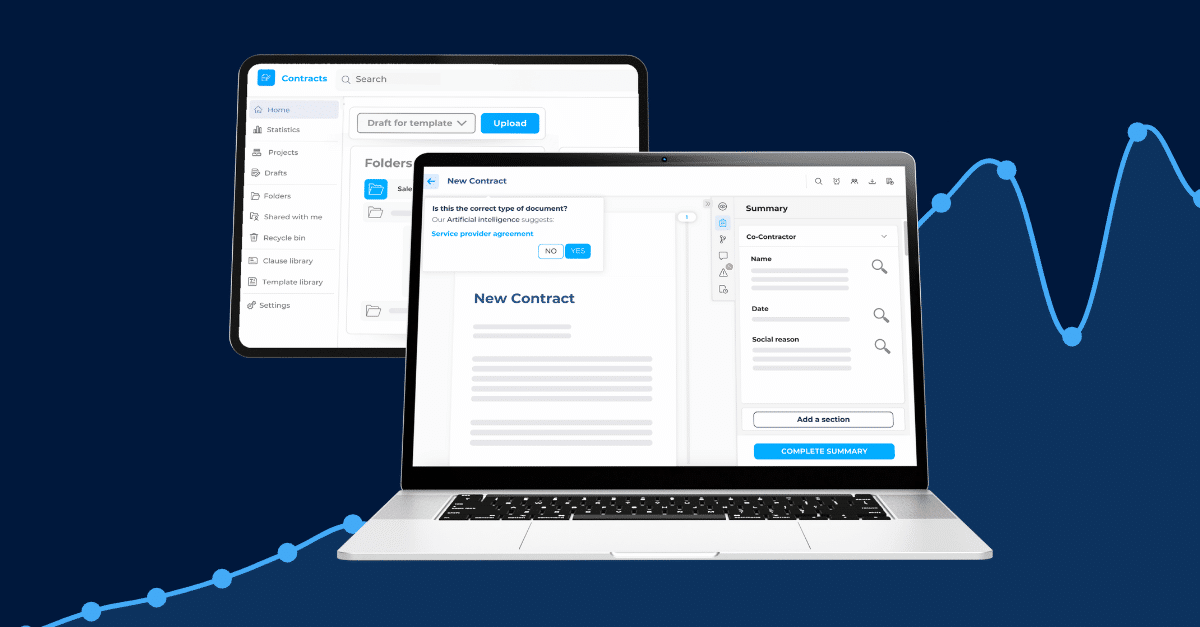
- AI extraction into the summary sheet. When a contract is imported, AI pulls key information into the summary sheet and suggests the contract type. A user then confirms, edits or completes it.
- Playbook-based review. Risk Detector reviews contracts against your company’s rules and flags risky or non-compliant clauses. It suggests changes as tracked edits in Microsoft Word. Playbooks need to be set up first.
- Ask Lini. Ask Lini summarizes, rewrites and compares contracts, inside Word or in a full-page assistant.
- Smart Reports. Ask a question about your portfolio, and Lini builds a results table you can turn into charts.
- Automatic reminders. Rules calculate notice dates, including for contracts with tacit renewal, and alert the right people. Our article on contract renewal management covers how to set these up.
- Connections to existing tools. Validation and signature workflows run through your e-signature provider. Connectors cover Salesforce, HubSpot and Microsoft Dynamics 365.
On data: no model training is performed by DiliTrust without the customer’s consent, and customer data isn’t shared between clients.
Want every contract checked against the same standard?
See how Lini flags clause deviations before a contract reaches signature.
Where intelligent contract management is heading
Contract analytics moves up the general counsel agenda
In a Gartner survey of 104 general counsel, 36% said they were focused on adopting AI, building AI skills or improving AI risk management (Gartner, October 2025). Contract analytics was named as a separate priority. Yet 37% of GCs reported low confidence in using advanced contract analytics. Interest is ahead of readiness.
AI reaches supplier negotiations
Gartner predicts that by 2027, half of organizations will support supplier contract negotiations with AI-enabled contract risk analysis and editing tools. That puts procurement in the review loop alongside legal. Shared playbooks become the way both teams apply the same rules.
Governing the AI itself becomes part of the job
The EU AI Act has been in force since August 2024 and applies in phases. Even where a contract tool isn’t classed as high-risk, legal teams now face practical questions. Where is contract data processed? Who validates AI output? Is there an audit trail? Expect these questions in every vendor evaluation.
Start with the contracts that cost you most
Intelligent contract management is a habit of treating contracts as data: extracted once, checked by a person, and kept current through renewal. The value shows up in renewals you catch, reviews that follow one standard, and questions business teams can answer themselves.
Begin with one workflow and one playbook. Measure what changes. DiliTrust CLM gives legal teams a structured place to do that, with AI that works from your own standards.
See how DiliTrust brings structure and AI to every contract
Planning a CLM rollout step by step
Most CLM rollouts stall on the same three things: unclear scope, messy data and low adoption outside legal. A written plan that covers each one before go-live saves months of rework.
Worried your CLM project will stall after the pilot?
Our CLM implementation framework walks through scoping, migration and adoption, step by step.
Frequently Asked Questions on intelligent contract management, intelligent contract solutions and AI contract review
How is intelligent contract management different from CLM?
CLM is the process and software that move a contract from request through signature to renewal. Intelligent contract management is CLM with AI applied to the contract content: data extraction, playbook-based review and portfolio analysis. Most modern CLM platforms include both, so the real question is how well the AI performs on your contracts.
What software do legal teams use for intelligent contract management?
Most legal teams use a CLM platform with AI features rather than separate tools for storage, signature and review. Check that it connects to Microsoft Word, your e-signature provider and your CRM. DiliTrust CLM combines these with Lini, its AI engine, for data extraction, clause review and portfolio reporting.
How can contract review be automated with AI?
Start by writing a playbook with approved, fallback and unacceptable positions for each key clause. An AI review tool compares incoming contracts against it and flags deviations, while the lawyer decides what to accept. In DiliTrust, Risk Detector does this inside the Word add-in and suggests changes as tracked edits.
Is it safe to use AI on confidential contracts?
It can be, if the vendor answers three questions clearly: where contract data is processed, whether it’s used to train models, and whether it’s kept separate from other clients’ data. Also check that AI output respects existing access rights and that every change is logged in an audit trail.