



A SaaS agreement defines who owns your data, what happens when the vendor goes down and how much you’ll pay in year three. Yet many of them reach legal two days before the business wants to go live, with the order form already signed by one party.
This guide is for in-house counsel who review these contracts every week. You’ll get the clauses that carry real risk, a review method you can apply to every vendor, the terms worth negotiating and a way to keep control of renewals once the contract is signed.
At a glance
- A SaaS agreement rents you access to software the vendor hosts, runs and can change. Your risk sits in data, uptime, liability and exit.
- Read the whole document stack: MSA, order form, SLA, DPA and any terms linked by URL.
- Six clauses deserve most of your time: liability, data, renewal, SLA, indemnity and price escalation.
- Tier your review by contract value and data sensitivity, so low-risk tools stop queuing behind strategic ones.
- Risk often continues after signature, especially when nobody tracks the notice window.
What a SaaS agreement covers
A SaaS agreement is a contract between a customer and a software-as-a-service provider that grants the right to access hosted software on a subscription basis. It sets out fees, service levels, data protection, liability, renewal and exit terms.
The difference from a traditional software license matters. With on-premises software, you hold a copy. With SaaS, the vendor stores your data and runs the service on its own infrastructure, so the contract is one of your main protections.
The document stack you’re actually signing
Most enterprise SaaS deals involve several documents. Map them before you redline anything.
| Document | What it governs | What to check |
|---|---|---|
| Master subscription agreement (MSA) | Core legal terms | Liability, indemnity, governing law, termination |
| Order form | Commercials for this purchase | Term, fees, user counts, renewal mechanics |
| Service level agreement (SLA) | Uptime and support commitments | Measurement method, exclusions, service credits |
| Data processing addendum (DPA) | How the vendor handles personal data | Subprocessors, breach notice, transfers, deletion |
| Online terms and policies | Acceptable use, security, support | Whether the vendor can change them on its own |
Then find the order of precedence clause. If the order form overrides the MSA, a customer-specific order form can quietly undo the terms you negotiated.
How to review a SaaS agreement in 7 steps
You need one method that works for a $5,000 tool and a $500,000 platform. This is it:
- Confirm what’s being bought, who owns it internally and what data it will touch.
- Collect every document in the stack, including terms linked by URL.
- Check the order of precedence.
- Review the six high-risk clauses against your playbook positions.
- Match the DPA and security commitments to the data classification.
- Record the term, renewal date and notice period before signature.
- Store the signed contract and its key data in your contract repository.
Steps 6 and 7 are often skipped, which can lead to missed notice deadlines and incomplete contract records.
The 6 SaaS agreement clauses that carry the most risk
Vendor paper is drafted to protect the vendor. That’s normal. Your job is to find the few terms that would hurt if something went wrong and spend your time there.
Where SaaS agreement risk concentrates
Six clauses deserve the closest review before you sign.
-
Limitation of liability
Test the cap, carve-outs and whether protection reflects the data at risk.
-
Data ownership, processing and exit
Confirm ownership, export format, retrieval timing and certified deletion.
-
Auto-renewal and termination
Record the notice window, renewal term and available exit rights.
-
SLA and service credits
Check measurement rules, exclusions, credits and remedies for repeated failure.
-
Indemnification
Review IP protection, customer indemnities and how the indemnity interacts with the cap.
-
Price escalation
Cap renewal increases and lock the per-user price for added seats.
Limitation of liability
Vendors often cap liability at the fees paid in the previous 12 months. For a $40,000 tool that holds customer data, that cap won’t come close to covering a breach response.
Push for:
- a separate, higher cap for data protection and confidentiality breaches
- carve-outs for gross negligence, wilful misconduct and IP infringement
- mutual caps, so the vendor isn’t better protected than you are
Data ownership, processing and exit
Your data should stay yours, and the contract should say so in plain words. Extend that to usage and derived data, especially if the vendor trains AI models on customer content.
If the vendor processes personal data on your behalf under the GDPR, Article 28 of the GDPR requires a binding contract covering processing instructions, confidentiality, subprocessors, security and the deletion or return of data at the end of the service. In California, the CCPA also requires specific contractual terms when a vendor acts as a service provider or contractor.
Then check the exit. You want a usable export format, a clear window to retrieve your data and certified deletion afterwards.
Auto-renewal and termination
This clause does damage quietly. A 12-month term with automatic renewal and a 90-day notice period means your real decision date is three months before the anniversary. Miss it and you’re committed for another year.
Look for:
- the notice period and the form notice must take
- whether renewal resets to the original term length
- termination for convenience, and what it costs
- exit rights if the vendor is acquired or materially changes the service
SLA and service credits
An uptime figure means little without the fine print. Check how availability is measured, what counts as scheduled maintenance and whether credits are your only remedy.
A 99.9% commitment with broad exclusions and credits capped at 5% of monthly fees may leave you with limited practical remedies. Ask for a termination right after repeated SLA failures.
Indemnification
At minimum, the vendor should defend you against third-party claims that the service infringes someone’s IP. Check that this indemnity sits outside the liability cap.
Watch for broad customer indemnities covering “any use of the service”. They can push the vendor’s own risk back onto you.
Price escalation
Renewal pricing is where SaaS budgets drift. Zylo’s 2026 SaaS Management Index found that 79% of IT leaders saw price increases at renewal in the past 12 months, and 77% hit unexpected costs after a contract was signed.
Cap the uplift in the contract, either as a fixed percentage or linked to an inflation index. Lock the per-user price for seats added during the term.
Stop SaaS contracts from renewing before you’ve had a say
See how legal teams track every notice date
How to negotiate a SaaS agreement as the customer
You won’t win every point. Large vendors rarely rewrite their MSA for one customer. You still have more room than vendor paper suggests, especially on commercial and data terms.
| Usually negotiable | Sometimes negotiable | Rarely negotiable |
|---|---|---|
| Price caps at renewal | Amount of the liability cap | Core service architecture |
| Notice period and renewal term | Higher cap for data breaches | Vendor-wide security policies |
| Data export and deletion terms | Termination for convenience | Hosting model for multi-tenant services |
| Payment terms | Termination right for SLA failure | Roadmap and feature commitments |
At signing vs at renewal
At signing, your bargaining power comes from the deal itself. The vendor wants the revenue this quarter. Spend it on structural terms: liability, data and exit.
At renewal, your power comes from the credible option to switch. That only works if you start early, with usage data, SLA history and at least one alternative on the table. Four to six months ahead of the notice deadline gives you time to run that process.
When to walk away from a “non-negotiable” template
Some gaps are hard stops. If the vendor won’t sign a DPA that meets your legal obligations, or won’t commit to returning your data, the tool shouldn’t touch sensitive data.
Everything else is a business decision. Document the risk, have the business owner accept it in writing and move on.
How to build a SaaS agreement review process that scales
Reviewing one SaaS contract is legal work. Reviewing 60 a year, while every business team wants its tool live tomorrow, is a capacity problem. You solve it by deciding in advance how much review each contract gets.
Tier contracts by value and data risk
| Tier | Typical profile | Review depth |
|---|---|---|
| 1 | High spend, personal or confidential data, business-critical | Full legal review, security sign-off, negotiated DPA |
| 2 | Moderate spend, limited data access | Playbook check on the six clauses, standard DPA |
| 3 | Low spend, no sensitive data | Click-through accepted within pre-approved limits |
Tiering can let Tier 3 tools move through review in days when they stay within pre-approved limits.. Procurement stops waiting on legal for contracts that fall within pre-approved limits.
Turn your positions into a playbook
For each high-risk clause, write down your preferred position, acceptable fallback and walk-away point. A contract manager or junior lawyer can then handle Tier 2 without escalating every question to you.
The playbook also keeps your positions consistent. Vendor A shouldn’t get a liability cap you refused vendor B last month.
Use AI review for the first pass
This is where AI contract review earns its place. It reads vendor paper against your playbook and flags deviations, so your lawyers can start with the issues that need attention.
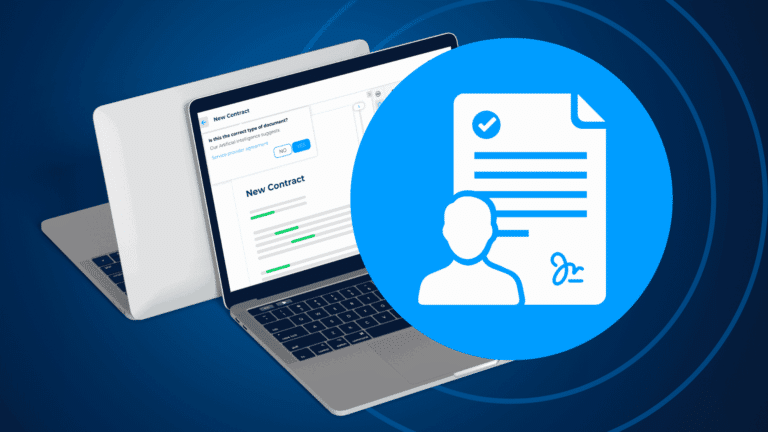
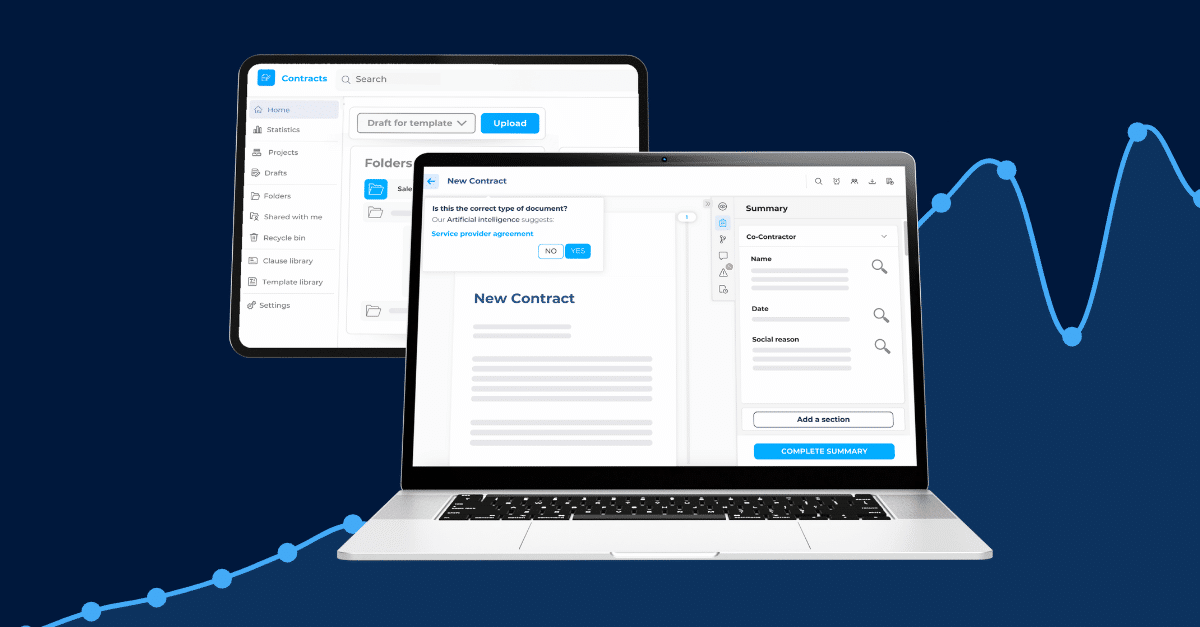
DiliTrust’s AI contract review with Risk Detector works this way. It detects the document type, applies your playbook rules, highlights non-compliant clauses and suggests edits you can accept or adjust. You keep the judgement call. The AI tells you where to look first.
How to manage SaaS agreements after signature
Your exposure keeps running long after signature. When your CFO asks which SaaS contracts renew next quarter and what they cost, can you answer in five minutes?
If the answer lives in a spreadsheet last updated in March, probably not.
Centralize every SaaS contract in one repository
Pull every signed MSA, order form and DPA into one searchable repository. Capture the data you’ll need later: vendor, business owner, term, renewal date, notice period, liability cap and data categories.
Contracts scattered across inboxes and shared drives can cause auto-renewals slip through.
Track notice windows, not just expiry dates
Set alerts on the notice deadline. A reminder 30 days before the anniversary is useless if notice was due 90 days before it.
For the full method, see our guide to building a contract renewal management process.
Monitor obligations on both sides
SaaS agreements create obligations for both parties. The vendor owes you security reports, SLA performance and breach notifications. You owe user caps and payment terms.
Give each obligation an owner. At renewal, you’ll negotiate from evidence instead of memory.
How DiliTrust supports SaaS contract management
DiliTrust Contract Management stores agreements in one repository, extracts key dates, sends alerts and adds approval workflows that route Tier 1 contracts to security and finance before signature. Key data is extracted when contracts are imported, and reminders are generated from contract data such as renewal and notice dates. The right person hears about a renewal while there’s still time to renegotiate or exit.
Approval workflows route Tier 1 contracts to security and finance before signature. Smart Reports turn contract searches into visual reports, so you can show leadership which SaaS agreements renew this quarter and what’s at stake.
One global sporting goods retailer reported more than €1M in avoided losses from automated renewal alerts after rolling out DiliTrust Contract Management across its countries.
SaaS agreement checklist
Run this list before every signature. Print it, or build it into your intake form.
- Every document in the stack identified, including terms linked by URL
- Order of precedence favors the negotiated terms
- Liability cap reflects data risk, with a higher cap or carve-outs
- DPA meets GDPR, CCPA or other applicable requirements
- Data export format, retrieval window and deletion confirmed
- Renewal term, notice period and notice method recorded
- Price increase at renewal capped
- SLA measurement, exclusions and termination right for repeated failure checked
- IP indemnity sits outside the liability cap
- Business owner and renewal owner named
- Signed contract and key data stored in the repository
Find out what missed renewals and slow reviews cost your legal team
Get a realistic ROI based on industry standards when you partner with DiliTrust on CLM.
SaaS agreement FAQ
What’s the difference between a SaaS agreement and a software license agreement?
A software license grants the right to install and use a copy of the software, usually on your own systems. A SaaS agreement grants access to software the vendor hosts and runs. That shifts the legal focus to data protection, uptime, vendor changes and exit rights.
Is a master subscription agreement the same as a SaaS agreement?
Often, yes. Many vendors call their core SaaS terms a master subscription agreement (MSA). The MSA holds the legal terms, while order forms add the commercial details for each purchase.
Which SaaS agreement clauses are negotiable?
Renewal pricing, notice periods, payment terms and data export rights are usually negotiable. Liability caps and termination for convenience are sometimes negotiable, depending on deal size. Core architecture and vendor-wide security policies rarely change.
Does a SaaS agreement need a data processing addendum?
If the vendor processes personal data on your behalf, you’ll usually need one. GDPR Article 28 requires a binding contract with processors, and the CCPA sets contract requirements for service providers. The DPA is where those terms live.
How do auto-renewal clauses work in SaaS contracts?
The contract renews for a new term unless one party gives notice before a set deadline, often 30 to 90 days before the end date. If you miss the notice window, you’re usually committed for another full term.
What software do legal teams use to track SaaS contract renewals?
Legal teams typically use contract management software that stores agreements in one repository, extracts key dates and sends alerts before notice deadlines. DiliTrust Contract Management does this and adds approval workflows and reporting across the whole contract portfolio.
Can AI review a SaaS agreement?
Yes, for the first pass. AI contract review tools such as DiliTrust’s Risk Detector compare vendor paper with your playbook and flag deviating clauses with suggested edits. A lawyer still makes the final call on risk.
Treat every SaaS agreement as a contract you’ll revisit
A SaaS agreement is a live commitment that renews, reprices and changes with the vendor’s product. Review it against the six clauses that matter, negotiate where you have real bargaining power and track the notice dates from day one.
Do that consistently and renewals stop being surprises. They become your best moment to cut cost, tighten terms or walk away.
See every SaaS renewal while there’s still time to negotiate