


Board meetings carry a lot of weight. Strategy gets validated, risks get assessed, and accountability gets documented, all in a few hours, a few times a year.
The problem is that most boards aren’t getting that value. NACD’s 2025 research shows independent directors now commit more than 300 hours per year to board work, up from under 250 hours five years ago. That time is going up. The results often aren’t keeping pace.

Much of it comes down to process. Materials arrive late. Minutes are written manually. Post-meeting follow-up happens by email. Administrative work eats into the time that should be spent on governance.
The fix isn’t more meetings. It’s running them more deliberately.
Here are five practical tips to improve how your board prepares, meets, and follows up, along with what technology can realistically take off your team’s plate.
Key Takeaways
1. Build a preparation process that actually works
Effective board meetings don’t start on the day of the meeting. They start weeks earlier.
That means building agendas collaboratively, distributing materials with enough lead time for directors to actually read them, and giving members the context they need to show up ready to discuss rather than just absorb.
The practical baseline:
- Distribute materials at least 48 to 72 hours before the meeting. Some governance experts recommend one full week, with an asynchronous review period built in before the session.
- Use consent agendas. Move routine items (approval of previous minutes, standard financial reports) out of live discussion time. Directors review these in advance and raise questions only if something needs attention. This protects agenda time for decisions that actually require debate.
- Build from templates. Recreating the same board pack structure from scratch every quarter wastes time. Templates and duplicate-from-previous-meeting features keep things consistent and save hours of setup work.
- Keep packs focused. Long board packs signal that curation hasn’t happened. Directors can’t prepare well when they’re wading through hundreds of pages. Shorter, sharper materials lead to better discussions.
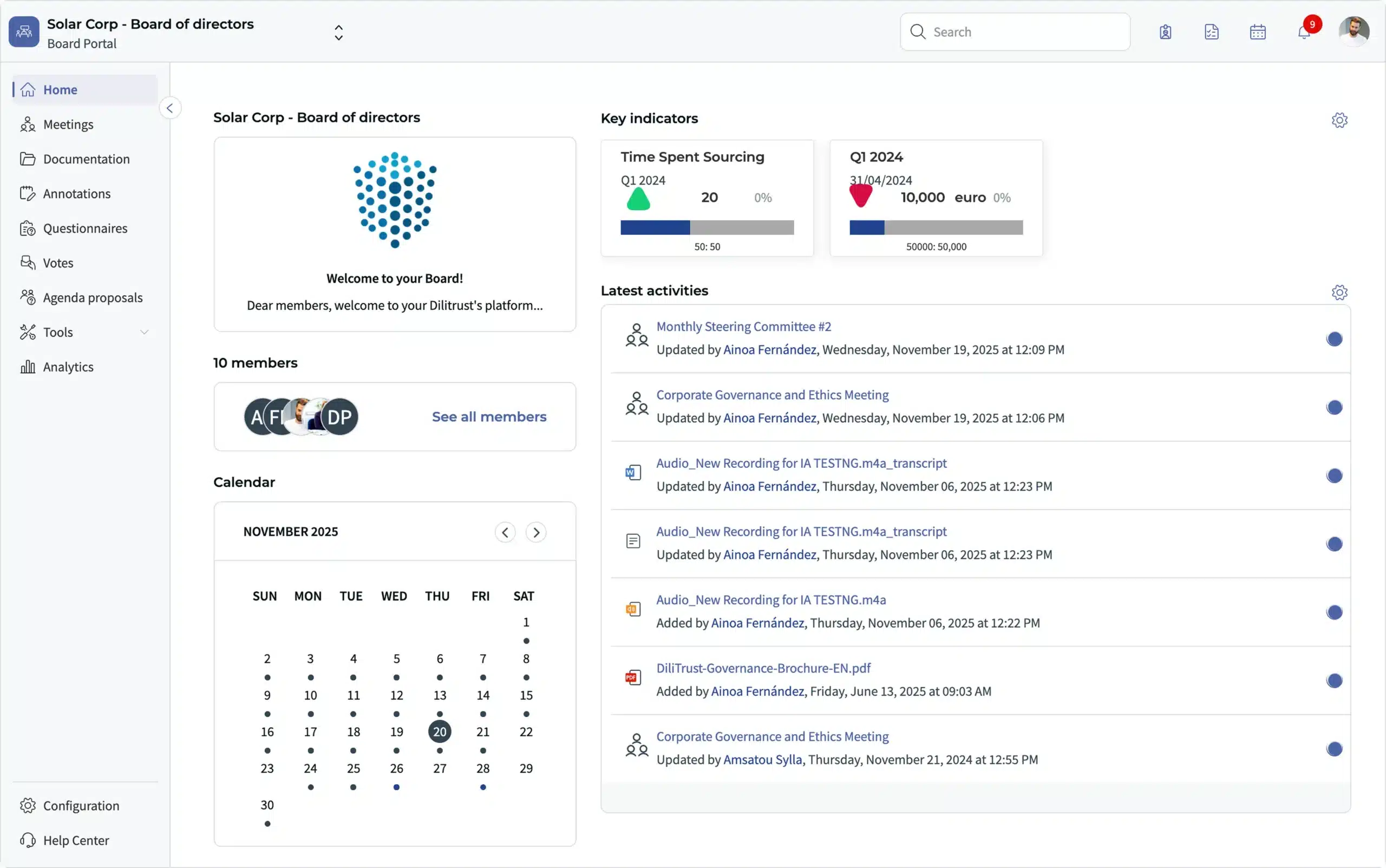
Board management software handles most of this automatically. Administrators build agendas from previous meetings, attach documents at the item level, set permissions by participant, and distribute everything in one secure environment. Directors receive automated notifications and can access materials on any device before the meeting starts, including Outlook and Teams integrations for calendar coordination.
2. Design agendas for decisions, not updates
The most consistent complaint from board directors isn’t that meetings run long. It’s that they’re too operational.
Russell Reynolds Associates’ 2025 Board Culture and Director Behavior survey found that 85% of directors rank strategic planning as a top-2 priority for board time. Yet only 56% feel their organization consistently meets or exceeds stated financial growth goals. Part of that gap is an agenda problem.
When board time disappears into status updates, directors don’t get to do what they’re actually there for: applying their collective judgment to the decisions that matter.
A few changes make a significant difference:
- Reserve at least half of meeting time for 1-2 strategic topics. These might include a market risk review, a product roadmap discussion, or a major operational decision.
- Assign decision rights clearly before the meeting. Directors should know which items require a vote, which are for discussion, and which are informational only. Ambiguity slows everything down.
- Keep a running action list. Every commitment made in the meeting should be captured with an owner and a deadline. At the next meeting, those items come first.
- Clarify roles across the full meeting cycle. When the chair, CEO, corporate secretary, and directors each know their specific responsibilities, the whole process moves faster and with less friction.
Transparent governance also depends on consistent documentation. When every director knows the process and has access to the same information, decisions are better and disputes are fewer.
Board preparation taking too long? Automate agendas, document distribution, and member notifications in one platform built for board governance.
3. Enable flexible participation without sacrificing structure
Geography shouldn’t determine who can contribute meaningfully.
Remote and hybrid boards are now standard for most organizations. But supporting flexible participation goes well beyond video conferencing. Directors need access to materials from any device, the ability to vote remotely on resolutions, and confidence that the meeting record is complete regardless of where they joined from.
What good participation infrastructure looks like:
- Mobile-friendly access to board materials, with offline capability for directors who are traveling or in areas with limited connectivity.
- In-app annotation and note-taking that syncs across devices.
- Remote voting on resolutions with timestamped, attributed records.
- Real-time document updates so last-minute agenda changes reach every director instantly.
- Training and support so all board members can use the platform confidently.
Board Portals like DiliTrust includes a mobile application that gives directors access to meeting materials, document annotations, and votes from their phone or tablet, online or offline. Whether the board is meeting in person, fully remote, or split between locations, every member works from the same information.
4. Stop managing post-meeting tasks manually
After the meeting ends, the work continues. Minutes need to be written, action items tracked, signatures collected, and records filed. For many corporate secretaries, this takes longer than the meeting itself.
Manual post-meeting work carries real risk:
- Minutes drafted from memory or rough notes are often incomplete.
- Action items tracked informally through email are easy to lose.
- Signature collection by email can take days, delaying resolutions.
- Without version control, board members may be working from different versions of the same document.
AI tools close most of these gaps.
The DiliTrust Board Portal’s AI assistant, Lini, generates draft minutes directly from audio transcriptions, agenda items, and attached documents. It organizes the output by agenda section, detects action items automatically, and flags owners and deadlines. Corporate secretaries review and finalize the draft rather than writing it from scratch. Around 80% of the minutes content is ready by the end of the meeting.
E-signature providers including Adobe Sign, SignatureIT, and DocuSign are integrated directly into the platform, so resolutions can be signed without leaving the governance environment.
Every document access, annotation, vote, and approval is logged in a complete, tamper-proof audit trail. For boards that need to demonstrate governance quality to regulators, auditors, or shareholders, that record is what makes accountability concrete.
Managing post-meeting work manually?
See how Lini AI generates board minutes from audio transcripts, detects action items, and creates an audit-ready record, all within DiliTrust’s closed platform.

5. Treat data security as part of your governance framework
Board meetings involve your organization’s most sensitive information: financial projections, executive compensation, M&A plans, and regulatory correspondence. Directors are also high-value targets for phishing, social engineering, and data theft.
Russell Reynolds Associates’ 2025 Board Culture and Director Behavior survey found 66% of board directors identify cybersecurity and data privacy as a top-3 operational risk concern. The awareness is there. The infrastructure often isn’t.
The minimum standard for board meeting security:
- End-to-end encryption for all documents, both in transit and at rest.
- Role-based access controls so each director and committee member sees only what they need to see.
- Two-factor authentication for platform access.
- Document watermarking to track the distribution of sensitive materials.
- A complete, tamper-proof audit log of every access, annotation, and vote.
- ISO 27001 and SOC 2 Type II certification from your platform provider.
Training matters alongside the technical controls. A secure platform only works if directors know how to use it safely. Regular briefings on phishing awareness, device hygiene, and data handling reduce the human-side risk.
Board management software vs. legacy tools
Most organizations still run board meetings through a mix of email, shared drives, and video conferencing tools. The problem isn’t that these tools are bad at what they do. They weren’t designed for governance.
Email has no audit trail. Shared drives have no granular access controls. General collaboration tools have no governance record. When an auditor or regulator asks to see 18 months of board decisions, someone spends days doing email archaeology instead of a corporate secretary pulling a 30-second report.
Here’s how dedicated board management software compares:
| Capability | Board management software | Email + shared drives |
|---|---|---|
| Agenda building from templates | Yes | No |
| Encrypted document distribution | Yes | No |
| AI-generated meeting minutes | Yes | No |
| Remote voting with audit trail | Yes | No |
| Mobile and offline access | Yes | Limited |
| Automatic action item tracking | Yes | No |
| Document version control | Yes | Partial |
| E-signature integration | Yes | No |
| ISO 27001 / SOC 2 Type II certified | Standard with reputable vendors | Not applicable |
The gap is structural. A governance-specific platform documents decisions with traceability and accountability by design. A general-purpose tool makes that someone’s full-time manual job.
See how DiliTrust helps boards run more structured, efficient meetings, from agenda to approved minutes. Explore the DiliTrust Board Portal →
What is a board meeting strategy?
A board meeting strategy is the set of practices, processes, and tools an organization uses to plan, run, and follow up on board meetings. It covers preparation (agenda design, materials distribution), execution (facilitation, voting, decision-making), and post-meeting work (minutes, action tracking, record-keeping). A strong strategy reduces administrative overhead and protects time for governance work.
What are the most important board meeting best practices?
The core practices are: distributing materials at least 48-72 hours before the meeting, using a consent agenda to protect time for strategic discussion, assigning clear decision rights before each session, tracking action items from every meeting, and using a dedicated platform with an audit trail for board communications and documents.
What software do corporate secretaries use to manage board meetings?
Corporate secretaries typically use dedicated board portal software that covers agenda management, document distribution, voting, minutes generation, and audit trails. The DiliTrust Board Portal is used by more than 15,000 boards and committees across 65 countries. It includes Lini AI for meeting preparation, transcription, and automated minutes generation.
Can AI make your board meetings more efficient?
See three practical ways AI can streamline audit committee meeting preparation, sharpen decision-making, and keep sensitive board data secure.