When contracts are spread across email threads, shared drives, and local folders, no one has a complete picture of what the company has committed to. Missed renewal notices, auto-extended agreements, clauses that slipped through review: the costs are quiet, but they compound.
A contract management system covers every agreement from first draft to final archive, all in one place. Legal teams get visibility over the full portfolio. Business teams can create and sign contracts without routing everything through legal. Finance knows what’s due and when.
This guide covers what a contract management system does, who runs it, and how to choose the right one.
What is a contract management system?
A contract management system is a digital solution for the structured handling and analysis of contracts. It allows companies to store all agreements in one place, manage contracts efficiently, and monitor every stage of the contract life cycle, from initial drafting to final archiving. The goal is to reduce risk, ensure reliable deadline tracking, and streamline collaboration across departments.
Companies can choose from different system variants: from cost-effective standard solutions to customized, comprehensive platforms. Companies can configure operation flexibly, whether as a cloud solution, an on-premises system, a hybrid model, or integrated with existing third-party applications such as ERP or CRM.
The use of a contract management system brings numerous business benefits: it makes processes more efficient, saves time and money, and significantly increases transparency in all contractual relationships.
The system also supports compliance with legal regulations and helps to identify and minimize contractual risks at an early stage. This management software can unlock potential by combining insights across all contracts into one unified view, creating contract intelligence across the organization.
The Evolution of Contract Management
In the past, contract management was limited to legal validation and document storage. Like many legal activities, it was entirely manual. However, with the rise of new technologies, contract management has evolved to incorporate automation and analytical tools. These LegalTech solutions simplify contract processes and enhance transparency.
With business projects becoming increasingly complex, contract management has transitioned into a critical function. It is no longer just about archiving documents; rather, it involves optimizing every step to maximize service value and minimize risks.
The life cycle of contracts at a glance
A contract management system accompanies contracts from creation to archiving and supports each phase with digital workflows:
- Creation and drafting: Standardized templates and modular text modules enable efficient contract creation, ensuring documents are produced quickly, uniformly, and in a legally compliant way that saves time and minimizes errors. By using an intelligent contract management approach, companies can automate and streamline drafting and ensure that every contract meets compliance requirements.
- Negotiation: Once the draft contract is created, it moves into the negotiation phase if necessary. A modern contract management system supports this step by storing all versions centrally, documenting changes in audit trails and making them available to the parties involved in real time. This allows contract content to be efficiently coordinated between the parties, to collaborate on contracts, open points to be clarified and interests to be balanced.
- Approval: After the negotiation, all relevant departments are specifically involved via automated workflows in order to review and approve the draft contract. Each adjustment is automatically documented and versioned so that the entire coordination process remains transparent, audit-proof and traceable at all times for all parties involved.
- Signing: Contracts can be concluded quickly and with legal certainty, regardless of location, by integrating electronic signatures. This contracting process not only saves time, but also speeds up business processes and significantly reduces paperwork. A modern management software enables secure signatures from any location.
- Administration and control: A contract management system serves as a central platform overview in which all contract documents, deadlines and relevant data are bundled. Users can access contract content at any time, monitor key figures, performance metrics and track the degree to which agreements have been fulfilled and this way gain visibility and control over all contracts. Automated reminders ensure that no important obligations or deadlines are overlooked.
- Renewal or termination: Automatic reminders ensure timely decisions and minimize risks such as unwanted contract renewals and the resulting costs.
- Archiving: Once a contract has been concluded, it can be stored in an audit-proof manner and remains accessible at all times. Intelligent search and filter functions enable relevant documents to be called up in seconds, even in large and complex contract archives.
A contract management system thus accompanies the entire life cycle of a contract. Companies not only gain security and control, but also noticeably more time for strategic tasks.
Who Oversees Contract Management?
The Role of the Contract Manager
The contract manager ensures the smooth execution of contract management. This role requires expertise in law, finance, and project management.
The contract manager is involved from the negotiation stage through execution, handling risk assessments, modifications, and conflict resolution. To succeed, they must possess strong analytical and problem-solving skills.
The Role of the Legal Team
The legal team plays a crucial role in contract validation and monitoring. Their expertise ensures legal compliance and safeguards the company’s interests.
They also contribute to training operational teams, enhancing their understanding of contract-related risks and best practices.
Core functions of a contract management system
A modern contract management system combines numerous functions that make the entire contract process efficient and transparent. These include digital storage of all documents with version and access management, automated workflows for approvals and deadlines, and powerful search and filter functions for quick access to contract content.
Deadline and task management provide reliable reminders of terminations or extensions, while digital signatures enable legally compliant signatures from any location. In addition, integrated reporting and analysis functions provide valuable insights into contract terms, risks and financial obligations.
Advantages of a contract management system at a glance
Digital contract management offers numerous advantages for both small companies and large corporations:
Reasons for use: Why do companies use contract management systems?
In an increasingly complex business world, companies face the challenge of managing a growing number of contracts efficiently and in compliance with the law. A contract management system provides the ideal basis for this.
Complexity of the contract landscape: As the company grows in size, the number and complexity of contracts increases. A system creates order and structure.
Risk minimization: Missing notices, forgotten renewals or missed deadlines can be expensive. A system prevents exactly that.
Increased efficiency: Digital workflows speed up approvals and reduce the coordination effort between departments.
Which departments benefit from this?
A contract management platform supports use across all departments. Key benefits:
- Legal department: By standardizing templates and defining clear approval processes, the legal department retains legal control over contract content at all times, while at the same time reducing the workload through automated processes.
- Purchasing: Structured processes document contract negotiations with suppliers and make them more efficient. This makes it possible to manage framework agreements, conditions, and SLAs transparently.
- Finances: Users can view payment obligations, contract terms, and budget effects at any time. This supports precise liquidity planning and minimizes financial risks.
- Sales: Contract management systems allow sales teams to swiftly create, adapt and finalise customer agreements by using standardised templates, automated approvals and digital signatures. This shortens the sales cycle, ensures compliance with internal and legal requirements, and provides complete visibility of terms, conditions, and renewals.
- HR: Companies can centrally manage, version, and archive employment contracts and supplementary agreements in a revision-proof manner. This maintains an overview of employment relationships, deadlines and contract amendments.
Thanks to standardized templates within contract management software, specialist departments no longer need to go through the legal department to create or review contracts. This saves a great deal of time, and contract processes run much more efficiently.
Discover your savings
Get a realistic ROI based on industry standards when you partner with DiliTrust on CLM.
Cloud-based contract management: Secure and Flexible
More and more companies are opting for cloud-based contract management systems as they offer a high degree of flexibility, scalability and security. Especially in times of hybrid working models and decentralized teams, cloud-based solutions are a viable choice for the future.
Overall, cloud-based contract management offers a future-proof, user-friendly and secure solution, ideal for companies of all sizes that value efficiency and mobility.
AI-powered contract management solutions
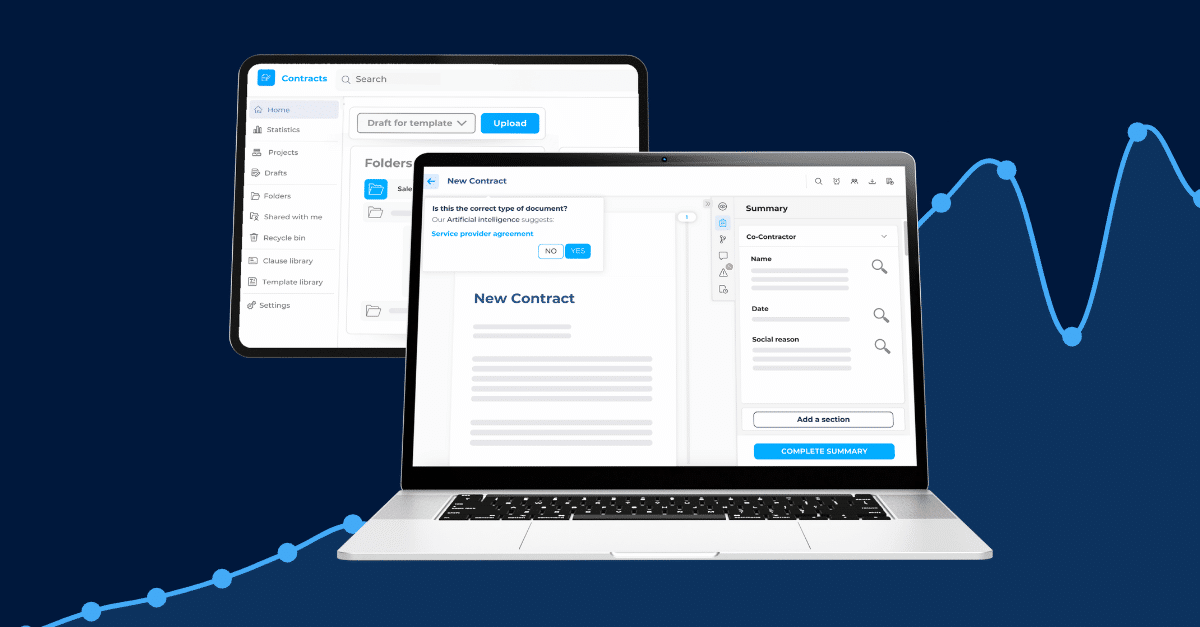
AI-powered contract management technology goes beyond simple digitalization by applying machine learning and natural language processing to accelerate legal work. Automated clause detection and contract review highlight risks, inconsistencies, or missing provisions in seconds, reducing manual effort and human error. Predictive analytics forecast renewal risks, financial exposure, and negotiation outcomes, while intelligent search makes critical information instantly accessible across large contract portfolios. A modern contract management suite brings all of these capabilities into one platform, giving legal teams faster decisions, stronger compliance, and full visibility over every active agreement.
Selection criteria: How to find the right system
Choosing the right contract management system is crucial for the long-term success of your digital contract management. You should consider various criteria to ensure that the solution is not only technically convincing, but also fits your individual requirements.
1. Define requirements
Start with a clear analysis: Which functions do you really need? For example, should the system support e-signatures, automatically monitor deadlines and data or enable granular assignment of rights? Solutions such as the Contract management platform from DiliTrust offer a high degree of customizability and cover all use cases, from automated contract creation to audit-proof archiving.
2. AI-supported contract review
A modern contract management system should offer more than digital filing. Solutions with integrated artificial intelligence that can automatically analyze contracts, identify risks or detect missing clauses are especially powerful. This capability saves time, reduces errors and increases legal certainty.
3. User-friendliness
An intuitive interface is crucial for company-wide adoption. The DiliTrust software stands out with its user-friendly design, tailored to different types of users. The system structures all functions logically so users can operate them without extensive training.
4. Integration into existing systems
Check whether the contract management system integrates seamlessly into your existing IT landscape, such as ERP, CRM, or collaboration platforms like Microsoft 365. DiliTrust CLM enables smooth integration and thus facilitates the cross-departmental exchange of information.
5. Security and data protection
Protection against unauthorized access is essential, especially for sensitive contract data. DiliTrust uses state-of-the-art encryption methods, native SSO integration (single sign-on) and a proprietary AI to ensure the highest security standards and GDPR compliance. The system stores your contract documents centrally and provides secure access at any time.
6. Training, support, and continuous improvement
A reliable provider not only offers a strong product, but also continuous support, regular updates, and training for your employees when needed. DiliTrust provides dedicated customer service in multiple languages and ensures that your system always stays up to date.
With a powerful solution like DiliTrust CLM, you not only simplify your contract management, but also automate complex processes and reduce manual effort. The result: more efficiency, better control and maximum security, tailored to your company’s needs.
FAQ
What is contract management?
Contract management is responsible for managing and optimizing a company’s contractual relationships. A uniform structure for all processes enables employees to find the contract information they need quickly and without inconsistencies.
What are the responsibilities of a contract manager?
A contract manager is responsible for the entire lifecycle of contracts within a company. Responsibilities include drafting, negotiating, reviewing, and managing contracts to ensure that the terms of the contract are consistent with and meet the company’s objectives. Major tasks also include coordinating with other departments such as legal, procurement and finance, monitoring deadlines, and developing contract management processes.
What is the difference between a contract manager and a legal advisor?
Whereas contract manager have experience in negotiating and drafting contracts, ensuring compliance with regulations, and maintaining relationships with customers and suppliers, legal advisors focus on providing legal consultation and representing their clients.
Conclusion: Why contract management is indispensable today
The business case for a contract management system isn’t about chasing efficiency metrics. It’s about knowing what your organization has committed to, when obligations come due, and where the risks sit, before they become expensive problems.
DiliTrust CLM covers the full contract lifecycle, from AI-assisted drafting to audit-proof archiving, and integrates with the tools your teams already use. Explore DiliTrust Contract Management or calculate your ROI.