



…
Board work creates pressure long before directors enter the room. The corporate secretary must shape the agenda, collect papers, protect confidential information, guide the meeting, record decisions, and track what happens next.
That workload has a governance consequence. When board information sits in email threads, local files, and paper binders, version control weakens and decisions become harder to trace. The modern board secretary needs a clear operating model, reliable records, and tools that support the full meeting cycle.
Key takeaways
- A modern board secretary is a governance adviser, records custodian, and meeting-cycle owner.
- The role covers agendas, board and committee meetings, minutes, resolutions, filings, director support, and follow-up.
- Accurate records need controlled access, version history, audit trails, and clear ownership of actions.
- Cybersecurity and AI regulation have made governance documentation a board-level concern.
- Board management software can centralize preparation, live meeting work, minutes, votes, signatures, and archives.
What is a modern board secretary?
A modern board secretary is the governance professional who helps the board operate lawfully, efficiently, and with a reliable record of its decisions. The role combines meeting administration, corporate records, board advice, compliance coordination, and communication between directors and management. The Society for Corporate Governance describes the corporate secretary as both the custodian of board records and a resource for the board and senior management.
| Traditional focus | Modern governance responsibility |
|---|---|
| Taking minutes | Maintaining an accurate, approved record of decisions and actions |
| Sending meeting papers | Managing a controlled information flow for directors and committees |
| Booking meetings | Planning the annual governance calendar and meeting cycle |
| Filing documents | Coordinating statutory records, disclosures, and governance evidence |
| Administrative support | Advising the chair and board on process, policy, and compliance |
Board secretary responsibilities: what does the role include?
Prepare the board and committees
The secretary works with the chair, chief executive, general counsel, and committee leads to build a useful agenda. That includes setting the annual calendar, requesting papers, checking that recommendations contain enough context, and giving directors time to review the board pack.
The work continues after publication. Last-minute changes, missing approvals, late papers, and conflicting versions can all affect the quality of a meeting. A clear workflow gives every contributor a defined task and keeps the current version visible.
Protect the corporate record
Minutes should capture decisions, resolutions, abstentions, material discussion points, and assigned actions in a form the organization can rely on later. The secretary manages the minutes lifecycle, from first draft to review, approval, signature, and archive.
The same discipline applies to committee records, policies, delegations, and written resolutions. Records must be easy to retrieve for an audit, disclosure, or future board discussion.
Advise on governance and compliance
A board secretary helps the chair and directors apply the company’s constitution, bylaws, committee charters, internal policies, and applicable law. They also monitor changes that affect board procedure, reporting, director duties, and the handling of sensitive information.
The role can include director onboarding, governance training, board evaluations, shareholder meeting support, subsidiary governance, and corporate disclosure.
Keep decisions moving after the meeting
A decision has little operational value if nobody knows who owns the next step. Modern secretariats track resolutions, deadlines, approvals, and evidence of completion across the organization.
That follow-up creates a useful link between board oversight and management execution. It also gives the chair and directors a clearer view of what has changed since the last meeting.
Give every resolution a clear owner, deadline, and audit trail. See how a secure board workflow can connect agendas, decisions, and follow-up.
Why board secretary responsibilities have become more demanding
The meeting itself is only one part of the work. A secretary may coordinate several committees, multiple legal entities, directors in different time zones, and information from finance, risk, HR, compliance, and operations.
The board’s agenda has expanded as well. The 2025 NACD Public Company Board Practices and Oversight Survey treats AI oversight, cybersecurity oversight, supply chain oversight, and the board-CEO relationship as distinct areas of board attention.
This creates four recurring points of pressure:
- Information quality: Current papers with the right context.
- Confidentiality: Strict permissions and controlled sharing.
- Traceability: A record of what was approved, by whom, and when.
- Follow-through: Owners, deadlines, and status updates for actions.
When these activities run through disconnected tools, the secretary spends time checking versions and chasing contributors. That time could support agenda quality, chair advice, and preparation for difficult decisions.
Keep board and committee work in one controlled cycle, from paper collection to approved minutes. Watch practical guidance on improving board meeting preparation and follow-up.
Governance and compliance pressure in 2026
Regulatory change has increased the amount of evidence boards need to review and retain. The corporate secretary often sits at the point where governance policy, board oversight, and formal records meet.
AI oversight and documentation
The EU AI Act became applicable on 2 August 2026, with different dates for specific obligations. The framework uses a risk-based model and includes requirements around transparency, governance, documentation, human oversight, and traceability for relevant systems.
For secretariats, this means recording which systems are in use, who owns them, what risks were assessed, and what the board approved. Those questions can become agenda items, minutes, policies, and follow-up actions.
Cybersecurity oversight
For US public companies subject to the relevant SEC reporting rules, a material cybersecurity incident must be disclosed on Form 8-K within 4 business days after the company determines that the incident is material. The rules also require annual disclosure about cybersecurity risk management, strategy, and governance.
The secretary may support the record around these decisions by coordinating board briefings, capturing oversight, preserving approvals, and keeping the final documentation under controlled access. The exact process depends on the organization’s jurisdiction, listing status, and legal advice.
Multi-entity governance
Groups with subsidiaries and joint ventures need a current view of directors, officers, mandates, ownership, filings, and local requirements. The board secretary often coordinates this information across legal entities and committees.
A reliable record makes it easier to answer practical questions: Which body approved this matter? Which entity is affected? Which filing is due? Which director has authority to act?
How technology supports the board secretary
Technology should remove avoidable administration while leaving governance judgment with the people responsible for it. Useful board management software supports the full cycle:
- Agenda planning, paper collection, and controlled distribution
- Calendars, invitations, reminders, and document review
- Permissions, version history, attendance, votes, and approvals
- Draft minutes, resolutions, action items, signatures, and archives
- Mobile access for directors away from a desk
The practical test is simple: can the secretary see what is ready, who owns the next step, and which version is final? Can the organization retrieve the record without reconstructing it from inboxes?
Visual suggestion for the CMS: Add a DiliTrust Board Portal screenshot showing the before, during, and after meeting workflow. The image should show agenda items, attached papers, voting or approvals, and the minutes workspace.
Where DiliTrust fits
DiliTrust Board Portal gives directors and board administrators one secure environment for meetings, documents, and decisions. The workflow covers preparation, live meeting activity, and post-meeting follow-up.
For the corporate secretary, that means one place for agendas, papers, notifications, votes, surveys, signatures, minutes, and resolutions. DiliTrust also supports offline agenda review, annotations, and voting on mobile and tablet devices.
Lini can draft meeting minutes from agendas, audio transcripts, notes, and voting records. A human must review and approve the draft before it becomes the official record. Ask Lini can also help users find, summarize, translate, and extract information from documents in DiliTrust.
Read more about DiliTrust AI capabilities, or explore the article on AI fluency at board level for the director education angle.
A board portal supports the secretary’s judgment with current information, defined workflows, traceable decisions, and less manual checking.
See how DiliTrust Board Portal supports agenda preparation, decisions, minutes, and secure archives in one governance workflow.
How board secretary responsibilities are changing in 2026
AI moves from experimentation to governance work
Boards are moving from general AI awareness toward oversight of specific use cases and controls. Secretaries will help document AI decisions, training, risk reviews, and policy updates.
Cyber incidents require board-ready records
Disclosure rules and rising cyber risk make timing and evidence matter. Governance teams need a process for recording briefings, materiality decisions, approvals, and follow-up without exposing sensitive technical details.
The board secretary becomes a governance data owner
Board work produces information about decisions, mandates, entities, risks, and obligations. The secretary helps keep it structured, current, permissioned, and ready for review.
A practical operating model for modern board secretaries
A useful operating model follows the meeting cycle:
- Plan: Set the calendar, confirm the purpose of each meeting, and agree the agenda with the chair.
- Prepare: Request papers, check completeness, apply permissions, and publish the board pack.
- Run: Record attendance, manage votes and resolutions, and support the chair during the meeting.
- Finalize: Review the draft minutes, confirm actions, collect signatures, and archive the approved record.
- Follow up: Track decisions, deadlines, and evidence until each action is closed or escalated.
- Improve: Review recurring delays, missing papers, and board feedback before the next cycle.
This makes responsibilities visible and gives the board a consistent record across meetings, committees, and legal entities.
Download the Board Governance Checklist
Choosing board management software?
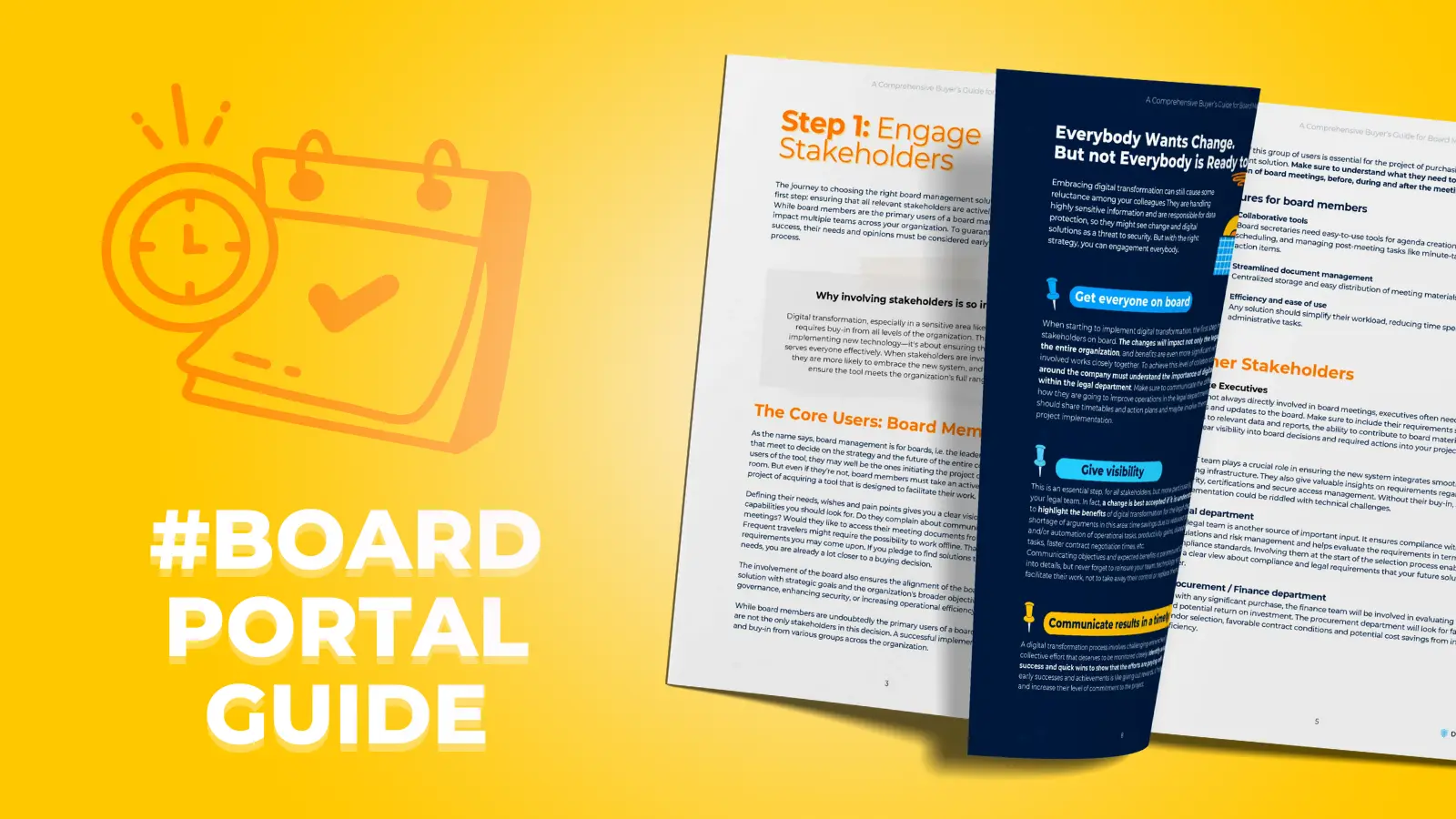
Download our Board Management Buyer’s Guide to compare key features, assess your governance needs, and choose the right solution for your organization.
Frequently Asked Questions
What does a modern board secretary do?
A modern board secretary manages the board’s governance process, including meeting planning, agendas, papers, minutes, resolutions, records, compliance coordination, and follow-up. The role also includes advising the chair and board on governance procedure and helping directors receive the information they need.
Why is the board secretary important to corporate governance?
The board secretary helps connect board decisions to accurate records, clear procedures, and accountable follow-up. This supports director oversight, regulatory readiness, and confidence in the corporate record.
What software do corporate secretaries use to manage board meetings?
Corporate secretaries use board management software to organize agendas, documents, votes, minutes, signatures, and archives in one controlled workspace. DiliTrust Board Portal supports these workflows for directors, committees, and board administrators, with mobile access and permission controls.
How can board meeting workflows be automated?
Automation can assign preparation tasks, send reminders, organize papers, capture votes, draft minutes, and track resolutions. DiliTrust combines Board Portal workflows with Lini features such as audio transcription and AI-generated draft minutes, which the secretary reviews before approval.
Give your corporate secretary the right infrastructure — DiliTrust’s board management software supports every stage of the meeting cycle, from preparation to signed archives.