



Every company that operates with a board faces the same underlying question: how should that board actually work? The answer is not obvious, and it is rarely the same twice. Ownership structures differ. Regulatory environments differ. The balance of power between shareholders, management, and other stakeholders varies by industry, geography, and company size. What works for a publicly listed European conglomerate will not work for a family-controlled business in Latin America or a state-owned enterprise in the Gulf.
That is why board governance frameworks exist. They give organizations a structured way to define roles, distribute authority, and build accountability into how decisions get made. Choosing the wrong one, or running without one altogether, tends to show up in exactly the ways you would expect: inconsistent decisions, misaligned priorities, and governance failures that are difficult to recover from.
What is a board governance framework? A board governance framework is the system of rules, processes, and structures that defines how a board of directors makes decisions, distributes authority, and maintains accountability. It determines who has a voice in the boardroom, how responsibilities are divided among directors, and how the board interacts with management and other stakeholders.
Corporate governance models vs. board governance frameworks
The terms “governance model” and “governance framework” are often used interchangeably. They refer to distinct things.
A governance model defines who governs: who holds authority, whose interests the board must serve, and how ownership and accountability are distributed. A governance framework defines how governance is implemented through the structures, committees, processes, and tools that translate the chosen model into daily practice.
Both are required for effective oversight. A company might adopt a stakeholder model as its governance philosophy while implementing it through an executive board structure with specialized committees and a secure board management platform. The model sets the direction. The framework makes it operational.
The main corporate governance models
Different governance models reflect different views on what a corporation exists to do. Four primary models account for most of the world’s corporate structures.
The stakeholder model holds that the corporation has obligations to a wider set of parties: employees, suppliers, communities, and the environment, alongside shareholders. It is most fully developed in continental Europe, particularly Germany, where codetermination laws require large companies to include employee representatives on supervisory boards.
This approach demands governance mechanisms sophisticated enough to mediate competing interests. Done well, it produces durable, trust-based organizations. Done poorly, it leads to diffused accountability and slow decision-making.The shareholder model
The family and concentrated ownership model
Family-controlled and closely held companies operate under a fundamentally different governance structure. A founding family or dominant shareholder retains majority control, which can accelerate decisions and support longer investment horizons.
The same structure creates real challenges: minority shareholders may have limited recourse, board independence is harder to achieve, and succession planning can become entangled with family dynamics. Independent audit functions and clear governance frameworks matter more here precisely because external market discipline is weaker.
State-owned enterprise (SOE) governance
When government is the dominant shareholder, the board serves quasi-political functions alongside its commercial ones. The government acts simultaneously as owner, regulator, and public-interest representative. These layered conflicts of interest compromise the independence and accountability that effective governance depends on. Best practice calls for separating the ownership function from regulation, establishing clear performance mandates, and building independent audit capacity within SOE boards.
Managing board governance across multiple entities or jurisdictions? The DiliTrust Board Portal centralizes the full board meeting lifecycle — from agenda building and document distribution to digital voting, e-signatures, and AI-assisted minutes — in one secure, audit-ready environment.
The most prominent board governance structures
While the governance model defines the philosophy, the board’s structural design determines how authority flows day to day. Here are the most widely used governance structures.
The traditional governance model
This is the oldest and most common board governance structure, typically adopted when forming a board of directors. The structure usually includes a chairperson alongside a parallel management structure, while other board members act as advisors assisting the CEO or president in formulating the company’s goals and objectives. The board of directors commonly acts as a collective voice on all matters.
The executive board model
An executive board is a highly active governance structure where all members engage in day-to-day operations. The chairperson is elected by the board. Executive boards typically meet at least monthly to address company concerns, including strategy development and employee issues.
The board organizes operational, financial, and risk management processes to ensure the business runs strategically and adheres to compliance requirements. This includes monitoring technology investments, IT strategy, and cybersecurity risk.
The advisory board model
Under this structure, board members bring deep expertise in a specific field or industry and provide feedback and guidance to CEOs on business opportunities, ideas, and approaches that may improve growth or efficiency. The advisory board is typically consulted when the CEO needs outside perspective that the internal team alone cannot provide.
Advisory boards meet quarterly or less frequently. This model is common among non-profit organizations, where the board is consulted on matters such as fundraising or partnerships.
The executive management team model
This is a more flexible governance structure with no strict roles or responsibilities assigned to each board member. It allows for greater transparency and adaptability among executives. Small and medium-sized businesses adopt it most often.
The most common implementation divides the board into committees that oversee different departments. These committees, typically covering audit, compensation, and governance or nominations, provide focused oversight without requiring all directors to weigh in on every decision.
The five pillars of an effective governance framework
Regardless of which governance model or structure a company adopts, effective frameworks share five core principles:
- Fairness: All stakeholders are treated equitably, and decisions weigh the interests of shareholders, employees, customers, and the broader community.
- Transparency: The company makes clear, timely disclosures about its activities, finances, and governance practices.
- Responsibility: The board prioritizes long-term value creation and manages economic, environmental, and social factors.
- Accountability: Clear lines of responsibility hold the board and management accountable for their actions.
- Risk management: The board identifies, assesses, and mitigates risks on an ongoing basis — not as a periodic exercise.
These pillars apply across all governance models and structural configurations. They are the baseline against which any framework can be evaluated.
How EU regulations are reshaping board governance
The regulatory environment for boards has changed materially since 2022. For organizations operating in or with significant exposure to the European Union, two directives in particular have expanded the scope of board responsibility.
The Corporate Sustainability Reporting Directive (CSRD) was adopted in 2022 and entered into force progressively from 2024. It requires covered companies to report on environmental, social, and governance matters under standardized European Sustainability Reporting Standards (ESRS). Reports must be digitally tagged in iXBRL format and subject to external assurance.
In 2025, the EU introduced an Omnibus simplification package and a “stop-the-clock” adjustment that reduced some reporting complexity and revised certain timelines. The core obligations remain: digital reporting, double materiality assessments, and limited assurance from external auditors.
The Corporate Sustainability Due Diligence Directive (CSDDD) adds a further layer. Large companies must now identify and address adverse impacts on human rights and the environment across their supply chains. This puts non-financial risk oversight on the same governance footing as financial oversight.
For boards, the practical implications are significant:
- Sustainability reporting is now a board-level responsibility.
- Directors need to understand ESG metrics and how they connect to financial performance and risk exposure.
- Board information flows must include sustainability data alongside financial data.
- Audit and risk committees need to expand their oversight scope to cover environmental and social risks.
Companies that treat CSRD compliance as a reporting exercise, rather than a governance improvement, will find it harder to adapt as requirements continue to evolve.
Board reporting obligations are growing. Does your governance infrastructure keep up? Centralize board documentation, approvals, and audit trails with a platform built for modern governance requirements. Request a Board Portal demo
AI and technology in board governance
AI is moving from the boardroom agenda into boardroom practice. According to PwC’s 2026 governance research, 35% of board members say their boards have already integrated AI into oversight activities, a share expected to grow through 2026.
Boards are using AI to process large volumes of information, surface patterns in governance data, and speed up the analysis of board materials. AI-assisted minute generation, agenda management, and entity monitoring are among the most practical applications in active use.
PwC notes that human judgment remains essential. AI-generated outputs carry real risks of inaccuracy and bias. Directors need clear protocols for how AI tools are used, what data is shared with them, and how outputs are reviewed before informing decisions.
What boards should put in place:
- Clear guidelines on how AI tools are used in board preparation and oversight activities
- Data security protocols that prevent sensitive board information from being shared with public AI systems
- Director training on AI, so board members can evaluate what AI surfaces rather than simply accept it
- Governance platforms that integrate AI within a secure, access-controlled environment
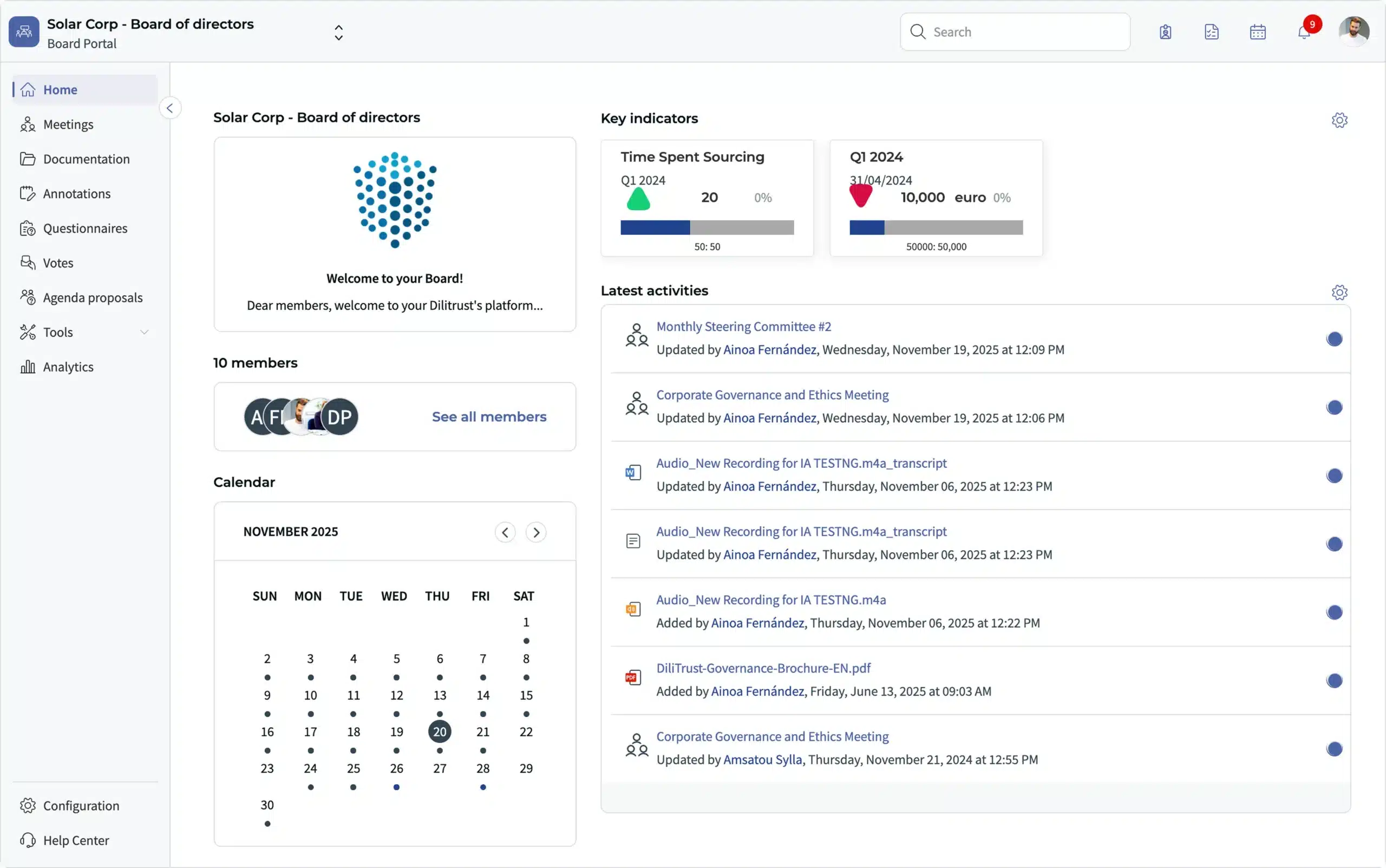
The DiliTrust Board Portal includes Lini, a proprietary AI built specifically for governance workflows. Lini generates meeting minutes from agendas and audio transcriptions, powers AI-assisted search across board materials, and operates within DiliTrust’s secure hosting environment. Directors work with AI capabilities without exposing sensitive board information to external systems.
Choosing the right framework for your organization
There is no single correct governance model. The right framework depends on ownership structure, regulatory environment, organizational size, and strategic priorities. A few principles help narrow the choice.
Start with your ownership structure. Publicly listed companies in Anglo-American markets typically operate under shareholder-oriented models with strong disclosure requirements. Family-owned or closely held businesses have more design flexibility but need to compensate for the absence of external market discipline.
Match the framework to your regulatory obligations. Organizations subject to CSRD or CSDDD reporting need governance structures that can accommodate sustainability oversight at board level. Companies operating across jurisdictions need frameworks that handle multiple regulatory environments simultaneously.
Build in flexibility. Governance frameworks are not static. According to The Conference Board’s 2026 research, geopolitical and economic volatility is the top governance priority for the third consecutive year. Boards that lock themselves into rigid structures find it harder to respond when conditions shift.
Invest in the tools that support good governance. Effective frameworks depend on timely, accurate information reaching the right people. That requires more than well-designed committees. It requires technology that supports secure document distribution, efficient meeting management, and clear audit trails across all governance activity.
A governance framework that works on paper but fails in execution provides little protection. The DiliTrust Governance Suite supports boards and legal teams in managing the full governance lifecycle, from board meetings and entity management to contract oversight and compliance documentation.
Evaluating board management solutions for your organization? The DiliTrust Board Management Buyer’s Guide covers the key criteria for assessing governance platforms: security standards, integration requirements, committee configuration, and feature checklists. Download the Board Management Buyer’s Guide
Frequently asked questions about frameworks of board governance
Can a single governance framework apply across subsidiaries in multiple jurisdictions?
Not without adaptation. A common governance standard can apply at group level, but each jurisdiction has its own rules on director composition, reporting obligations, and entity registration. Groups that ignore local requirements often find themselves non-compliant in one market or ungovernable in another. A tiered approach works best: group-wide principles with jurisdiction-specific parameters built in at entity level.
When a company transitions between governance models, what tends to fail first?
Information flows. When a company moves to a more active governance structure, directors suddenly need visibility into decisions that used to sit with management. If the reporting infrastructure does not scale with the new model, oversight becomes a formality. Committee design and digital tooling need to be updated at the same time as the structure itself.
How does the choice of governance framework affect director personal liability?
Directly. Under a traditional model, collective decision-making offers individual directors some protection, provided they were informed and exercised reasonable judgment. Under an executive board model, directors are operationally active and harder to separate from individual decisions that go wrong. Regardless of the framework, directors who cannot document how they received information and applied independent judgment carry more exposure.
Under CSRD, which board committee owns sustainability reporting oversight?
Most organizations are placing it with the audit committee, since CSRD requires external assurance on sustainability data alongside financial reporting. Some boards are creating standalone ESG committees, but that risks siloing sustainability from financial and risk oversight — which the CSRD’s double materiality requirement is specifically designed to prevent.
Good corporate governance requires more than a well-designed structure. It requires the right model for the organization’s context, a framework that puts principles into practice, and the tools to make governance work reliably across every meeting, decision, and reporting cycle.
See how boards manage governance, meetings, and compliance in one place.