



An auditor calls. A potential acquirer’s legal team sends over a due diligence request. Your regulator asks for evidence of a board decision made two years ago. In each of these moments, the same question surfaces: is your company secretarial file ready? For most companies, the honest answer is no. Records are scattered across email threads, filing cabinets, and shared drives. When it matters most, nothing is where it should be.
This guide explains exactly what a company secretarial file must contain, who is responsible for it, and how to keep it in a state where any governance question can be answered in minutes, not days.
What Is a Company Secretarial File?
A company secretarial file is the master collection of legal, governance, and statutory documents that record a company’s history, structure, and compliance from incorporation onward. It includes formation documents, statutory registers, share records, meeting minutes, and all regulatory filings the company has made.
Company secretarial file: The official legal record of a company’s ownership, governance decisions, officer history, and regulatory compliance, maintained from the date of incorporation and updated continuously throughout the company’s life.
A company secretarial file serves as the legal DNA of an organization. Without it, a company cannot prove ownership, verify who held authority at a given time, or demonstrate regulatory compliance. With it, every board decision, every share transfer, and every officer appointment is traceable, documented, and defensible.
In the US, the equivalent is commonly called a corporate records book or corporate minute book. The terminology varies by jurisdiction, but the function is identical.
What Documents Must Be in a Company Secretarial File?
A complete company secretarial file typically contains five categories of documents. Which records are legally required, and where they must be kept, depends on the applicable jurisdiction; gaps in required records can create compliance exposure.
What a Company Secretarial File Must Contain
Formation Documents
Statutory Registers
Share Certificates & Ownership Records
Board & Shareholder Meeting Records
Compliance & Filing History

Formation Documents: The Legal Foundation of the Company
Formation documents establish the company’s legal existence and define how it operates. A complete company secretarial file includes:
- Certificate of incorporation (or articles of incorporation in the US)
- Articles of association (or bylaws in the US)
- Memorandum of association (where applicable under local law)
- Shareholder agreements
- Any subsequent constitutional amendments
Formation documents rarely change. When they do, such as after an amendment to the bylaws or a change of registered address, the updated version should be added to the file, with the superseded version retained for the historical record.
Statutory Registers: The Live Record of Ownership and Leadership
Statutory registers are the ongoing, legally required records that track who owns the company and who runs it. Depending on your jurisdiction, your company secretarial file may include:
- Register of members/shareholders: names, addresses, number of shares held, and share class
- Register of directors, where required by applicable law: full name, date of appointment, date of resignation (if applicable), and service address
- Register of officers, where required by applicable law: the company secretary and any other statutory officers
- Register of share transfers: a chronological log of all share transactions
- Register of charges, where required by applicable law: any fixed or floating charges secured against company assets
In the UK, the register of members must be kept at the registered office or a single alternative inspection location and made available for public inspection. Separate registers of directors and secretaries are no longer required to be held, although the information must still be kept up to date with Companies House.
Share Certificates and Ownership Records: Proof of Who Owns What
Share ownership records document every share issuance and transfer in the company’s history. A complete company secretarial file includes:
- Issued share certificates (physical or electronic)
- Allotment records and returns of allotment
- Shareholder agreements governing rights, drag-along, or tag-along provisions
- The cap table, updated after every transaction
Companies that have raised external funding or operate employee share plans will find this section grows quickly. Discrepancies between the cap table and the register of members are one of the most common issues flagged during M&A due diligence, and one of the most avoidable.
Board and Shareholder Meeting Records: The Evidence of Every Decision
Meeting records are the legal proof that governance decisions were properly made and authorized. A company secretarial file must contain:
- Board minutes: a formal record of each board meeting, the resolutions passed, and who was present
- AGM and EGM minutes: annual and extraordinary general meeting records
- Written resolutions: for decisions made outside of formal meetings, signed by the requisite majority
Board minutes are not administrative housekeeping. They are a key legal record showing how a decision was considered and authorized. If a corporate resolution is challenged, the minutes are often one of the first records reviewed.
Compliance and Filing History: The Paper Trail of Regulatory Obligations
The compliance section of a company secretarial file documents everything filed with your regulatory authority. This includes:
- Annual returns or confirmation statements
- Accounts filed with the registrar
- Change of registered office notifications
- Director appointment and resignation filings
- Returns of allotments
- Regulatory correspondence and consents received
Missing filings, late submissions, or gaps in this section are immediate red flags for auditors and acquirers alike.
Who Is Responsible for Maintaining a Company Secretarial File?
In a public company, responsibility for the company secretarial file is typically assigned to the company secretary or the legal or governance function. This responsibility may cover maintaining required registers, filing documents, and ensuring the board’s decisions are properly recorded and stored.
In a private company, the directors remain responsible for ensuring that required records are maintained, although day-to-day responsibility may be delegated to a company secretary, legal team, or external service provider.
Outsourcing to a company secretarial services firm is common for smaller entities. For larger organizations with multiple subsidiaries, the function typically sits within the in-house legal or governance team.
Regardless of who manages the file, it must have a single, named owner. Shared responsibility means no one checks it. In governance, what no one checks is what fails during an audit.
How to Build a Company Secretarial File from Scratch
Building a company secretarial file from scratch, or reconstructing one that has lapsed, follows a clear five-step process.
- Retrieve your formation documents. Request certified copies from your registrar if originals are missing. In the US, state Secretary of State offices generally hold formation filings and other documents submitted to the state, but not the company’s complete internal record. In the UK, Companies House holds them digitally and makes most available for download.
- Reconstruct your statutory registers. Cross-reference your current shareholder list, director history, and share transfer history against bank records, past board minutes, and prior filing confirmations. There are no shortcuts to this step; accuracy matters more than speed.
- Gather and date-sort all meeting records. Board minutes, AGM records, and written resolutions must be filed chronologically. If minutes were never formally taken, document what you know and note the gap. Attempting to backdate records is legally risky and ethically indefensible.
- Audit your filing history. Pull a full filing history from your national registrar. Every filing on record should have a corresponding document in your file. Every gap is a compliance risk to address, not ignore.
- Establish a compliance calendar. A company secretarial file is not a one-time project. It requires continuous maintenance triggered by specific events and tied to recurring deadlines. Set that process up before you close the folder.
Still tracking entity data across spreadsheets and shared drives?
There is a better way to keep statutory registers current, mandates visible, and every entity audit-ready in one place.
How to Keep Your Company Secretarial File Up to Date
A company secretarial file degrades quickly without a process governing its updates. Two things keep it current: trigger events and a compliance calendar.
Which Events Require an Immediate Update to the Secretarial File?
The following events require the company secretarial file to be updated, typically within a legally defined window. In the UK, changes to directors and company secretaries generally must be reported to Companies House within 14 days. In the US, timelines vary by state.
- Appointment or resignation of a director or company secretary
- Change of registered office address
- Share allotment, transfer, or cancellation
- Change of company name
- Any amendment to the company’s articles or bylaws
- Creation or satisfaction of a charge
- Shareholder agreement amendments
Set a process where these events automatically trigger a file update. If your governance team learns about a director resignation from HR weeks after the fact, your process has a structural gap.
How to Build a Compliance Calendar for Secretarial Obligations
A compliance calendar ensures recurring filing obligations are never missed. A well-maintained company secretarial file is supported by calendar reminders for:
- Annual return or confirmation statement deadline (tied to your company anniversary and jurisdiction)
- Year-end accounts filing deadline
- AGM date (where required by local law)
- Director mandate renewal dates
- Sector-specific regulatory renewal deadlines
A missed annual filing can result in financial penalties. In some jurisdictions, it triggers automatic administrative dissolution. In the US, consequences vary by state. For example, Delaware imposes a $200 penalty plus interest for late corporate annual reports and franchise tax payments, while California may suspend or forfeit an entity’s rights, powers, and privileges for certain filing failures. These are not theoretical risks; they happen regularly to companies that let their calendar lapse.
Why Does the Company Secretarial File Matter in M&A Due Diligence?
The company secretarial file is often among the first document sets requested in an M&A due diligence process. When an acquirer’s legal team arrives, whether for a full acquisition, a merger, or a significant investment round, legal due diligence opens with corporate basics: prove the entity exists as described, prove ownership is as claimed, and prove the board has authority to enter this transaction.
Gaps in the company secretarial file at this stage can delay or kill a deal. Specific issues that regularly surface include:
- Missing board minutes for a resolution authorizing a key transaction
- A share register that doesn’t match the cap table
- A register of charges never updated after a loan was repaid
- Officer registers showing directors who resigned years ago
Each gap becomes a negotiating point, or a condition precedent that must be resolved before closing.
For organizations managing multiple subsidiaries across jurisdictions, the challenge scales dramatically. When an acquirer requests the corporate records of 20 entities across 10 jurisdictions, a fragmented, manual process collapses under the weight of that request.
Physical File vs. Digital Entity Management: Which Is Right for You?
In many jurisdictions, both physical and digital formats may satisfy applicable record-keeping requirements, but local law and the type of record determine whether originals, certified copies, or specific storage arrangements are required.
Physical files, including binders, folders, and locked cabinets, were the standard for decades. The cost of a disorganized physical file becomes visible the moment someone needs to find something fast.
| Physical file | Digital entity management | |
|---|---|---|
| Access | On-site only | Anywhere, with controlled permissions |
| Version control | Manual | Automatic, with an audit trail |
| Search | Manual | Instant |
| Filing alerts | None | Automated |
| Due diligence readiness | Slow | Near-instant document export |
| Multi-entity management | Not scalable | Purpose-built |
For a single entity, a well-organized physical or cloud-based file may be sufficient.
For five or more entities across multiple jurisdictions, a dedicated entity management platform is not a convenience; it is a risk management tool.
How to Digitize Your Company Secretarial File with Entity Management Software
The move from a physical company secretarial file to a digital entity management system follows a structured process. Done correctly, it eliminates document retrieval delays and creates an audit-ready record available in real time.
When compliance gaps are invisible until they become a problem, the issue is not discipline; it is infrastructure.
DiliTrust’s Entity Management module, part of the DiliTrust Suite, gives legal and governance teams a single, structured environment to maintain all corporate records across every entity in their portfolio. Statutory registers, share records, officer mandates, board minutes, and filing deadlines are centralized in one place and accessible in real time.
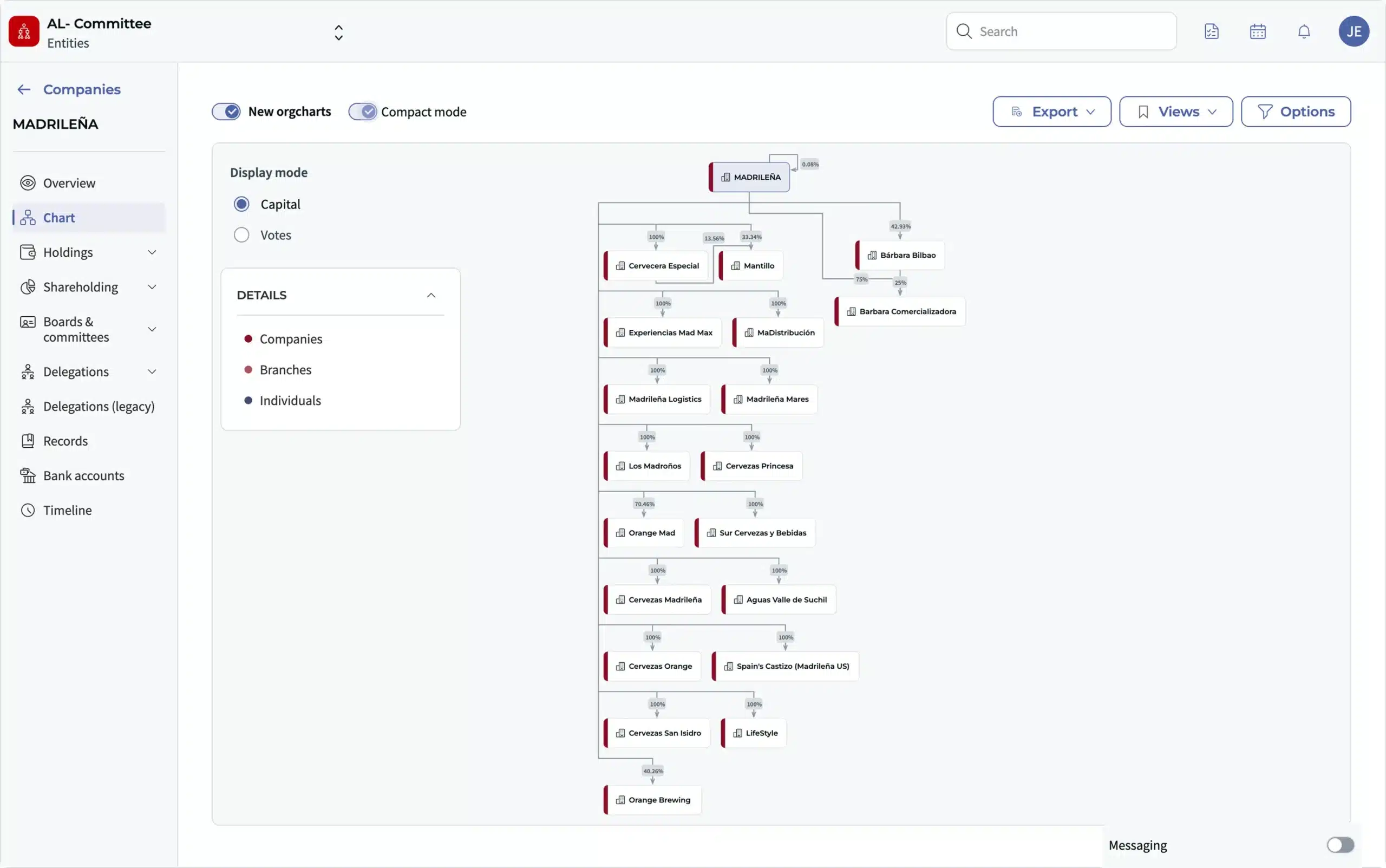
The module generates pre-built statutory registers, including share, officer, and director registers, directly from live entity data. Compliance alerts flag upcoming filing deadlines before they pass. For organizations managing subsidiary structures, the platform’s org chart visualization shows ownership and mandate relationships at a glance.
DiliTrust also integrates the Board Portal and Entity Management modules directly, so a resolution passed in a board meeting automatically links to the entity it affects. That connection between governance decisions and corporate records transforms a secretarial file from a static archive into a live compliance asset.
When a due diligence request arrives, your team is not scrambling to locate documents. You export them.
Learn more about how DiliTrust helps corporate secretaries maintain audit-ready entity records at scale.
The Most Common Mistakes in Company Secretarial File Management
Most company secretarial file failures are not dramatic events. They accumulate quietly, through small lapses that compound over time:
- Registers not updated after officer changes. A director resigned six months ago. The register of directors still shows them as active.
- Minutes drafted but never signed. A written resolution was circulated but never returned signed by the requisite majority, which may mean it is not effective.
- Share certificates issued without a register entry. Share certificates exist, but no corresponding register of members entry was ever made.
- Annual filings made, but copies not retained. The confirmation statement was filed with the registrar, but no copy was added to the secretarial file.
- Articles amended, but the updated version is missing. The company adopted new bylaws two years ago, but the secretarial file still contains only the original.
Each of these is a fixable problem until it becomes an issue during an audit, a regulatory inquiry, or a deal.
Frequently Asked Questions About Company Secretarial Files
What is a company secretarial file?
A company secretarial file is the master legal record of a company’s governance, ownership, and statutory compliance. It contains formation documents, statutory registers, share certificates, meeting minutes, and the full history of regulatory filings made since incorporation.
What is the difference between a company secretarial file and a minute book?
A minute book is specifically a record of board and shareholder meetings and resolutions. A company secretarial file is broader: it includes the minute book plus formation documents, statutory registers, share certificates, and the complete history of regulatory filings.
Who is responsible for maintaining a company secretarial file?
Responsibility depends on the applicable jurisdiction and company structure. It is often assigned to the company secretary, legal or governance team, or an external provider, while the directors remain responsible for ensuring that required records are maintained.
How often should a company secretarial file be updated?
A company secretarial file should be updated after every trigger event, such as officer changes, share transfers, address changes, or constitutional amendments, and reviewed at least annually as part of a routine compliance audit.
What is the equivalent of a company secretarial file in the US?
US companies typically maintain a corporate records book or corporate minute book, kept in accordance with the laws of the state of incorporation. Requirements differ materially by state. Delaware, California, and New York each have distinct rules for record-keeping, inspection rights, and public filing obligations.
How does a company secretarial file support due diligence in a merger or acquisition?
The company secretarial file is often among the first document sets reviewed in an M&A due diligence process. Acquirers use it to verify the entity’s legal existence, confirm ownership, validate board authority to authorize the transaction, and identify any undisclosed liabilities or filing gaps.
Want to see what an audit-ready secretarial file looks like?
DiliTrust Entity Management centralizes your statutory registers, officer mandates, and filing deadlines across every entity. No more scrambling when due diligence lands.