


Running a board of directors is primarily a governance challenge. Directors make consequential decisions under time pressure, with high volumes of information and growing regulatory scrutiny, often across multiple time zones and governance bodies. The logistics of coordinating that process (distributing documents, tracking votes, and archiving decisions) have to work reliably. They rarely do when managed by email.
Digital corporate governance gives boards the infrastructure to meet that standard: structured meeting workflows, secure document management, and a complete, auditable record of every decision. Many boards have moved past the question of whether to digitize. The priority now is doing it well.
Key Takeaways
- Digital corporate governance replaces paper-based board processes with structured, secure, and auditable digital workflows.
- Board portals reduce meeting preparation time significantly: tasks that once took days can be completed in hours.
- AI-powered minute drafting cuts post-meeting administrative work for corporate secretaries by up to 50%.
- Fewer than 40% of AI and data leaders believe their boards have sufficient AI literacy to oversee it effectively (Heidrick & Struggles, 2025).
- Regulatory frameworks including the EU AI Act, CSRD, and DORA are making formal governance documentation an operational requirement, not optional good practice.
What is digital corporate governance?
Digital corporate governance is the use of dedicated technology to manage the processes, documents, and decisions through which a board exercises its oversight role.
In practice, this means replacing paper board packs, email-based approvals, and physical signatures with a platform that centralizes agendas, voting, minutes, and resolutions in one controlled environment. Every action is timestamped. Every document is versioned. Every decision leaves a traceable audit trail.
The shift matters beyond convenience. Regulators and auditors increasingly expect formal evidence of how board decisions were made. A digital governance platform produces that evidence as a natural output of routine operations, not a reconstruction after the fact.
| Traditional board governance | Digital board governance |
|---|---|
| Paper board packs distributed by courier | Board packs published digitally in one step |
| Email threads for document approvals | Integrated voting and signatures within the platform |
| Manual minute-taking after each meeting | AI-generated draft minutes from agendas and audio |
| Physical signatures collected post-meeting | Remote e-signatures with a full audit trail |
| Documents scattered across inboxes and shared drives | Centralized, version-controlled document library |
Why boards are moving to digital governance tools
Meeting preparation absorbs too much time
Preparing a board pack traditionally takes days. Someone has to gather documents from multiple sources, consolidate them, check versions, and distribute copies, often by messenger or email attachment. Last-minute changes (a revised financial report arriving the morning of the meeting, or an updated agenda item at noon) can trigger a new round of distribution with version confusion almost guaranteed.
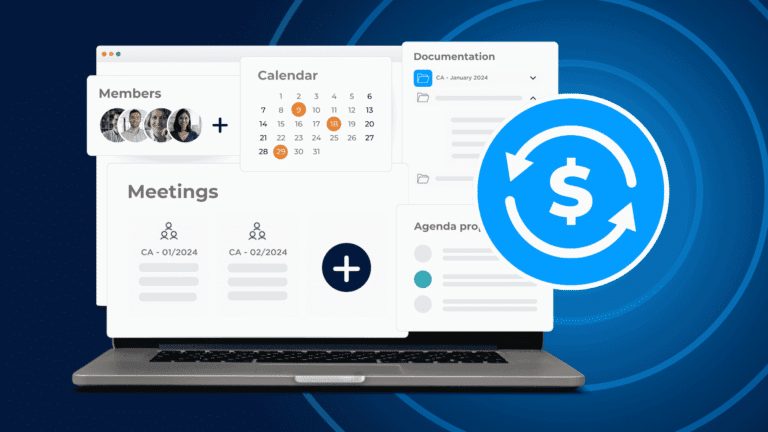
Board management software changes this cycle. The corporate secretary builds the agenda, attaches supporting documents, and distributes the full board pack in a single workflow. Board members receive a notification and access everything on any device, including offline. Updates reach all participants automatically, with no re-sending required.
Directors manage more governance responsibilities than before
Many directors sit on more than one board or committee. Managing that volume of information without a structured system is genuinely difficult. Documents get buried in email. Annotations made on printed copies remain invisible to everyone else.
A board portal gives directors one environment for all their governance work. Annotations are digital and can be shared selectively. Search tools let directors retrieve specific information across all board books instantly, including archived materials from previous meetings.
Compliance requires formal documentation
Governance bodies operate under legal obligations. Resolutions must be clearly recorded. Quorum must be documented. Minutes must be retained and accessible for regulatory review. When a regulator or auditor asks for evidence of how a specific decision was made, the corporate secretary needs to produce it quickly and completely.
Digital governance platforms generate signed, archived records of every meeting as a matter of course. That documentation protects the board in disputes, satisfies auditors, and demonstrates governance quality to shareholders. It is also the foundation for effective board meeting management, where preparation, execution, and follow-up all leave a complete, traceable record.
Ready to cut your board pack preparation time in half?
See how DiliTrust’s Board Portal manages the full meeting cycle, from agenda to archived minutes, in one secure platform.
Explore the Board Portal
What good digital board governance looks like
Use one platform for the full meeting cycle
The efficiency gain from a board portal depends on covering the whole process. Teams that use it only for document sharing but continue managing votes and minutes by email capture a fraction of the potential value.
Effective board meeting management runs every step inside one environment: agenda building, board pack distribution, real-time voting, e-signatures, and post-meeting archiving of signed minutes. That is what produces a clean, complete governance record.
Configure access controls before onboarding anyone
Board and committee meetings involve confidential materials. Different members need different levels of access. Role-based permissions should be configured before the platform is opened to users, so every director and observer sees exactly what they need to, and nothing more.
Occasional attendees (external auditors, legal advisors, transaction counterparties) should be granted per-meeting access scoped to the specific agenda items that concern them.
Use AI-generated minutes as a drafting tool, not a final output
AI minute drafting, when properly configured, produces a structured first draft from the meeting’s audio transcription and agenda items, organized by item, with action owners flagged automatically. The format can be tailored by meeting type: verbatim records for some committees, concise summaries for others.
The draft then moves through review and e-signature before archiving. The corporate secretary validates the content; the AI handles the initial structuring. That combination is where the time saving is most significant.
Track governance data over time
Digital platforms generate governance data as a natural byproduct of normal operations. Meeting frequency, attendance rates, voting patterns, and mandate expirations can all be monitored. That data supports board self-assessments and helps identify structural weaknesses before they become governance failures.
Still managing board processes manually? Download the board governance checklist and assess your current setup against digital governance standards. Get the checklist
Common governance mistakes
| Mistake | Why it matters | The fix |
|---|---|---|
| Using email to distribute board materials | Version confusion, security risk, and no audit trail | Distribute all materials through a dedicated board portal with strict access controls |
| Treating minutes as administrative rather than legal output | Minutes are legal records; errors or omissions create liability | Use AI-assisted drafting with structured validation before e-signature and archiving |
| Granting blanket access to all board materials | Confidential information exposed beyond those who need it | Configure granular, role-based permissions from day one of platform setup |
| Waiting for a governance incident before digitizing | Reactive adoption means missing the compliance window | Build the digital governance infrastructure before it is needed as a defense |
What’s changing in 2026
AI governance is now a board responsibility
Boards are not just being asked to adopt AI tools. They are being asked to govern them. According to research from Heidrick & Struggles cited by the Harvard Law School Forum on Corporate Governance, fewer than 40% of AI and data leaders believe their boards have sufficient understanding to provide effective AI oversight. That is a structural gap, not a knowledge gap.
Regulatory guidance, including the EU AI Act, is placing formal AI oversight obligations on governing bodies. Boards that cannot demonstrate a governance framework for AI face reputational, regulatory, and legal exposure. Technology oversight can no longer be delegated or treated as a periodic agenda item.
Regulatory pressure is raising documentation standards
The EU AI Act, CSRD, DORA, and NIS2 each create new oversight and reporting obligations that reach the board level directly or indirectly. Compliance is no longer confined to legal teams. Boards must show they understood key risks, that decisions were properly documented, and that oversight was genuinely exercised in good faith.
A digital governance environment is the most reliable way to produce that evidence. This is one reason why sound governance practices increasingly depend on structured digital tools rather than manual, reconstructed documentation. The regulatory direction is clear: documentation requirements will tighten, not ease.
Cybersecurity oversight sits at board level
Cybersecurity is no longer a management issue with occasional board updates. It is a board governance responsibility. According to PwC’s 2025 Global Digital Trust Insights, generative AI has increased organizations’ attack surface by an estimated 67%, and the cost of breaches globally is projected to rise from $9.22 trillion in 2024 to $13.82 trillion by 2028.
For boards, this means their own communication and documentation infrastructure is part of the organization’s security posture. Board portals with sovereign hosting, end-to-end encryption, and role-based access controls are a governance requirement, not an optional upgrade. Boards that use email and shared drives for sensitive materials are exposing themselves to risks that are now visible to regulators and shareholders.
How a board portal supports digital corporate governance
When boards choose a platform for digital governance, the selection has real operational consequences. A poorly adopted tool adds another system without changing the underlying workflow. A well-implemented one changes how governance is practiced day to day.
The DiliTrust Board Portal is built around the full meeting cycle. Before the meeting, corporate secretaries build and distribute board packs directly in the platform. During the meeting, directors vote, sign documents, and access materials from one interface. After the meeting, Lini, DiliTrust’s proprietary AI, drafts structured minutes from the audio transcript and agenda, reducing post-meeting workload by up to 50%.
Key capabilities:
- Agenda management: Members propose topics in advance for collaborative agenda-setting before the board pack is finalized.
- AI-generated minutes: Lini structures meeting minutes from audio transcriptions, agenda items, and supporting documents, with format configurable by meeting type.
- Integrated voting and e-signatures: Manage standard and weighted votes, and collect signatures from board members via DocuSign, Adobe Sign, or SignatureIT, all within the platform.
- Full audit trails: Every action is logged with timestamps, producing a governance record that holds up under regulatory or legal scrutiny.
- Governance reporting: When combined with the DiliTrust Suite’s entity management module, the Board Portal generates a consolidated governance dashboard covering meetings, mandates, and attendance across all corporate entities.
The platform holds ISO 27001 and SOC 2 Type II certifications, with sovereign hosting options outside the US CLOUD Act, a protection increasingly required by regulated industries and public-interest organizations.
Building governance infrastructure before you need it
The boards that handle regulatory complexity well in the coming years are building their governance infrastructure now, before an incident forces the question. That means structured workflows, complete documentation, and technology that reduces administrative burden while maintaining a clear chain of accountability.
DiliTrust helps governance teams build that infrastructure: from agenda preparation to post-meeting archiving, across boards, committees, and entities. The goal is the same one boards have always had: good decisions, properly made, and properly recorded.
See how DiliTrust helps boards run more efficient, compliant governance workflows
Frequently asked questions
What is digital corporate governance?
Digital corporate governance is the practice of using dedicated software to manage the workflows, documentation, and decisions through which a board exercises its oversight role. This covers agenda management, board pack distribution, voting, e-signatures, and minute archiving, all within one secure, auditable platform.
What is a board portal and how does it work?
A board portal is a secure platform built specifically for board and committee meetings. It replaces paper board packs, email-based document sharing, and manual minute-taking with structured digital workflows. Directors access materials on any device; corporate secretaries manage the full meeting cycle from one interface.
How does AI improve board meeting management?
AI tools embedded in board management platforms handle tasks that previously required significant manual work. DiliTrust’s AI assistant Lini drafts structured minutes from audio transcriptions and agenda items, organizes the output by agenda item, flags action owners, and routes the draft for validation automatically. Corporate secretaries review and finalize the minutes in a fraction of the time previously required.