


When a board resolution is challenged, auditors ask for three things first: the meeting notice, the signed minutes, and proof that a quorum was present. If your answer involves searching through email chains and shared drives, you have a meeting management problem. Not just an administrative one.
Meeting management covers every task that turns a formal gathering into a defensible record. For general staff meetings, that bar is low. For boards, executive committees, and governance bodies, it is the foundation of legal compliance. This article covers what meeting management means, why corporate secretaries sit at the center of it in governance contexts, and how purpose-built board management software changes what is possible when managing meetings at scale.
Definition of Meeting Management
Meeting management covers all tasks relating to the preparation, implementation and follow-up of formal meetings, whether in executive committees, supervisory boards, project teams or staff meetings. Meeting management includes:
- Scheduling and invitation creation
- Agenda creation and document distribution with clear agenda items
- Minutes and resolution documentation (don’t forget to make a note of critical points)
- Tracking of tasks and measures
The goal is to ensure that every meeting runs smoothly, transparently, and productively. When legal and compliance rules are required, effective meeting management becomes even more critical. Professional processes improve decision quality, strengthen leadership, and help organizations manage governance effectively. In many countries, recording minutes and securing documents are legally required, making effective meeting management a key part of corporate responsibility.
In the context of board meetings and formal governance bodies, meeting management carries additional legal weight. Boards operate under fiduciary duties, and procedural gaps can create direct liability. Effective meeting management for boards means more than scheduling: it requires proper convening notices, a complete vote record, signed and approved minutes, and secure long-term archiving. These requirements apply whether you are managing meetings for a listed company, a not-for-profit, or a regulated financial institution.
The Role of the Meeting Manager and Corporate Secretary
In a board governance context, the corporate secretary is the primary meeting manager, responsible for the end-to-end cycle: from scheduling dates and preparing board packs to capturing resolutions and ensuring signed minutes reach the archive on time. Where a general operational meeting has an “organizer,” formal governance bodies have a function whose entire job is built around effective meeting management.
The role requires strong management skills, legal understanding, and the ability to manage different stakeholders. Good communication helps keep discussion clear and productive, ensuring that people stay focused on key topics and conversations. Especially in regulated industries like banking, insurance, and pharmaceuticals, meeting management skills are part of the governance framework. For corporate secretaries specifically, those meeting management skills extend to verifying legal convening requirements, coordinating signatures from multiple board members, and maintaining a complete governance record across years of activity.
Traditional versus Digital Meeting Management
The way organizations manage meetings has changed significantly. While paper-based processes once dominated, today most companies start with digital tools to stay efficient and secure. This shift doesn’t just improve workflows; it can lead to better compliance, productivity, and collaboration.
Classic Meeting Management
Traditional meeting management relied heavily on email, Word, Excel, and paper-based communication. Agendas were created manually, documents were printed, and notes were often unstructured. Such practices can lead to unproductive meetings, poor follow-up, and wasted time. To avoid this, make sure you limit the number of unnecessary gatherings and focus on priority issues.
Digital Meeting Management
Digital solutions — board portals, apps, and meeting management tools — simplify and professionalize the process. Organizations can use a central platform to manage a meeting, send meeting invites, share documents, and track action items. With mobile devices and a mobile app, team members can join virtual meetings, read documents, and view updates in real time. Remote teams can also use video conferencing to discuss projects and share progress across departments.
Key features of digital meeting management include:
- Central hub for planning and communication
- Clear version history of the meeting agenda
- Secure access on PC, tablet, or smartphone
- Integrated task and project management tools
- Compliance-ready meeting minutes with audit logs
These digital services help everyone stay aligned, keep discussions focused, and create efficient and productive workflows. Especially when managing complex projects across multiple teams, these tools can help you make better decisions and achieve stronger outcomes.
Advantages of Digital Meeting Management
Switching to digital meeting management offers companies, public institutions and supervisory bodies numerous advantages, not only in terms of efficiency, but also in terms of security, traceability and governance. Compared to the traditional approach, many processes can be significantly optimized. The most important advantages of digital meeting management are:
- Save time and resources: Invitations, agenda creation, minutes and task tracking are all automated.
- Central access: All meeting documents are available digitally at any time, including versioning and comment function.
- Maximum security: Data is transmitted and stored in encrypted form. Access rights, two-factor authentication and audit logs protect sensitive information.
- Transparency and traceability: Decisions, tasks and responsibilities are clearly documented and can be accessed at any time, ideal for compliance requirements.
- Flexible working: Whether in the office, remotely or on the road, participants can access all documents and prepare themselves via tablet or laptop using an app.
- Sustainability: Paperless working reduces printing costs and supports ESG goals.
After all, modern meeting management must not only comply with legal requirements, but also meet the demands of a modern, digital way of working. Organizations that rethink their processes will become more efficient and ready for the next challenges.
Board Meeting Management Software: How DiliTrust Board Portal Works
The DiliTrust Board Portal is purpose-built board management software that covers the full governance meeting cycle: from the first convocation to the final signed archive.
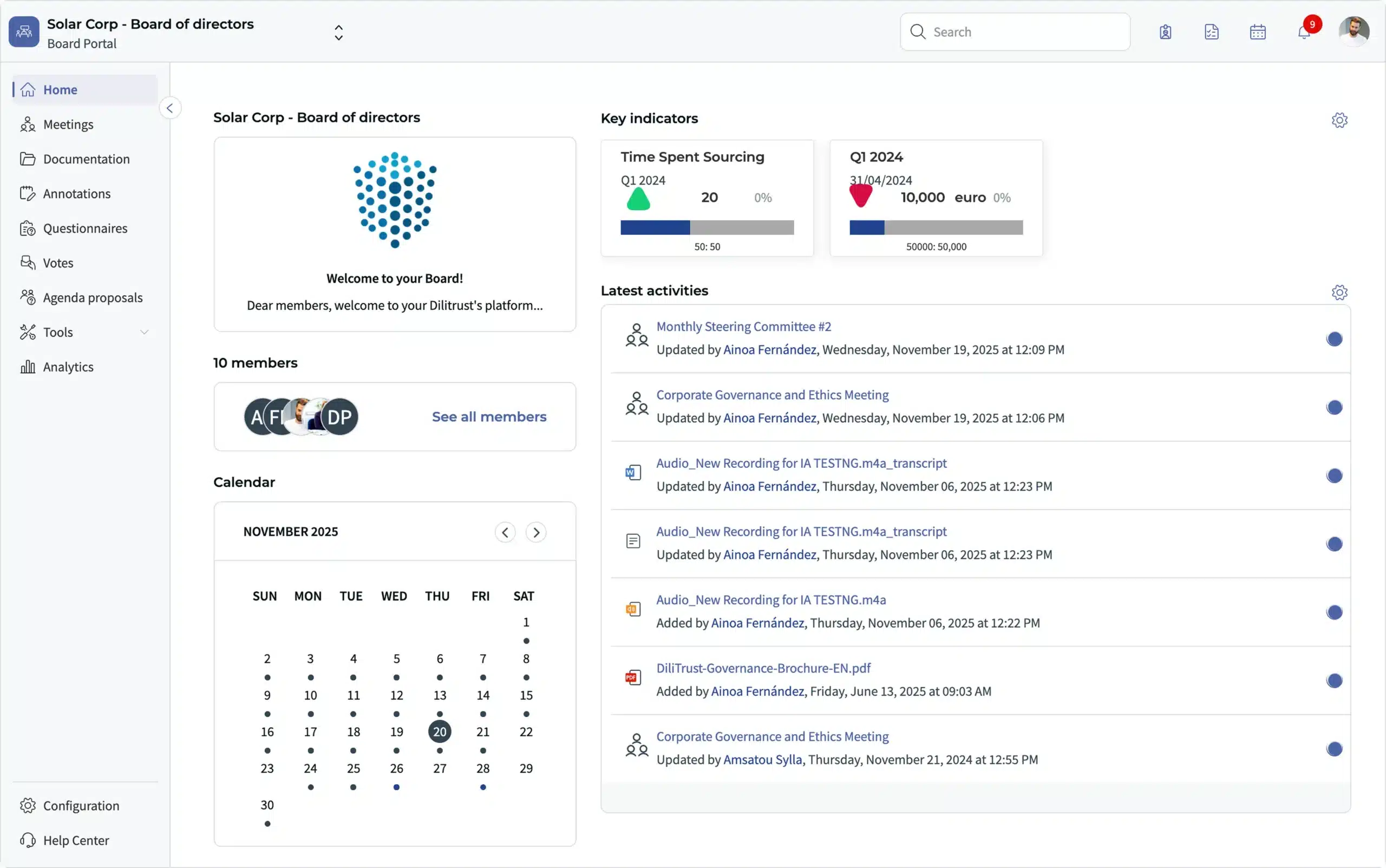
Before the meeting, the corporate secretary builds the agenda directly in the portal, attaches documents to each item, and times the agenda to keep the session on track. Once ready, the full board pack reaches every board member in a single publication step. Occasional attendees — auditors, advisors, external consultants — can be invited per meeting with precisely scoped access limited to the specific agenda items they need to see.
During the session, board members cast votes directly in the platform. Where governance rules require confidentiality, anonymous voting is available. Multiple administrators can edit the minutes simultaneously in real time, so a working draft is typically 80% complete before the meeting ends.
After the meeting, the corporate secretary uses Lini — DiliTrust’s built-in AI assistant — to generate structured minutes from the audio transcript, agenda items, and voting records. Lini organizes the output by agenda item, flags action items, and identifies deadlines and owners when stated. The output format is configured per meeting type: verbatim for some committees, bullet-point summaries for others. The draft then moves through validation, e-signature collection from relevant signatories, and is archived in the portal’s dedicated meeting archive — permanently accessible and fully auditable.
Good meeting management at board level means nothing is left to memory or email. The Board Portal makes that the default, not the exception.
Why Digital Board Meeting Management Matters
For boards and governance teams, effective meeting management is not a convenience. It is a legal obligation. Formal governance bodies must convene properly, document every decision, and retain records that hold up under regulatory or legal scrutiny.
The primary driver for shifting to a digital board meeting approach is compliance and auditability — not just operational efficiency. A complete, signed, archived record of every board decision is what protects your organization when regulators or auditors ask questions.
AI-assisted governance is already changing what is possible. Lini drafts structured minutes from recordings automatically, and action items get logged without anyone transcribing by hand. The administrative load on corporate secretaries is falling. The governance standard is not.
Frequently Asked Questions
What is the difference between meeting management and board management?
Meeting management refers to the full process of planning, running, and documenting any formal meeting, including staff meetings, project reviews, and committee sessions. Board management is a specific subset of meeting management focused on the governance of formal decision-making bodies such as boards of directors and supervisory boards. Board management adds legal compliance requirements, fiduciary accountability, and formal documentation standards that go beyond general meeting management practices.
What does a corporate secretary do in meeting management?
A corporate secretary manages the full meeting lifecycle for governance bodies: drafting the agenda, preparing and distributing the board pack, facilitating voting during the session, taking or validating minutes, coordinating signature collection, and archiving the final record. Effective meeting management in a governance context requires the corporate secretary to ensure that every procedural step meets the legal requirements applicable to the specific governance body, from statutory notice periods to minutes approval timelines.
How does board portal software support meeting management?
Board portal software centralizes every step of the governance meeting cycle on a single secure platform. Corporate secretaries use it to create and publish agendas, share documents with role-based access, run votes, co-edit minutes in real time, and collect electronic signatures, all within an auditable environment. AI-powered features such as automated minute generation from audio transcripts reduce the post-meeting workload significantly, while the permanent archive makes retrieving past decisions fast and reliable.
Ready to bring structure to your board meeting management process?