


At board of directors meetings, the members of the Board come together to monitor the work of the Management Board, discuss strategic decisions and ensure compliance with legal regulations. They play a key role in ensuring that a company operates successfully and in compliance with the law in the long term. Whether face-to-face, hybrid or fully online, careful preparation, clear decision-making processes and complete minutes are essential for effective board meetings. In this article, you will learn everything you need to know about board meetings.
Definition: Board of Directors Meetings
A board of directors meetings is a formal meeting of the board of a company and serves to monitor, advise and control the management board or management and is required by law in many types of companies. These meetings are central to corporate governance and legal compliance.
One-Tier vs. Two-Tier Board Systems
Board structure varies significantly across jurisdictions. Knowing which model applies to your company directly shapes how meetings are organized and governed.
Two-tier system (Germany, Austria, the Netherlands, and other continental European countries): Companies have two separate bodies. A supervisory board (Aufsichtsrat) monitors and advises the management board (Vorstand), which runs daily operations. The roles are strictly separated. This article primarily addresses supervisory board meetings in this context, referencing the German Stock Corporation Act (AktG) and related legislation.
One-tier system (UK, US, and most Anglo-American jurisdictions): A single board of directors combines oversight and executive responsibilities. It typically includes both executive directors and non-executive (independent) directors on one body.
Understanding which system applies determines the legal requirements, quorum rules, and decision-making processes that govern your meetings
Presentation of a Board of Directors
The board of directors is a central body in many companies, as it monitors the management, advises on strategic issues and ensures compliance with legal requirements. But how is this body actually composed and who attends its meetings?
Composition and Election of the Board of Directors
A board of directors is usually made up of employee and shareholder representatives. The exact composition depends on the type and size of the company. The board elects a chairman and deputy chairman from among its members. In boards with equal representation, the chairman can have a double vote in the event of a tie and chairs the meeting.
Regulations on staffing depending on the type of company:
Inside and Outside Directors
Board members fall into two broad categories. Inside directors have a direct connection to the company, they may be major shareholders or executives. Outside directors (also called independent directors) have no employment or financial relationship with the company beyond their board seat. They bring external expertise and an objective perspective. Independent directors are particularly important on audit and remuneration committees. Many stock exchange listing rules require publicly traded companies to maintain a majority of independent board members.
Who May Attend the meetings?
In principle, all members of the board of directors are obliged to attend. In addition, external experts or assistants may be called in as required, e.g. for complex financial, legal or IT issues. These guests do not have voting rights, but provide support in an advisory capacity.
Recording clerks, assistants or representatives of the legal department may also attend in order to provide organizational and legal support. In addition, experts and informants may be called in to provide advice, but do not have the right to vote.
The participation of external experts is generally regulated by the Chairman in consultation with the Board. The exact powers are based on the Board’s rules of procedure and relevant legal provisions.
Who Convenes the Meetings?
In principle, a board of directors meetings is convened by the Chairman of the Board. However, according to the German Stock Corporation Act (Section 110 (1) AktG), any Board member or the Management Board can request that a meeting be convened if they state the purpose and reasons for doing so, stating the purpose is a legal requirement.
If the Chairman does not respond to this request, the applicants may also convene the Board themselves. The prerequisite is that they communicate the facts of the case and an agenda.
Tasks and Powers of the Board of Directors
The board of directors has three central tasks that are closely linked and contribute significantly to corporate governance:
1. Monitoring the management board
The board examines whether the Management Board acts in a legally correct manner, manages risks and pursues the company’s objectives.
2. Strategic consulting
It advises on important decisions such as investments, mergers or restructuring and provides advice on individual measures or projects.
3. Control of finances and compliance
The board monitors the annual financial statements, risks and compliance with legal requirements.
The board’s effectiveness depends on the infrastructure behind it. DiliTrust Board Portal centralizes meeting management, document access, and compliance tracking, so the board can focus on oversight, not administration. → See DiliTrust Board Portal in action.
Aim of Board of Directors Meetings
The aim of the board of directors meeting is to reflect on corporate strategy decisions, assess risks, ensure compliance and review and approve management decisions.
For example, a study by the Universities of Göttingen and Marburg on “Co-determination in the Board” (2019) shows the added value of well-functioning board work, especially in times of crisis:
Procedure of a Board of Directors Meetings
The course of a board of directors meeting is based on clear legal and organizational guidelines. It begins with the preparation, includes the agenda and ends with the passing of resolutions and the recording of minutes.
Preparation and planning
The invitation to the board of directors meeting must contain all essential information: Company name and registered office, place, date, time and convener. Each member must be invited personally and the agenda must be communicated in full.
If items on the agenda are missing or are submitted too late, resolutions on them are generally invalid unless all those present agree and those absent have the right to object.
Careful preparation is therefore essential for a legally compliant meeting.
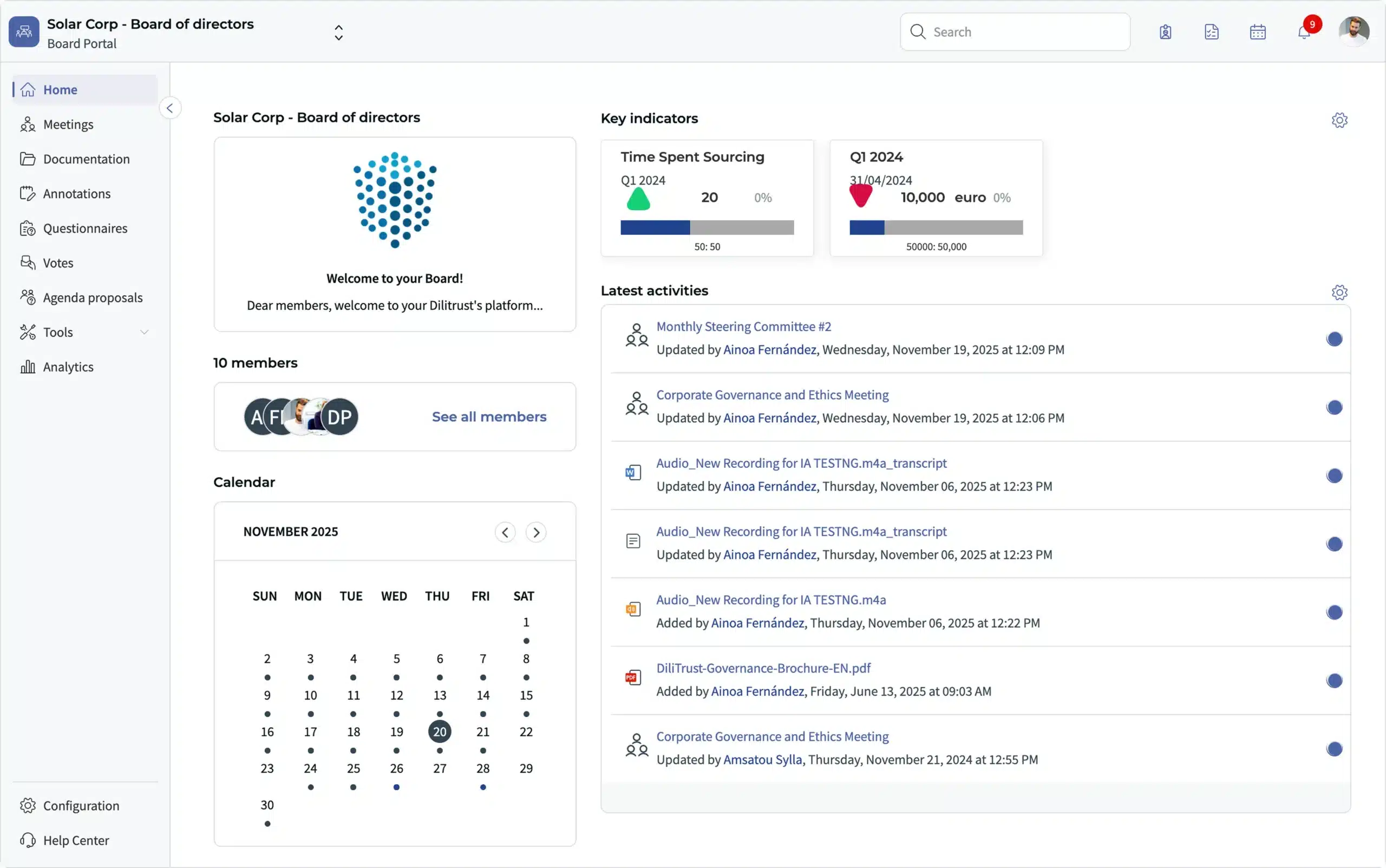
DiliTrust centralizes meeting preparation, document distribution, and agenda management, making legally compliant board meetings the default, not the exception
Agenda of a Board of Directors Meeting (Content)
The agenda determines which topics will be discussed at the meeting and is an integral part of the notice convening the meeting. Typical agenda items are
The agenda must be communicated in full and in good time in order to allow for the proper adoption of resolutions.
What About the Deadlines?
As a rule, Board members must be invited at least 14 days before the meeting. Resolutions may only be passed on items announced in good time unless all those present agree and those absent can object or cast their vote afterwards.
Committees of the Board
The Board often forms specialized committees to handle certain tasks more efficiently. The most important of these are:
These committees prepare decisions, deliberate intensively and report to the full Board.
Is your audit committee ready for the next era of governance?
See how governance leaders are shifting from reactive oversight to strategic value creation.

Meetings of the Board
How often does a board of directors meet? Most boards hold at least two ordinary meetings per calendar half-year, meaning a minimum of four times per year. Companies with active committees or significant strategic agendas often meet more frequently. The articles of association and applicable law set the minimum.
Board of directors meetings can be divided into three main types:
Participation in Board of Directors Meetings
Today, board of directors meetings can take place physically, hybrid or completely digitally. Physical participation in a common room remains the classic form.
Increasingly, companies are also relying on hybrid meetings, where some members are on site and others are connected via video conference.
Digital meetings offer flexibility and enable participation from anywhere. The prerequisite is that the articles of association or rules of procedure permit this and technical security is guaranteed.
Regardless of the format, all members must be able to exercise their rights in order to participate effectively in discussions and resolutions.
Decision-Making in the Board of Directors Meetings and Passing of Resolutions
The Board’s decision-making is based on a formal vote, tacit consent is not sufficient (Section 108 (1) AktG). Resolutions must be clearly formulated and actively adopted.
The quorum usually depends on the articles of association. If there is no provision, the following applies: at least half of the members must take part in the vote. Abstentions count, mere presence does not.
The type of voting (e.g. open, written, digital) and the necessary majorities are regulated by the articles of association or rules of procedure.
All resolutions must be properly recorded so that they remain legally effective and can be traced at a later date.
Importance of Minutes in Board of Directors Meetings
Board Minutes play a central role in the work of the Board. They not only document processes and resolutions, but are also indispensable from a legal perspective. Every resolution must be clearly formulated and recorded in writing, as tacit consent is not sufficient; only expressly adopted resolutions are legally effective. As courts interpret resolutions very cautiously, precise wording in the minutes is particularly important. The quorum of the committee must also be documented in a comprehensible manner: it must be recorded how many members took part and whether they voted or abstained. Minutes must be kept carefully, as they can be decisive in the event of legal disputes or audits. They protect the Board from liability risks and ensure the traceability of decisions.
Manage every supervisory board meeting from preparation to follow-up — agendas, documents, votes, and AI-generated minutes in one secure environment.
Board Self-Evaluation
Effective governance does not stop at passing resolutions. Leading boards conduct structured self-assessments to evaluate the quality of their meetings, the effectiveness of their committees, and the adequacy of information received from management.
A regular review helps identify weaknesses before they become governance failures. It also demonstrates accountability to shareholders, regulators, and other stakeholders. The corporate secretary typically coordinates this process, collecting feedback and preparing a summary for the chairman and the full board.
Presentation of Digital Board Portals
Board of directors meetings require precise organization, seamless documentation and smooth communication. Digital board portals offer a modern solution for this by bundling all relevant information such as agendas, minutes and important documents in one secure, central location. Board portals are an indispensable tool, especially in times of increasing digitalization and rising data protection and compliance requirements.
DiliTrust Board Portal
Board Management Software enables efficient, secure and paperless organization. The DiliTrust Board Portal is intuitive to use, can be used both online and offline, and supports board members with tasks before, during and after the meeting using integrated AI.
Key features:
Security is built in by design: the platform holds ISO 27001 and SOC 2 Type II certifications, with sovereign hosting outside the scope of the US CLOUD Act. This matters for boards handling sensitive strategic, regulatory, or M&A information. Board members access all materials anytime and from any device.
Frequently Asked Questions About Board of Directors
How often does a board of directors meet?
Most boards meet at least four times a year. The minimum is typically set in the articles of association or by law. Extraordinary meetings can be called at any time when urgent decisions are required.
Is the CEO higher than the board of directors?
No. The board of directors sits above the CEO in the governance hierarchy. The board hires and, if necessary, removes the CEO. It sets the strategic direction the CEO is expected to execute. The CEO manages the company’s day-to-day operations but is accountable to the board for results. In two-tier systems, this separation is explicit: the management board (led by the CEO) reports to the supervisory board. In one-tier systems, the CEO may also sit on the board, but the board as a collective body retains final authority.
What is a quorum for a board of directors meeting?
A quorum is the minimum number of members required to hold a valid meeting and pass legally binding resolutions. Where no specific provision exists, German law (§ 108 (2) AktG) requires at least half the total number of members to participate. Company bylaws may set a different threshold.
Who can call an extraordinary board meeting?
Any board member or the management board can request the chairman to convene an extraordinary meeting, provided they state the purpose and reasons. If the chairman does not act, the requesting parties may convene the meeting themselves (§ 110 (1) AktG).
Can AI make your board meetings more efficient?
Discover three practical and secure ways to streamline board meeting preparation and follow-up, improve decision-making, and protect sensitive data with AI-driven tools.