



When an auditor asks for a full list of your group’s subsidiaries, their shareholding percentages, and every director appointment across 12 jurisdictions, how long does it take you to respond? If the answer involves spreadsheets, email chains, or a phone call to the company secretary in another country, you already know the problem.
Subsidiary management software exists to solve exactly that. This guide covers what it does, who needs it, and what to look for when evaluating your options.
Key Takeaways
What Is Subsidiary Management?
Subsidiary management is the ongoing governance, administration, and compliance work required to maintain a group’s legal entities. This includes tracking ownership structures, managing director and officer appointments, monitoring filing deadlines, maintaining corporate records, and ensuring each entity meets its local regulatory obligations.
The function sits at the intersection of legal, finance, and compliance. It’s not owned by any single department, which is precisely why it breaks down without a structured system.
Subsidiary Management vs. Entity Management: Key Differences
The two terms are closely related, but not identical. Entity management is the broader category: it covers all legal entities in a corporate group, regardless of structure or purpose. Subsidiary management is a subset focused specifically on the governance of subsidiaries, companies in which a parent holds a controlling stake.
In practice, most software marketed under either label handles the same core workflows: entity registers, ownership tracking, mandate management, and compliance monitoring. The distinction matters more for organizational responsibility than for technology selection.
Why Managing Subsidiaries Gets Complex Fast
A single subsidiary in one jurisdiction is manageable. Five subsidiaries across three countries, each with different regulatory calendars, share structures, and reporting requirements, is a different challenge entirely.
Subsidiary governance is never a one-team job. Legal handles mandates and corporate records. Finance tracks capital structures and ownership percentages. Tax needs entity data for transfer pricing analysis. HR manages director appointments. When each function maintains its own version of the truth in its own system, inconsistencies multiply fast.
During an M&A process or a regulatory audit, those inconsistencies surface at the worst possible moment.
Data Silos and the Spreadsheet Trap
Most companies start managing subsidiaries in Excel. It works well enough at three entities. By entity 20, the spreadsheet is already outdated, no one is sure whose version is current, and pulling a consolidated view of the corporate structure requires hours of manual work.
The problem isn’t that spreadsheets are the wrong tool. It’s that subsidiary data is live: it changes constantly, involves multiple contributors, and needs to be auditable. Static files can’t do that job.
Multi-Jurisdictional Compliance Obligations
Every subsidiary operates under the laws of its home jurisdiction. Delaware annual report deadlines differ from those in France, Germany, or Singapore. A missed filing in one jurisdiction can mean loss of good standing, penalties, or personal liability for directors. According to Harbor Compliance, one of the most common failures in subsidiary governance is the lack of a centralized system to track these per-jurisdiction obligations before they become overdue.
Tracking these deadlines manually across dozens of entities is high-risk. The more jurisdictions you operate in, the less margin for error.
Why the Pressure to Act Is Building Now
The compliance environment is changing faster than manual processes can absorb. CSRD now requires organisations to report with far greater precision on their entity structures. The AI Act introduces new accountability requirements tied to how data is governed at the entity level. Cross-border regulatory complexity is accelerating, not stabilising.
At the same time, boards and CFOs are asking legal to demonstrate strategic value, not just manage risk quietly. Legal teams that cannot produce real-time visibility into their group structure cannot answer those questions. And organisations investing in AI-driven decision-making are discovering that AI cannot function without clean, structured, auditable data as its foundation. Entity governance data is where that foundation either holds or breaks.
The cost of waiting is not staying the same. It is compounding.
Discover your savings
What is inefficient subsidiary management actually costing you? Calculate your potential savings in minutes.
What Does Subsidiary Management Software Do?
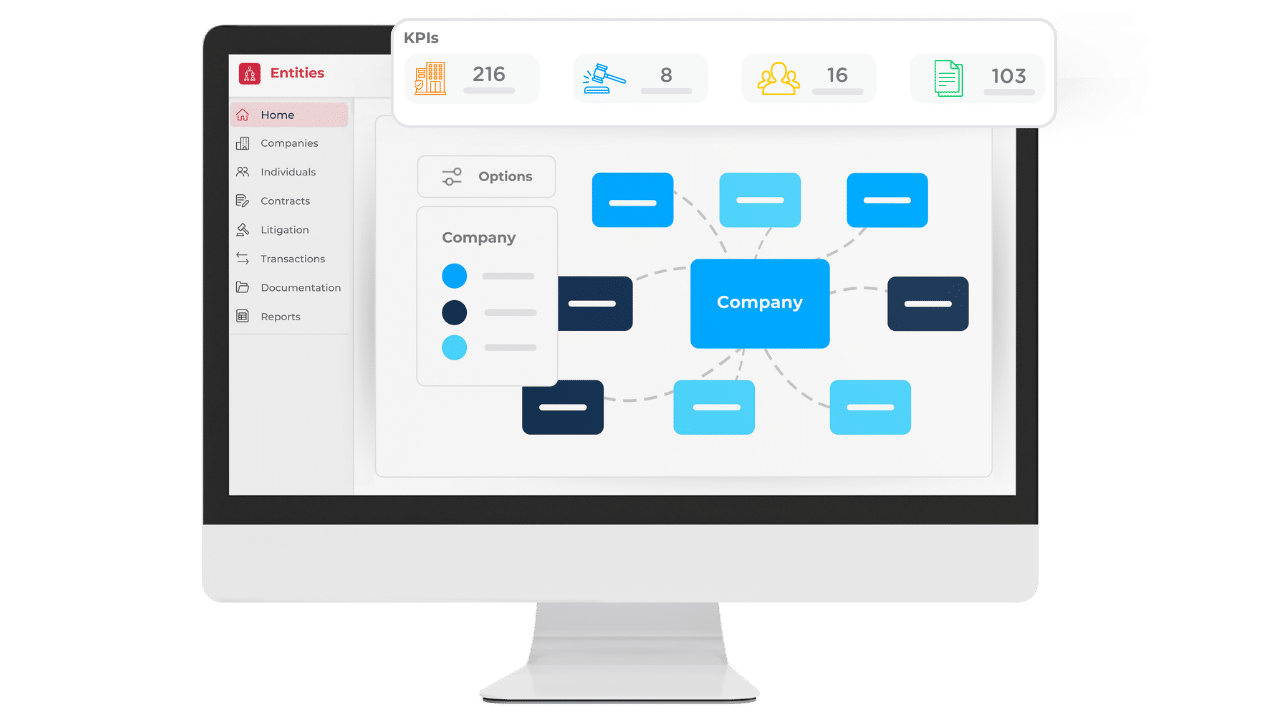
Subsidiary management software replaces fragmented records and manual processes with a centralized platform where all entity data lives in one place, all changes are logged, and all deadlines are visible.
Here’s what the core functionality looks like in practice.
Centralized Entity Data Repository
The foundation of any subsidiary management platform is a structured database of your legal entities. Each entity has its own profile: legal form, jurisdiction, registered address, capital structure, shareholding history, corporate documents, and custom fields for internal data points.
Everyone who needs access can find what they need without asking. Every change is tracked with a timestamp and an author.
For groups with complex structures, tracking who owns what percentage of each entity is not straightforward. Share classes, voting rights, cross-holdings, and minority stakes all affect the picture.
Purpose-built software calculates direct and indirect ownership automatically. Change one shareholding, and the ownership percentages throughout the group update in real time. This is critical for board meetings, regulatory filings, and acquisition due diligence.
Org Chart Generation
A visual representation of the group’s corporate structure should be a one-click export, not a project. Good subsidiary management software generates org charts automatically from the ownership data already in the system, filtered by jurisdiction, legal form, or any other criteria you choose.
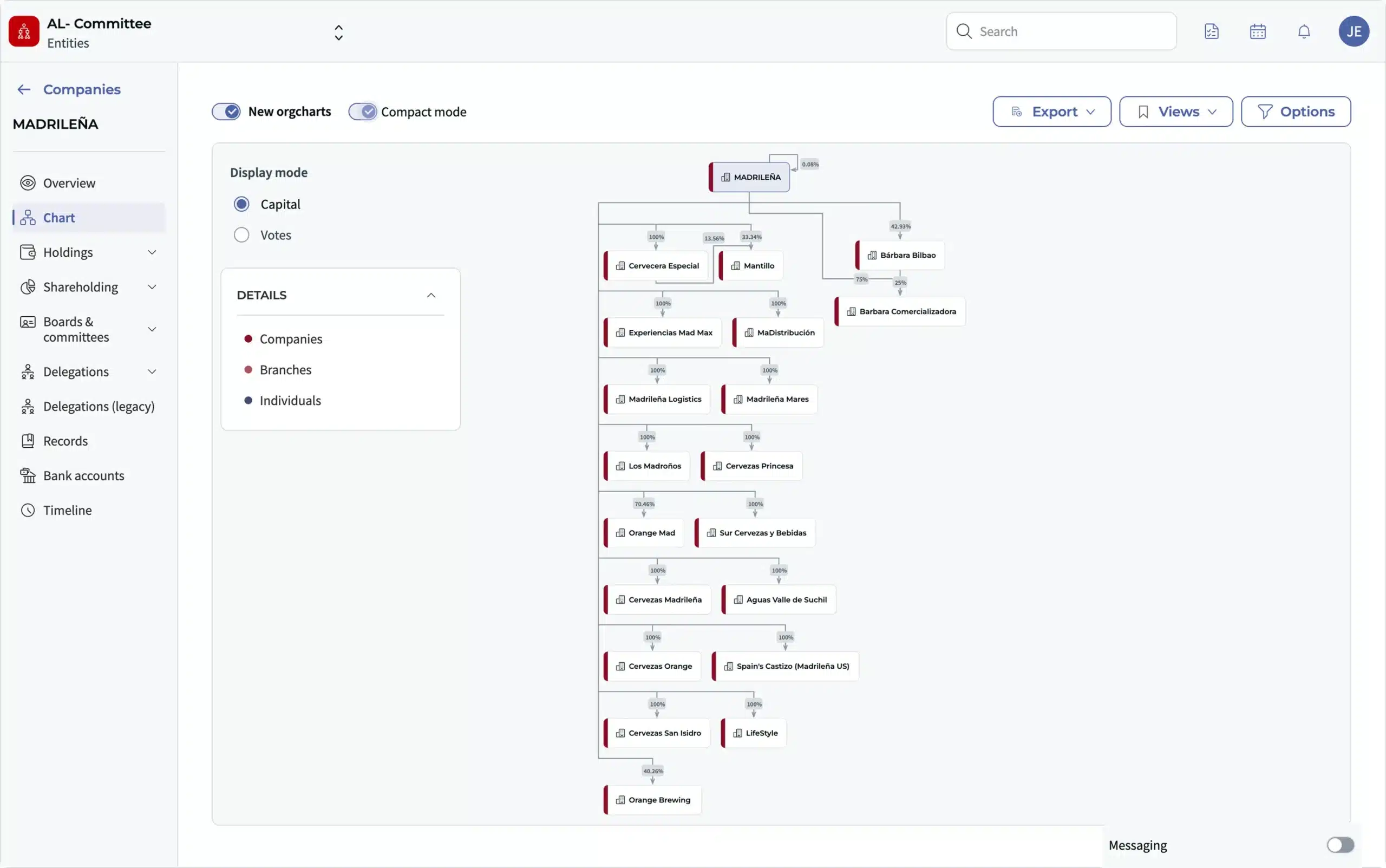
This matters most during audits, investor presentations, and M&A processes, when accurate structure diagrams are needed quickly.
Compliance Tracking and Automated Reminders
Annual filings, renewal deadlines, board meeting schedules, and regulatory obligations vary by entity and jurisdiction. The software tracks these deadlines and sends automated reminders before they fall due.
A missed deadline at one subsidiary doesn’t have to become a compliance incident group-wide. Proactive alerts ensure nothing slips through.
Delegation of Authority Management
Managing who has signing authority across a large group is a governance risk if done informally. Subsidiary management platforms allow you to create, track, and update delegations of authority, linked directly to the relevant entities and individuals. Every delegation is documented, auditable, and easy to revoke when someone leaves.
Key Features to Look for in Subsidiary Management Software
Not all platforms are equal. These are the capabilities that separate a robust solution from a basic entity register:
| FEATURE | DESCRIPTION |
|---|---|
| Multi-jurisdictional support | Handles capital-based companies and capital-less structures (LLCs, LPs, partnerships) within the same platform. |
| Automatic ownership calculation | Computes direct and indirect ownership percentages, including voting rights through control chains. |
| Configurable org charts | Exportable and filterable by country, legal form, or custom criteria. |
| Granular access controls | Perimeter-based permissions so regional teams see only the entities within their scope. |
| Compliance deadline tracking | Jurisdiction-aware calendars with automated reminders. |
| Mandate and DOA management | Full officer appointment history with renewal mechanisms. |
| Audit trail | Every data change is logged with the responsible user and timestamp. |
| Custom company profiles and reports | Shareholder registers, transaction histories, and tailored exports. |
| AI-assisted search | Semantic search across all entity data, not just exact-match lookups. |
| Integration-ready architecture | Connects to board portals, CLM systems, and other legal tech tools in your stack. |
Subsidiary Management Software vs. ERP Systems
A common misconception is that an ERP like SAP or Oracle already covers subsidiary management. It doesn’t, at least not in the way a legal team needs.
ERP systems are built for financial consolidation and operational reporting. They track entities as accounting units. What they don’t do well is manage governance data: director appointments, shareholding histories, delegation of authority chains, compliance filing deadlines by jurisdiction, or auditable org charts.
A legal team trying to answer a governance question inside an ERP is using the wrong tool. The data structure isn’t built for it, access controls are typically not granular enough for legal confidentiality requirements, and the outputs don’t match what regulators or auditors actually ask for.
Subsidiary management software is designed specifically for the governance layer. It integrates with ERP systems where needed but serves a fundamentally different purpose.
Common Use Cases
Subsidiary management software delivers the most value in scenarios where the volume of entities, jurisdictions, or stakeholders exceeds what manual processes can handle reliably.
How DiliTrust Simplifies Subsidiary Management
For legal teams managing entities across multiple jurisdictions, the question is not whether to centralise entity governance, but how to do it without disruption. DiliTrust’s Legal Entity Management keeps your legal entity data accurate, current, and compliant across every jurisdiction. Ownership percentages, share classes, mandates, delegations of authority, and governance documents all live in one governed system. Every change is logged automatically against the responsible user and timestamp. Nothing leaves the audit trail, and nothing is left to memory.
Org charts generate directly from the ownership data in the system and update in real time when capital structures change. When an auditor asks a question you weren’t expecting, you don’t have to search manually across dozens of entity records. DiliTrust’s LINI AI lets you search the entire entity database in plain language and surface a structured answer in seconds, without relying on whoever last updated a spreadsheet.
Ready to bring your entire entity structure under one governed, auditable system?
Frequently Asked Questions
What is subsidiary management software?
Subsidiary management software is a platform that centralizes the governance, compliance, and administrative data of a company’s legal subsidiaries. It typically includes an entity database, ownership tracking, org chart generation, compliance deadline monitoring, and mandate management.
When does a company need subsidiary management software?
Once a group reaches 10 to 15 entities across multiple jurisdictions, manual tracking becomes unreliable. Most organizations adopt dedicated software when they face a compliance incident, an M&A event, or an audit that exposes gaps in their entity records.
How is subsidiary management software different from an ERP?
ERP systems track entities as financial accounting units. Subsidiary management software handles governance data: director appointments, shareholding histories, compliance filing deadlines, delegation of authority chains, and auditable corporate records. These are fundamentally different data structures serving different stakeholders.