


Legal teams are managing more work with the same headcount, and the tools most of them rely on were never designed for the job. Matters tracked in spreadsheets. Status updates buried in email threads. KPIs that nobody can actually calculate. When information is scattered across platforms and people, legal risk doesn’t announce itself, it accumulates quietly until it becomes a board-level problem.
That gap is what matter management software is designed to close. This article walks through the features that make Matter Management by DiliTrust a practical answer to how in-house legal teams actually work.
A smarter approach with Matter Management by DiliTrust
Centralising matters, structuring projects, and giving all involved parties consistent access to the same information sounds simple enough. In practice, it requires a platform built around the way legal teams operate, not adapted from a generic project management tool. Matter Management by DiliTrust is purpose-built for in-house legal, and teams are up and running in under 30 minutes.
QuickView AI: instant status updates on any matter
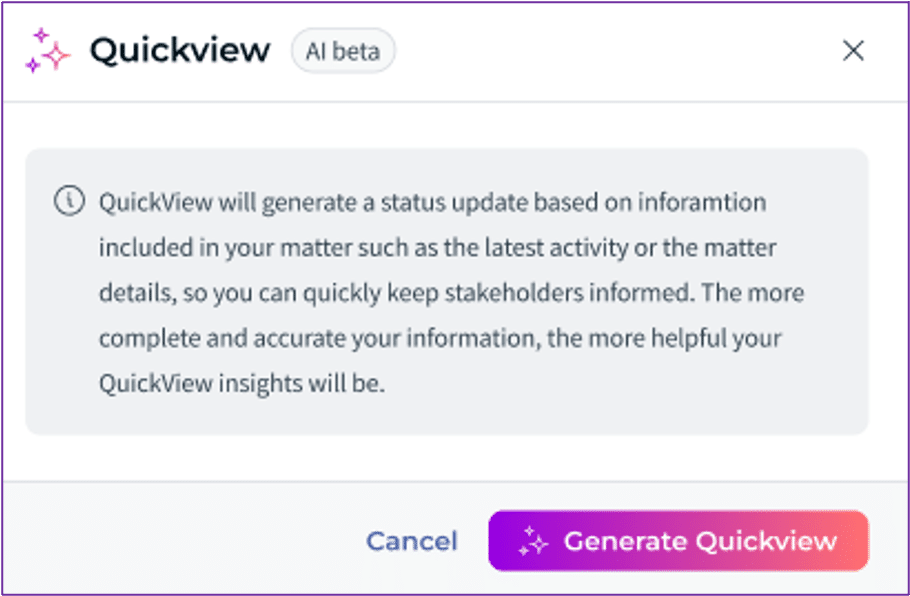
Status reporting is one of the most time-consuming tasks in any legal department. Writing a clear, current update on a complex matter, one that makes sense to a manager, a collaborator, or an external party, requires pulling together activities, documents, and context that are rarely in one place.
QuickView AI cuts that work down to a single click. It analyses the information already stored in the platform: matter description, current status, the 30 most recent activities, uploaded document names, details fields, and any previous QuickView version. The result is a structured status update, ready in seconds, editable and shareable.
QuickView is accessible from the matter page itself or from the matter list, where a dedicated column shows a preview of the latest update for every matter. It’s particularly useful during monthly reviews, team handovers, and long-running matters where keeping shared context is half the battle.
One platform for complete visibility across all matters
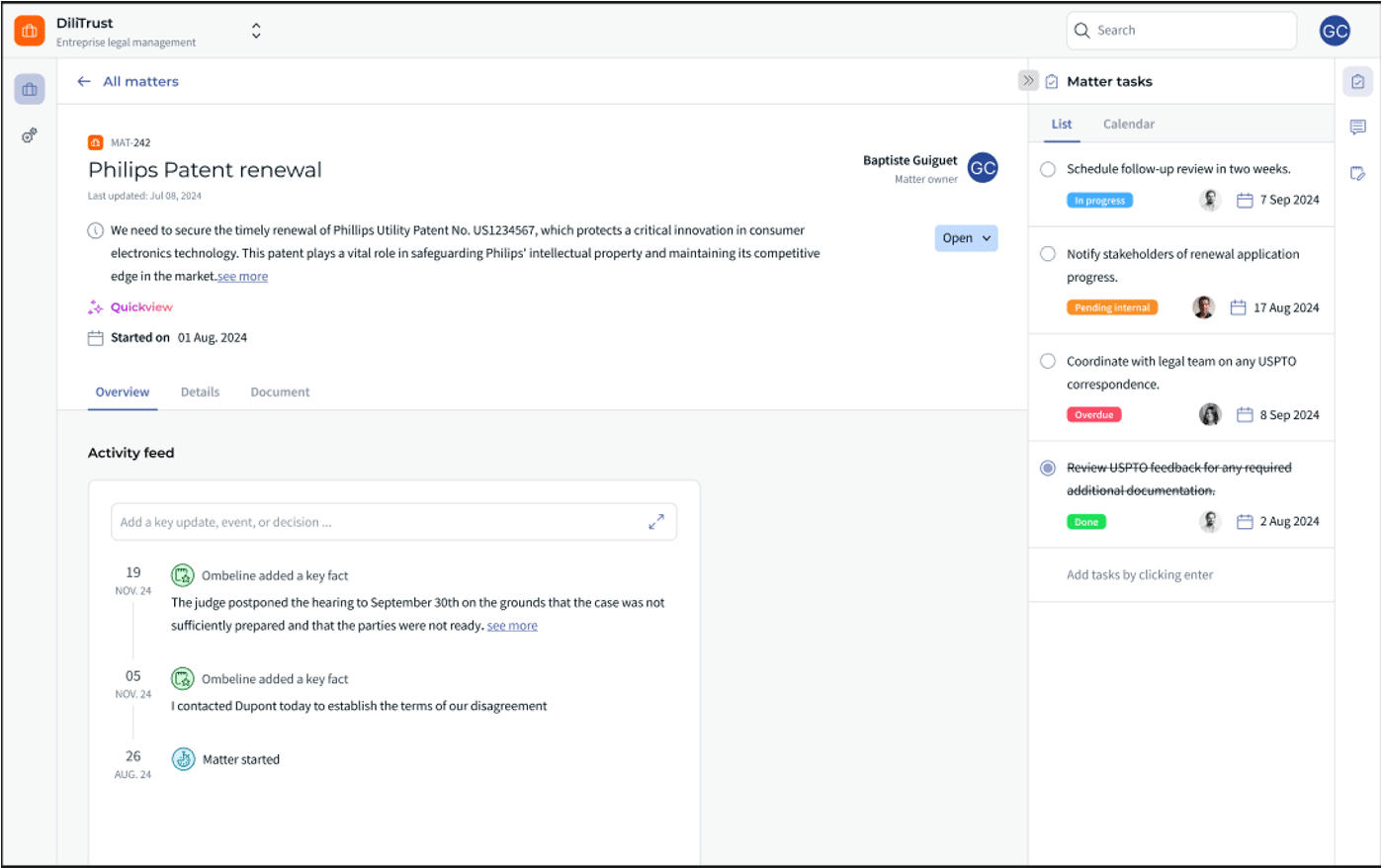
Keeping every stakeholder aligned on a portfolio of active matters is difficult when information lives in inboxes, shared drives, and individual notes. The module provides a 360-degree overview of all matters on a single page: owners, statuses, deadlines, and related parties, visible to everyone with the right access.
Matter Management by DiliTrust gives your legal team one system for tracking status, KPIs, and reporting
See the module in full before you book a call.
In-house legal teams and external collaborators can track progress in real time, reducing the friction that typically slows matter resolution when context gets lost between handovers.
Real-time legal matter tracking, no missed deadlines
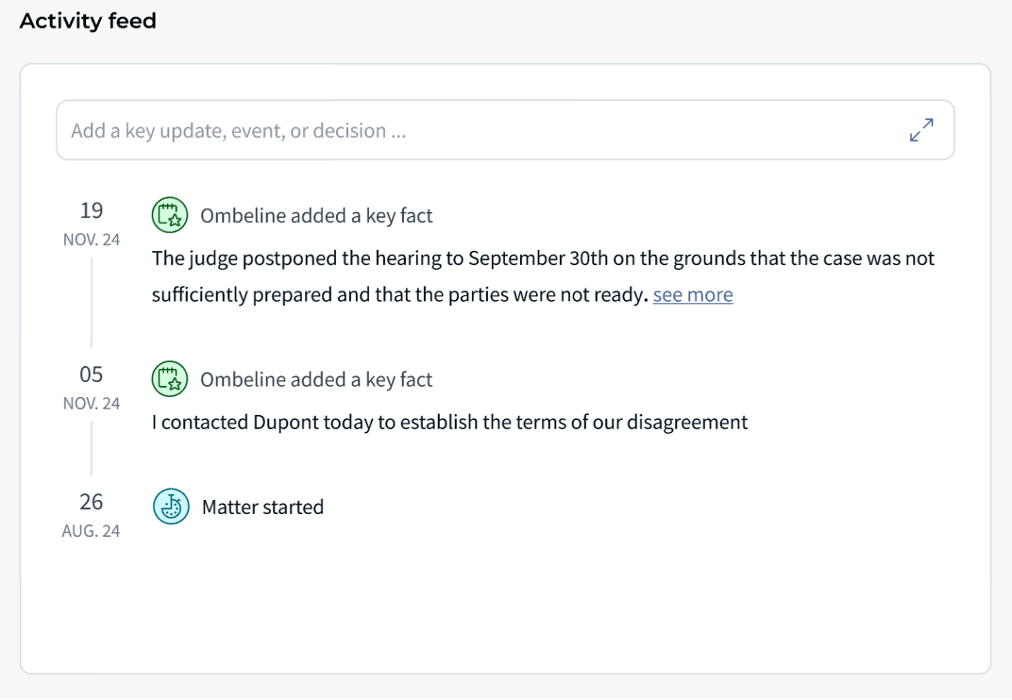
A missed deadline in a legal matter is rarely a minor inconvenience. The activity feed keeps all updates consolidated in one place: comments, document changes, status shifts. Legal matter tracking becomes a continuous, passive process rather than a recurring administrative burden.
Find any matter in seconds
The global matter list view is the central hub for the entire legal portfolio. Users can search by keyword, filter by status (active, pending, closed), and access key details without navigating into individual records. The dynamic search bar opens directly into a matter’s context, cutting the time from question to answer.
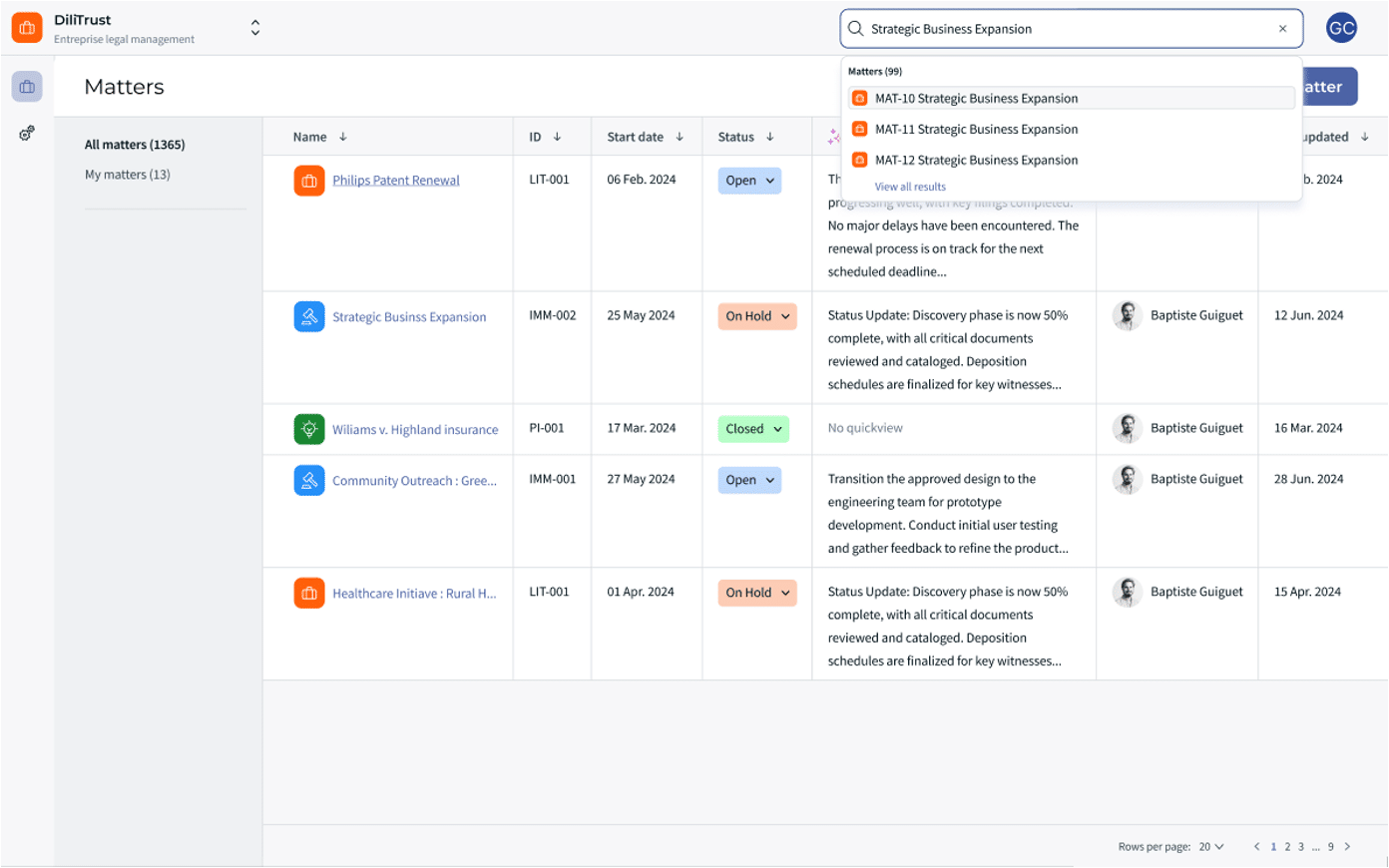
Prebuilt templates or custom structures
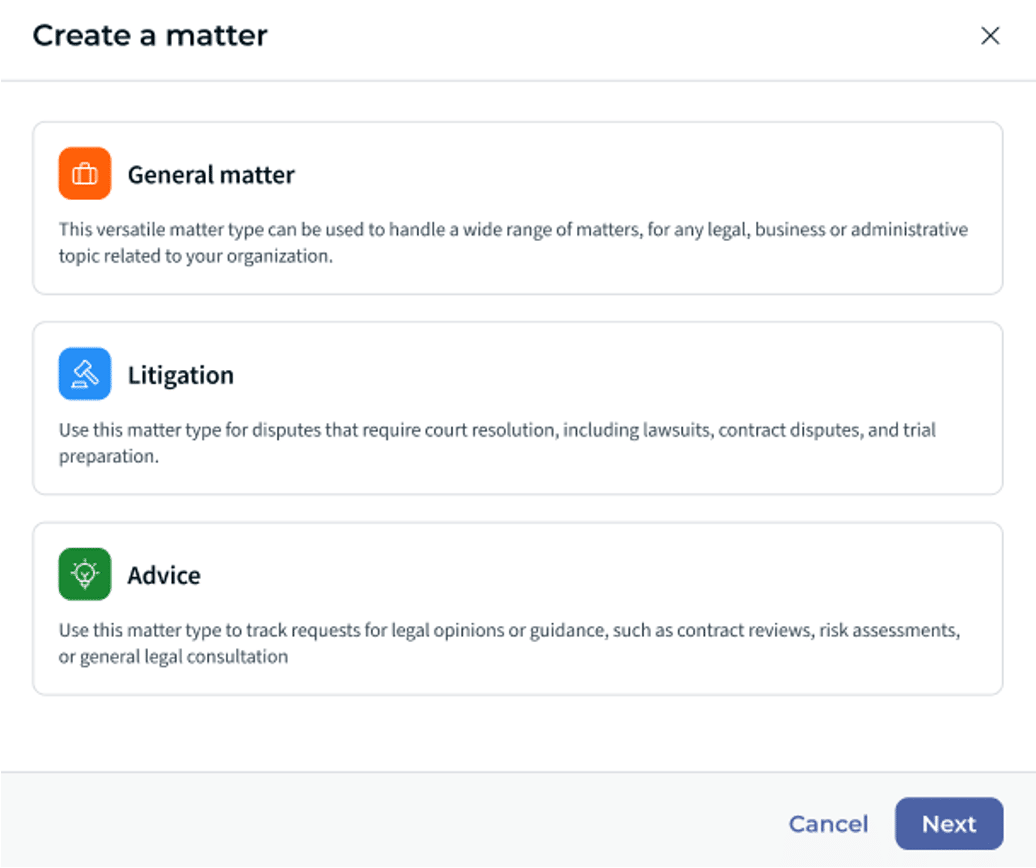
Consistency across matters reduces errors and speeds up intake. Three prebuilt templates cover the most common matter types: litigation, general matters, and legal advice, ready to use without configuration. Teams that need structures tailored to their specific workflows can build and save their own. Either way, every matter opens with the right fields, in the right order, for the work at hand.
Know your KPIs with the analytics module
For legal department heads, the ability to report on activity with data is increasingly non-negotiable. Boards and CFOs expect legal to justify cost, demonstrate workload management, and identify risk before it escalates. Without structured data, that conversation is hard to have.
The analytics module in Matter Management by DiliTrust gives legal operations managers the visibility to have it. The Statistics dashboard surfaces 4 core views out of the box:
- Average time to close: per matter type, calculated across all closed matters, so teams can benchmark performance and spot which types consistently take longer to resolve
- Matters by type: a breakdown of open and on-hold matters by category, making it immediately clear where volume is concentrated and where resources may be stretched
- Time since creation: matters grouped by age (under 30 days, 30 to 60, 60 to 90, over 90), flagging cases at risk of becoming bottlenecks before they do
- Workload distribution: matters by owner and team, surfacing imbalances so managers can reallocate before anyone is overwhelmed
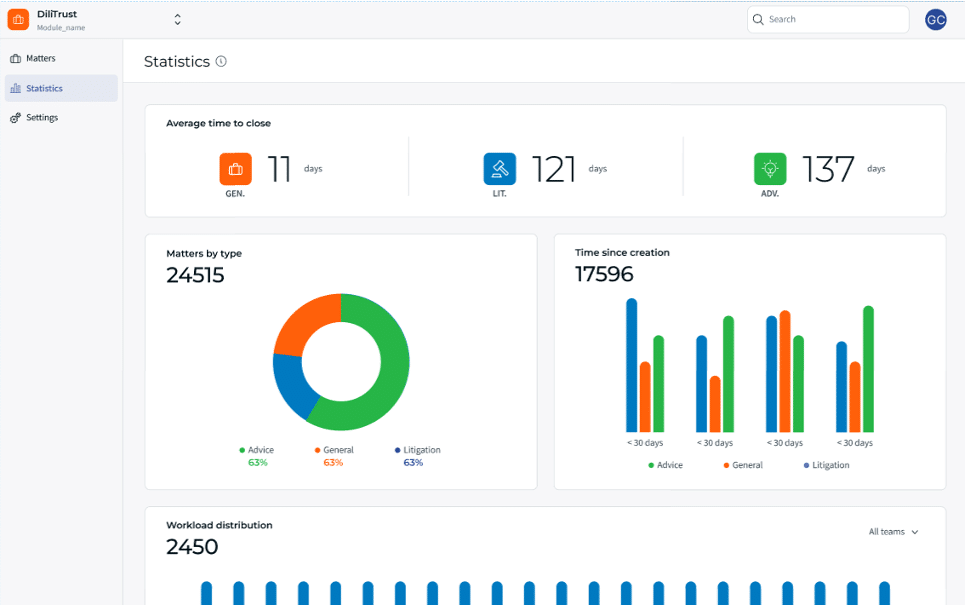
For teams that need to go further, the new Custom Dashboards capability extends the analytics layer with configurable chart types (bar, donut, time series), filters across the full matter list, and support for spend and financial exposure data alongside standard matter metrics. Teams can now track claims, provisions, and budget compliance in the same environment where they manage the underlying work.
Legal matter tracking stops being a reporting exercise and becomes an operational tool, one that supports real-time decisions about staffing, prioritisation, and risk.
What this means for your legal department
Every major corporate function has a system of record. Finance has ERP. Sales has CRM. HR has HCM. Legal has historically run on a patchwork of disconnected tools, and the cost shows up as delayed matters, invisible risk, and a legal team perceived as reactive rather than strategic.
Matter Management Software gives in-house legal teams the infrastructure to change that: a structured environment where every matter is trackable, every status is current, every KPI is measurable, and AI handles the reporting that used to fall on the people with the least time to spare.
Matter Management by DiliTrust gives your legal team one system for tracking status, KPIs, and reporting.
Want to see how it works for your team?
Frequently asked questions about matter management software
How does QuickView AI generate status updates if some matter activity or document data is incomplete?
QuickView AI builds its update from whatever is actually stored in the platform at the time: the matter description, current status, the 30 most recent activities, uploaded document names, details fields, and any prior QuickView version. If activity logging has been inconsistent or documents are missing, the summary reflects that gap rather than fills it with assumptions. This matters because an AI-generated status update that overstates completeness creates audit exposure if used in regulatory reporting or executive briefings. In practice, QuickView is most reliable on matters where the team has maintained consistent logging. Teams migrating historical matters with sparse records should expect leaner summaries on legacy items until those matters accumulate new activity in the platform.
Can the KPI analytics module produce data for CFO or board-level reporting, or is it limited to in-platform views?
The analytics module surfaces KPIs directly within the platform, including average time to close by matter type, workload distribution by owner, and matters grouped by age and category. For CFO or board-level reporting, legal ops teams can configure Custom Dashboards with the specific metrics and filters their executive audience needs, then use that data as the source for external reporting. This matters because legal departments that cannot show cost trends or financial exposure by matter type are at a disadvantage when budget decisions are made. DiliTrust gives that data a permanent, structured home rather than making it a quarterly spreadsheet exercise.
How much existing matter data can be migrated when switching to DiliTrust, and how long does onboarding take?
New teams are typically live within 30 minutes for standard configuration. Migration of existing matter records depends on the volume and structure of the source system. DiliTrust supports structured imports, and the prebuilt templates for litigation, general matters, and legal advice make it straightforward to map legacy categories into the new structure. The more relevant risk for most teams is not migration speed but data quality: matters tracked informally in spreadsheets or email threads need cleaning before they carry over. Teams that invest in that cleanup before go-live get the most out of the KPI analytics module from day one, since historical accuracy directly affects the reliability of benchmarks like average time to close.
Does DiliTrust matter management software require an ERP or e-billing integration to track financial exposure at the matter level?
No integration is required. The analytics module tracks financial exposure, including claims, provisions, and budget compliance, natively within the platform. For departments that already use an e-billing system or ERP and want to consolidate financial data further, the relevant question to raise with the DiliTrust implementation team is which data connectors are available and how they map to the Custom Dashboards module. This matters because financial tracking that lives outside the matter system creates reconciliation risk: figures in two systems diverge, and the legal team ends up defending numbers it cannot easily trace back to source. Keeping financial exposure in the same environment as the underlying matter removes that gap.