


The 2008 financial crisis exposed a critical flaw in global finance: no one could reliably answer “who owns whom” when counterparty risk mattered most. When Lehman Brothers collapsed, regulators spent weeks untangling thousands of legal entities across dozens of jurisdictions. As a result, the G20 mandated a new standard: one unique identifier for every legal entity participating in financial markets. The result is the Legal Entity Identifier (LEI), a 20-character alphanumeric code built on ISO 17442.
Today, over 3 million entities have obtained LEIs, from Wall Street banks to private equity funds to multinational corporations. In fact, more than 300 regulations worldwide now require or encourage LEI use. So, if your organization trades derivatives, files with the SEC, or operates across borders, you need to understand what an LEI is and whether your company needs one.
Key Takeaways
What Is a Legal Entity Identifier (LEI)?
A legal entity identifier is a unique 20-character code that identifies legal entities engaged in financial transactions. Developed under ISO 17442, the LEI provides standardized identification for companies, funds, branches, and other legal structures that can enter into legally binding agreements.
Each LEI carries two levels of reference data. Level 1 data answers “who is who”: the entity’s legal name, registered address, jurisdiction of formation, legal form, and registration date. Level 2 data answers “who owns whom”, mapping direct and ultimate parent companies to reveal ownership relationships.
Together, these data points create a transparent view of corporate structure and accountability. The LEI is essentially the digital fingerprint that lets regulators, counterparties, and financial institutions verify they’re dealing with the right legal entity and understand where it sits in a broader corporate hierarchy.
How Does an LEI Work?
The global LEI system is managed by the Global Legal Entity Identifier Foundation (GLEIF), an international not-for-profit organization established by the Financial Stability Board. In turn, GLEIF oversees a network of Local Operating Units (LOUs), accredited organizations authorized to issue and renew LEIs.
When a legal entity applies for an LEI, an LOU collects the required reference data, validates it against official sources, and assigns the 20-character identifier. The LEI and all associated entity data are then published in the Global LEI Index, a free, publicly searchable database maintained by GLEIF.
This open-access model sets the LEI apart from proprietary identifier systems. Any party can look up an LEI to verify an entity’s legal name, address, ownership structure, and registration status. That transparency supports due diligence, compliance checks, KYB (Know Your Business) workflows, and risk assessment.
Each LEI must be renewed annually. If an entity fails to renew, the LEI status changes to “lapsed,” and the code may no longer be accepted for regulatory filings or transaction reporting.
Why Legal Entity Identifiers Matter
The legal entity identifier system was built to solve real problems that cost the financial sector billions and exposed systemic risk. Three benefits stand out.
Enhanced Transparency in Financial Markets
Before the LEI, identifying counterparties across borders was a manual, error-prone process. Different subsidiaries of the same group might use variations of their legal name. At the same time, mergers, restructurings, and cross-border registrations created gaps in data that slowed transactions and hid risk.
Now, the LEI provides a single, standardized reference that doesn’t change when an entity moves, rebrands, or restructures. According to the US Office of Financial Research, universal LEI adoption could save the financial sector between $300 million and $10 billion through reduced onboarding friction, faster KYB, and lower operational costs.
Improved Risk Management
Beyond transparency, the LEI enables firms to aggregate exposure across entities within the same corporate group. For example, a bank can identify all entities under a single ultimate parent and assess concentration risk in real time. That visibility was missing in 2008. Now, it’s standard practice in credit risk, collateral management, and counterparty monitoring.
In particular, for firms managing derivatives portfolios or structured transactions, the legal entity identifier code is the key to understanding who you’re trading with and what other exposures might exist in that relationship.
Streamlined Regulatory Compliance
Finally, regulators worldwide use LEIs to track systemic risk, monitor market activity, and enforce disclosure rules. In the US, for instance, the CFTC requires LEIs for swap reporting under Dodd-Frank. Similarly, the SEC now requires LEIs for certain EDGAR filings and will mandate them for Form PF filings starting October 2026. Additionally, the Federal Reserve uses LEIs in stress testing and resolution planning.
Without a valid LEI, firms may be unable to file required reports, execute regulated transactions, or meet audit requirements. Therefore, compliance teams rely on LEIs as the foundation for entity identification across multiple reporting frameworks.
Who Needs an LEI?
Not every business needs a legal entity identifier code. Instead, the requirement depends on your activities, your industry, and the jurisdictions where you operate.
US Regulatory Requirements
In the United States, LEIs are required for:
- Swap dealers, major swap participants, and commodity pool operators reporting under CFTC rules (17 CFR Part 45)
- Investment advisers filing Form PF with the SEC (mandatory starting October 1, 2026)
- Filers using EDGAR for certain SEC submissions
- Financial institutions subject to Federal Reserve and FDIC reporting obligations
Beyond these mandates, other entities may need LEIs when entering into transactions with counterparties that require them for compliance. For example, a corporate issuing bonds in European markets may need an LEI even if US law doesn’t mandate it, because EU regulations do.
Financial Institutions and Funds
Banks, broker-dealers, insurance companies, pension funds, hedge funds, and private equity funds are the most common LEI holders. Essentially, any entity trading derivatives, issuing debt securities, or reporting under MiFID II (in Europe) will need a legal entity identifier.
Important to note: Subsidiaries must obtain their own LEIs. A parent company’s LEI does not cover its subsidiaries or branches. Put simply, each legal entity that can incur obligations under law must have its own identifier.
On the other hand, individuals acting in a personal capacity generally do not need legal entity identifiers. The LEI is designed for legal entities, not natural persons.
How to Obtain and Renew an LEI
The Application Process
Getting an LEI involves five straightforward steps:
- First, choose a GLEIF-accredited Local Operating Unit (LOU). Examples in the US market include Bloomberg LEI, RapidLEI, and services offered by DTCC and other providers.
- Gather required entity data. You’ll need the legal name as registered with authorities, registered address, jurisdiction of incorporation, legal form, and entity registration number.
- Submit your application. Most LOUs offer online portals. You upload your documentation, and the LOU verifies it against official registries.
- Receive your LEI. Processing typically takes 1–3 business days. However, some providers offer expedited same-day service for an additional fee.
- Finally, publish and use. Once issued, your LEI is published in the Global LEI Index and can be used immediately for regulatory filings and transactions.
How Much Does an LEI Cost?
Annual registration fees range from $50 to $150, depending on the LOU and any value-added services. Notably, multi-year renewals often come with discounts. In addition, some providers offer entity management dashboards, automated renewal alerts, and API access for bulk LEI management.
Generally speaking, cost is rarely a barrier. Instead, the bigger challenge is maintaining accurate data and ensuring timely renewal across a portfolio of entities.
Annual Renewal Requirements
LEIs must be renewed annually to remain valid. If you miss the renewal deadline, your LEI status becomes “lapsed.” Once lapsed, the code cannot be used for new filings or transactions. Furthermore, counterparties and clearinghouses may reject trades from entities with expired LEIs.
During renewal, you’ll need to confirm that your entity data is still accurate. If ownership structures, legal names, or addresses have changed, you must update your Level 1 and Level 2 data before renewal is approved.
For organizations managing dozens or hundreds of entities, tracking renewal deadlines manually becomes impractical. That’s where entity management software can help.
DiliTrust’s Entity Management module connects LEI tracking to your broader governance workflow. Explore Entity Management Software.
Understanding the LEI Code Structure
| Component | Position | Description | Example |
|---|---|---|---|
| LOU Prefix | Characters 1–4 | Identifies the Local Operating Unit that issued the LEI | 5493 |
| Entity Identifier | Characters 5–18 | Unique identifier assigned to the legal entity | 00SL5K0R22KX6E |
| Verification Digits | Characters 19–20 | Check digits calculated using ISO 17442 algorithm | 02 |
For example, a complete legal entity identifier code might look like this: 5493001KJTIIGC8Y1R29. The first four characters identify the issuing LOU, the middle 14 are unique to the entity, and the final two are check digits that validate the code’s integrity.
LEI vs. Other Business Identifiers
| Identifier | Purpose | Issuer | Geographic Scope | Use Cases |
|---|---|---|---|---|
| LEI | Global entity identification for financial transactions | GLEIF via LOUs | Global (225+ countries) | Derivatives reporting, SEC filings, cross-border KYB, regulatory compliance |
| EIN (Employer Identification Number) | US federal tax identification | IRS | US only | Tax filings, payroll, banking |
| DUNS Number | Business credit and supplier identification | Dun & Bradstreet | Global (proprietary) | Credit checks, supplier onboarding, government contracting |
| Company Registration Number | National business registry identifier | National authorities (e.g., Secretary of State) | Jurisdiction-specific | Incorporation records, local compliance |
Here’s the key difference: The LEI is purpose-built for financial markets and regulatory reporting. An EIN identifies you to the IRS. A DUNS number supports credit assessments. A state registration number proves you’re incorporated. However, none of these replace an LEI for regulated financial activities.
For instance, if you need to report a derivative trade to the CFTC, your EIN won’t work. You need a legal entity identifier.
Common Challenges in Managing LEI Data
Organizations face three recurring problems with LEI management:
Lapsed LEIs due to missed renewals. Across the global database, approximately 30% of LEIs are lapsed at any given time. Renewal tracking for multi-entity groups is often manual, scattered across spreadsheets, and prone to error. A lapsed LEI can block a transaction or filing on short notice.
Inaccurate or outdated reference data. Mergers, restructurings, address changes, and ownership shifts require updates to Level 1 and Level 2 data. If your LEI data doesn’t match official records, your LOU may refuse renewal. Coordinating updates across multiple LOUs and multiple entities adds administrative burden.
Lack of visibility across the corporate group. Legal, finance, tax, and compliance teams all interact with LEI data, but they rarely work from the same source. Who owns which LEI? Which subsidiaries need renewals this quarter? What parent-child relationships are captured in Level 2 data? Without centralized tracking, these questions take days to answer.
How Legal Entity Management Software Supports LEI Governance
Managing LEI compliance across dozens or hundreds of entities means tracking renewal dates, maintaining accurate reference data, and coordinating updates across multiple LOUs. Spreadsheets don’t scale.
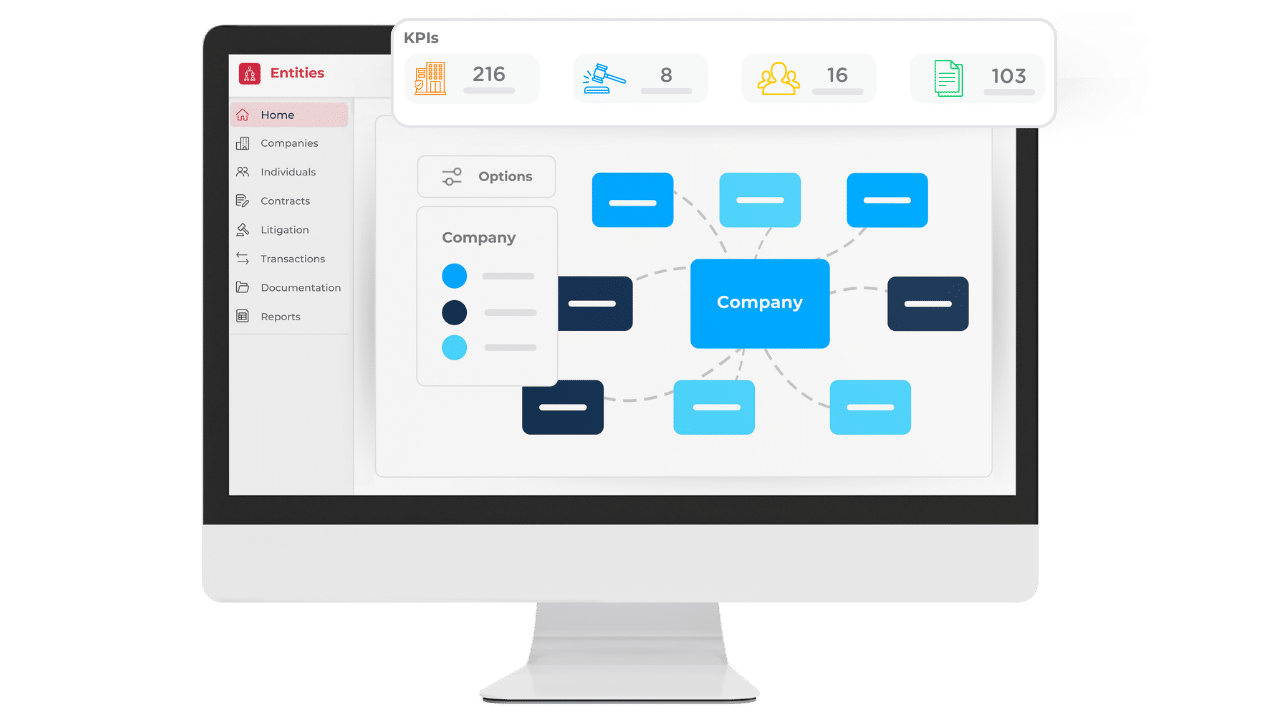
Legal entity management software centralizes entity records and automates deadline tracking. When a director changes, an address updates, or a subsidiary is acquired, those changes flow through to LEI data automatically. Alerts flag upcoming renewals before they lapse.
DiliTrust’s Legal Entity Management module connects LEI tracking to your broader governance workflow — board approvals, filing calendars, and delegation records all reference the same entity data. That means LEI management stops being a standalone task and becomes part of your standard corporate housekeeping.
Learn more about DiliTrust’s Legal Entity Management solution.
Discover your savings
Calculate your potential annual benefit by streamlining governance and centralizing corporate records with DiliTrust.
Frequently Asked Questions About LEI
What does LEI stand for?
LEI stands for Legal Entity Identifier.
Who is required to have an LEI?
In the US, LEIs are required for entities reporting swaps to the CFTC, filing Form PF with the SEC, and certain EDGAR filers. Financial institutions subject to Federal Reserve and FDIC reporting also need LEIs. Outside the US, MiFID II and EMIR regulations in Europe require LEIs for a broad range of market participants.
Do I need an LEI if I’m not a financial institution?
If you trade derivatives, issue securities, or do business with counterparties that require an LEI for compliance, yes. Many corporate treasurers and CFOs discover the LEI requirement only when a bank or clearinghouse asks for it ahead of a transaction.
Can I use one LEI for all my subsidiaries?
No. Each legal entity must have its own LEI. A parent company’s LEI does not cover its subsidiaries. If your corporate group has 20 subsidiaries, you need 20 LEIs.
How long does it take to get an LEI?
Most LOUs process applications within 1–3 business days. Expedited same-day service is available for urgent needs.
What happens if my LEI expires?
An expired (lapsed) LEI cannot be used for regulatory filings or transactions. Counterparties may reject your trades. You must renew the LEI and update any outdated data before the code becomes active again.
How do I look up a company’s LEI?
Use the Global LEI Index at search.gleif.org. The database is free, public, and searchable by entity name, LEI, or registration number.