




Item 7 on next week’s agenda is the CEO’s pay. The CEO sits on the board. The paper is already in the board pack. Can the CEO open it?
If you run the board secretariat, you’ll face some version of this question every quarter. The answer comes down to one distinction. Executive directors run the company and sit on the board. Non-executive directors sit on the board to oversee the people who run it.
Both may vote when they are not conflicted, and both generally carry the same core fiduciary duties. But they see the business differently, and they shouldn’t always see the same board papers. This guide covers what each role does, what US listing rules and the UK Corporate Governance Code expect, and how to run board meetings that work for both.
At a glance
- Executive directors are employees who also sit on the board. Non-executive directors (NEDs) aren’t employees.
- In the US, “independent director” is the more common term. Every independent director is non-executive, but a NED isn’t automatically independent.
- Directors generally owe the same core fiduciary duties of care and loyalty, whatever their title.
- In the US, NYSE and Nasdaq require a majority of independent directors. In the UK, the Code expects at least half the board, excluding the chair, to be independent NEDs.
- For the secretariat, the split shows up in board packs, access rights, executive sessions and minutes.
What is the difference between executive and non-executive directors?
An executive director is a board member who also holds a senior management role in the company, such as CEO or CFO. A non-executive director is a board member who isn’t part of management and provides oversight and challenge. Executive directors bring inside knowledge of the business. Non-executive directors bring enough distance to question it.
| Executive director | Non-executive director | |
|---|---|---|
| Employment | Full-time employee | Appointed to the board, not an employee |
| Day-to-day role | Runs operations | None outside board and committee work |
| Main contribution | Proposes strategy, owns performance | Tests strategy, monitors management |
| Typical titles | CEO, CFO, COO | Independent director, lead director, committee chair |
| Information access | Direct and daily | Through board packs, briefings and the corporate secretary |
| Pay | Salary, bonus, equity | Annual retainer and committee fees, often with stock awards |
| Committee seats | Usually kept off audit, compensation and nominating committees | Fill audit, compensation and nominating committees, if independent |
| Legal duties | Fiduciary duties of care and loyalty | The same fiduciary duties |
The last row is the one new directors tend to forget. More on that below.

Both sit within the wider board, alongside the chair, the officers and the committees. If you need that bigger picture first, our guide to board of directors roles and structure covers who sits on a board and how it makes decisions.
What is an executive director?
An executive director is an officer of the company who also holds a board seat. On most US public company boards, that’s the CEO. Some boards add the CFO, the COO or a founder.
Their value is proximity. When the board asks why margins fell in the Midwest, the executive director knows the answer. That same proximity is why they can’t mark their own homework.
Responsibilities of an executive director
- Develop and propose the strategy the board approves
- Run day-to-day operations and deliver the budget
- Report performance, risks and incidents to the board
- Prepare or sponsor most of the papers in the board pack
- Implement board decisions and report back on progress
An executive director has two roles in relation to the board. As a director, they vote. As an employee, the board evaluates their performance, and the board or its compensation committee sets or approves their pay. The company may remove them from their executive role, while removal from the board depends on applicable law and the company’s governing documents.
A note on nonprofit “executive directors”
In US nonprofits, “executive director” usually means the top staff role, the equivalent of a CEO. That person often isn’t a voting board member at all. This article uses the corporate meaning.
What is a non-executive director?
A non-executive director, sometimes called a non-executive board member or outside director, sits on the board without holding a management role. They attend board and committee meetings, read the papers and vote. They don’t run the company’s day-to-day operations.
Their job is to ask the questions management won’t ask itself. What’s the downside case? Who owns integration? What did we assume about churn?
Role of a non-executive director
- Challenge and test the strategy executives propose
- Monitor management performance against agreed targets
- Sit on committees, if independent
- Set pay and plan CEO succession
- Oversee risk, internal controls and the external audit relationship
- Protect the company’s interests
Non-executive vs independent director
US governance documents use “independent director” more often than “non-executive director.” The two overlap, but they’re different tests.
A NED is generally a director who is not part of the company’s management. An independent director must also have no material relationship with it. Under NYSE Section 303A.02, the board has to affirmatively determine that before calling a director independent.
So a CFO who retired last year is non-executive but not independent. A director appointed by a private equity sponsor that holds 40% of the shares may or may not be independent, depending on the relationship and the applicable exchange and SEC tests. The appointment alone does not determine independence, and audit committee eligibility requires a separate analysis.
The UK draws a similar line. Provision 10 of the UK Corporate Governance Code lists circumstances that are likely to impair a NED’s independence, such as having been an employee in the last 5 years. If any apply and the board still considers the director independent, it has to explain why. If you own the annual review, our guide on how to assess director independence walks through the NYSE and Nasdaq tests step by step.
Executive and non-executive directors share the same legal duties
A common misconception is that NEDs carry a lighter load because they attend 8 meetings a year. They don’t.
Under US state corporate law, every director owes fiduciary duties of care and loyalty to the corporation. The effect on shareholder claims depends on the applicable state law and the circumstances. That applies to the CEO and to the independent director who joined last month. In the UK, sections 171 to 177 of the Companies Act 2006 set out general duties owed by directors to the company. Our guide on how boards meet and prove their fiduciary duties walks through each duty and the record that supports it.
The practical consequence is simple. “I wasn’t involved day to day” is a weak defense for a director who approved an acquisition without reading the due diligence report.
How listing rules shape board composition in the US and UK
For listed companies, exchange rules and governance codes partly shape the balance between executive and non-executive directors, though they don’t determine board composition in full. The approach differs. US exchanges set listing rules. The UK relies on a code that companies apply or explain against.
US: NYSE and Nasdaq rules
If your company is listed on NYSE or Nasdaq, start with these requirements.
| Requirement | NYSE | Nasdaq |
|---|---|---|
| Majority of independent directors | Section 303A.01 | Rule 5605(b)(1) |
| Regular sessions without management | Section 303A.03 (non-management directors) | Rule 5605(b)(2) (independent directors) |
| Audit committee | At least 3 members, all independent (Sections 303A.06 and 303A.07, SEC Rule 10A-3) | At least 3 members, all independent (Rule 5605(c)) |
| Compensation committee | Fully independent (Section 303A.05) | At least 2 members, all independent (Rule 5605(d)) |
| Director nominations | Fully independent nominating/governance committee (Section 303A.04) | Independent directors or an independent committee (Rule 5605(e)) |
These requirements are subject to exemptions and transition periods, including those for controlled companies and foreign private issuers.
One exception matters. Under the NYSE Section 303A guidance, a controlled company is exempt from the majority-independent board and the fully independent nominating and compensation committee requirements. The audit committee rules still apply. Nasdaq has a similar exemption.
UK: the UK Corporate Governance Code
If your company has shares in the FCA’s commercial companies category, the UK Corporate Governance Code 2024 applies. It works on a “comply or explain” basis: you can depart from a provision, but you have to explain why in the annual report.
| Provision | What the Code expects |
|---|---|
| Provision 9 | Chair independent on appointment; chair and CEO roles held by different people |
| Provision 11 | At least half the board, excluding the chair, made up of independent NEDs |
| Provision 12 | One independent NED appointed as senior independent director (SID) |
| Provision 17 | Nomination committee with a majority of independent NEDs |
| Provision 24 | Audit committee of independent NEDs: at least 3 members, or 2 for smaller companies; the board chair isn’t a member |
| Provision 32 | Remuneration committee of independent NEDs: at least 3 members, or 2 for smaller companies; the board chair can join only if independent on appointment, and can’t chair it |
| Provision 34 | NED pay excludes share options and other performance-related elements |
“Smaller companies” means companies below the FTSE 350 throughout the year before the reporting year.
The senior independent director has no exact US equivalent, though the lead independent director comes closest. The SID is a sounding board for the chair and a route to the board for shareholders and other directors. Once a year, the SID also leads a meeting of the NEDs, without the chair, to appraise the chair’s performance.
The remuneration committee matters most for this article’s opening question. Under Provision 33, it sets pay for the chair, the executive directors and senior management. So in a UK listed company that follows the Code, the CEO pay paper goes to a committee of independent NEDs, which the CEO doesn’t sit on.
If you’re mapping which committee needs which members, our guide to board committees and their functions covers charters, composition and minutes for each one.
What US boards actually look like
According to the 2026 U.S. Spencer Stuart Board Index, the average S&P 500 board has 10.6 directors, and 86% of them are independent. That leaves one or two non-independent seats on a typical board.
The same data shows 59% of S&P 500 boards separate the chair and CEO roles, 41% have an independent chair and 58% have a lead or presiding director. Where the CEO also chairs the board, that lead director usually chairs the sessions without management.
Private companies don’t have exchange rules to follow. They often start with a founder-heavy board and add independent directors when a funding round, an acquisition or a sale process forces the question.
Keeping director mandates in a spreadsheet?
DiliTrust Entity Management tracks each director’s mandate, from start date to renewal and expiry, so you know which terms end before the next annual meeting.
How to run board meetings for executive and non-executive directors
The comparison tables stop at definitions. If you’re the corporate secretary or general counsel, the split becomes a set of workflow decisions you make before every meeting.
1. Build the board pack for the director who wasn’t in the room
Your executive directors wrote half the pack. Your NEDs read it on a plane. Write for the second group.
- Put the ask on page one. Each paper opens with the decision required, the options and the recommendation.
- Separate must-read papers from background. A 300-page pack with no hierarchy hides the 3 pages that matter.
- Hold management to a distribution deadline. Many secretariats aim for 5 to 7 days before the meeting. A pack that lands the night before tells NEDs their scrutiny is optional.
2. Control access when an executive director is conflicted
Back to the CEO pay paper. When an executive director has a personal interest in an agenda item, such as their own compensation, a related-party contract or their succession, follow the company’s conflict policy and applicable law to determine what they may access, and restrict access where required.
Set the restriction on the document itself. Asking a director to skip pages 112 to 118 does not create a reliable access record. A recorded access rule provides evidence of how the restriction was applied.
3. Schedule executive sessions and keep their records separate
NYSE and Nasdaq both require regular sessions without management. In the UK, Provision 13 asks the chair to meet the NEDs without the executive directors present, and Provision 12 adds an annual NED meeting without the chair. Even where nothing requires it, a standing slot lets NEDs raise concerns they’d never voice in front of the CEO.
4. Minute who decided, who abstained and who left the room
Minutes are where the distinction becomes evidence. For every conflicted item, record that the executive director declared the interest, left the discussion and didn’t vote.
If a shareholder challenges the decision 18 months later, that paragraph helps show how the conflict was handled. These board meeting minute examples show how to structure it.
5. Onboard each role differently
A new CEO joining the board already knows the business. A new NED knows a director’s duties but not your company. Their induction pack should include:
- Bylaws, committee charters and matters reserved for the board
- The last 12 to 18 months of board and committee minutes
- Strategy, budget, latest management accounts and risk register
- Group structure chart and key subsidiaries
- Conflicts, insider trading and related-party policies
- One-to-one meetings with the CEO, CFO, general counsel and audit partner
The corporate secretary usually owns this process end to end. Our guide to board secretary responsibilities covers onboarding alongside the rest of the meeting cycle.
Where a board portal fits
All five steps come down to one question: who sees what, and when. On email and shared drives, the honest answer is often “we’re not sure.” That uncertainty has a cost. A board that defers an acquisition vote because two NEDs didn’t get the final papers can delay a transaction by weeks.
DiliTrust Board Portal, part of the DiliTrust Suite, gives the secretariat specific controls for a board of executive and non-executive directors:
- The audit committee’s papers stay with the audit committee. Each board and committee has its own room. When the full board needs an item, Circulate Information copies the agenda item, decision or document to the board’s room.
- A conflicted executive director can’t open the paper. Manage User Access Rights sets view, download, print and watermark rights for users or teams on folders, documents and votes. An “Everyone except” rule handles the CEO pay paper, and the setting itself shows the restriction was applied.
- NEDs can prepare on the plane. Directors read, annotate and vote offline in the iOS and Android apps.
- A 200-page pack gets a first-pass summary. Lini, DiliTrust’s AI assistant, summarizes long documents with AI Summary and answers questions about the meeting’s documents through Ask Lini.
- Independence declarations come back in one format. D&O questionnaires collect directors’ declarations ahead of the annual independence review.
- The minutes start from what was actually said. “Generate with Lini” drafts the minutes from the audio transcript, in the format you set for each meeting type. Your team then edits the draft together in real time and validates it.
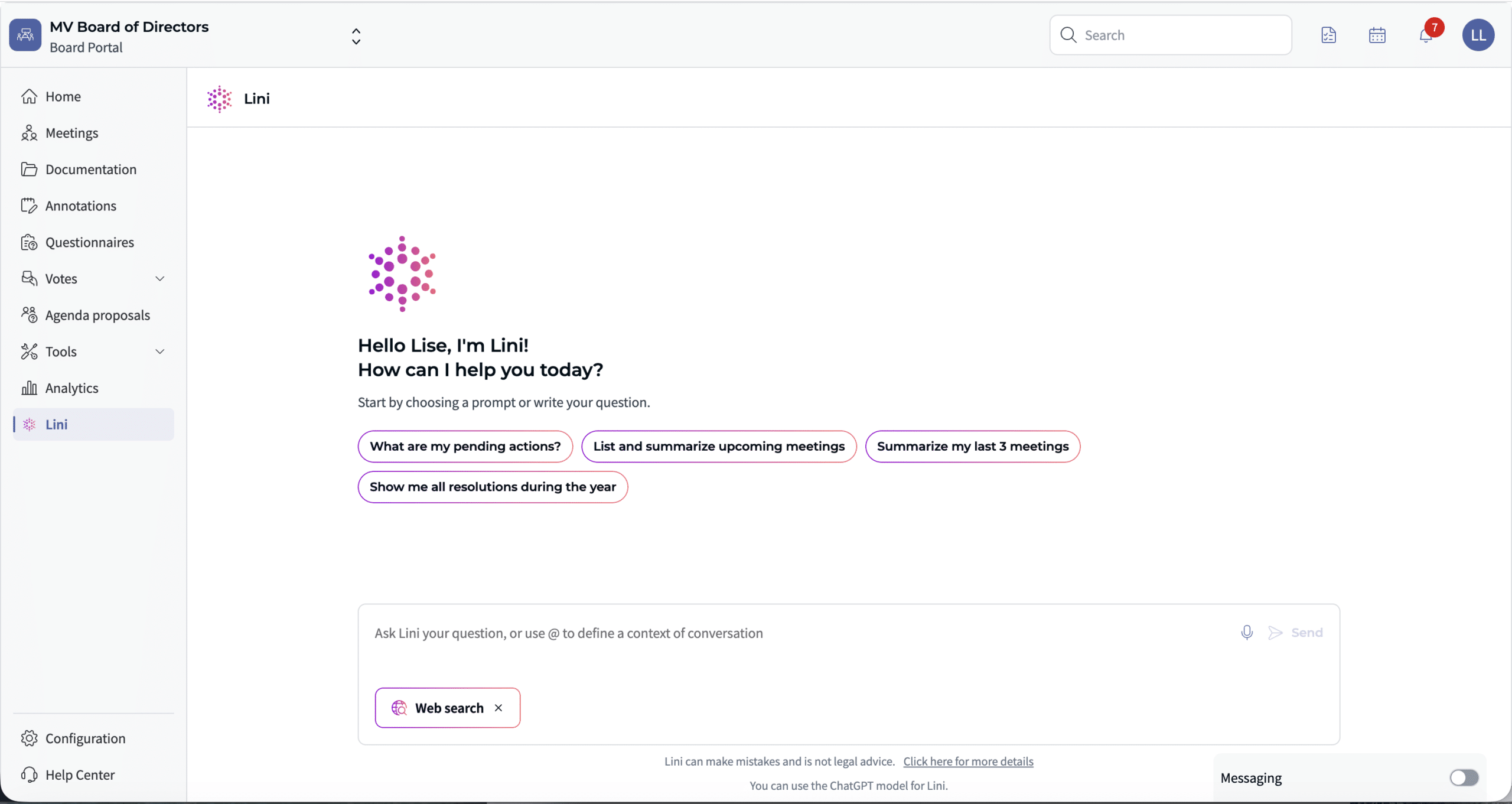
The outcome: every director walks in with the same complete record, apart from the papers they’re conflicted on. And the board can decide in the meeting instead of deferring to the next one.
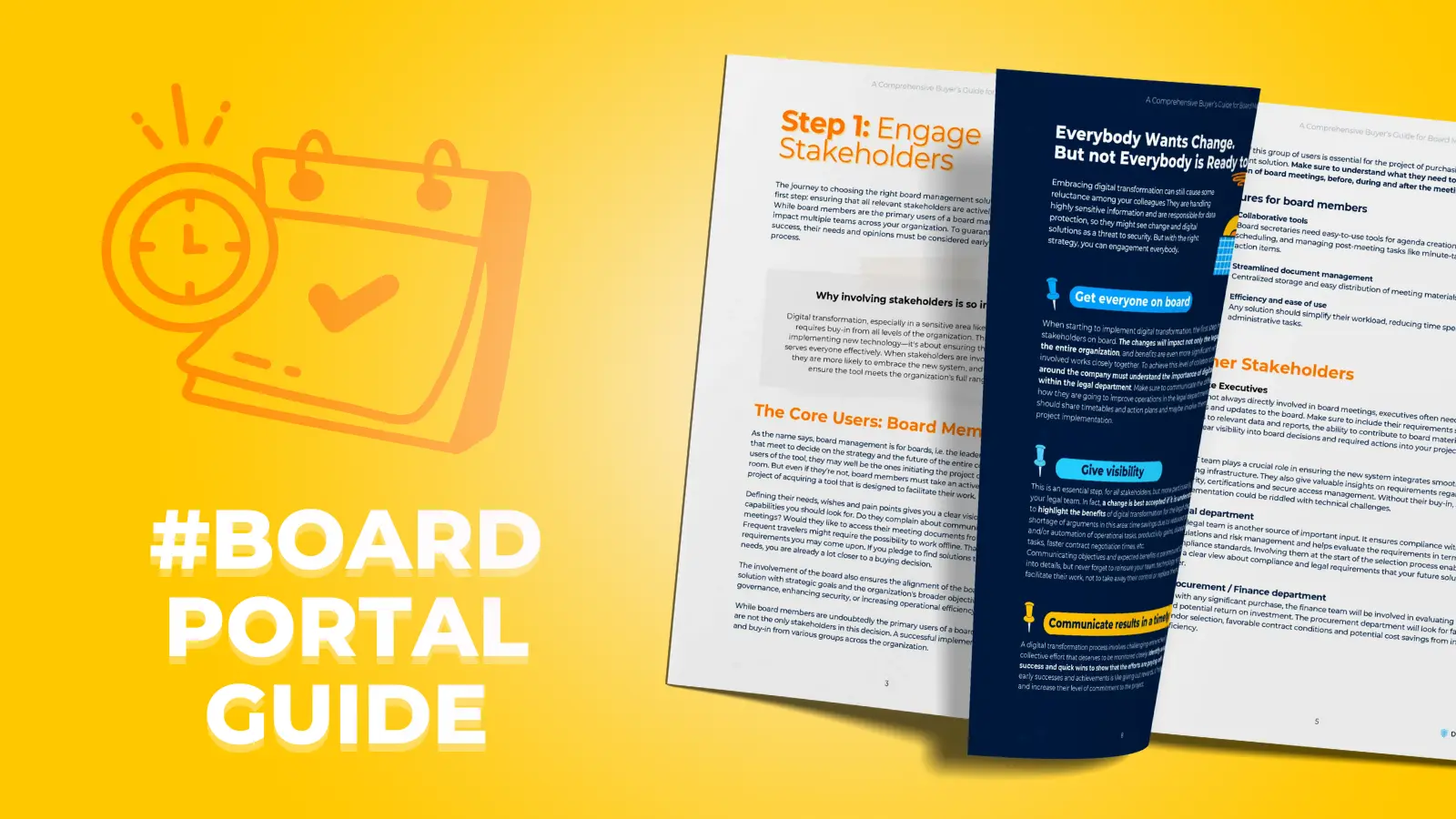
Comparing board portal options?
Discover our Board Management Buyer’s Guide, designed to help you evaluate solutions, compare key features, and make the best choice for your organization.
Frequently asked questions
These are the questions corporate secretaries and new directors ask most often about the two roles.
Can an executive director become a non-executive director?
Yes, but they usually won’t count as independent straight away. Under NYSE Section 303A.02, a director who was an employee of the company within the last 3 years can’t be considered independent. The UK Corporate Governance Code treats employment in the previous 5 years as a factor weighing against independence; it is not an automatic rule.
Do non-executive directors get paid?
Yes. NEDs receive fees rather than a salary: typically an annual retainer plus extra for chairing or sitting on committees. On US public company boards, director pay often includes stock awards. In the UK, Provision 34 rules out share options and performance-related pay for NEDs, although FRC guidance updated in November 2025 says paying part of the fees in shares may be appropriate.
How many non-executive directors should a board have?
NYSE and Nasdaq companies need a majority of independent directors, unless they qualify for an exemption such as the controlled company exemption. S&P 500 boards are 86% independent on average, according to Spencer Stuart. In the UK, the Code expects at least half the board, excluding the chair, to be independent NEDs, on a comply-or-explain basis. Private companies have no minimum number of NEDs in either country.
What is a senior independent director?
A senior independent director (SID) is an independent NED appointed under Provision 12 of the UK Corporate Governance Code. The SID acts as a sounding board for the chair, gives shareholders and other directors a route to the board, and leads the NEDs’ annual appraisal of the chair.
What committees do non-executive directors sit on?
Independent non-executive directors mainly sit on the audit, compensation and nominating or governance committees. On US listed boards, the audit committee must be entirely independent, and NYSE requires the same for compensation and nominating committees. In the UK, the Code expects audit and remuneration committees made up of independent NEDs, and a nomination committee with an independent majority.
How can a corporate secretary restrict board papers for a conflicted executive director?
Apply restricted permissions to the relevant folder or document, then record the restriction and the director’s absence in the minutes. In DiliTrust Board Portal, Manage User Access Rights lets you apply “Everyone except” rules to folders, documents and votes.
What software do general counsel use to manage boards with executive and non-executive directors?
A board portal can help legal teams distribute board packs, run committee rooms and keep a record of minutes and votes. DiliTrust Board Portal adds document-level access rights, encrypted offline reading and AI-drafted minutes that your team reviews and validates.
Conclusion: same duties, different information
Executive and non-executive directors vote on the same resolutions and answer for the same decisions. What separates them is what each one knows when they walk into the room.
Executives bring the inside view. Non-executives bring the distance to challenge it. Your job is to give the second group enough information to do that, and to keep the first group out of the papers it’s conflicted on. Do both consistently and your board creates a record that supports defensible decision-making.
See how DiliTrust Board Portal gives each director the papers they need, and only those.