A sales agreement starts life as a Word file copied from last year’s deal. It gets approved in an email thread with 9 replies, signed in an e-signature tool, and saved to a shared drive; its renewal date ends up in a spreadsheet that one paralegal maintains. Each tool does exactly what it promises.
Together, they created a new problem. Nobody can see the whole contract.
If that sounds like your department, the issue is the gaps between the tools you already pay for. This guide compares CLM platforms with point solutions, shows where fragmentation quietly costs you, and walks through a step-by-step path to consolidation that doesn’t stall the contracts already in flight.
At a glance
- A CLM platform runs every contract stage on one record. A point solution covers one stage or task.
- The real cost of a fragmented stack shows up between tools: missed notice windows, split audit trails and shadow processes.
- Connected data for AI, budget scrutiny and governance expectations explain why consolidation is on the agenda now.
- Point solutions still make sense for narrow, low-volume needs or as a temporary bridge.
- Consolidate in phases, timed to tool renewals, starting with one high-volume, low-risk contract type.
What are CLM platforms and point solutions?
Both get sold under the label “contract management.” But they solve problems of a very different scope, and mixing them up is how a legal team ends up with 5 tools and no overview.
What a CLM platform covers across the contract lifecycle
A CLM platform runs the entire contract lifecycle in one system, using one data model. That means intake (a business user requests a contract), drafting from approved templates and a clause library, negotiation and redlining, approval routing, e-signature, a repository with obligation tracking, and finally renewal or expiry.
The stages matter less than what connects them. Every stage works on the same contract record.
The counterparty name, contract value, signing entity and renewal date you capture at intake flow straight into the draft, the approval request, the signed copy’s metadata and the renewal alert. Nobody retypes them. Nobody wonders which version is current. In practice, that’s what a working contract lifecycle management system looks like: data entered once and reused until the contract renews or ends.
This is also the line between real contract management software and a folder with a search bar. If the record breaks somewhere between request and renewal, you’re back to reconciling by hand.
What counts as a point solution
A point solution is a tool built for one stage or one task of the contract lifecycle. It usually does that one job well, and it’s often the first thing a team buys when a specific pain becomes urgent.
The trouble is what each tool leaves out.
| Point solution type | Lifecycle stage it covers | What it leaves out |
|---|---|---|
| E-signature tool | Execution | Drafting, approvals, post-signature tracking |
| Contract repository / shared drive | Storage and search | Authoring, workflow, negotiation |
| Document generation / template tool | Drafting | Negotiation history, obligations, renewals |
| Redlining add-in for Word | Negotiation | Approvals, storage, reporting |
| Spreadsheet or calendar tracker | Deadline tracking | Source documents, ownership, audit trail |
One observation from the market: many products sold as CLM software are, in practice, point solutions with a repository attached. The test is simple. Does every stage run natively in the same system, on the same record? If drafting happens in one product and approvals happen in a partner’s product, you’re buying a bundle with a shared login. Ask the vendor to show you a contract moving from request to renewal without leaving the system. If they can’t, you have your answer.
CLM platforms vs. point solutions: a side-by-side comparison
Strip away the marketing, and the two approaches differ in 5 practical ways. Here’s how they compare.
| Criterion | Point solutions | CLM platform |
|---|---|---|
| Lifecycle coverage | One stage or task per tool | All stages, from intake to renewal |
| Where contract data lives | Spread across tools, drives and spreadsheets | One contract record in one repository |
| Reporting and portfolio visibility | Manual exports reconciled by hand | Portfolio reports from one dataset |
| Upfront investment and setup effort | Low per tool, quick to start | Higher, with configuration and data migration |
| Vendor relationships to manage | One contract, renewal and security review per tool | One contract, one renewal, one security review |
Point solutions win on speed and upfront cost when you have a single need. If your team sends 40 NDAs a year for signature and nothing else, an e-signature tool may be the right answer. You may be able to go live in an afternoon.
CLM platforms win once contracts cross teams and stages. When sales, procurement, finance and legal all touch the same agreement, every handoff between tools is a point where data gets retyped, delayed or lost. Those delays push back the signature date, which can delay the start of the commercial relationship. That’s the moment the platform stops being a legal purchase and becomes a business one.
There’s also a middle path that rarely works as well as it sounds: stitching point solutions together with integrations. You can connect an e-signature tool to a repository and a tracker. But every connector is another thing to maintain, and the contract record still breaks wherever a field doesn’t map. When a vendor updates its API, someone on your team finds out the hard way, usually when a renewal alert fails to fire.
The hidden cost of a fragmented legal tech stack
Each tool in your stack probably works fine on its own. The cost appears between them, in the exports, the copy-paste and the “can you send me the latest version?” emails.
That cost is rarely small. World Commerce & Contracting estimates that poor contracting practices erode value equivalent to almost 9% of annual revenue on average, and 15% or more in complex industries. Fragmentation isn’t the only cause of that leakage. It’s one of the easiest to spot, though, and one of the few you can fix with a procurement decision.
Data silos and no single source of truth
Picture a supplier agreement with a 60-day termination notice window before auto-renewal. The renewal date sits in a spreadsheet. The signed copy is in the repository. The negotiation history, including the price you planned to renegotiate, lives in someone’s inbox. And the business owner? In nobody’s system, because she changed roles last spring.
The notice window passes. Nobody notices until the next invoice arrives, and you’re locked in for another year at the old price.
That single scenario contains the 3 classic symptoms of data silos:
- Duplicated data entry. The same dates and parties typed into 3 tools, with 3 chances for error.
- Conflicting versions. The repository holds one draft, the inbox another, and nobody is sure which one was signed.
- Reports that need reconciliation. Every portfolio question from the CFO turns into a week of exporting, matching and cleaning spreadsheets.
Fragmented audit trails and security gaps
Every tool brings its own access model, its own hosting location and its own audit log. Meanwhile, sensitive documents travel between tools as email attachments and file exports, each one a copy outside any controlled environment.
The result is a split audit trail. When an auditor asks who approved a contract, who changed the liability cap and who accessed the signed version, you assemble the answer from 4 different logs, if they still exist.
Permissions drift apart too. A former employee loses access to the repository but keeps it in the template tool. Every additional vendor adds another third-party security review and may require updates to your GDPR records of processing activities, depending on the data and processing relationship. For regulated and multi-country organizations, where each tool may host data in a different region, that scope grows with every subscription.
Shadow processes and low adoption
Ask business users to jump between 4 tools to get a contract out the door, and they’ll find a shortcut. Contracts get requested by email. Drafts get copied from “the last version we used.” Approvals happen in a chat message that nobody will find in 18 months.
Legal ends up as the bottleneck and the last to know. You can’t report on what you can’t see, and you can’t enforce templates that people route around. Gartner’s Hype Cycle for Legal research makes the same point about email, forms and spreadsheet trackers: they’re good starter solutions, but they “require high administrative effort and are not scalable for long-term needs.”
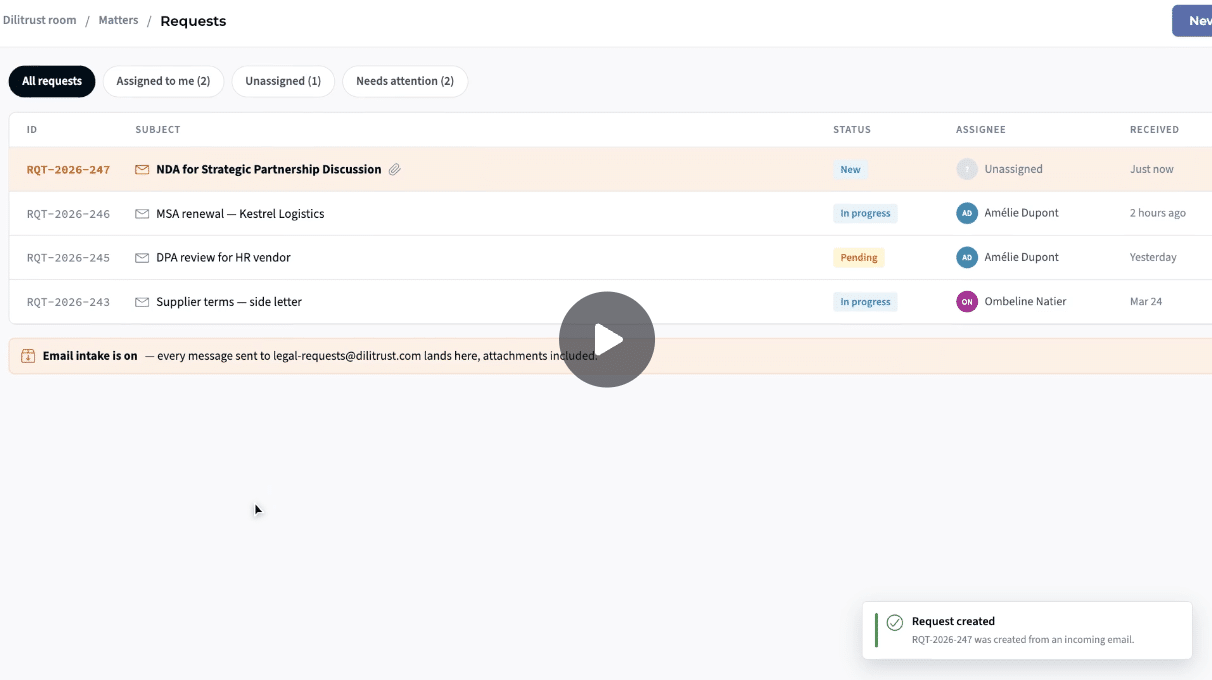
The fix is to give the business one front door to Legal. Here’s what that looks like in DiliTrust: contract and legal requests, including the ones sent by email, land in one queue where you can assign, prioritize and track them.
One workspace for every dimension of legal work
DiliTrust connects Contract Lifecycle Management with Entity Management, Matter Management, Board Portal and Dataroom, with Lini AI working across every module. One secure workspace instead of a patchwork of tools.
Why legal teams are consolidating now
Fragmentation isn’t new. Legal teams have lived with disconnected tools for a decade. What’s changed is the pressure coming from outside the department, and 3 forces are pushing at the same time.
AI needs connected contract data
AI for contracts (clause extraction, risk flags, portfolio search) is only as good as the data it can reach. That’s the quiet weakness of an AI feature bolted onto a point solution.
The AI inside your e-signature tool sees signed PDFs. It doesn’t see the negotiation history. The AI inside your repository can’t see the obligations tracked in a spreadsheet. So when your CFO asks, “Which supplier contracts have uncapped liability and renew in the next 6 months?”, no single tool can answer, because the clause text, the metadata and the dates live in different places.
On a platform, AI works across the full contract dataset. The question gets one answer, and you can check it against the source.
Budget scrutiny and SaaS sprawl
Finance and procurement teams are actively cutting overlapping subscriptions. Legal tech is an easy target, because from the outside it looks like 4 tools that all “store contracts.”
Every point solution adds another renewal on the calendar, each with its own risk of a price increase and its own security questionnaire. When procurement asks why the department pays for a repository, a template tool and a tracker, “they each do one thing well” is a hard answer to defend.
The subscription fee is only the visible part. Each tool also needs someone to provision users, remove leavers, answer the vendor’s renewal call and fix the export that broke after the last update. On a small legal operations team, that admin load lands on the same 1 or 2 people who should be improving processes. Replacing 4 tool renewals with 1 frees their time for work the business actually notices.
Rising governance and compliance expectations
Boards, auditors and regulators expect a clear record of who approved what, under which authority and for which entity. A contract signed by the wrong subsidiary, or by someone whose signing authority lapsed, is a governance failure. It won’t pass as an admin slip.
That expectation shows up in very ordinary moments. An external auditor samples 25 contracts and asks for the approval trail behind each one. A regulator asks which group entities have agreements with a sanctioned counterparty. If answering means searching inboxes, your setup is the problem.
Meanwhile, legal demand is growing faster than budgets and headcount. Axiom’s 2026 GC Report found that 56% of in-house teams face a likely headcount freeze or reduction. If you can’t add people, you scale through systems. And systems that don’t talk to each other don’t scale.
When a point solution still makes sense
Consolidation isn’t always the right call, and any vendor who says otherwise is selling. Here’s when a point solution may be the smarter choice.
| If your situation is… | A point solution may be enough because… |
|---|---|
| One narrow need (e.g., only e-signature) and low contract volume | The problem is contained, and a platform’s setup effort outweighs the benefit |
| A small team with fewer than ~100 active agreements and no cross-team workflow | A shared repository and calendar alerts can cover the essentials |
| A temporary bridge before a planned platform rollout | A short-term tool keeps contracts moving while you prepare migration |
| A specialized requirement outside the contract lifecycle | No CLM platform is built for it, so a dedicated tool fills the gap |
Watch for the signal that it’s time to move on. It usually arrives quietly: contract data starts crossing tools and teams. The moment someone in finance asks for a renewal report and you need 3 exports to produce it, the point solution has stopped saving you time. That’s when scoping contract lifecycle management software properly pays off, before the next tool renewal locks you in for another year.
Beyond CLM: consolidating the wider legal tech stack
Here’s the uncomfortable part. Even a full CLM platform becomes a point solution at the level of the legal department.
Contracts don’t exist in isolation. They’re signed by legal entities, disputed in matters, approved by boards and shared in deal rooms. If each of those lives in a separate system, you’ve rebuilt the same fragmentation one level up. Consider 4 everyday scenarios.
This is the approach behind the DiliTrust Suite, where Contract Management, Entity Management, Matter Management, Board Portal and Dataroom share one workspace with Lini AI across modules. Entity Management supplies the company list your contracts use, and a matter links directly to the contract it came from, with no duplicate file to maintain.
How to evaluate CLM platforms for consolidation
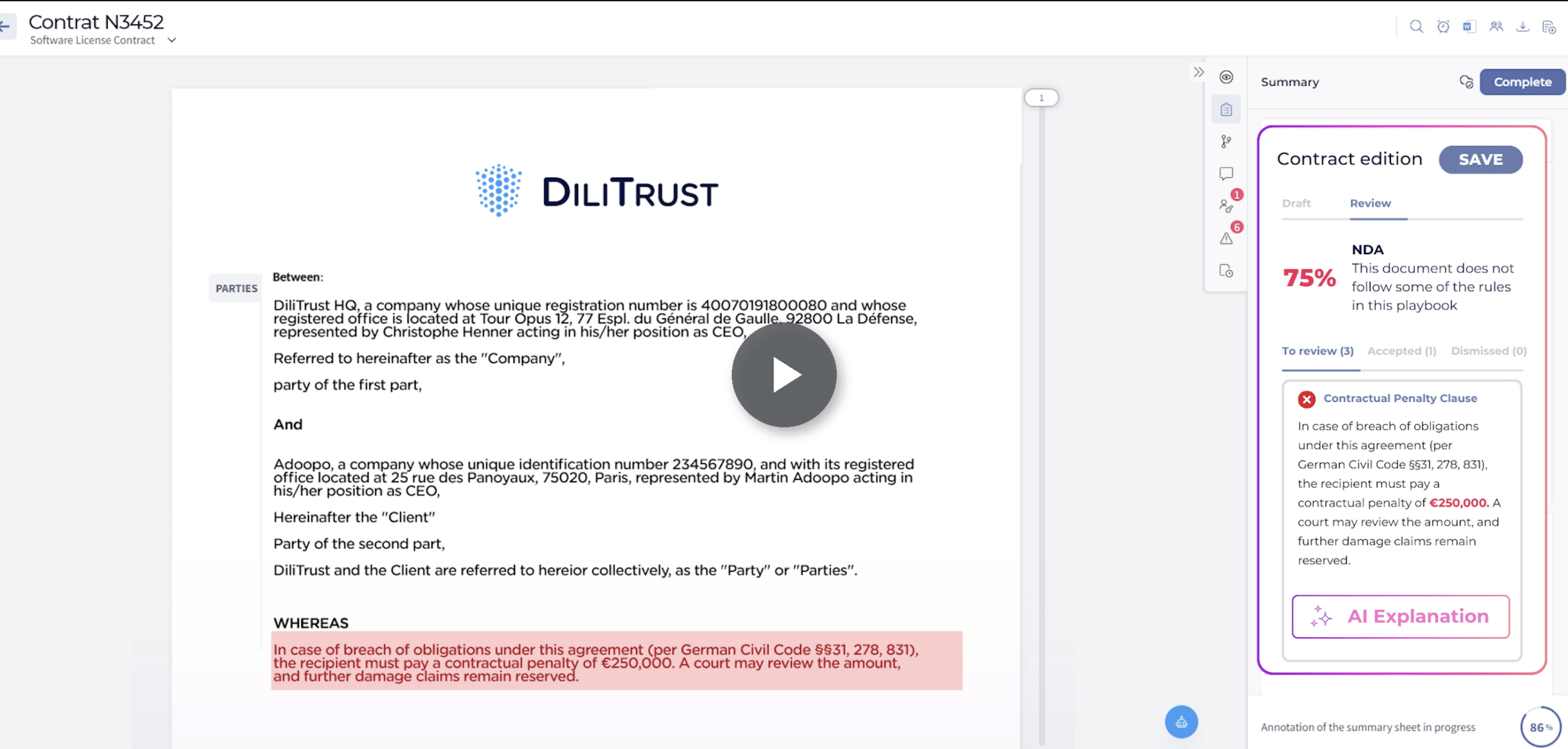
Every vendor demo looks clean because it runs on files built for the demo. Test platforms on your own contracts instead: a messy supplier agreement, a bilingual NDA, an amendment that changes the renewal date. How a system handles your edge cases tells you more than any feature list.
Bring the people who’ll use it daily alongside the buying committee. A legal operations manager will spot workflow gaps a General Counsel won’t, and your IT lead will ask the integration questions before they become surprises. When you compare shortlisted contract lifecycle management software options side by side, use these 7 criteria to structure the evaluation.
| Criterion | What to verify in the demo | Red flag |
|---|---|---|
| Native lifecycle coverage | Ask to see every stage, from intake to renewal, run inside the platform | Key stages handled “through a partner” |
| Single repository and data model | Follow one contract record from request to renewal alert | Data re-entered or synced between modules |
| Integrations | Request live connectors to your ERP, CRM, e-signature provider and SSO | “We have an API” with no working connector |
| Security and compliance | Check current ISO 27001 and SOC 2 Type II reports, data residency or sovereign hosting options, and granular permissions | Expired certificates or one hosting region only |
| AI grounded in your contracts | Ask a portfolio question and trace the answer back to source clauses; confirm it respects user permissions | Answers you can’t trace to a clause |
| Usability for business users | Have a non-legal colleague request and approve a contract unaided | Business users need training to submit a request |
| Data portability | Ask for a full export of files plus metadata | Export limited to PDFs, or only on request at extra cost |
Score each criterion against your own priorities. A multi-country group will weigh hosting and entity handling heavily. A fast-growing scale-up may care most about sales adoption. Then ask each vendor for a reference customer with a similar stack to yours, and ask that customer one question: what did you retire, and when?
How to consolidate without disrupting legal operations
A big-bang switch is the fastest way to lose your team’s trust. Consolidation works best as a sequence, with each step building on the last.
- Audit your current stack: List every tool, its owner, the contract types it handles, its subscription renewal date and where it overlaps with others. You’ll almost always find at least one tool nobody remembers buying.
- Align stakeholders and define success metrics: Bring legal, procurement, finance, IT and sales to the table early, because each will judge the project differently. Agree on 3 or 4 measurable KPIs, such as contract cycle time, share of contracts managed in the system and missed renewals.
- Prioritize contract types and set the migration scope: Decide deliberately what moves and what stays. Migrating active agreements only is often smarter than importing 15 years of expired contracts, which can stay archived and searchable elsewhere.
- Pilot one high-volume, low-risk contract type: NDAs are the classic choice: frequent, standardized and low stakes if something goes wrong. A good pilot proves the workflow to business users before you touch complex agreements.
- Retire point tools in phases, timed to their renewal dates: Line up each tool’s cut-off with its subscription end so you never pay twice. The audit from step 1 gives you that calendar.
- Train, measure adoption and iterate: Track the KPIs from step 2 monthly and talk to the business users who still email Legal. Their shortcuts show you exactly where the new process needs work.
Ready to plan your move to one CLM platform?
Get the CLM implementation framework.
Turn the 6 steps above into a working plan, from your first pilot to full rollout, with a step-by-step guide built for in-house legal teams.

FAQ
What is the difference between contract management software and a CLM platform?
The terms often overlap in vendor marketing. Strictly speaking, contract management software can mean any tool that stores or tracks contracts, including a simple repository. A CLM platform covers the full lifecycle, from intake and drafting through negotiation, approval, signature and obligation tracking to renewal, on one contract record. Our guide to CLM software covers the distinction in more depth.
How long does it take to move from point solutions to a CLM platform?
It depends on scope more than on the vendor. A focused pilot on one contract type, such as NDAs, can often go live within weeks. Full consolidation is usually phased over several months, with each point tool retired at its renewal date. Migrating active agreements only, rather than your entire archive, shortens the timeline considerably.
Can general-purpose AI tools replace a CLM platform?
No. General-purpose AI assistants can summarize or draft a contract you paste into them. They don’t run approval workflows, enforce templates, track obligations, trigger renewal alerts or keep an audit trail. They also sit outside your contract permissions. AI built into CLM software works on your governed contract data instead.
Do CLM platforms support multi-entity and multi-jurisdiction organizations?
The better ones do, but check carefully. Look for the ability to assign each contract to the right legal entity, apply entity-specific approval rules, work in several languages and host data in the regions your regulators require. Platforms connected to an entity management system keep company data current instead of relying on a manually maintained list.
Why CLM platforms win long-term
The platform-versus-point-solution debate usually gets framed as a software choice, a line in the budget, a decision for IT. The more useful question is about your contracts. How many systems does a single agreement have to pass through between request and renewal? Every extra system is another place for a date to slip, a version to fork or an approval to vanish.
That’s why a CLM platform can win over time: it reduces the number of systems a contract passes through. And consolidation doesn’t have to be a leap. Start with the contract type that hurts most, retire tools as their renewals come up, and widen the scope as the data proves itself. The legal teams moving now will be the ones answering the CFO’s next portfolio question in minutes, not weeks.
See connected contract management in action
Book a walkthrough of DiliTrust’s Contract Management module and see how one secure workspace replaces the patchwork of point tools your team manages today.