


Only 13% of directors rate their board packs as “extremely effective.” That figure, from the National Association of Corporate Directors (NACD), points to something worth fixing. Most boards aren’t suffering from a lack of information. They’re suffering from information that arrives too late, runs too long, and doesn’t tell directors what they need to decide.
Board pack management is the end-to-end process of preparing, distributing, and archiving the documentation that board members receive before each meeting. Done well, it shapes how your board spends its time, what decisions get made, and whether your governance record holds up under scrutiny.
This guide gives you a practical, repeatable process: what to include, how to build it, how to distribute it safely, and where technology changes the equation.
What Goes in a Board Pack?
A complete board pack should include the meeting agenda, prior meeting minutes, the CEO report, financial reports, a risk and compliance update, committee reports, and any papers requiring a board decision. Supporting materials belong in appendices, not the main body.
Before covering the build process, it helps to be precise about terminology. “Board pack,” “board packet,” and “board book” refer the same set of meeting materials, although the terminology and format can vary by region and organization. The differences are not only regional or stylistic; “board book” can also describe a bound or consolidated digital format.
| Term | Common usage | Format |
|---|---|---|
| Board pack | UK, Europe, international | Digital or printed document set |
| Board packet | US corporate standard | Same content, same purpose |
| Board book | North America | Bound or consolidated digital set |
| Board portal | The software that manages all of the above | Cloud-based application |
Board portal: A dedicated software platform used to build, distribute, and archive board packs. Distinct from the board pack itself.
Core Documents Every Board Pack Needs
Every effective board pack includes these components:
- Meeting agenda: with time allocations per item
- Previous meeting minutes: for formal approval
- CEO or MD report: strategic priorities and key developments since the last meeting
- Financial reports: P&L, balance sheet, cash flow, budget variance
- Risk and compliance report: current risk register, incidents, regulatory updates
- Committee reports: audit, remuneration, nomination, and specialist committees
- Strategic updates: major projects, M&A activity, or market developments requiring input
- Declarations of interest: director conflicts or updates for the record
What Supporting Documents Belong in the Appendix?
Supporting materials that provide context but don’t require a decision belong outside the main pack body. These include industry briefings, external counsel memos, board evaluation results, HR updates, and data annexes. As a practical guideline, keep each main report to four to six pages, with detailed data in appendices. If a director needs 40 minutes to read one report, the report needs editing.
How to Build an Effective Board Pack: Step by Step
An effective board pack is built in seven steps: define the meeting’s objectives, build the agenda first, set a hard contributor deadline, standardize report formats, compile and review, distribute securely, and archive with the minutes.
Poor board packs rarely result from bad intentions. They happen when the process is informal, deadlines are soft, and no one owns the outcome. Here is the process.
7 Steps to Build an Effective Board Pack
A repeatable process for corporate secretaries and governance teams

How Far in Advance Should You Send a Board Pack?
A board pack should be sent at least five working days before the meeting. For complex agendas, listed company obligations, or regulatory decisions, seven to ten days is better practice.
How to Distribute Your Board Pack Securely
Board packs should be distributed through a dedicated board management platform, not by email. Secure distribution requires encryption in transit and at rest, access controls at the document level, watermarking, and a full audit trail of who accessed which materials and when.
Email distribution of board packs, even with password protection, can create an uncontrolled document chain. Materials can end up in personal inboxes, on unmanaged devices, with no reliable document-level access records. For listed companies, regulated institutions, or organizations with dual-board structures, this isn’t a procedural inconvenience. It is governance exposure.
The four pillars of secure board pack distribution are:
- Encryption: AES-256 at rest; TLS 1.2 or higher in transit
- Access controls: role-based permissions down to individual document level
- Watermarking: visible or digital marks that trace unauthorized sharing to the source
- Audit trails: time-stamped records of every access event, by user and device
If you can’t answer “who opened the board pack, when, and on what device,” your distribution process carries governance risk that needs to be addressed now, not after an incident.
How to Avoid the Most Common Board Pack Mistakes
The most common board pack management mistakes are: treating the pack as a compliance exercise rather than a decision-preparation tool, having no single process owner, allowing silent document updates, ignoring director feedback, and distributing materials via email. Each one is avoidable with the right process in place.
Packing it with information instead of decisions. A board pack that documents activity without orienting directors toward decisions produces long meetings and poor outcomes. Every section should answer: “What does the board need to do with this?”
No single process owner. When the corporate secretary is chasing ten departments three days before distribution, the process is broken structurally. Name an owner. Set a calendar. Hold the deadline without exceptions.
Silent document updates. Any change to a distributed document that isn’t logged as a revision is a governance gap. Auditors may require depending on the applicable rules and audit scope, a clear version history. “We updated it quietly” is not a defensible record.
Ignoring what directors say. If board evaluations repeatedly show that packs arrive too late or contain too much irrelevant material, and nothing changes, the governance function isn’t listening. McKinsey research found that only 30% of board members said their boards had effective processes for sharing information and coordinating work toward a common goal. That is a signal, not a coincidence.
Email as your distribution channel. Email provides no reliable audit trail or document-level access control, and access cannot be revoked centrally when a director’s term ends.
How to Choose Board Pack Software: Features That Actually Matter
Board management software transforms board pack preparation by centralizing document assembly, enforcing version control automatically, replacing email with secure in-platform distribution, and generating a full audit trail without manual effort. Not all platforms deliver equally. Here is what to evaluate.
| Feature | Why it matters |
|---|---|
| Document-level permissions | Restricts committee materials to relevant members only |
| Offline access | Directors stay prepared in transit or low-connectivity environments |
| Version control | Reduces document ambiguity after initial distribution |
| Watermarking | Deters and traces unauthorized document sharing |
| ISO 27001 / SOC 2 Type II | Independent assessment of information-security controls |
| Sovereign hosting | Can support data-sovereignty requirements, but does not by itself exclude U.S. CLOUD Act jurisdiction |
| E-signature integration | Closes post-meeting approvals without leaving the platform |
| AI minutes drafting | Can reduce post-meeting turnaround time |
Beyond features, prioritize ease of adoption. A board portal that directors ignore in favor of email has not improved your governance.Add evidence for this benchmark or qualify the claim.
How DiliTrust’s Board Portal Manages the Full Pack Lifecycle
DiliTrust’s Board Portal manages every stage of the board pack process, from agenda construction through to post-meeting archiving, in a single secure environment. Corporate secretaries build packs by attaching documents to agenda items; directors access materials on any device, including offline; AI-assisted minutes and integrated e-signatures close the cycle without leaving the platform.
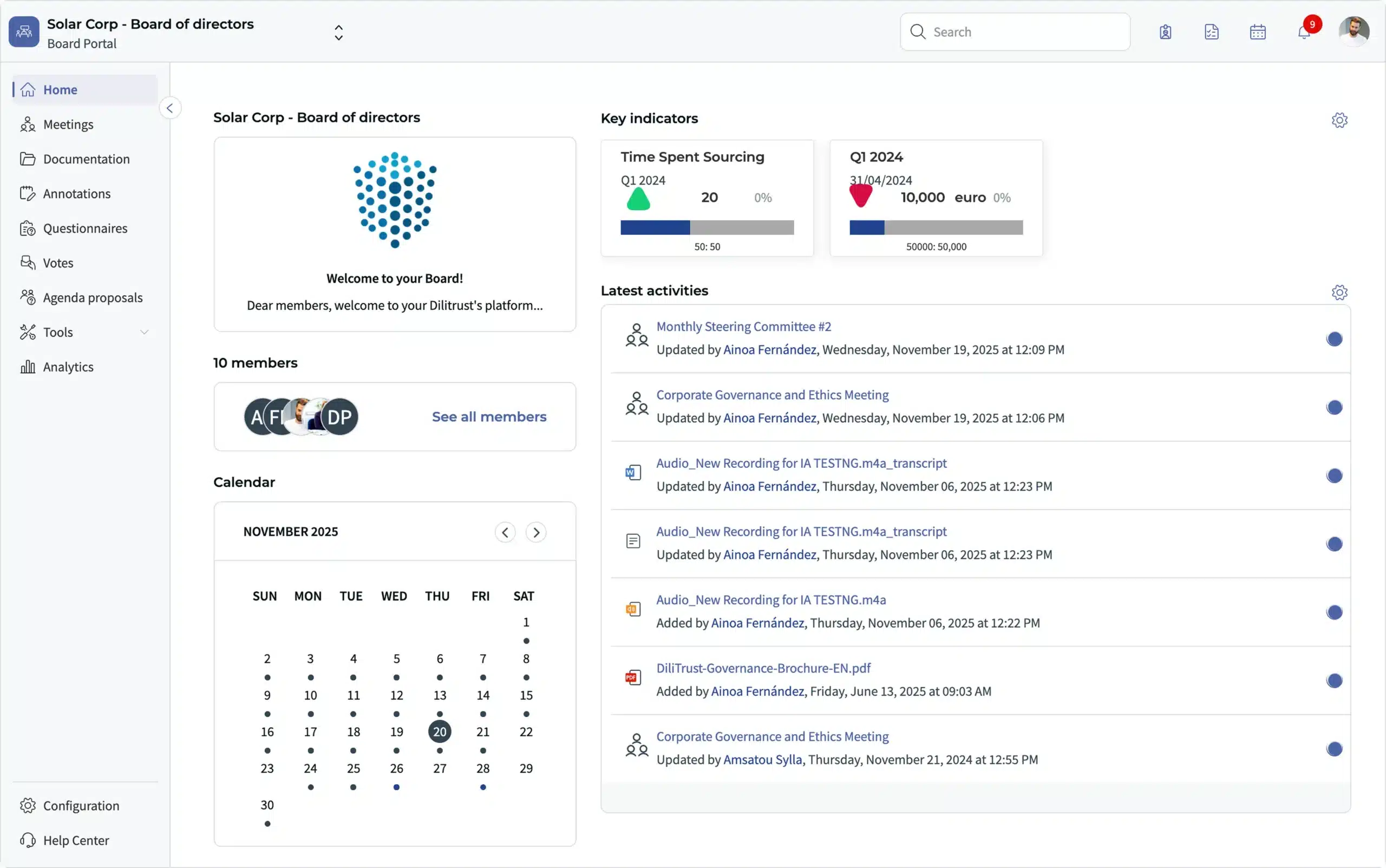
Before each meeting, administrators build the agenda in the portal, attach documents to specific agenda items, and route review requests to contributors, all within the platform. Multiple administrators can co-edit the agenda simultaneously in real time. Document versioning ensures directors always access the current file, with prior versions retained in the audit log.
Distribution happens inside the portal. Directors log in, access the full board pack on any device, and annotate documents directly, including offline on tablet or mobile devices. Private annotations remain invisible to administrators, giving directors a confidential workspace for their own notes.
After the meeting, DiliTrust’s AI assistant Lini drafts minutes from the agenda, transcript, and supporting documents, formatted to the meeting type: verbatim for executive committees, action-focused for audit committees. E-signature workflows via Adobe Sign, DocuSign, or SignatureIT complete the approval cycle without leaving the platform.
Governance teams using DiliTrust report reducing the time required for meeting preparation. For organizations managing multiple committees or subsidiary boards, the platform supports multi-board structures with fully separate permissions, document libraries, and audit trails per board or committee.
Board packs are only as effective as the process behind them.
See how DiliTrust manages the full lifecycle.
Frequently Asked Questions
What is board pack management?
Board pack management is the end-to-end process of preparing, distributing, and archiving the documents that board members receive before each meeting. It covers agenda construction, document compilation, version control, secure distribution, and post-meeting archiving, typically managed by the corporate secretary.
What should a board pack include?
A complete board pack includes the meeting agenda, prior meeting minutes, the CEO report, financial reports (P&L, balance sheet, cash flow), a risk and compliance update, committee reports, and any strategic papers requiring a board decision. Supporting materials such as legal memos or detailed data belong in appendices.
Who is responsible for managing board packs?
The corporate secretary typically owns the board pack process: coordinating document submission, reviewing materials for completeness, managing distribution, and overseeing archiving. In larger organizations, a governance or legal operations team may share the workload.
How far in advance should a board pack be sent?
At a minimum, five working days before the meeting. For complex agendas or listed company obligations, seven to ten days is better practice. Sending materials the day before is the leading cause of directors arriving underprepared.
What is the difference between a board pack and a board book?
“Board pack,” “board book,” and “board packet” can refer to the same set of meeting materials, although terminology and format vary by region and organization. “Board pack” is the preferred term in the UK and internationally; “board book” and “board packet” are standard in the US. A board portal is the software platform used to manage them. It is not the same as the board pack itself.
How does board management software improve board pack management?
Board management software replaces email with a secure in-platform distribution channel, enforces version control automatically, generates audit trails, and provides directors with offline access on any device. Platforms like DiliTrust’s Board Portal also include AI-assisted minutes drafting, integrated e-signatures, and document watermarking, covering the full board pack lifecycle in one environment.
Board packs are only as effective as the process behind them.
See how DiliTrust manages the full lifecycle.
¹ NACD, 2024 Board Practices and Oversight Survey, cited in “Preparing for Five Crucial Board Balancing Acts in 2025“, nacdonline.org. See also the full report: Board Packs: The Elephant in the Boardroom.