


Legal departments manage hundreds of contracts at any given time: vendor agreements, customer contracts, NDAs, employment terms, data processing agreements. Without a structured system, obligations get missed, deadlines slip, and contract value quietly erodes. Research from World Commerce & Contracting puts the average loss at 9.2% of annual revenue, directly attributable to poor contract management.
CLM software addresses this at the source. It centralises every agreement in a searchable repository, automates approval and signing workflows, and gives legal teams real visibility into what is active, what is at risk, and what is coming up for renewal. This article covers the core benefits of contract lifecycle management and what they mean for legal departments in practice.
Key Takeaways
- Organisations without effective contract management lose an average of 9.2% of annual revenue (World Commerce & Contracting, 2025)
- CLM cuts contract cycle times by automating templates, approval routing, and e-signature workflows
- AI clause review reduces the time spent on routine contract analysis, freeing lawyers for higher-value work
- A centralised repository gives all stakeholders a single source of truth, ending version-control disputes
- Automated renewal alerts prevent costly auto-renewals and missed termination windows
- CLM connects legal to procurement, finance, and CRM platforms for better portfolio-wide contract control
What is contract lifecycle management?
Contract lifecycle management (CLM) is the process of managing an agreement from initial drafting through execution, performance monitoring, and eventual renewal or termination. CLM software automates and centralises each stage: creation, negotiation, approval, signing, storage, obligation tracking, and renewal.
For legal departments, this replaces spreadsheets, shared drives, and email chains with a single structured platform. Every contract is stored, searchable, and monitored. Key dates trigger automated reminders. Approved clause libraries standardise what goes into each agreement. Approval workflows route contracts to the right people without manual follow-up.
The stages of the contract lifecycle
Most CLM processes follow the same sequence, regardless of organisation size or contract type:
- Request and intake: A business user submits a contract request through a structured portal, replacing ad hoc emails to legal.
- Drafting: Contracts are built from pre-approved templates and clause libraries, keeping language consistent across the portfolio.
- Review and negotiation: Stakeholders redline and comment within the platform, with full version control and no email attachments.
- Approval: Contracts route automatically to the right approvers based on type, value, or risk threshold, with every step logged.
- Execution: E-signature integrations bring contracts to final sign-off without printing, scanning, or courier logistics.
- Storage and management: Signed contracts sit in a centralised, searchable repository with metadata tagging and role-based access.
- Renewal or termination: Automated alerts surface expiry dates and renewal windows before they pass.
Knowing where your team loses time in this sequence is the first step toward understanding where CLM delivers the most value.
The core benefits of CLM software
Faster contract cycle times
Manual contract processes involve drafting from scratch, multiple rounds of email-based redlines, chasing approvals, and coordinating signatures. Each step is a potential delay.
CLM cuts through this. Pre-approved templates generate first drafts automatically. Approval workflows route contracts to the right stakeholders based on contract type, value, or risk level. E-signature integrations mean contracts go from draft to signed without printing, scanning, or sending anything by courier.
Weshare’s 2025 analysis found that automating contract management can reduce negotiation cycle times by up to 50%. For legal teams measured on business responsiveness and turnaround time, that is material.
Risk reduction and compliance management
Compliance is where poor contract management causes the most damage. Missing a regulatory clause, overlooking a data processing obligation, or failing to flag a non-standard indemnity can expose the organisation to liability, penalties, or litigation.
CLM reduces this risk across the board:
- Clause libraries ensure every contract is built from approved, legally sound language
- AI risk flagging scans incoming contracts for non-standard or high-risk clauses before legal review
- Audit trails log every edit, approval, and signature for compliance records
- Automated reminders flag renewal windows, notice periods, and regulatory deadlines in advance
For legal departments managing GDPR data processing agreements, CSRD supply chain obligations, or sector-specific regulatory requirements, the link between legal risk minimisation and CLM has become increasingly hard to ignore.
Manage contract risk, obligations, and renewals in one secure platform. See how DiliTrust’s Contract Management software works
Cost savings and measurable ROI
The financial case for CLM is clear. World Commerce & Contracting’s August 2025 data puts average annual revenue leakage from contract mismanagement at 9.2%. Best-in-class organisations hold this to around 3%. Applied to a large contract portfolio, the difference between those two numbers is significant.
Bain & Company’s research across procurement performance found that structured contract management produces a one-time cost reduction of 8–12% on purchasing spend, followed by annual savings of 2–3% thereafter.
The savings come from several directions:
- Avoided auto-renewals on contracts that were no longer needed or should have been renegotiated
- Faster payment cycles through automated obligation tracking
- Fewer disputes from clearer contract terms and consistent obligation management
- Reduced outside counsel spend where internal teams can handle more routine review work
Use DiliTrust’s CLM ROI calculator to estimate your specific savings based on contract volume and current process.
AI-powered contract analysis
AI has changed what CLM platforms can do for legal teams. The core shift is about removing time-consuming, low-value tasks from lawyers’ plates so they can focus on work that requires judgment.
The main AI capabilities now embedded in leading CLM platforms include:
- Automated data extraction: AI reads contracts and pulls key data (parties, dates, payment terms, termination clauses) into structured fields without manual input
- Clause risk detection: AI compares incoming contract clauses against your organisation’s standard positions and flags deviations for review
- Contract summarisation: Long or complex agreements are summarised automatically, giving reviewers a fast overview before they open the document
- Natural language search: Legal teams can query their contract repository in plain language without building complex filter logic
87% of general counsel now use generative AI in some form (FTI Consulting General Counsel Report, 2026). For a full breakdown of what to look for, the CLM software features guide for 2026 covers the capabilities that matter most for legal teams. For most departments, the question is no longer whether to adopt AI-enabled contract tools. It is which capabilities deliver the most value for their specific workflows.
See AI-powered clause review and automated data extraction in action. Explore DiliTrust’s AI contract review tools
Full portfolio visibility and reporting
Many legal departments cannot answer basic questions about their contract portfolio: how many vendor contracts are active? Which ones auto-renew next quarter? Where are the GDPR data processing agreement gaps?
This is a structural problem, not a diligence failure. When contracts live across shared drives, email folders, and local machines, building a consolidated view requires manual effort that no one has bandwidth for.
CLM provides a centralised repository where every agreement is indexed, searchable, and connected to key metadata. Dashboards show contract status at a glance. Automated alerts surface what needs attention. Custom KPI reporting gives legal leadership the data to track performance and report to the wider business.
This visibility matters for contract governance. It also has a direct operational impact: legal teams with a clear view of their portfolio make faster decisions and avoid the reactive scramble that comes from discovering a problem after the deadline has passed.
Cross-department collaboration
Contract management rarely sits with legal alone. Sales needs fast turnaround on customer contracts. Procurement needs visibility into supplier obligations. Finance needs contract data to track payment terms and due dates.
CLM creates a shared workspace for all of these stakeholders. Business users initiate contracts from approved templates without pulling in legal at every stage. Legal reviews and approves. Finance sees what has been signed. Everyone works from the same document, the same version, and the same platform.
Much of the delay in contract cycles comes from the handoffs between legal, business, and counterparties. CLM shortens those handoffs significantly.
CLM also has a less obvious benefit: it frees lawyers from administrative contract work. When legal professionals spend less time chasing approvals and routing documents, they spend more time on the analysis and advisory work they were hired to do. For general counsel managing lean teams, that reallocation matters as much as the process efficiency gains.
Here is how CLM benefits each team across the organisation:
| Department | Common friction | What CLM delivers |
|---|---|---|
| Legal | Manual review bottlenecks, non-standard terms, version chaos | AI clause review, approved templates, full audit trails |
| Procurement | Missed renewals, supplier obligation drift, unmonitored SLAs | Automated renewal alerts, obligation tracking, performance dashboards |
| Sales | Slow approvals, deal delays, no contract status visibility | Configurable workflows, e-signature, real-time progress tracking |
| Finance | Invoice inaccuracies, unmonitored payment obligations | Contract-to-invoice reconciliation, financial obligation alerts |
| HR and Operations | Siloed contract data, manual amendment tracking | Centralised repository, version control, role-based access |
Common CLM implementation mistakes
Choosing the right platform is one decision. Getting it adopted across legal, procurement, and sales is where most rollouts run into problems. These are the five mistakes that most often undermine CLM investments.
| Mistake | Why it matters | The fix |
|---|---|---|
| Keeping email and shared drives as parallel storage | Splits the portfolio across two sources of truth, defeating centralisation | Migrate legacy contracts at onboarding; make the CLM the only authorised storage from day one |
| Building approval workflows in email after rollout | No audit trail, no accountability, delays accumulate | Define and enforce approval rules inside the platform before go-live |
| Restricting CLM access to legal only | Business users bypass the system and create informal workarounds | Give procurement, sales, and finance access to self-service templates and status dashboards |
| Skipping the clause library build | Non-standard terms circulate unchecked in high-volume contracts | Build and review a clause library before rollout; maintain it as standard positions evolve |
| Ignoring renewal tracking setup | Auto-renewals on unfavourable terms, missed termination windows | Configure automated alerts at 90, 60, and 30 days before every key contract date |
How DiliTrust supports the full contract lifecycle
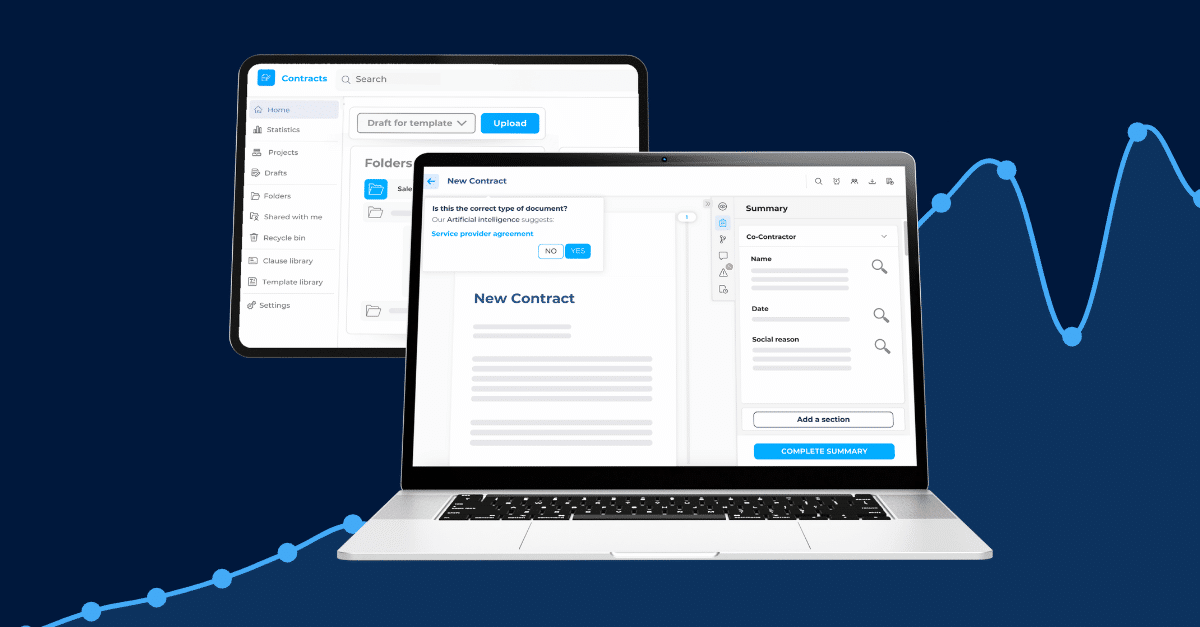
DiliTrust’s Contract Management module covers the complete lifecycle: creation from approved templates and clause libraries, collaborative editing in Microsoft Word or Google Docs, configurable approval workflows, e-signature via DocuSign, YouSign, Adobe Sign, and other providers, a centralised repository with granular permissions, and renewal tracking with automated reminders.
Lini, DiliTrust’s proprietary AI engine, adds several layers of intelligence to the process. The Risk Detector flags non-standard or high-risk clauses automatically during import or review, comparing every incoming agreement against your organisation’s standard clause positions. Ask Lini, available inside the platform and as a Microsoft Word add-in, allows legal teams to summarise contracts, extract specific data points, translate clauses, and query the contract portfolio in natural language. The full-page Lini workspace also allows teams to compare multiple contracts side by side, with comparison results structured by topic and a source trace for every AI-generated answer. Automated data extraction surfaces key metadata without manual input.
DiliTrust has been developing Lini on legal and governance-specific content since 2017. The AI supports 8 languages natively and handles contracts in 34+ languages, making it a practical option for organisations managing international contract portfolios.
The platform connects to Salesforce, HubSpot, Microsoft Dynamics, and major ERP systems, so contract data flows directly to and from the systems legal teams and business stakeholders already use.
| Capability | What it delivers |
|---|---|
| Automated data extraction | Key contract data captured without manual input |
| Clause risk detection | Non-standard provisions flagged before review |
| Contract summarisation | Fast overviews of long or complex agreements |
| Approval workflows | Contracts routed automatically based on defined rules |
| Renewal tracking | Alerts triggered at set intervals before key dates |
| E-signature | Multi-provider signing with full audit trails |
Discover your savings
Get a realistic ROI based on industry standards when you partner with DiliTrust on CLM.
Building the business case for CLM internally?
DiliTrust’s CLM ROI Calculator estimates your potential cost savings based on contract volume, current cycle times, and process maturity. Most in-house teams run the numbers in under five minutes, then use the output to make the case to finance or leadership.
What’s changing in 2026
Regulatory obligations are widening the scope of contract management
CSRD now requires large organisations to capture and report on supply chain sustainability data. Many of those obligations run through supplier contracts. Legal teams need contracts that include the right ESG commitments, and systems that track whether those commitments are being met in practice.
The EU AI Act’s high-risk AI provisions, enforceable from August 2, 2026, require documented contractual obligations between AI developers, deployers, and users. For legal teams in regulated industries, this creates a new category of agreement to manage and monitor.
GDPR enforcement has also intensified. EU data protection authorities issued over €6.1 billion in fines through May 2025. Systematic tracking of data processing agreement status across vendor relationships is no longer optional for most organisations.
AI review is raising business expectations
Business stakeholders who know that AI tools can review a standard NDA in under a minute will start asking why legal review still takes two weeks. CLM platforms with embedded AI help legal teams meet these expectations without adding headcount.
They also raise the baseline on contract quality. When every incoming agreement is automatically checked against your standard positions, the likelihood of a problematic clause slipping through on a time-pressured review decreases significantly.
CLM is becoming part of a connected legal operations platform
CLM is increasingly being deployed as one part of a broader legal operations platform rather than a standalone tool. Legal teams using matter management, entity management, or board governance software are connecting contract data to those platforms to get a clearer picture of legal risk and activity across the organisation. The result is a single operational layer for legal, covering contracts, matters, entities, and board governance in one place.
Build a contract process your team can actually manage
Contract lifecycle management delivers measurable results: shorter cycle times, lower risk exposure, reduced cost leakage, and a contract portfolio you can see and act on. For legal departments under pressure to do more with the same resource, those gains are significant.
For a deeper look at building an effective CLM process, the complete guide to contract lifecycle management covers the key stages, common implementation pitfalls, and what to look for in a platform.
See how DiliTrust helps legal teams take control of their full contract portfolio. Explore DiliTrust Contract Management
Discover your savings
Get a realistic ROI based on industry standards when you partner with DiliTrust on CLM.
Frequently asked questions
What are the main benefits of contract lifecycle management?
The core benefits of CLM are: faster contract cycles through workflow automation, reduced risk through clause standardisation and compliance alerts, lower cost leakage from better renewal and obligation tracking, AI-powered contract analysis that speeds up routine review, and centralised visibility across the full contract portfolio. Collectively, these capabilities give legal departments more control over contract risk and less time spent on manual, administrative work.
How does CLM save time for legal teams?
CLM reduces time at every stage of the process. Templates generate first drafts automatically. Approval workflows route contracts without manual chasing. E-signature removes the logistics of physical signing. AI tools extract key data and flag risk clauses without requiring lawyers to read every word of every agreement. Research indicates these combined automations can cut contract cycle times by up to 50% compared to manual processes.
What ROI can I expect from CLM software?
ROI depends on contract volume, portfolio size, and current process maturity. World Commerce & Contracting research from August 2025 shows the average organisation loses 9.2% of annual revenue to contract mismanagement. CLM directly addresses the main drivers of that leakage: missed renewals, overlooked obligations, slow cycle times, and non-standard terms slipping through review. Bain & Company’s analysis found that structured contract management produces initial cost reductions of 8–12% on purchasing spend. DiliTrust offers a CLM ROI calculator for teams that want a tailored estimate.
What CLM software do legal departments use?
Legal departments use a range of CLM platforms depending on organisation size, industry, and geographic footprint. The key capabilities to look for are: a centralised contract repository, template and clause library management, configurable approval workflows, e-signature integration, AI-powered clause review, and automated renewal tracking. DiliTrust’s Contract Management module covers all of these and connects to the broader DiliTrust Suite, including matter management and entity management, for full legal operations coverage.
How does AI improve contract lifecycle management?
AI improves CLM in four main areas: automated data extraction (pulling key terms and metadata from contracts without manual input), clause risk detection (flagging non-standard provisions before legal review), contract summarisation (giving reviewers a fast overview of long agreements), and natural language search (allowing legal teams to query their portfolio in plain language). These capabilities reduce the time lawyers spend on routine contract processing and improve the consistency of contract review across the portfolio.