



Your auditor just requested board papers from 18 months ago. The new independent director is asking why the risk section and the finance section show different figures. Your board chair is asking why the pack arrived two days before the meeting. Again.
These are board reporting problems.
When board reporting fails because of late delivery, inconsistent figures, or buried resolutions, the board cannot govern effectively. The G20/OECD Principles of Corporate Governance (2023) are explicit on this: boards must ensure the integrity of reporting and monitoring systems, with clear lines of responsibility and accountability throughout the organization.
This guide shows you exactly how to write a board report that works: what to include, how to format it, and a reusable template you can adapt from day one.
What Is a Board Report?
A board report is a structured briefing document prepared for the board of directors ahead of a board meeting. It consolidates information from finance, legal, risk, operations, and strategy so that directors can make informed decisions without processing raw data themselves.
Key Terms Explained
Board Report, Board Pack & Board Minutes: What’s the Difference?
Board Report
A formal document — typically 4–6 pages — that summarizes an organization’s performance, risks, legal matters, and strategic developments, and specifies the decisions the board is being asked to make at an upcoming meeting.
→ Drives what gets decided at the meeting
Board Pack
The full collection of documents distributed to directors ahead of a board meeting — typically including the board report alongside financial statements, committee reports, legal annexes, and supporting materials.
→ The board report is the primary summary document within the board pack
Board Minutes
The official record of decisions made and actions agreed at a board meeting. Board minutes capture what was decided after the meeting; a board report drives what gets decided during it.
→ Records what was decided; does not drive decisions

How Do You Write a Board Report? A Step-by-Step Guide
To write a board report, start by clarifying the purpose of the meeting, gather verified inputs from all contributing functions, draft the body before the executive summary, match detail to the board audience, make every decision explicit, circulate with adequate notice, and review for consistency before distribution. These seven steps apply regardless of organization size or report type.
Writing a board report that directors actually read requires discipline. Boards do not need an exhaustive summary of every department’s activity, and they will not read one.
Step 1: Clarify the purpose of the meeting
Before drafting a single line, confirm what the board needs to decide, review, or note at this meeting. Every section of the board report should serve that purpose directly.
Step 2: Gather and verify inputs from all contributing functions
Collect data from finance, legal, risk, HR, and operations. Set internal submission deadlines well in advance. Unverified or outdated figures in a board report erode the board’s trust in the reporting function and can undermine the decisions made on the basis of that report.
Step 3: Write the executive summary last
Draft the body sections first, then write the executive summary once you know exactly what matters most. A good executive summary gives directors a complete picture of the board report in under 200 words.
Step 4: Match the level of detail to the audience
Directors need trend data, risk signals, and decision-ready analysis, not a line-by-line account of operational activity. When in doubt about whether a detail belongs in the main body, move it to an annex.
Step 5: Make every required decision explicit
Do not make directors infer what they are being asked to do. Every item requiring board approval or endorsement should include a clear resolution statement: “The board is invited to approve X” or “The board is invited to note Y.” Vague framing produces vague decisions.
Step 6: Circulate with adequate notice
Distribute the full board pack five to seven business days before the meeting. Directors who receive a lengthy board pack only 24 hours before a meeting may not have enough time to review it properly, making it harder to discharge their duties on a fully informed basis. Last-minute distribution can be a governance failure, not merely a scheduling inconvenience.
Step 7: Review for clarity and consistency
Before distribution, verify that every figure in the board report matches the source data, all abbreviations are defined, and formatting is consistent throughout. A single discrepancy between the P&L in the finance section and the CEO update will distract the entire board from the substantive discussion.
Still coordinating board packs over email?
There is a better way to handle version control, distribution, and last-minute changes, without the back-and-forth.
What Should a Board Report Include?
A board report should include an executive summary, financial performance data, an operational update, risk and compliance status, legal and governance matters, committee reports, a review of prior actions, and proposed resolutions. The exact weighting of each section depends on the organization type, the meeting type, and what decisions are on the agenda.
There is no universal standard. The right content depends on the organization, the meeting type, and the committee involved. But across all contexts, the following sections are commonly included:
| Section | Purpose |
|---|---|
| Executive summary | 1–2 paragraphs summarizing key decisions required and critical issues |
| Financial performance | Revenue, costs, budget vs. actuals, cash position, key variances |
| Operational update | Progress against key objectives, KPIs, and milestones |
| Risk and compliance | Material risks, regulatory obligations status, litigation exposure |
| Strategic update | Developments relevant to the board’s long-term strategy |
| Legal and governance matters | Entity changes, resolutions, policy updates, compliance flags |
| Committee reports | Updates from Audit, Risk, Nominations, or Remuneration committees |
| Actions from previous meeting | Status of items carried over from the last board meeting |
| Proposed resolutions | Clear statement of what the board is being asked to approve |
Not every meeting requires every section. A quarterly board meeting will look different from a special committee meeting focused on a specific transaction. Let the agenda drive the structure, not the other way around.
What Is the Right Format for a Board Report?
A board report should follow a 4–6 page structure for standard items, with a cover page, executive summary, section-by-section body, proposed resolutions, and supporting annexes. Longer is not better: concise, well-structured reports get read; comprehensive ones get skimmed.
There is a persistent myth in governance that longer board reports signal greater rigor. The Corporate Governance Guidelines for UAE Bank Directors address this directly: board papers should be “no more than 4–6 pages with any further detail in annexes.” The format is a governance choice, not an aesthetic one. A report that is difficult to navigate produces worse decisions.
Recommended format elements:
- Length: 4–6 pages for standard periodic reports; 2–3 pages for committee reports; annexes for supporting data
- Structure: Cover page, executive summary, section-by-section body, proposed resolutions, appendices
- Visual design: Use tables, charts, and dashboards for financial and KPI data. Dense prose blocks are never the right format for numerical information.
- Hierarchy: Section headings should be clear and consistent. Directors should be able to navigate the board report without reading every line.
- Language: Plain, precise language. Jargon used to obscure bad news is not precision. It is a governance problem.
- Resolution visibility: Proposed resolutions should never be buried in a paragraph. They belong in a clearly labelled section at the end of each agenda item.
Board Report Template: A Reusable Section-by-Section Structure
The following board report template is reusable across most organizations. Adapt the section headers and weighting to match the governance requirements of each meeting.
BOARD REPORT
[Organization Name] | [Governance Body] | [Meeting Date]
1. Executive Summary
What is on the agenda, what decisions are required, and what are the two or three most critical issues for this meeting.
2. Financial Performance
Budget vs. actuals, key variances, cash position, forward outlook. Table format recommended.
3. Operational Update
Progress against objectives, KPIs, milestones achieved or missed, significant operational issues.
4. Risk and Compliance Update
Material risks, compliance status, regulatory matters, litigation flags, any emerging exposure requiring board awareness.
5. Legal and Governance Matters
Entity changes, policy approvals, resolutions carried over, audit matters, significant contracts above threshold.
6. Strategic Update
Market developments, competitor activity, and strategy execution status relevant to decisions in this meeting.
7. Committee Reports
One paragraph per committee – Audit, Risk, Remuneration, Nominations – summarizing activities and conclusions.
8. Actions from Previous Meeting
Status of each carried action, the responsible owner, and the expected completion date.
9. Proposed Resolutions
Every item requiring board decision or endorsement, numbered, with clear resolution language.
Annexes
Supporting financial statements, legal opinions, detailed KPI dashboards, third-party reports, and any material the board may need but does not need to read in full at the meeting.
Board Report Examples: How the Format Shifts by Organization Type
Board report content and weighting vary significantly by organization type. A publicly listed company’s quarterly report looks fundamentally different from a financial services firm’s regulatory report or a mid-market company’s operational update. The template structure stays consistent. What changes is which sections carry the most material information.
Example 1: Publicly listed company (quarterly board report)
Primary focus on investor relations, quarterly financial results, audit committee conclusions, regulatory disclosures, and M&A pipeline. Compliance and transparency dominate the structure.
Example 2: Financial services firm (regulatory board report)
Emphasis on OCC or FCA compliance status, risk committee conclusions, capital adequacy ratios, and operational incidents. In regulated environments, auditors and examiners may request access to board reports; accuracy and full traceability are non-negotiable.
Example 3: Mid-market company (quarterly operational board report)
Focus on sales performance, headcount, product development milestones, key contracts, and legal matters. Less regulatory complexity, greater emphasis on execution against plan.
Example 4: Legal committee report
Covers ongoing litigation status, new regulatory developments, contract approvals above a defined threshold, compliance audit outcomes, and any board committee or entity management changes requiring board awareness.
What Are the Main Types of Board Reports?
There are five main types of board reports: the standard periodic report, the committee report, the management report, the special purpose report, and the annual board report. Knowing which type you are preparing before you start drafting prevents scope creep and keeps the document focused.
- Standard board report: the regular periodic update ahead of each board meeting, monthly, quarterly, or annually. The primary focus of this guide.
- Committee report: prepared by the chair of a board committee (Audit, Risk, Remuneration, Nominations) for the full board. Typically 2–3 pages.
- Management report: submitted by the CEO, CFO, or other executives with more operational granularity than a governance-led board report.
- Special purpose report: prepared for a specific matter: an acquisition, a regulatory investigation, or an extraordinary resolution. No standard template applies.
- Annual board report: a comprehensive year-end summary used as a baseline for board evaluation and strategy review.
What Makes a Board Report Effective? Best Practices
An effective board report is concise, consistently structured, surfaces bad news as clearly as good news, tracks prior decisions formally, and is distributed with enough notice for directors to review it properly. These disciplines separate organizations that govern well from those that do not.
The mechanics of a good board report are learnable. What separates average board reporting from genuinely effective governance is applying these practices consistently across every meeting cycle:
- Write for the non-expert: Board reports should be self-contained. Never assume that every director around the table shares the same functional knowledge as the section author.
- Surface bad news with the same clarity as good news: A board that only hears positives cannot govern. If a risk is materializing, the board report is where you say so: clearly, early, and with a proposed response.
- Maintain a consistent structure across every meeting: Directors should be able to navigate any board report from your organization without searching for information. Consistency builds confidence; inconsistency erodes it.
- Track actions formally: Every board decision should generate a recorded action with an owner and a deadline, reviewed at the opening of the next meeting. If actions are not tracked, the board meeting is a discussion, not governance.
- Calibrate detail to the issue: A routine compliance update and a major acquisition proposal should not receive identical treatment. Prioritization is the core skill in board reporting.
- Archive every version: Board reports are legal documents that may be referenced years later in litigation, regulatory investigations, or director liability claims.
What Are the Most Common Board Report Mistakes?
The most common board report mistakes are burying the key message, presenting data without analysis, using inconsistent figures across sections, framing the report as a management defence document, and distributing the pack too late. Each one has a direct governance consequence.
Burying the key message. Directors have limited time to review a board pack. They may have as little as 20 minutes before a meeting with a full agenda. If the critical issue is on page 18, it will not receive the attention it deserves. Put the essential information at the top, every time.
Presenting data without analysis. A table of numbers is not a board report. What do the numbers mean? What decision do they support? What is the recommended course of action? The board report should interpret the data, not just display it.
Using inconsistent figures. If the P&L in the finance section shows a different revenue figure than the CEO update, the board will spend the meeting reconciling spreadsheets instead of governing. One discrepancy undermines confidence in the entire board report.
Framing reports as management defence documents. A board report should enable scrutiny, not prevent it. Boards lose their independent perspective when reports are structured primarily to justify past decisions.
Distributing too late. Last-minute circulation is one of the most common and most damaging governance failures. A structured preparation process with clear internal deadlines can reduce the risk of late circulation.
Ignoring length guidance. A 50-page board report covering every operational metric may indicate that the reporting function has not sufficiently prioritized the information required for effective governance.
How Can a Board Portal Help With Board Report Preparation?
A board portal supports board report preparation by providing a secure, structured environment for assembling, versioning, and distributing board packs, replacing email and PDF attachments with a controlled, auditable workflow.
Board Secretaries and General Counsels use board portals to reduce version-control failures, help ensure directors can access the current document, and maintain an audit trail of platform activity.
Writing the board report is only part of the challenge. Compiling it, distributing it securely, managing version control, and archiving it properly is where most governance teams lose time and introduce risk.
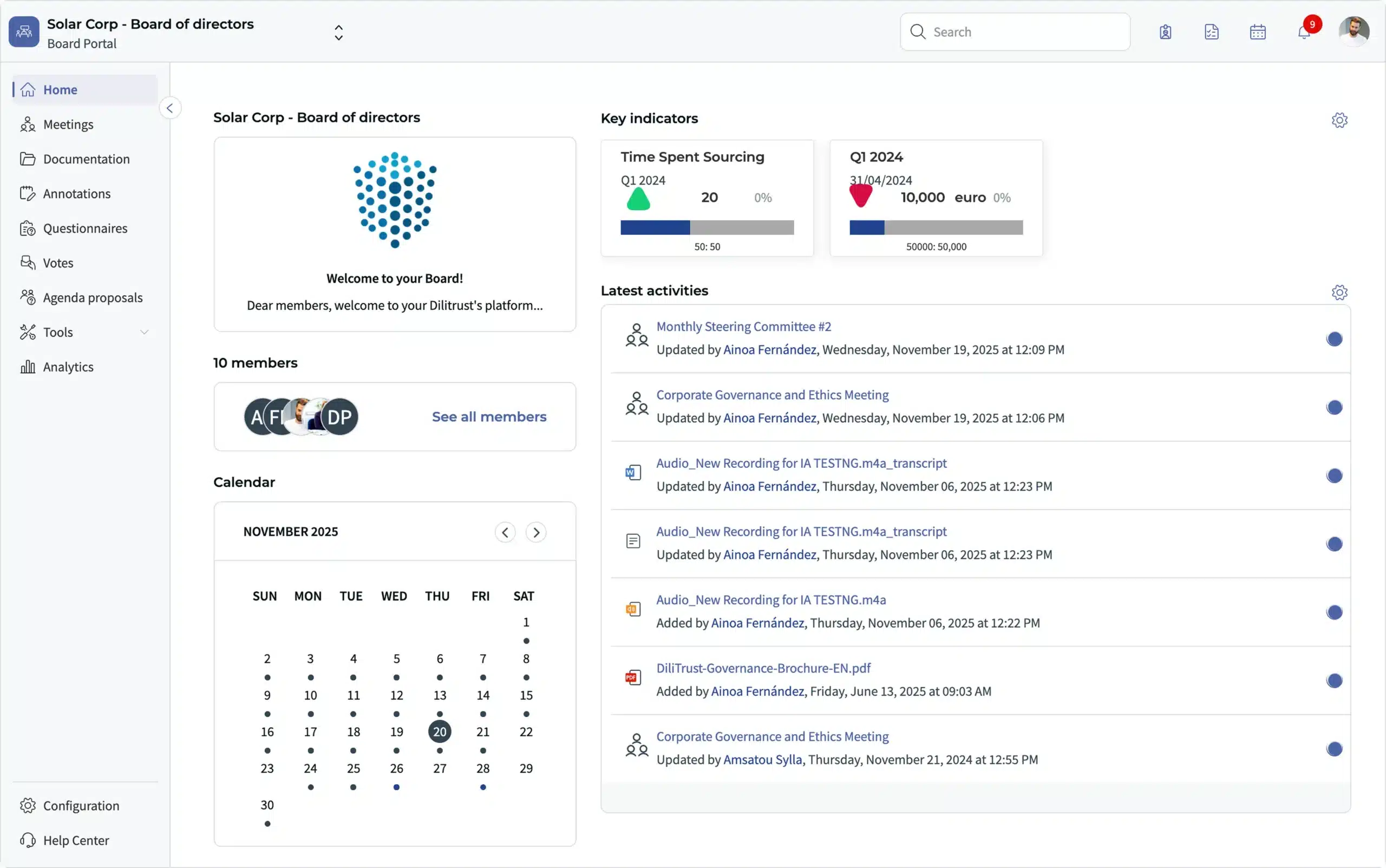
The DiliTrust Board Portal covers the full board pack lifecycle. Board Secretaries and General Counsels use it to build agendas and board packs with built-in version control, publish documents to directors through a permissions-controlled environment, manage annotations and secure votes, and generate AI-assisted draft minutes using organization-provided templates, subject to human review.
Board reports are only as good as the process behind them.
See how DiliTrust structures board reporting.
When a board report section changes, authorized users can access the current version through the DiliTrust Board Portal. This can reduce email chains, mismatched PDFs, and uncertainty about what was distributed.
For organizations managing multiple boards or committees, DiliTrust supports governance across multiple boards and committees in one platform, with separate, permissions-controlled spaces per governance body. The DiliTrust Suite brings Board Portal together with Contract Management, Entity Management, and Matter Management, and matter management, keeping the data feeding your board reports and the governance workflows around them in one place.
Frequently Asked Questions About Board Reports
What is a board report?
A board report is a structured document prepared for the board of directors ahead of a board meeting. A board report summarizes the organization’s performance, risks, legal matters, and strategic developments, and specifies what decisions the board is being asked to make. It is a key document through which management communicates accountability to the board.
What is the difference between a board report and a board pack?
A board pack is the full collection of documents distributed to directors ahead of a board meeting, including the agenda, financial statements, committee reports, annexes, and supporting materials. The board report is a key summary document within that board pack, typically the first substantive document directors read.
How long should a board report be?
A standard board report should be 4–6 pages for many standard agenda items, depending on scope and complexity, with supporting detail moved to annexes. Committee reports typically run 2–3 pages. A well-prioritized 5-page board report demonstrates stronger governance discipline than an unfocused 30-page one.
Who is responsible for preparing a board report?
The Board Secretary or Corporate Secretary typically coordinates the full board pack and is responsible for the final quality and consistency of the board report. Individual sections are prepared by the relevant function: finance, legal, risk, and operations, then consolidated by the Board Secretary before distribution.
What is the purpose of the executive summary in a board report?
The executive summary of a board report gives directors a complete picture of the meeting in under 200 words: what is on the agenda, what decisions are required, and what the critical issues are. Write the executive summary last, once all body sections are finalized, so it accurately reflects the most material points.
Can board portal software help with board report preparation?
Yes, a board portal replaces email-and-attachment workflows with a secure, structured environment where board reports are assembled, versioned, and distributed with granular access control. A board portal also produces an audit trail: every version, every access, every vote is recorded, which is essential for regulatory compliance and governance defensibility.
Board reports are only as good as the process behind them.
See how DiliTrust structures board reporting.