



“Legal OS,” short for legal operating system, is a term increasingly used to describe a unified technology platform that brings together core legal department functions: intake, matters, contracts, entities, documents, and governance, in one connected, AI-powered environment. Used this way, it describes an alternative to the fragmented mix of spreadsheets, email threads, and disconnected point solutions that most in-house legal teams still rely on today.
One clarification up front: “Legal OS” is not a standardized category or a single product. Different vendors use the term differently, and it is also the name of specific commercial products. Throughout this article we use “legal operating system” as the general concept and treat “Legal OS” only as shorthand, not as a settled industry standard.
The concept is gaining traction fast. 71% of legal departments have moved from experimentation to active AI deployment, up from just 24% two years prior, according to the Deloitte Chief Legal Officers Report 2026. The infrastructure question is no longer whether to digitize legal, but what that infrastructure should actually look like.
Key Takeaways
Why Legal Is the Last Function Without a System of Record
Finance has ERP. Sales has CRM. HR has HCM. Legal has, in most organizations, a patchwork of email inboxes, shared drives, and disconnected tools that were never designed to work together.
This is a structural problem. Legal was historically seen as a cost center, not a strategic function. Nobody built the equivalent of Salesforce for the General Counsel’s office, because nobody thought the GC needed one.
That assumption is now demonstrably wrong.
The Real Cost of Fragmentation
Think about what happens when a new regulation comes into force and your GC needs to assess which contracts carry exposure. Or when an auditor asks for board resolutions from 18 months ago. Or when a senior director’s mandate changes and you need to update records across 40 subsidiaries.
Without a unified system, each of those tasks involves hours of manual searching, cross-referencing, and chasing colleagues for access. The data exists. It’s just scattered.
The cost is not just time. It’s the inability to give leadership a clear picture of legal risk, in real time, when they need it most. It’s legal being reactive when the business needs it to be strategic.
What “Legal OS” Actually Means
The term “Legal OS” has been used by some vendors and commentators as shorthand for connected legal technology platforms, sometimes called legal operating systems or enterprise legal management suites, that attempt to solve the fragmentation problem at the infrastructure level.
It can be used as a category term, but it is also used as the name of specific products. Different vendors frame it differently.
Legal OS vs. Point Solutions
A point solution solves one problem well: a contract review tool, an e-signature platform, a board portal. Most legal departments have accumulated several of them. The issue is that none of them talk to each other. A contract dispute that escalates into a litigation matter means manually re-entering data. A board decision that affects an entity structure means updating records in a separate system.
A legal operating system can replace or consolidate that with a single connected layer. Data flows between modules. A contract that generates a matter automatically carries its context. An entity update can be reflected across all related records. The legal team stops being data entry operators and starts making decisions with full information.
Legal OS vs. Generic Enterprise AI
There is a separate category of tools (general-purpose AI assistants, large language model integrations) that legal teams are experimenting with for drafting or research. These are not a legal operating system. They are productivity tools operating on top of whatever data structure already exists.
A legal operating system is infrastructure. The AI layer on top is only as useful as the data underneath it. Clean, structured, connected legal data is what makes AI actually valuable for a GC.
Legal departments are facing a battle between generalist AI and specialized legal technology.
Eugenia Navarro, Strategic Legal Consultant and Spain Regional Community Leader at the CLOC
Read more: Generic AI vs. Specialized Legal Tools →
The Five Pillars of a Legal Operating System
Not every platform that calls itself a Legal OS covers the same ground. But the core pillars of a well-designed legal operating system map consistently to what in-house legal teams actually need to run and are interconnected to allow for seamless workflow.
1. Intake and Request Management
Every legal department has an intake problem. Requests arrive through Slack, email, WhatsApp, conversation in passing. Some get logged. Some don’t. Without a structured intake process, legal teams have no real view of their workload and no ability to prioritize.
A legal operating system creates a single front door: a standardized intake channel that captures, classifies, and routes every request before anything falls through the cracks.
2. Matter Management
Matters are the operational unit of in-house legal work. Each one (a litigation case, a regulatory investigation, an M&A transaction, a contract dispute) involves documents, deadlines, costs, and stakeholders.
Matter management within a legal operating system gives teams a real-time view of every open matter: where it stands, what it costs, who owns it, and what’s at risk. It also creates a data trail that enables meaningful reporting to leadership.
3. Contract Lifecycle Management
Contracts are both the most common legal output and the most frequent source of legal risk. Missed renewals, unchecked obligations, and buried liability clauses are not exceptions. They are the norm when contracts are managed in shared folders and email archives.
A legal operating system integrates contract lifecycle management from drafting through obligation tracking. Contracts connect to matters when disputes arise. They connect to entities when structural changes occur. That connection is what separates a legal operating system from a standalone CLM tool.
4. Legal Entity Management
For organizations with subsidiaries, joint ventures, or cross-border operations, entity management is one of the most operationally complex and compliance-sensitive tasks in legal. Ownership structures change. Directors rotate. Filing deadlines vary by jurisdiction. Managing all of this in spreadsheets is not sustainable above a certain scale.
A legal operating system centralizes entity data: org charts, mandates, statutory filings, and compliance deadlines, all in one place, with appropriate update controls and an audit trail.
5. Governance and Board Management
This is where most discussions of the legal operating system stop. It is also where the real risk sits for organizations.
Board governance, committee management, and corporate decision-making generate a class of legal obligation that is distinct from contracts or matters. Resolutions need to be documented. Board books need to be secure. Minutes need to be accurate and auditable. Decisions need to be traceable.
A legal operating system that doesn’t cover governance is incomplete for any company where legal and governance functions are intertwined, which is common among large organizations.
Who Actually Needs a Legal Operating System?
The concept applies across industries, but the starting point varies. If you’re managing a legal team of three people, one entity, and a contract volume you can still track manually, the priority is laying the right foundation, not necessarily deploying every module at once. A well-chosen legal tool vetted for its security, technological readiness, and ability to scale may be in order. What matters is that the infrastructure you choose today doesn’t become a constraint tomorrow.
If you recognize any of the following, the calculus changes:
- You have more than 15 legal entities across jurisdictions
- Contract renewals or expiration dates are tracked manually, or not at all
- You cannot answer “what is our current open litigation exposure?” without 48 hours’ worth of internal work
- Legal is using 4 or more disconnected tools that don’t share data
- The CFO or CEO has started asking legal for dashboards you cannot produce without exporting from multiple systems
- Your team is spending more than 30% of its time on administrative work rather than legal judgment
That last point is the most telling. A legal operating system doesn’t replace legal expertise. It removes the administrative friction that consumes it.
Calculate how much time and cost your team could recover with a unified legal platform.
How to Evaluate a Legal Operating System Platform
The market is noisy right now. Multiple vendors are positioning as a Legal OS, a legal operating system, or an AI-native legal platform. The terms are often used interchangeably and imprecisely.
Here is what actually matters when evaluating a platform at this level:
The Governance Gap Most Legal Operating System Platforms Miss
The in-house legal market has produced strong tools for intake, matter tracking, and contract management. Those are real problems, and the solutions have matured significantly.
The governance layer is where platform coverage varies significantly.
Corporate governance covers board management, entity compliance, delegation of authority, statutory filing calendars, and audit documentation. It is not a peripheral concern. For a General Counsel managing a group of companies, it is often the highest-stakes part of the job. A compliance failure in entity management or a gap in board documentation carries regulatory and reputational risk that no contract system can mitigate.
DiliTrust was built precisely for this intersection. The DiliTrust Suite connects contract lifecycle management, legal entity management, matter management, and board governance in a single platform, with Lini, DiliTrust’s sovereign AI engine, embedded across every module. Unlike tools that rely on third-party AI infrastructure, Lini is built and hosted in-house, which means legal data stays within a controlled, auditable environment.
One platform for every dimension of legal work.
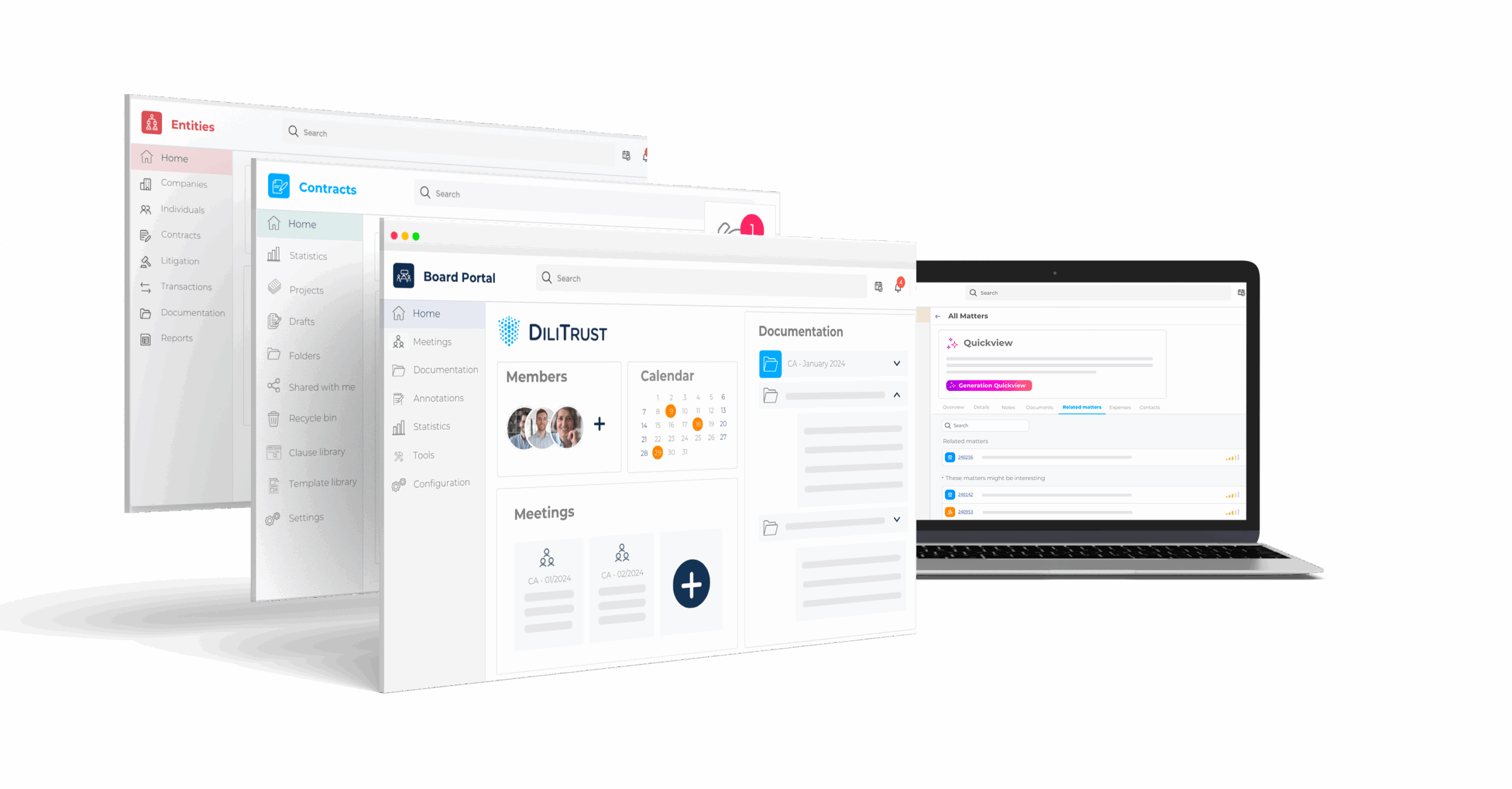
For legal teams where governance obligations are not optional (financial services, listed companies, regulated industries, organizations operating across jurisdictions), that architecture is not a differentiator. It’s a requirement.
What 2026 Is Changing for In-House Legal
The market is moving faster than most legal departments anticipated.
Deloitte report found that 71% of respondents were in initial, scaling, or fully embedded AI deployment which is up from just 24% who had any form of active adoptions in 2024. A separate 2026 report found that 87% of General Counsels reported using generative AI within their teams. These figures reflect different populations and measures of adoption.
The organizations that will be in the strongest position in 2028 are not the ones that adopted the most AI tools. They are the ones that built the data infrastructure to make AI useful. Clean, connected, governed legal data is the foundation. Everything else follows.
That is exactly what a well-designed legal operating system provides, and what legal departments that still run on email and spreadsheets will spend years trying to reconstruct.
Frequently Asked Questions
What is a Legal OS?
A Legal OS (Legal Operating System) is a unified technology platform that centralizes all core legal department functions, including intake, matter management, contract lifecycle management, entity management, and board governance, in a single connected environment. It gives in-house legal teams the operational infrastructure that finance has had with ERP and sales with CRM.
How is a Legal OS different from an ELM system?
Enterprise legal management (ELM) software and a Legal OS cover similar ground, but Legal OS is the newer, broader framing. It emphasizes AI-native architecture, cross-module data connectivity, and the idea of a single operational layer for the entire legal function, rather than a suite of separate modules.
Does a Legal OS replace outside counsel?
No, a Legal OS is infrastructure for managing in-house legal work more efficiently. It reduces the volume of work sent to outside counsel by enabling in-house teams to handle more internally, but strategic, specialist, or litigation-heavy work will always require external expertise.
What size legal team needs a Legal OS?
There’s no hard threshold, but most legal departments start to feel the pain of fragmentation above 5–10 lawyers, 20+ entities, or high-volume contract environments. The right moment to evaluate a legal operating system is before the complexity becomes unmanageable, not after.
How does AI fit into a Legal OS?
AI should be embedded at the infrastructure level: extracting obligation data from contracts, flagging risk in matter portfolios, generating board minutes, surfacing anomalies in entity compliance. The difference between useful legal AI and a novelty is the quality of the data it works with. A Legal OS creates that data foundation.
DiliTrust helps legal and governance teams build the operational infrastructure to lead, not just manage. Explore the DiliTrust Suite or book a demo to see how it works for organizations at your complexity level.
Legal teams work better when everything is connected.