


Only 26% of business leaders have an actual continuity plan, yet 94% believe they’re prepared for a disruption. That gap isn’t a planning failure. It’s a measurement problem: what most organizations call a “plan” is, at best, a document that sits unread in a shared drive. When a ransomware attack locks down your systems at 2 a.m. on a Friday, or a geopolitical event halts your supply chain overnight, you’ll find out very quickly whether your plan is real or theoretical.
Business continuity is not about expecting the worst. It’s about ensuring that your organization can keep making critical decisions — and serving its stakeholders — regardless of what happens. This guide covers the strategies, frameworks, and governance considerations that separate organizations that survive disruptions from those that define them.
Key Takeaways
What Is a Business Continuity Strategy?
A business continuity strategy is a documented, tested approach that enables an organization to maintain or rapidly resume its critical functions following a disruptive event. It defines what must be protected, how recovery will be sequenced, who is responsible for each decision, and what resources are required to return to normal operations within an acceptable timeframe.
It’s a system that that includes risk analysis, operational protocols, communication channels, technology architecture, and governance structures working together.
Business Continuity Strategy vs. Disaster Recovery Plan
These two terms are frequently used interchangeably. They shouldn’t be.
| Business Continuity Strategy | Disaster Recovery Plan | |
|---|---|---|
| Scope | Entire organization: people, processes, governance | Primarily IT systems and data |
| Focus | Maintaining operations during a disruption | Restoring systems after a disruption |
| Timeframe | Real-time and ongoing | Post-incident |
| Owned by | Leadership, GC, COO, Risk | IT and CTO |
| Activation | Any business-disrupting event | Technology failure or data loss |
Think of disaster recovery as a subset of business continuity, the IT chapter in a much larger playbook.
Why Business Continuity Planning Can’t Wait
The landscape of organizational risk has shifted permanently. Ransomware now constitutes the leading cause of business disruption globally, with average downtime exceeding 21 days per incident. Supply chain failures — accelerated by geopolitical tensions and trade volatility — now affect organizations that have never thought of themselves as exposed. Extreme weather events have moved from edge cases to planning assumptions.
Regulatory pressure is following the same trajectory. DORA (the EU Digital Operational Resilience Act) now mandates documented continuity and recovery frameworks for financial institutions operating in Europe.
Ready for DORA?
Rewatch or discover our webinar on DORA, covering the principles of this new regulatory framework and sharing actionable insights on getting ready to be DORA compliant.

NIS2 extends similar obligations to a broader set of sectors. Organizations that have delayed formalized BCM are not just operationally exposed; they’re increasingly non-compliant.
The cost of doing nothing is no longer abstract. A single week of operational paralysis in a mid-size organization typically runs into seven figures when you factor in lost revenue, remediation costs, reputational damage, and regulatory exposure. Getting the strategy right before you need it is, by a significant margin, the cheaper option.
The 5 Foundations of a Solid Business Continuity Strategy
Before you can choose strategies and assign recovery timeframes, you need to build the analytical foundation. Skip this step and your BCP will be built on assumptions, which fail under pressure.
1. Business Impact Analysis (BIA)
A Business Impact Analysis identifies which functions are critical to your organization’s survival and quantifies the cost of disrupting them. It asks: what happens if this process stops for one hour? One day? One week?
The BIA maps every critical function against two core metrics: how long it can be interrupted before causing unacceptable damage (your Maximum Tolerable Downtime, or MTD) and what resources are needed to sustain it. This is the document your recovery strategy must be designed around.
2. Risk Assessment
Once you know what you’re protecting, you assess what could threaten it. A structured risk assessment covers both internal vulnerabilities (single points of failure, undocumented processes, over-reliance on key personnel) and external threats (cyberattacks, supplier failures, regulatory changes, natural events).
Prioritize by impact and likelihood. High-impact, high-likelihood risks — a ransomware attack on your legal document repository, for instance — demand immediate, fully resourced response plans. Lower-probability risks require monitoring, not mobilization.
3. Critical Function Identification
Not everything can be recovered at once. Your strategy must define which functions are restored first, second, and third, and what “good enough” looks like at each stage of recovery.
For a legal or governance team, this often means: board decision-making first, contract obligations tracking second, litigation management third. The sequence depends on your specific contractual, regulatory, and fiduciary obligations.
4. Recovery Time Objectives (RTO) and Recovery Point Objectives (RPO)
These two metrics define the boundaries of your recovery:
| Metric | Definition | Example |
|---|---|---|
| RTO (Recovery Time Objective) | Maximum time a function can be offline before unacceptable damage occurs | Board communications: 4 hours |
| RPO (Recovery Point Objective) | Maximum data loss acceptable, measured in time | Contract repository: 1 hour |
RTO and RPO are binding architectural requirements. Every technology and process decision in your BCP must be designed to meet them.
5. Communication Plan
Who gets notified first? Who speaks to regulators? And who tells your clients? A continuity event is, simultaneously, a communication event. Without pre-defined escalation chains, notification templates, and designated spokespersons, your response will be improvised, and improvised crisis communication is almost always damaging.
Your communication plan should cover internal stakeholders (board, executives, legal, HR), external parties (clients, suppliers, regulators), and media, with clear roles, pre-approved messaging, and fallback channels if primary systems are down.
7 Core Business Continuity Strategies
These are the tactical building blocks that organizations use to execute their continuity plans. Most organizations will combine several, not choose one.
1. Geographic Redundancy
Distributing operations, data centers, or critical personnel across multiple physical locations ensures that a localized disruption — fire, flood, power failure — does not take down the entire organization.
Example: A global law firm with offices in Paris, London, and Chicago can shift document management and board operations to a remote region if one site becomes inaccessible.
2. Data Backup and Recovery
Regular, tested, encrypted backups of critical data — stored offsite or in the cloud — form the baseline of any continuity strategy. “Regular” means daily at minimum; “tested” means you’ve actually restored from them under pressure.
Many organizations discover their backups are incomplete or corrupted only when they need them. The discipline is in the testing, not the scheduling.
3. Remote Work Enablement
The shift to distributed work demonstrated that most knowledge work can continue from anywhere, provided the right tools are in place. Secure remote access to critical systems, cloud-native document repositories, and digital collaboration platforms are no longer optional continuity measures. They are table stakes.
For governance and legal teams specifically, this means secure access to board materials, entity records, contracts, and legal documents from any device, at any location, without compromising confidentiality.
DiliTrust gives legal and governance teams exactly that: one secure, cloud-native platform accessible from anywhere. See it in action →
4. Vendor and Supply Chain Diversification
Single-supplier dependencies are organizational vulnerabilities. A continuity strategy that addresses only internal risks while ignoring supplier exposure is incomplete.
Map your critical supplier relationships. Identify which vendors, if they failed tomorrow, would stop your operations. For each one, assess whether an alternative exists and what your contractual obligations are under disruption scenarios.
5. Communication Failover
If your primary communication systems go down — corporate email, intranet, telephony — you need an independent fallback channel that can reach all stakeholders immediately. This might be an out-of-band messaging platform, an emergency notification system, or pre-agreed personal contact protocols for critical personnel.
Test it before you need it. An untested failover system has the same value as no failover system.
6. Incident Response Playbooks
Documented, rehearsed playbooks for your most likely disruption scenarios — ransomware attack, key executive incapacitation, regulatory emergency, data breach — eliminate the cognitive load of deciding under pressure. Your people should know exactly what to do, in what order, before the incident starts.
The most effective playbooks are short. One page per scenario, maximum. The goal is clarity under stress, not comprehensiveness.
7. Cross-Training and Knowledge Transfer
What happens when your only person who understands a critical process is unavailable? Cross-training distributes operational knowledge across multiple team members, eliminating single-person dependencies.
Document your critical processes. Map who can perform them. Identify gaps, and close them before an absence forces the question.
How to Build a Business Continuity Plan: Step by Step
A Business Continuity Plan (BCP) is the operational document that translates your strategy into action. Here’s how to build one that holds up under pressure.
Step 1: Conduct your BIA: Start with impact, not risk. Know what you’re protecting and why before you start planning how.
Step 2: Assess and prioritize your risks: Use a structured risk matrix. Resist the urge to list every conceivable threat and focus on what is both impactful and realistic.
Step 3: Define RTOs and RPOs for each critical function: This step forces the conversation about what “acceptable” actually means and it will expose disagreements among stakeholders that are better resolved now.
Step 4: Design your response strategies: For each critical function and its associated risk scenarios, define the specific actions, resources, and responsible individuals needed to maintain or restore operations.
Step 5: Build your communication plan: Who is notified, in what order, through which channels, with what pre-approved messaging. Do this before you need it.
Step 6: Document and distribute: Your BCP must be accessible, stored somewhere that remains reachable when your primary systems are down. Cloud-based, access-controlled repositories are the standard.
Step 7: Test, update, and test again: A BCP that hasn’t been tested is a hypothesis, not a plan. Conduct tabletop exercises at minimum annually. Simulate realistic scenarios. Update the plan based on what the exercises expose.
The Governance Gap: What Most BCPs Don’t Cover
Most BCPs address IT recovery, operational processes, and supply chain continuity. Very few address what happens to the governance function itself: who makes strategic decisions during a disruption, whether the board can convene remotely, whether the legal team can access the contracts and powers of attorney needed to act.
Leadership paralysis is often more damaging than the technical failure that caused it. Boards that cannot meet, GCs who cannot access their documents, corporate secretaries who cannot distribute board materials: these are not edge cases. They happen.
Governance continuity requires:
- Secure remote access to board materials, agenda, and minutes from any location
- Digital decision-making infrastructure for resolutions, votes, and approvals without physical meetings
- Centralized legal document repositories that stay accessible and audit-ready during disruptions
- Current entity management records so legal teams can verify delegations of authority and subsidiary structures in real time
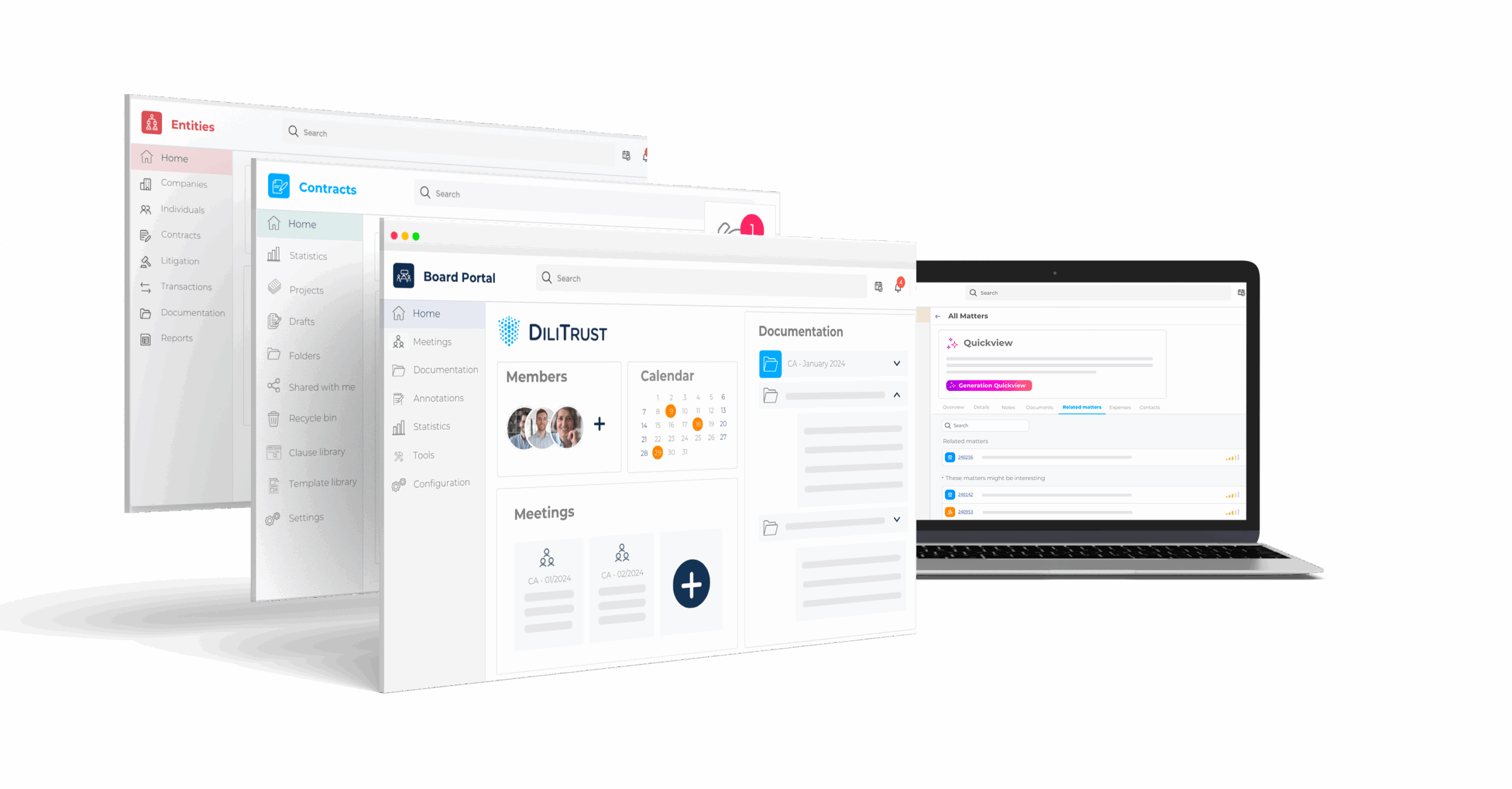
The DiliTrust Suite is built for exactly this context: a single, cloud-native system that keeps boards decision-ready, contracts visible, and legal documentation secure and accessible from anywhere. When an auditor asks for board minutes from eighteen months ago, your team should respond in minutes, not days.
This is what governance continuity looks like in practice
For a deeper look at how boards can prepare for crisis scenarios, see: A Crisis Management Plan for Your Board.
Key Frameworks and Standards for BCM
If you’re building or formalizing your business continuity program, these frameworks provide the industry-recognized structure:
Business Continuity Strategy: Best Practices
If you take one thing from this guide, let it be this: a continuity strategy is only as good as the last time you tested it. Here’s the checklist that separates serious programs from compliance theater:
- Document every critical function — if it lives only in someone’s head, it’s a single point of failure
- Define RTOs and RPOs at the function level, not just at the IT infrastructure level
- Test your backups — not just schedule them
- Run tabletop exercises at least annually — and invite board members and legal leadership, not just IT
- Keep your communication plan out-of-band — it’s useless if it’s stored only in the systems that are down
- Assign explicit ownership — every element of your BCP must have a named responsible person and a named backup
- Update after every test, every incident, and every significant organizational change
- Integrate supplier risk — map critical dependencies and their continuity posture
- Digitize governance-critical processes — board meetings, resolutions, contract access — before a disruption forces improvisation
- Review regulatory requirements annually — DORA, NIS2, and sector-specific regulations are evolving faster than most BCPs
Frequently Asked Questions
How often should a business continuity plan be tested?
At minimum, annually. Best practice is to test after every significant incident, major organizational change, or meaningful shift in your risk landscape. Tabletop exercises are the most effective format for governance and legal teams, they expose decision-making gaps that technical tests miss entirely.
Is business continuity planning required by law?
For many organizations in regulated sectors, yes. DORA (the EU Digital Operational Resilience Act) mandates documented ICT continuity and recovery frameworks for financial institutions in Europe. NIS2 extends similar obligations to a broader set of sectors. Beyond formal mandates, business continuity documentation is increasingly expected by clients, insurers, and auditors as a baseline of organizational due diligence, regardless of sector.
What tools do legal and compliance teams use for business continuity?
Legal teams typically rely on a combination of cloud-based contract lifecycle management, entity management platforms, and secure board portals to maintain continuity. The key requirement is that these tools remain accessible and audit-ready during a disruption, not just on a normal working day. The DiliTrust Suite consolidates contracts, corporate entities, and board governance into a single cloud-native platform, so legal teams aren’t scrambling across disconnected systems when time and access matter most.
What’s the difference between a business continuity plan and a disaster recovery plan?
A business continuity plan (BCP) covers the entire organization — people, processes, governance, communications, and technology. A disaster recovery plan (DRP) focuses specifically on restoring IT systems and data after a technical failure. The DRP is one component of a broader BCP.
What are the most common types of business continuity strategies?
The most widely used strategies include geographic redundancy, data backup and recovery, remote work enablement, vendor diversification, communication failover systems, incident response playbooks, and cross-training programs. Most organizations implement a combination of several.
What is ISO 22301?
ISO 22301 is the international standard for Business Continuity Management Systems. It provides a framework for establishing, implementing, and continuously improving a BCM program. Certification indicates that your program has been independently audited and verified against a globally recognized standard.
How do boards maintain governance continuity during a crisis?
Governance continuity requires that boards have access to secure, remote decision-making infrastructure before a crisis occurs. This includes digital board portals that function from any location, centralized document repositories, and clear escalation and communication protocols. Organizations that rely on physical board meetings and paper-based processes are the most exposed when disruption strikes.
Legal teams needs the right tools to work well. So does your team.