


…
Your contract is ready to sign. Both parties agree. But the other side is in Singapore, and your policy still requires wet signatures. Three days later, a courier arrives. The deal closes late, at unnecessary cost, with a document that now needs to be scanned, re-filed, and stored in a cabinet no one will open again.
This is a scenario legal teams replay dozens of times a year. Not because the law demands it, but because no one has drawn a clear line between documents that genuinely require wet ink and those that simply never got updated.
This guide draws that line.
What Is a Wet Signature?
A wet signature is a handwritten signature made with pen and ink directly on a physical paper document. The term “wet” refers to the ink that requires time to dry after signing. Wet signatures are the traditional standard for legally binding agreements and may still be required for certain documents, depending on the jurisdiction and applicable execution formalities.
Signatures have existed for thousands of years. Some of the earliest known written marks and seals date back to around 3000 B.C. The wet signature became the common standard for formal documents long before electronic alternatives existed, and it still carries unique legal weight in certain contexts today.
Wet Signature Meaning in Legal Contexts
In legal terms, a wet signature signals a person’s intent to agree to the content of a document. Courts may consider handwriting analysis, witness testimony, or notarization when authenticating a signature if someone challenges it.
That physical presence is both the strength and the limitation of the wet signature.
Wet Signature vs. Electronic Signature vs. Digital Signature
These three terms are used interchangeably, but they shouldn’t be. Each represents a different level of authentication, legal weight, and technical complexity.
| Wet Signature | Electronic Signature | Digital Signature | |
|---|---|---|---|
| Format | Ink on paper | Typed name, drawn image, or checkbox | Cryptographic certificate |
| Legal framework | Contract law; applicable formalities | ESIGN Act, UETA (US) / eIDAS (EU) | eIDAS (EU); ESIGN Act/UETA (US) |
| Identity verification | Handwriting, witnesses, or notary | Varies by level (SES / AES / QES) | Cryptographic certificate |
| Tamper-evident | No | Depends on provider | Yes |
| Turnaround time | Days to weeks | Minutes to hours | Minutes to hours |
| Best for | Documents requiring wet ink | Contracts, HR, NDAs, board resolutions | High-assurance regulated transactions |
What Is an Electronic Signature?
An electronic signature is any electronic process that captures a person’s intent to sign. That could be a typed name, a finger-drawn signature, or clicking “I agree.” The critical variable is how the signer’s identity is verified, which determines whether the signature qualifies as Simple (SES), Advanced (AES), or Qualified (QES) under frameworks like eIDAS.
For most corporate documents: NDAs, employment contracts, supplier agreements, board resolutions, a Simple Electronic Signature is legally sufficient and practically far more efficient than wet ink.
What Is a Digital Signature?
A digital signature is a specific type of electronic signature that uses cryptographic technology to verify the document’s authenticity and the signer’s identity. If the document someone alters the document after signing, the certificate breaks. Think of it as a tamper-evident seal built into the file itself.
Digital signatures sit at the top of the security pyramid, used in banking, regulated industries, and cross-border transactions where proof of identity must be forensically verifiable.
When Is a Wet Signature Still Required?
Despite broad global adoption of e-signatures, some documents may still require a wet-ink original or specific execution formalities under applicable law. Using an electronic process without meeting those formalities can affect enforceability. Here are examples where wet ink or additional formalities may still apply in the US:
Family and estate law
- Wills and last testaments
- Living wills and advance healthcare directives
- Adoption documents
- Divorce decrees (jurisdiction-dependent)
Financial and real estate
- Mortgage agreements and deeds of trust (in many states)
- Promissory notes secured by real property
- Notarized loan documents
Government and legal proceedings
- Court filings requiring original signatures (varies by jurisdiction)
- Affidavits and statutory declarations
- Some government benefit applications
Industry-specific requirements
- Certain healthcare records or submissions subject to specific FDA requirements
- Specific public procurement documents requiring notarization
| Document Type | Wet Signature Required? | Notes |
|---|---|---|
| Commercial contracts | Generally not | ESIGN Act applies |
| NDAs | Usually No | E-signatures common |
| Employment contracts | Usually No | E-signatures common |
| Wills and trusts | Varies | State-specific rules |
| Mortgage deeds | Often | Varies by state and lender |
| Court affidavits | Varies | State-specific rules |
| Board resolutions | Usually No | Often accepted |
| Notarized documents | Not always | RON varies by state |
One important exception: Remote Online Notarization (RON) now allows notarization via video in many US states, subject to state-specific rules and document requirements. Where RON is accepted, it removes a significant barrier to fully digital workflows, even for documents that previously required in-person signing before a notary.
The Real Costs of Wet Signatures
Here’s a metric worth sitting with: US businesses spend an estimated $350 billion per year on computer printouts. The average office worker uses 10,000 sheets of paper annually. Wet signature workflows drive a meaningful share of that.
Beyond paper costs, the inefficiencies compound in ways that are harder to quantify:
- Storage and retrieval: A wet-signed document requires teams to scan, file, and store it. When an auditor asks for a board resolution from 18 months ago, that’s either a 30-second search or a 30-minute scramble, depending on your system.
- No built-in digital audit trail: Physical documents can be lost, damaged, or altered without leaving a digital record. A wet signature does not automatically provide a digital timestamp, IP log, or digital chain of custody.
- Security exposure: Forging a wet signature is technically simpler than defeating a cryptographic certificate. The perceived security of ink is often overstated.
- Geographic friction: Any deal requiring physical presence or courier delivery creates a hard dependency on geography and timing, something no modern legal operation should accept for routine documents.
- Environmental overhead: Paper-intensive signing workflows are increasingly difficult to justify against sustainability commitments.
The US Legal Framework for Electronic Signatures
The US established clear legal standing for e-signatures over 25 years ago. The Electronic Signatures in Global and National Commerce Act (ESIGN Act), which Congress enacted in June 2000, generally prevents electronic records and signatures from being denied legal effect solely because they are electronic, subject to statutory exceptions and requirements.
The Uniform Electronic Transactions Act (UETA), adopted by 49 US states, reinforces this at the state level. Together, they mean that most commercially signed contracts are as legally binding electronically as on paper, when the parties have consented where required and the applicable legal, disclosure, record-access, and retention requirements are met.
Both laws carve out explicit exceptions. Wills, family law documents, and certain government filings fall outside their scope, which is exactly why the wet signature hasn’t disappeared.
For organizations with European counterparties, the EU’s eIDAS regulation recognizes electronic, advanced electronic, and qualified electronic signatures, with different legal effects under the regulation. An electronic signature cannot be denied legal effect solely because it is electronic, but a Simple Electronic Signature is not automatically equivalent to a handwritten signature. A Qualified Electronic Signature has the equivalent legal effect of a handwritten signature under eIDAS and relies on a qualified certificate from a qualified Trust Service Provider. Whether a QES is required depends on the applicable national or sector-specific rule.
The practical takeaway: the vast majority of corporate signatures — contracts, board resolutions, HR documents, NDAs — operate comfortably at the SES level under both US and EU frameworks.
How to Transition from Wet Signatures to a Digital Workflow
Moving from physical to digital signing is a structured process. Here’s how to do it without creating compliance gaps.
Step 1: Audit your document portfolio
List every document type your organization signs. Flag which require a wet signature by law in your jurisdiction, which require notarization, and which are “wet by habit”, common documents that no one has revisited since the ESIGN Act passed. The proportion of documents that qualify for e-signature varies by jurisdiction, document type, and internal policy. The remaining fraction drives your exception process.
Step 2: Match signature level to document risk
Not all e-signatures are equivalent. For most corporate documents, SES is sufficient. Advanced signatures add identity verification, useful for higher-stakes transactions involving sensitive data or larger financial commitments. Qualified signatures are required only in specific regulated contexts. Match the level to the document’s risk profile, not to the maximum security available.
Step 3: Choose a platform that keeps signing in-context
The biggest friction point in e-signature adoption isn’t the signature itself. It’s the workflow around it. When teams export a document, open a separate tool, download the signed copy, and manually re-archive it, the process creates new inefficiencies to replace the old ones.
Platforms like DiliTrust integrate e-signature directly into contract management and governance workflows. Teams sign from the platform using whichever certified provider they already have in place, including, supported third-party providers, with DocuSign, Adobe Sign, YouSign, and others, without switching tools or adding a new contract.
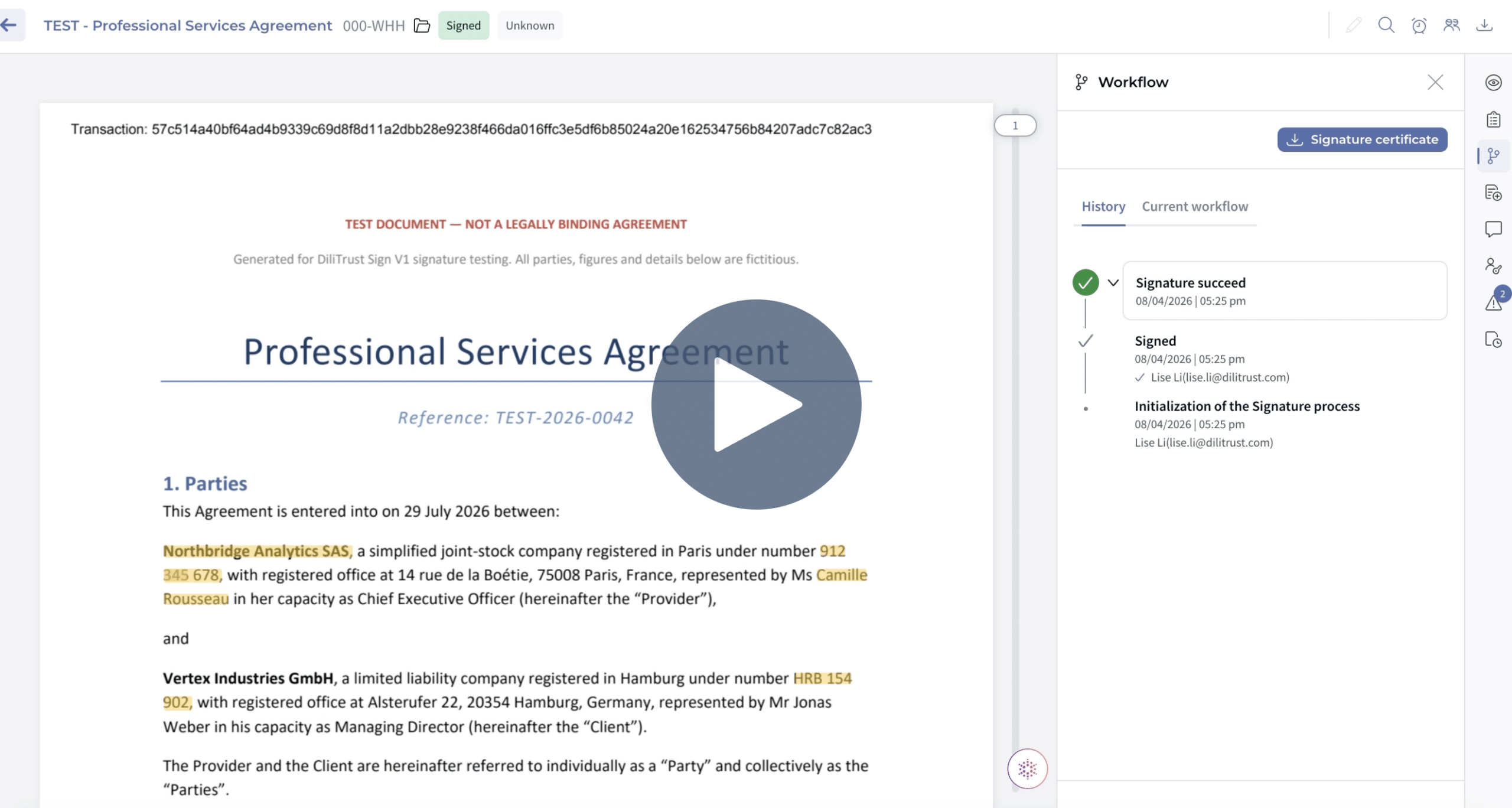
For a closer look at combining e-signature with your contract lifecycle, see: Electronic signature and CLM: why combine the two?
Step 4: Build your wet-signature exception workflow
Don’t try to eliminate wet signatures on day one. Instead, write a clear policy that explains which documents go digital by default, which require wet ink, and who owns the exception decision when a new document type comes up. Document this for legal, HR, and operations teams before rollout.
Step 5: Ensure retention and audit trail
Organizations must retain signed documents according to applicable law, regulation, limitation periods, contractual obligations, and company policy. Electronic signatures carry a built-in audit trail: signer identity, timestamp, IP address, and event log. Teams should scan, index, and store physical documents still in circulation in a searchable system.
Frequently Asked Questions
Is a wet signature more legally binding than an electronic signature?
No, not for most documents. Under the ESIGN Act and UETA, an electronic signature carries the same legal weight as a wet signature for the vast majority of commercial agreements. The question isn’t which format is “more binding” but whether the specific document type requires physical ink.
Is a scanned wet signature legally valid?
It depends. A scanned image of a wet signature is not the same as the original wet signature, and courts have ruled inconsistently on this. It may qualify as a Simple Electronic Signature in some jurisdictions. If the document legally requires a wet original — a will, for example — a scan is unlikely to meet that standard.
What does “wet signed” mean on a contract?
“Wet signed” means the document was signed with physical ink, as opposed to electronically. Some contracts in real estate and financial services specify this requirement to ensure an original physical document exists for recording purposes.
What is a wet signature on a PDF?
When someone prints a PDF, signs it with a pen, and either returns the physical copy or scans it back as an email attachment, that is a wet-signature PDF workflow. It preserves the tradition of ink but eliminates most of the efficiency benefits of going digital, and it is not equivalent to a properly executed electronic signature with an audit trail.
Still printing contracts to sign them?
Most contracts don’t require wet ink. See how DiliTrust moves the rest to digital, without switching tools.