


An auditor asks for the full ownership structure of your 14 subsidiaries, including capital percentages, registered jurisdictions, and current board mandates. You have three hours. If your answer involves spreadsheets, email chains, and a call to outside counsel, you already have a governance problem. It often starts with how wholly owned subsidiaries are structured, and what that structure actually demands in practice.
What Is a Wholly Owned Subsidiary?
A wholly owned subsidiary is a company whose entire share capital (100% of its outstanding stock) is owned by a single parent company. It operates as a separate legal entity, with its own directors, contracts, and liabilities, but reports entirely to one controlling shareholder.
The parent company’s ownership is total. There are no minority shareholders, no outside investors, no joint-venture partners with competing interests.
Key Characteristics of a Wholly Owned Subsidiary
- 100% parent ownership: no external shareholders or partial investors
- Separate legal entity: its debts are not automatically the parent’s debts (absent a guarantee or veil-piercing scenario)
- Independent governance: its own board of directors, corporate records, and registered address
- Full consolidated reporting: its financials are consolidated into the parent’s statements under GAAP ASC 810 or IFRS 10
- Subject to the parent’s strategic direction: day-to-day autonomy may vary, but ultimate control is absolute
Wholly Owned Subsidiary vs. Subsidiary: What’s the Difference?
The terms are often used interchangeably. They are not the same.
A subsidiary is any company in which a parent holds a controlling interest — typically more than 50% of voting shares. A wholly owned subsidiary goes further: the parent holds 100%, with no external ownership at all. That difference matters for governance, financial reporting, and strategic flexibility.
| Feature | Subsidiary | Wholly Owned Subsidiary |
|---|---|---|
| Parent ownership | >50% | 100% |
| Minority shareholders | Yes, potentially | No |
| Consolidated financials | Yes (GAAP/IFRS) | Yes (GAAP/IFRS) |
| Full operational control | Not always | Yes |
| Transfer of assets/IP | May require third-party consent | Generally unrestricted |
| Going public independently | Possible | Requires partial divestiture first |
Wholly Owned Subsidiary vs. Joint Venture
A joint venture involves two or more parties sharing ownership, risk, and control. The trade-off is explicit: you get a local partner’s knowledge, distribution, or capital, and you give up full control. With a wholly owned subsidiary, there is no co-investor. Every strategic decision, every profit, and every liability sits with the parent.
Wholly Owned Subsidiary vs. Affiliate
An affiliate is a company in which the parent holds a minority stake, often between 20% and 50%. The parent has influence but not control. A wholly owned subsidiary is the opposite: control is absolute.
Why Form a Wholly Owned Subsidiary? Key Advantages
Full Operational Control
When you own 100%, you set the strategy. There are no co-shareholders to negotiate with, no board vetoes from outside investors, no dividend disputes. If you need to pivot the subsidiary’s market positioning, restructure its operations, or integrate it more closely with the parent, you do it on your timeline.
This is particularly valuable during M&A. If an acquirer needs to integrate technology, brand, or distribution assets quickly, a wholly owned structure makes that process far simpler than a partial stake.
Tax Efficiency and Flexibility
A US parent and its wholly owned domestic subsidiary can elect to be treated as a single tax entity through a consolidated federal tax return under IRS rules. This means losses in one entity can offset profits in another, a meaningful advantage for multi-division groups.
For acquisitions, the parent may elect to treat the purchase as a deemed asset acquisition under IRS Section 338, allowing a step-up in the subsidiary’s tax basis. Under GAAP (ASC 805), the transaction is recorded using acquisition accounting, with goodwill recognized on the parent’s consolidated balance sheet.
Brand and IP Protection
When a company enters a new market through a joint venture, its intellectual property (trademarks, patents, proprietary processes) is exposed to the partner. A wholly owned subsidiary eliminates that risk. The parent transfers and licenses IP on its own terms, with no obligation to share ownership or revenues with a third party.
This is why technology and pharmaceutical companies overwhelmingly prefer wholly owned structures for international expansion in markets where IP is a core asset.
Market Entry Without a Partner
Entering a new geography with 100% ownership means no shared control over local decisions. Hiring, pricing, product positioning, and distribution are entirely the parent’s call. The higher upfront cost is the trade-off: there is no local partner absorbing part of the capital requirement. But for companies with the resources and the market conviction, that cost buys something: certainty.
When 100% ownership means 100% governance responsibility — across every jurisdiction — manual tracking isn’t a strategy.
→ See how DiliTrust centralizes subsidiary governance
The Real Costs and Risks
Capital Outlay
Acquiring or incorporating a wholly owned subsidiary requires full capital commitment. An acquisition means paying the entire purchase price. A greenfield formation means funding the entity alone from day one. There is no partner to share the exposure.
For smaller companies or those entering unfamiliar markets, this is often the decisive reason to choose a joint venture or a partial acquisition instead.
Regulatory and Legal Exposure
Every jurisdiction has its own incorporation requirements, ongoing compliance obligations, and corporate tax rules. A US parent operating wholly owned subsidiaries in the EU, APAC, or the Gulf must navigate separate regulatory frameworks for each entity, often simultaneously.
In some countries, foreign wholly owned structures face additional regulatory scrutiny or sectoral restrictions. Your legal team needs to assess each jurisdiction’s rules on foreign ownership before formation.
Integration Challenges
Governance integration is harder than it looks. When you acquire a company outright, you inherit its corporate culture, its existing contracts, its compliance gaps, and its board dynamics. Making it operate as a coherent part of your group while preserving what made it valuable takes time and deliberate effort.
Accounting and Financial Reporting
Under GAAP (ASC 810) and IFRS 10, a parent company must consolidate the financial statements of all subsidiaries it controls, which always includes wholly owned subsidiaries. That means the subsidiary’s assets, liabilities, revenues, and expenses are folded into the parent’s consolidated financial statements, with intercompany transactions eliminated.
For publicly traded parents, the SEC requires consolidated reporting for all controlled entities. The audit committee is ultimately responsible for the accuracy of those consolidated statements.
Transfer Pricing and the Arm’s Length Principle
When a parent and its wholly owned subsidiary transact with each other (whether for goods, services, IP licenses, or intercompany loans) the IRS requires those transactions to be priced at arm’s length. That means pricing the transaction as if the two entities were unrelated parties.
This is one of the most scrutinized areas of intercompany accounting. Inadequate transfer pricing documentation is a common trigger for tax authority audits. Legal and finance teams should maintain contemporaneous documentation for every material intercompany arrangement.
How to Form a Wholly Owned Subsidiary
Route 1: Acquisition
The parent purchases 100% of an existing company’s outstanding shares, either through direct share purchase, a statutory merger, or a tender offer. Post-closing, the acquired entity becomes a wholly owned subsidiary.
If the parent acquires less than 100% initially, say 80%, and later purchases the remaining 20% from minority shareholders, the entity becomes wholly owned at that point of full buyout.
Route 2: Greenfield Formation
The parent incorporates a new entity from scratch. In the US, Delaware is the default choice for incorporation due to its well-developed corporate law, Court of Chancery, and predictable legal framework. The parent may also choose an LLC structure for operational flexibility or a C-Corp for equity issuance purposes.
Greenfield formation takes longer to generate revenue but gives the parent full control over the entity’s structure, governance, and capitalization from day one.
Converting a Partially Owned Subsidiary to Wholly Owned
A parent holding 75%, for example, can acquire the remaining shares from minority shareholders through a tender offer or a squeeze-out merger, depending on the jurisdiction. In the US, Delaware law allows a short-form merger at 90% ownership, letting the majority shareholder acquire remaining shares without a full shareholder vote.
Real-World Examples of Wholly Owned Subsidiaries
- Google LLC: When Alphabet Inc. was created in 2015, Google became a wholly owned subsidiary of the new holding company. Alphabet retained all strategic control while creating cleaner separation between Google’s core business and its other ventures (Waymo, Verily, DeepMind).
- YouTube: A wholly owned subsidiary of Google LLC since Google’s $1.65 billion acquisition in 2006. YouTube operates with significant day-to-day independence but is fully consolidated into Alphabet’s financial statements.
- Airgas: Acquired by Air Liquide in 2016 for $13.4 billion, becoming a wholly owned US subsidiary of the French industrial gas group. The structure allowed Air Liquide to access the US market at scale while maintaining Airgas’s operational infrastructure.
- Instagram and WhatsApp: Both operate as wholly owned subsidiaries of Meta Platforms, Inc., each with its own product leadership but fully consolidated under Meta’s governance and financial reporting structure.
Managing Governance Across Multiple Wholly Owned Subsidiaries
Managing one wholly owned subsidiary is a documented process. Managing 20, 50, or 200 (across different states and jurisdictions) is a fundamentally different operational challenge.
Ownership percentages, director mandates, delegations of authority, share capital records, compliance filing deadlines, and corporate resolutions all need to be maintained, updated, and surfaced on demand. When a regulator, auditor, or acquiring party asks for a snapshot of your corporate structure, the answer cannot take two days to assemble.
This is where most legal teams hit a wall. Entity data lives in spreadsheets, internal drives, and the institutional memory of whoever set up the structure three years ago. When that person leaves, or when the group grows through acquisition, the gaps become audit findings.
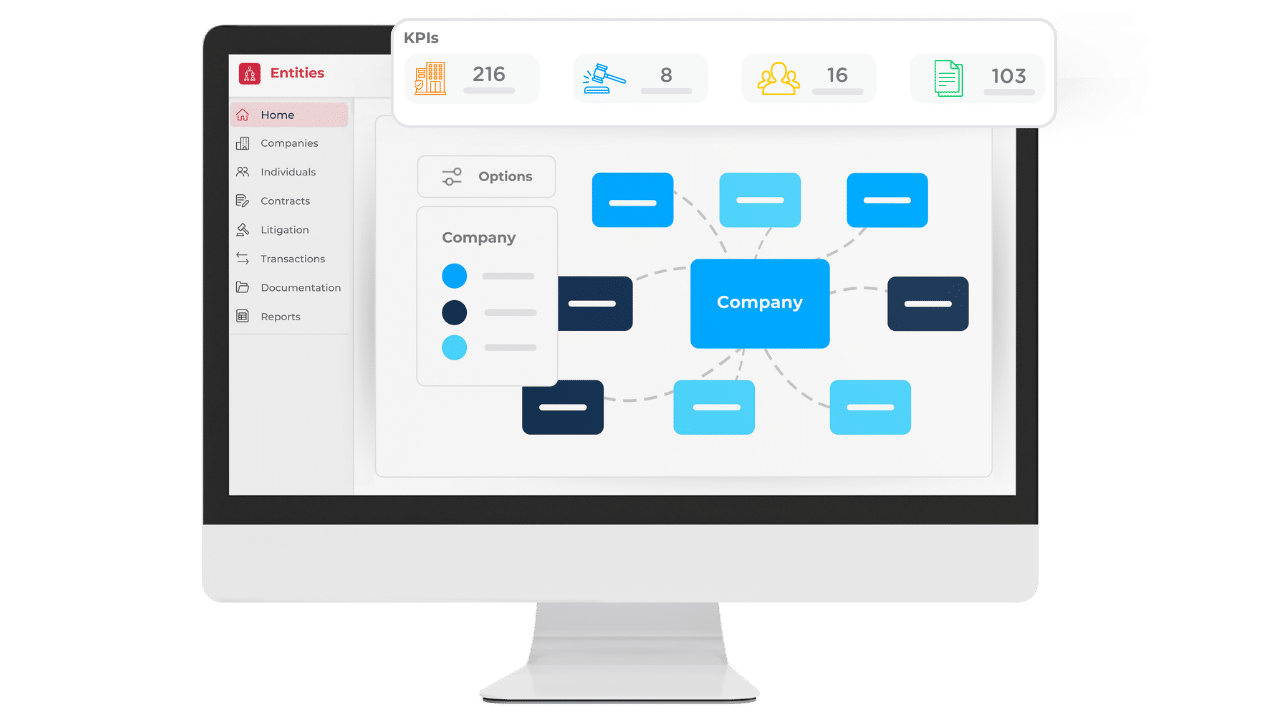
DiliTrust’s Legal Entity Management gives corporate legal teams a single governed platform for every entity in the group. Ownership percentages, board mandates, delegations of authority, and capital structure changes are all maintained in one place, with every change timestamped and the full audit trail preserved.
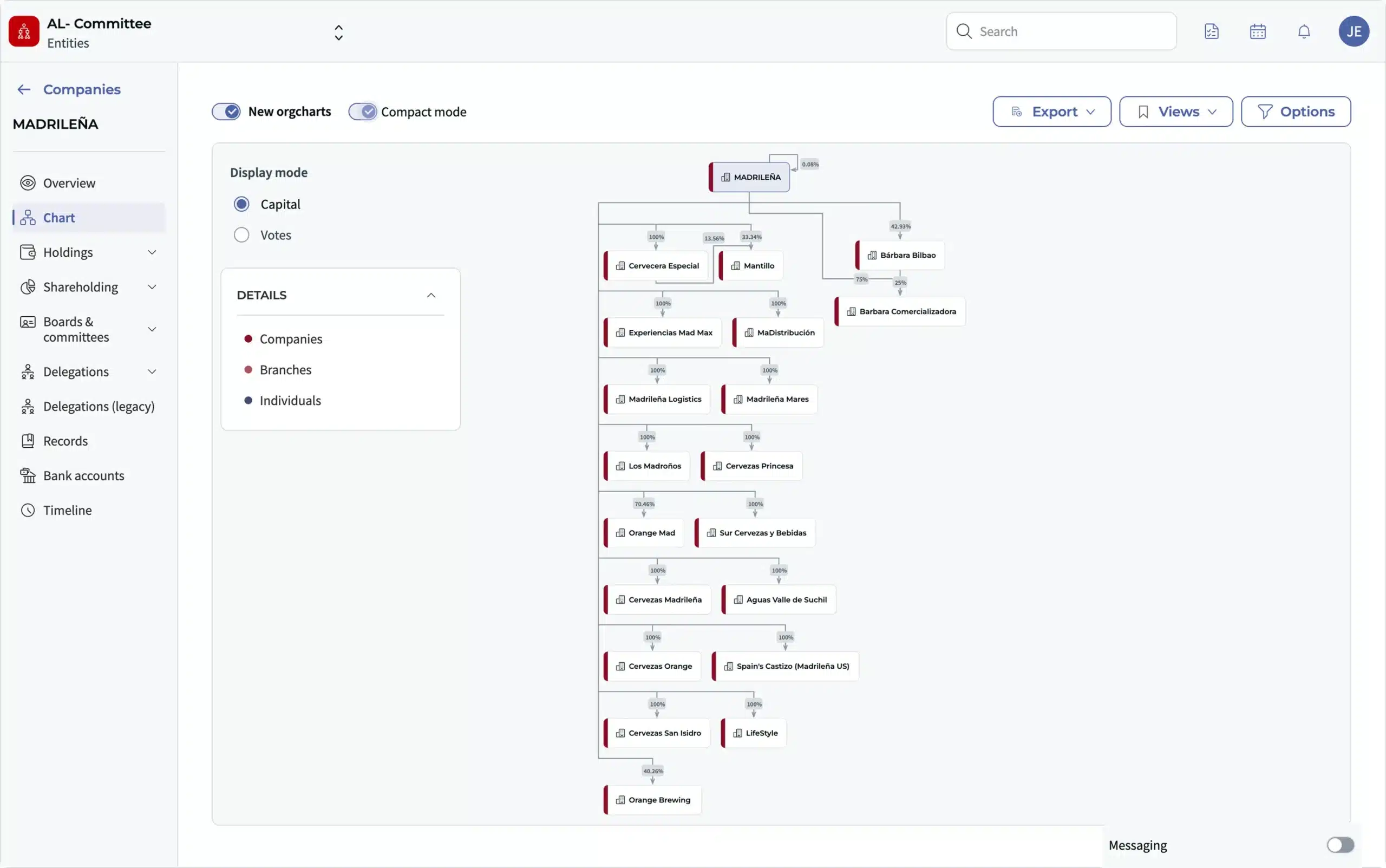
Org charts update automatically when the capital structure shifts. When an auditor asks for the historical ownership structure of a subsidiary as of a specific date, the answer is available in seconds.
Discover your savings
Calculate your potential annual benefit by streamlining governance and centralizing corporate records with DiliTrust.
The Bottom Line
A wholly owned subsidiary gives a parent company total control, clean IP ownership, and consolidated financial reporting. That comes at a price: full capital commitment and full governance responsibility across every jurisdiction where those subsidiaries operate.
Simple to define. Far harder to manage. For legal teams overseeing structures at scale, it goes well beyond tracking ownership percentages. They are maintaining compliance across dozens of entities, board compositions, mandate records, and capital changes in real time.
If that work is still happening in spreadsheets, the question is not whether something will go wrong. It is when.
To understand the principles behind effective legal entity management, and what good looks like at scale, DiliTrust’s resources are a practical starting point.
Ready to move entity management out of spreadsheets?
Frequently Asked Questions
Is a wholly owned subsidiary a separate legal entity?
Yes, a wholly owned subsidiary is incorporated as a separate legal entity with its own registered address, directors, corporate records, and liabilities. The parent company’s ownership does not merge the two entities legally: the subsidiary can enter contracts, hold assets, and incur debt independently.
Can a wholly owned subsidiary go public?
Not without first ceasing to be wholly owned. An IPO requires the sale of shares to public investors, which by definition reduces the parent’s ownership below 100%. Parents can spin off or partially divest subsidiaries to enable a public listing.
Is an LLC a wholly owned subsidiary?
Yes, an LLC can be a wholly owned subsidiary if 100% of its membership interests are held by a single parent company. In the US, a single-member LLC owned by a corporation is a common structure for wholly owned subsidiaries.
How do legal teams manage subsidiary governance at scale?
The teams that do it well operate from a single system of record: one platform where every entity’s data is current, every ownership change is logged, and every mandate is tracked across jurisdictions. Spreadsheets break at 10 subsidiaries. Purpose-built legal entity management software scales to thousands.