


Legal departments are absorbing more work than ever, without the budget or headcount to match. The 2025 Law Department Survey by Harbor makes this structural gap impossible to ignore: demand is surging in regulatory compliance (63%) and cybersecurity (58%), while only 47% of departments expect inside legal spend increases and just 32% expect attorney headcount growth. Meanwhile, only 37% of in-house teams now expect outside counsel spend to increase, down sharply from 58% the year before. More legal work is staying in-house.
That shift puts direct pressure on the systems your team relies on every day. Choosing between legal case management and matter management isn’t a theoretical debate. It’s a decision that affects how much legal work your department can handle, track, and report on. Here’s how to tell the difference, and how to choose.
What is Legal Case Management?
Legal case management refers to software designed primarily to track and organize litigation-related activities. These systems focus on the chronological progression of legal cases through defined stages, from initial filing through resolution.
Case management platforms typically include features for:
- Document storage and retrieval specific to individual cases
- Deadline tracking and calendar management for court dates and filings
- Task assignment and monitoring for case-related activities
Legal case management solutions excel in environments where organizations handle numerous similar cases following predictable patterns. Law firms specializing in high-volume practice areas such as personal injury, immigration, or family law often benefit from case management software. The structured approach helps legal teams maintain consistency across similar cases while tracking the unique details of each matter.
Case management systems provide a framework for organizing information about specific legal disputes. They create a centralized repository for all case-related documents, communications, and activities.
What is Matter Management?
What is matter management? It takes a broader approach, encompassing all types of legal work beyond litigation. This solution addresses the full spectrum of legal activities, including advisory work, transactions, compliance, and corporate governance.
Matter management systems offer:
- Comprehensive tracking of all legal matters across the organization
- Budget management and financial reporting capabilities
- Resource allocation tools for both internal and external counsel
- Advanced analytics for strategic decision-making
Matter management is particularly valuable for in-house legal departments and corporate legal teams managing diverse legal activities. These systems help general counsel track all legal matters affecting the business while providing visibility into spending, resource allocation, and operational efficiency.
Key Differences Between Case Management and Matter Management
The fundamental difference between legal case management vs matter management lies in their scope and focus. Case management centers on litigation processes, while matter management addresses the broader spectrum of legal work.
Scope and Organization
Case management organizes information around specific disputes or litigation events. Each case represents a discrete unit with its own timeline, documents, and tasks. The system follows the litigation lifecycle from filing through discovery, trial, and resolution.
Matter management, alternatively, organizes information around business objectives rather than specific disputes. A single matter might encompass multiple related activities, including contract negotiations, regulatory compliance, and potential litigation. This approach aligns legal work with business goals and provides a more comprehensive view of legal activities.
Financial Management
Financial tracking represents another significant difference. Case management systems typically offer basic expense tracking focused on individual cases. Matter management solutions provide more sophisticated financial tools, including:
- Budget creation and monitoring per matter
- Outside counsel fee tracking
- Allocation of costs across departments
- Financial reporting and analytics
These capabilities allow legal departments to demonstrate their value to the organization through improved cost control and resource allocation.
Integration Capabilities
Matter management systems generally offer more extensive integration with other business systems. While case management focuses on legal-specific workflows, matter management platforms connect with:
- Contract lifecycle management
- Document management systems
- Financial and billing systems
- Corporate entity management
This integration creates a more unified experience for legal teams working across multiple systems and departments. For organizations weighing case and matter management within a single technology environment, this breadth of connectivity is often the deciding factor.
Similarities Between the Approaches
Despite their differences, both systems share certain core functionalities. Both case and matter management solutions provide:
- Document organization and storage
- Task management and assignment
- Calendar and deadline tracking
- Reporting capabilities
Both approaches aim to improve efficiency, reduce risk, and enhance collaboration among legal professionals. When comparing matter management vs case management, the right choice depends on the specific needs and structure of your organization — not a universal ranking of one over the other.
Choosing the Right Solution for Your Organization
When evaluating legal management solutions, consider the following factors.
Don’t Want to Choose Between the Two?
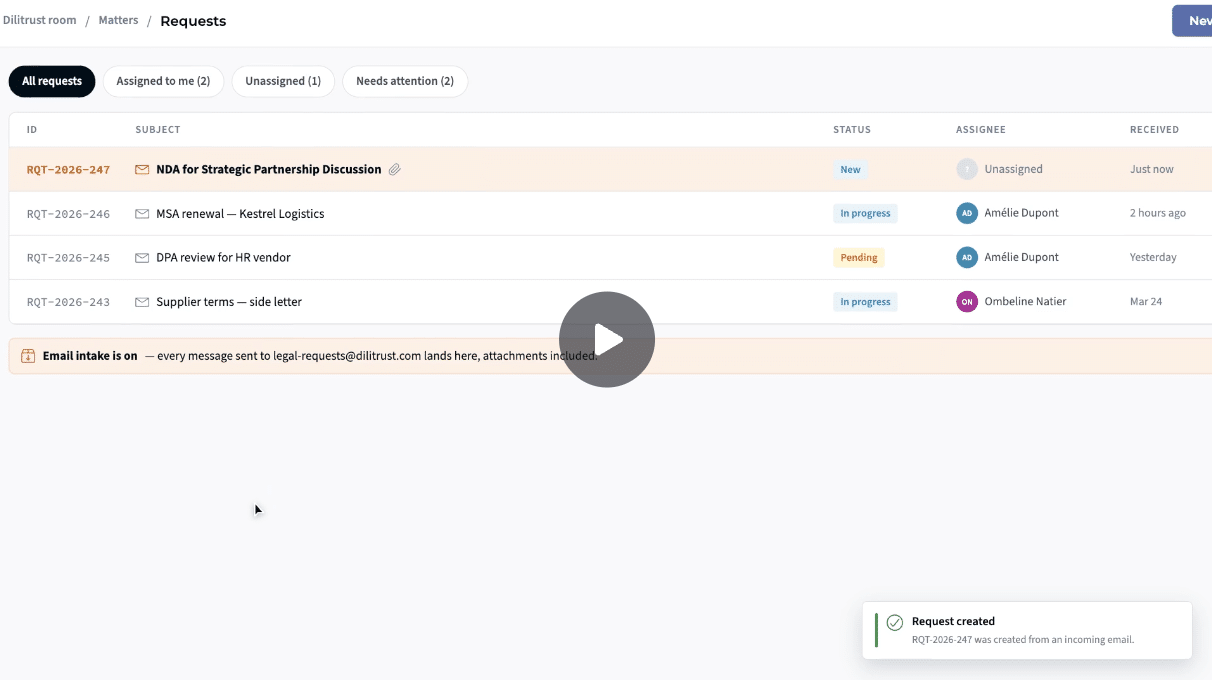
DiliTrust’s Matter Management module handles both — every matter and case tracked in one place, with automated routing, AI-generated status updates, and full audit trails, connected to contract and entity data instead of sitting in a separate tool.
Organization Type and Structure
Law firms typically benefit from case management systems that support their practice-specific workflows. The structured approach helps manage similar cases efficiently while maintaining quality standards.
In-house legal departments generally require matter management solutions to address their diverse responsibilities. The broader scope supports both routine legal work and strategic initiatives while providing visibility into all legal activities affecting the business.
Volume and Complexity of Legal Work
Organizations handling high volumes of similar cases often find case management systems more efficient. The standardized approach speeds up repetitive tasks and ensures consistency across matters of the same type.
Those managing fewer but more complex matters typically benefit from matter management solutions. The comprehensive approach provides better support for multifaceted legal issues requiring diverse expertise and resources.
Integration Requirements
Consider how your legal management system will connect with other technology platforms. Matter management solutions typically offer more extensive integration capabilities, creating a more unified technology ecosystem. When a single department handles both active litigation and transactional work, a platform that covers case and matter management avoids the operational cost of maintaining two disconnected systems.
The Evolution Toward Integrated Legal Management
The distinction between case and matter management is evolving fast as technology advances. Modern legal management platforms now combine elements of both approaches, offering comprehensive solutions for diverse legal needs.
These integrated platforms provide:
- Customizable workflows for both litigation and non-litigation matters
- Advanced document management with AI-powered search capabilities
- Sophisticated reporting and analytics
- Secure collaboration tools for internal and external stakeholders
The DiliTrust Suite exemplifies this integrated approach, offering a secure, unified platform for managing all aspects of legal operations. With modules for contract management, entity management, matter management, and document management, the suite provides a comprehensive solution for modern legal departments.
Most in-house teams manage cases in one tool, contracts in another, and entities somewhere else entirely. DiliTrust brings all of it into one platform — with matter tracking, contract management, and entity data connected from day one.
FAQ: Legal Case Management vs Matter Management
What is the difference between a case and a matter?
A case refers specifically to a litigation event: a formal legal dispute progressing through defined court stages, from filing to resolution. A matter is a broader term covering any type of legal work, including contracts, regulatory compliance, advisory requests, and litigation. All cases are matters, but not all matters are cases. The distinction matters most when choosing between legal case management vs matter management systems: case management tracks disputes specifically, while matter management covers the full scope of a legal department’s workload.
Can one system handle both case and matter management?
Yes. Modern legal management platforms are built to support both case and matter management within a single environment. Integrated matter management systems handle litigation tracking alongside contract work, compliance obligations, and advisory matters, without requiring separate tools for each category. DiliTrust’s Matter Management module is one example of a platform that consolidates both functions under a unified interface.
What are the four types of case management?
The four main types of case management are: litigation case management (tracking court-based disputes), transactional case management (managing deals, contracts, and closings), regulatory case management (handling compliance matters and investigations), and operational case management (processing high-volume, routine legal requests). In practice, matter management vs case management as distinct system categories maps most directly onto litigation, while the other three types are generally better handled by matter management systems with broader workflow capabilities.
What are the disadvantages of case management for in-house legal teams?
Legal case management systems are optimized for litigation workflows, which limits their usefulness in in-house departments that handle far more than disputes. Case management tools typically lack portfolio-level budget management, integrate poorly with contract or entity management systems, and offer limited analytics beyond individual case reporting. For in-house teams managing compliance, transactions, and advisory work alongside active cases, relying on case matter management in an isolated tool creates data silos and reporting gaps that dedicated matter management systems are built to resolve.
Making the Right Choice for Your Legal Department
Understanding where legal case management vs matter management diverges is the foundation for selecting the right solution for your organization. While case management excels in litigation-focused environments with standardized workflows, matter management offers a more comprehensive approach for diverse legal activities.
As legal technology continues to evolve, the most effective solutions combine elements of both approaches, providing flexible, integrated platforms that adapt to changing legal needs. This is especially relevant for case and matter management for large firms and enterprise in-house teams, where the variety of legal work — from active litigation to M&A and regulatory response — makes a siloed system impractical.
By assessing your organization’s structure, workload mix, and integration requirements, you can select a solution that improves collaboration and delivers measurable value. For legal departments ready to move from evaluation to implementation, matter management software provides a practical starting point.
Still tracking matters in a spreadsheet?
Spreadsheets and disconnected tools make it harder to see what is happening across your legal work. DiliTrust brings matters, contracts, and entity data together in one platform, giving your team the visibility and control to manage legal work more efficiently.