


Corporate legal teams are handling more work every year. Litigation files, regulatory inquiries, advisory requests, employment matters, cross-border compliance projects — the volume keeps growing, and so does the pressure to track it all accurately and report on it fast.
Most departments are still managing that work across spreadsheets, email threads, and informal updates. The system holds together until something slips through. And it always does eventually.
Legal matter management software is the fix. This guide covers what it is, what problems it solves, what features actually matter, and how AI is changing what’s possible.
What is legal matter management?
Legal matter management is the practice of organizing, tracking, and managing all legal work that flows through a corporate legal department. A “matter” is any discrete legal task or project: a contract dispute, a regulatory inquiry, an employment matter, an NDA review, a compliance investigation, or a transactional filing.
Matter management software brings all of that work into a centralized platform where it can be tracked, assigned, documented, and reported on. The result is a single source of truth for the legal department’s entire workload, replacing the scatter of shared inboxes, personal spreadsheets, and status-update meetings.
For General Counsel, it’s also a reporting tool. When every matter is captured in the system, producing a snapshot of legal exposure, team capacity, or spend takes minutes.
Matter management vs. case management
These terms get used interchangeably, but they describe different tools for different contexts.
Case management is built for litigation-heavy environments: law firms, courts, and practices where each case follows strict procedural rules, filing deadlines, and evidence requirements. The focus is procedural compliance within a single matter.
Matter management is broader. It covers the full portfolio of work a corporate legal department handles — advisory requests, compliance projects, transactional work, employment matters, and litigation. Legal teams use it to get an operational view across everything, not just individual cases.
For most in-house teams, matter management is the right category. Case-level activity can sit within it, but it’s one part of a much larger picture.
Who uses matter management software?
The users vary by role.
Finance and Compliance teams need visibility into legal spend and matter exposure — especially in regulated industries where cost accountability is non-negotiable.
Legal Operations teams typically own the system. They configure workflows, track capacity, and enforce billing guidelines.
In-house attorneys manage individual matters, log activity, upload documents, and coordinate with outside counsel.
General Counsel and Legal Managers use dashboards to review portfolio health, identify at-risk matters, and produce reports for the C-suite and the board.
Four problems it solves
1. Siloed information When every attorney manages their matters in a personal inbox or local folder, there’s no shared picture of what’s happening. Requests get duplicated. Context disappears when someone is out.
2. No visibility into workload Without a shared system, no one knows who’s overloaded until it’s too late. Deadlines get missed not because attorneys are careless, but because the demand on the team is invisible.
3. Budget surprises Outside counsel costs accumulate quietly when invoices aren’t reviewed against approved budgets. By the time Finance flags the overrun, it’s already happened.
4. Audit stress When a regulator or internal auditor asks for the full history of a matter, the team has to reconstruct it from email chains. That process is slow, error-prone, and creates real exposure.
Managing legal matters across scattered spreadsheets and inboxes? See how in-house legal teams centralize every matter, deadline, and document in one structured workspace.
Key features to look for in a matter management platform
Matter intake and triage
Every matter should start the same way: a structured request, not a Slack message or a hallway conversation. Good intake tools capture the right information at the point of request (deadline, type, priority, requesting team) and route it to the right person automatically. No back-and-forth emails. No lost context.
Task and workflow management
The platform should assign tasks, set deadlines, and move work forward without manual follow-up. Prebuilt templates for the most common matter types — litigation, advisory, regulatory — let teams launch new matters in minutes and keep every case consistent from day one.
Reporting and analytics
Workload dashboards, risk heat maps, and cycle time analysis are what turn matter management into a strategic tool. Legal ops and General Counsel need those numbers to manage capacity, justify headcount, and report to the business with actual data.
Document management
Every matter generates documents. A good platform keeps them organized within the matter record, version-controlled, and visible only to the right people. No hunting through shared drives or forwarding sensitive files over email.
Outside counsel management and e-billing
For organizations that use external law firms, the platform should connect billing directly to the matter. That means enforcing billing guidelines, reviewing invoices line by line, and tracking spend against budget in real time. One Fortune 500 industrial company used exactly this approach to reduce legal administration time by 40% and project $15 million in savings.
AI-generated matter summaries
The most capable platforms now generate automatic status updates for each matter. The system reads activity logs, task completions, and document uploads, then produces a plain-language summary. For a General Counsel preparing for a board briefing, that’s the difference between two hours of prep and a five-minute review.
How DiliTrust’s Matter Management module works
DiliTrust’s Matter Management module is part of the DiliTrust Governance Suite — a platform built specifically for corporate legal departments. It brings every active matter, task, and document into one centralized workspace, with real-time visibility into status, progress, and cost.
Four core components make up the module:
- Quick View: AI-generated status snapshots for each matter, pulling together comments, tasks, key dates, and progress updates into a concise brief ready to share.
- Activity Feed: A real-time log of every action attached to a matter, including calls, meetings, document updates, and key dates. The whole team works from the same record.
- Prebuilt Matters: Templates for the three most common matter types. Teams launch new matters in minutes without building structure from scratch each time.
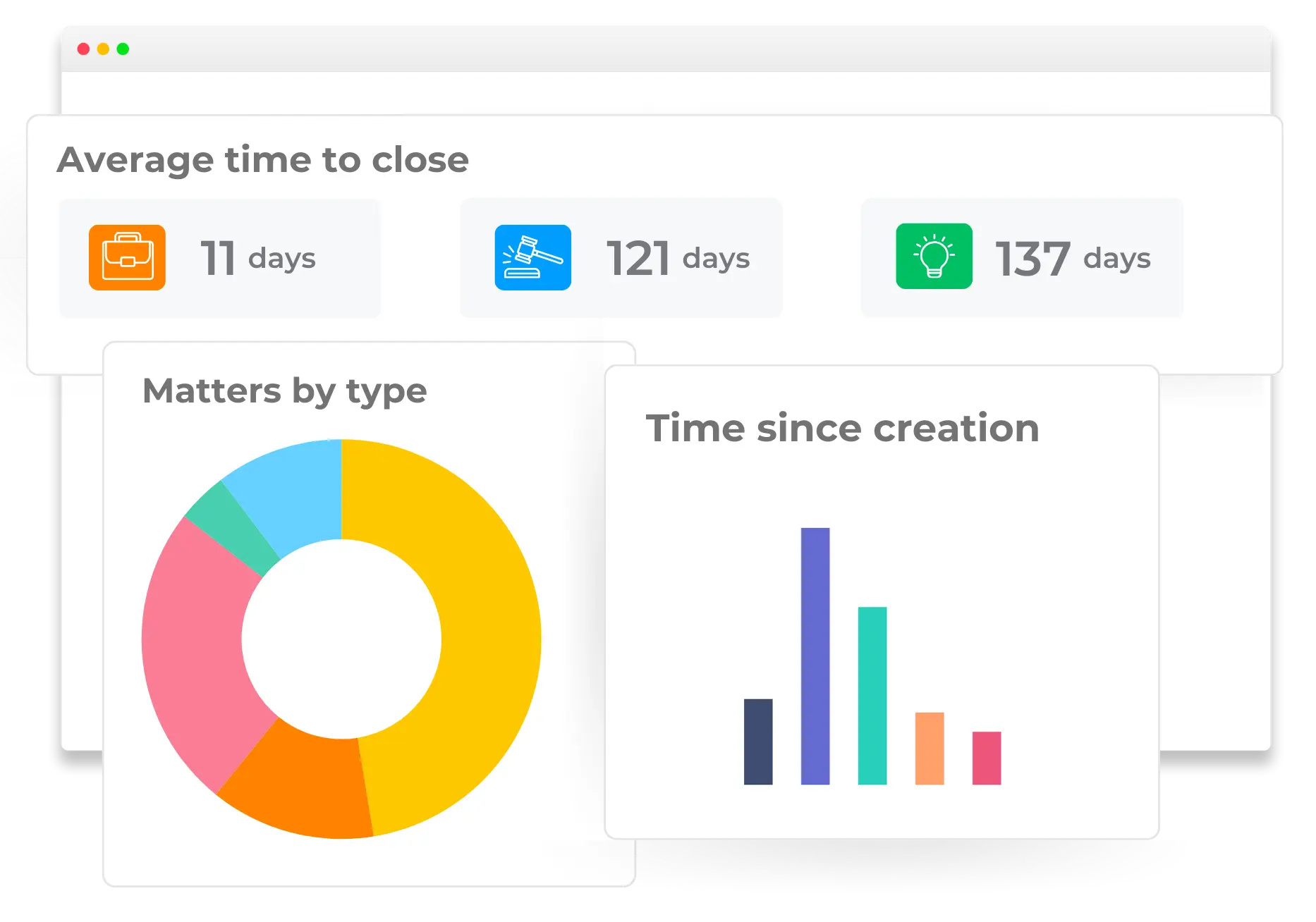
- Statistics Dashboard: A live view of open matters, matter types, complexity levels, and workload distribution. Managers get the data to reallocate resources before a deadline is missed.
Lini: the AI layer across every matter
Lini is DiliTrust’s proprietary AI engine, built in-house over seven years. In matter management, Lini generates the Quick View summaries, surfaces key dates and outstanding actions, and gives attorneys an instant read on any matter’s current state.
Because Lini is proprietary, it operates entirely within DiliTrust’s data security environment. Matter data isn’t processed by a third-party AI service, which matters for organizations with strict data handling obligations across multiple jurisdictions.
Handling matters across multiple jurisdictions and outside counsel relationships? DiliTrust’s Matter Management module connects intake, tracking, spend, and AI-generated summaries in one governed workspace. Download the Matter Management brochure →
Matter management as part of a connected legal platform
The value of matter management grows when it sits inside a unified legal platform. A contract dispute that starts in the Contract Management module can be escalated directly into a matter. An entity tied to that dispute can be pulled from Legal Entity Management. The General Counsel sees the full picture — contract to matter to entity — without switching systems or re-entering data.
This connected model is what separates a purpose-built legal platform from a collection of disconnected tools.
AI depends on it too. According to the 2026 General Counsel Report by FTI Consulting and Relativity, 87% of General Counsel now use generative AI in their work, up from 44% in 2025. But AI only produces reliable output when the data it draws from is structured and connected. A matter management module that sits in isolation gives AI very little to work with. One that shares data with contracts, entities, and board decisions gives it a full operational picture.
Matter management platform evaluation checklist
Frequently asked questions
What is the difference between matter management and case management?
Case management tracks procedural deadlines, court filings, and evidence within a single litigation matter. Matter management covers the full range of work a corporate legal department handles: advisory requests, compliance projects, employment issues, transactions, and litigation. For in-house teams, matter management is the broader operational category. Case activity can sit within it, but it’s one part of the larger portfolio.
What software do legal operations teams use for matter management?
Legal operations teams use dedicated matter management platforms that combine intake, workflow automation, document storage, reporting, and e-billing in a single system. DiliTrust’s Matter Management module is built for corporate legal departments, with AI-generated status updates through Lini, prebuilt matter templates, and a live statistics dashboard. It can be deployed as a standalone module or as part of the full DiliTrust Governance Suite.
How can matter management workflows be automated?
Matter management platforms automate intake routing, task assignment, deadline notifications, and status reporting. DiliTrust uses Lini, its proprietary AI, to generate plain-language matter summaries automatically — so attorneys spend less time on status updates and more time on substantive legal work. Prebuilt templates for common matter types also cut setup time significantly.
How long does it take to implement matter management software?
It depends on the platform and the complexity of the deployment. DiliTrust’s Matter Management module is designed for fast implementation — no external consultants required, no custom code. A global insurance organization migrated from a legacy enterprise legal management system to DiliTrust in under a year, reducing IT support costs by more than 50% and cutting report delivery time from weeks to hours.
What features should matter management software include?
At minimum: structured intake, task and deadline tracking, document storage, real-time reporting dashboards, and role-based access controls. For organizations working with external law firms, e-billing integration and billing guideline enforcement are essential. AI-generated summaries and connectivity to other legal workflows (contracts, entity management, board management) are now standard expectations for any serious platform evaluation.
See how DiliTrust works for in-house legal teams
Legal departments that have moved past spreadsheets share one thing: a single, structured system for all their legal work. Every matter tracked. Every deadline visible. Every dollar accountable.