


When a regulatory authority asks for a complete, audited view of your group’s shareholding structure across 30 subsidiaries in 8 countries, you have 72 hours to respond. Can your team do it?
For many enterprise legal departments, the honest answer involves pain. Ownership records split across spreadsheets, legacy tools, and email threads. Share transfers recorded by finance but missing from the legal register. Historical data that doesn’t match what’s in the corporate books. Cap table management is where governance gets real, and where the gap between “good enough” and “audit-ready” becomes expensive.
Key Takeaways
What Is Cap Table Management?
Cap table management is the ongoing process of tracking, updating, and maintaining a company’s capitalization table, the authoritative record of all equity ownership. It covers every class of shares, the identity of each shareholder, their ownership percentage, voting rights, and the complete history of capital transactions: issuances, transfers, splits, mergers, and buybacks.
For a startup with 10 shareholders, this might fit in a spreadsheet. For an enterprise managing 50 subsidiaries across Europe and North America, it’s a governance discipline that sits at the heart of regulatory compliance, strategic decision-making, and financial reporting. It requires purpose-built infrastructure to maintain reliably.
What a Cap Table Includes
A complete cap table goes well beyond a list of shareholders. At minimum, it needs to reflect:
In practice, enterprise cap tables also need to track cross-holdings between group entities, shareholder agreements, and pledged or encumbered shares. That’s complexity no standard spreadsheet handles gracefully.
Why Cap Table Accuracy Is a Governance Imperative
A mismanaged cap table is rarely just an administrative inconvenience. It creates real legal and financial liability.
The risks of inaccurate ownership records
A single unrecorded share transfer can produce conflicting ownership claims. Incorrect voting rights records can invalidate shareholder meeting resolutions. Gaps in historical data make regulatory reporting unreliable and expose the organization to penalties in jurisdictions with strict corporate transparency requirements.
The consequences compound during transactions. A buyer’s legal team conducting M&A due diligence will ask for a complete, audited view of your shareholding structure, across every entity in the group, as of the current date and often as of specific past dates. If that picture lives in a patchwork of tools and email threads, assembling it takes days. If it contains inconsistencies, the deal timeline slips. Sometimes, the deal itself does.
What regulators and investors actually ask for
Regulatory requests in Europe increasingly require granular disclosure of ownership structures: beneficial owners, voting arrangements, cross-holdings, and intra-group transactions. Banking regulators (Pillar 2, NIS 2), securities authorities, and tax administrations all rely on accurate cap table data. The organizations that respond reliably are those that have invested in maintaining it as a live, audited record rather than a document you reconstruct on demand.
A 2021 EY report found that, while a majority of organizations use purpose-built legal entity management technology, 96% still report challenges with their systems. Outdated tools and fragmented data remain the norm. That’s the gap a modern Legal Entity Management platform is built to close.
See how DiliTrust Entity Management centralizes shareholding data, tracks capital transactions, and generates real-time org charts across your entire group structure. Explore DiliTrust →
The Limits of Spreadsheets
For a single-entity company with a handful of shareholders, a well-maintained spreadsheet can work. But it breaks down at the first sign of complexity:
| Scenario | Spreadsheet reality |
|---|---|
| Multiple share classes with different voting rights | Manual, error-prone to maintain |
| Share transfer logged by finance, not by legal | Conflicting versions, no reconciliation |
| Historical snapshot needed for a specific past date | Hours of manual reconstruction |
| Org chart update after a capital increase | Another manual process, another error risk |
| Regulatory filing requires a certified shareholder register | Requires external validation |
| Group with 20+ subsidiaries | No longer feasible |
When legal, finance, and corporate secretarial teams each maintain their own version of shareholding data, the cap table stops being a reliable record. It becomes a liability. The question stops being whether to move to dedicated software. It becomes whether the software you choose was built for your level of complexity.
What to Look for in Cap Table Management Software
Most cap table tools were designed for a specific audience: startup founders managing a simple equity structure in a US jurisdiction. Enterprise legal teams need something built around different requirements.
Shareholding and capital management
Look for a platform that handles all share types natively (including no-par-value shares, standard in North American and common law jurisdictions) and that supports multiple ownership models: by number of shares, by percentage, or by direct capital amounts. Capital operations (share splits, regroups, mergers, capital reductions) should update ownership records and voting rights automatically.
Audit trail and data governance
Every change to shareholding data should be date- and time-stamped, attributed to a specific user, and preserved immutably. For regulated industries, the ability to produce a certified historical snapshot of ownership data as of any past date isn’t a nice-to-have. It’s a compliance requirement.
Multi-entity and cross-jurisdictional support
Enterprise groups don’t have one cap table. They have dozens, often across different legal systems and regulatory environments. The platform needs to handle this natively: entity-level records that feed into a consolidated group view, org charts that update automatically, and support for jurisdiction-specific share structures and legal forms.
Role-based access and permissions
Finance teams shouldn’t be able to modify legal data, and vice versa. Granular, role-based access control lets different teams update their own data fields while maintaining a single authoritative source of truth, with a clear record of who changed what.
Integration with legal entity management
A cap table doesn’t exist in isolation. It connects to director and officer records, board resolutions, shareholder agreements, and regulatory filings. Managing these in separate systems recreates the fragmentation you’re trying to eliminate. An integrated Legal Entity Management platform connects shareholding data to the full governance record of each entity in the group.
Cap Table Management Across a Corporate Group
Here’s where most cap table discussions stop making sense for enterprise legal teams. The typical guide assumes a single entity, a short shareholder list, and a US-based equity structure.
Reality looks different. A General Counsel managing a group of 50 subsidiaries across Europe and North America deals with shareholding structures that cross jurisdictions, legal forms, and ownership types. Some entities issue shares with par value. Others (especially in Delaware, the UK, and Belgium) issue shares with no par value. Some ownership interests are expressed as percentages rather than share counts. Some subsidiaries are partially owned by other group entities, creating multi-level ownership chains that no startup cap table tool was designed to handle.
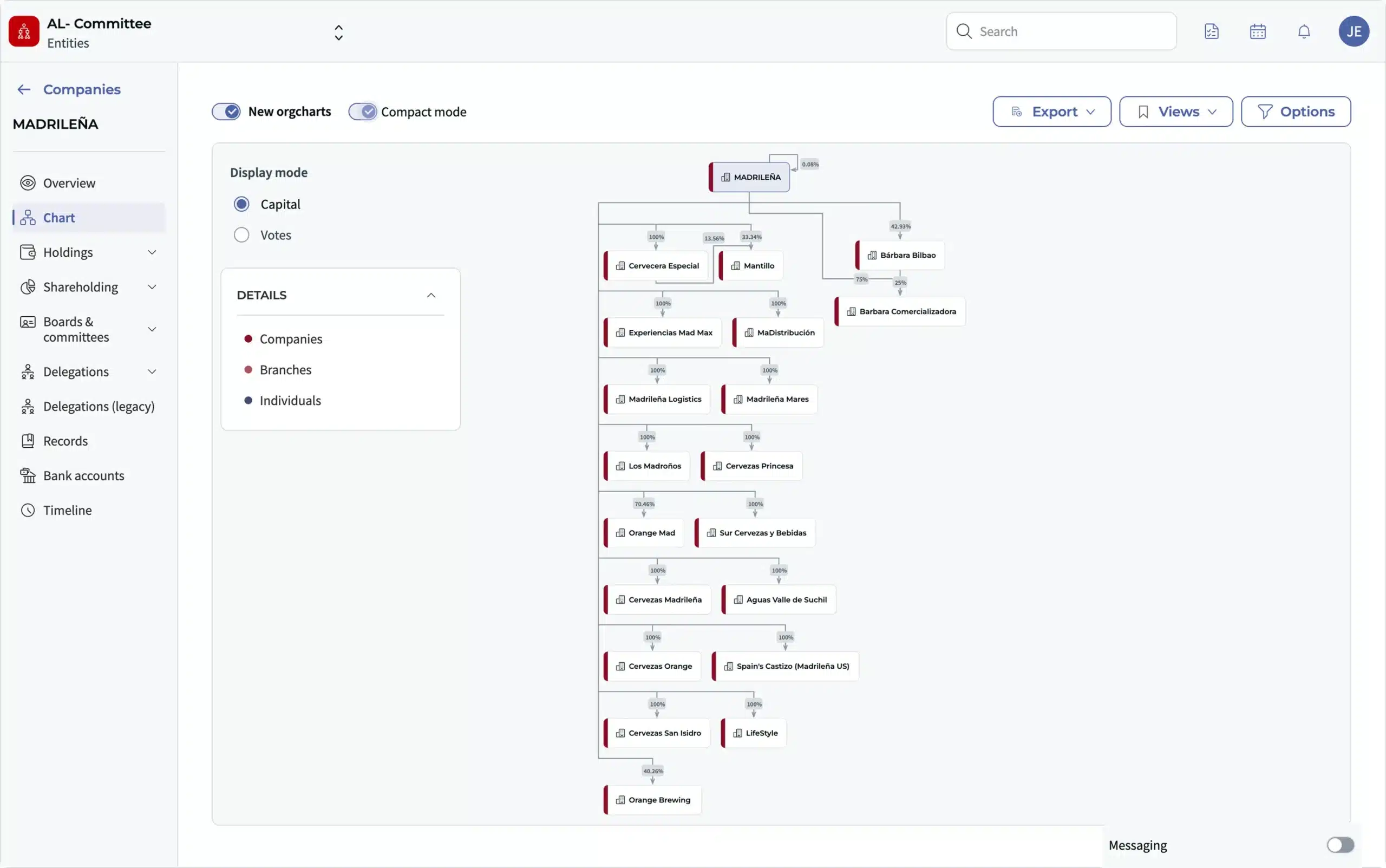
This is where Legal Entity Management software differs from startup equity software. A purpose-built LEM platform centralizes all shareholding data across the group: share classes, ownership percentages, capital operations, voting rights, corporate books and registers, and dynamic org charts, all in a single, jurisdiction-aware system. When a share transfer occurs in one subsidiary, the group org chart updates automatically. When a regulatory review requires a historical snapshot of the entire group structure as of 18 months ago, the platform generates it in seconds, not days.
DiliTrust Entity Management does exactly this. It manages shareholding structures across complex group hierarchies, handling no-par-value shares, percentage-based ownership, flexible voting rights, and capital operations, with full audit trail and automated org chart generation built in.
Managing shareholding structures across multiple entities and jurisdictions? DiliTrust Entity Management gives your legal team a real-time, auditable view of every cap table in the group. See how it works →
Conclusion: Get Your Shareholding Data Right
Cap table management gets called a compliance obligation. It’s also a strategic asset. Legal teams that maintain accurate, auditable shareholding records across their entire group can respond to regulatory requests in hours, close transactions without delays, and give leadership real-time visibility into ownership and governance.
The tools startup founders use to manage a handful of shareholders don’t hold up at enterprise scale. Legal teams managing complex group structures need platforms built specifically for multi-entity governance: platforms where shareholding data connects to the full legal record of each entity, updates automatically with every capital transaction, and produces certified historical snapshots on demand.
DiliTrust Entity Management gives General Counsels exactly that: one governance platform for shareholding structures, capital operations, voting rights, and corporate books, across every entity in the group, in every jurisdiction.
Discover your savings
Calculate your potential annual benefit by streamlining governance and centralizing corporate records with DiliTrust.
Frequently Asked Questions
What software do General Counsels use to manage shareholding structures across multiple entities?
Purpose-built Legal Entity Management platforms are the standard for enterprise legal teams. Startup-focused equity tools like Carta or Ledgy are built for single-entity, US-centric structures. For groups with multiple subsidiaries across jurisdictions, platforms like DiliTrust Entitiy Management provide the multi-entity shareholding management, capital operation tracking, audit trail capabilities, and dynamic org charts that enterprise governance requires.
How can cap table management be automated?
Modern LEM platforms automate the most time-consuming parts: org chart updates after ownership changes, deadline alerts for regulatory filings, capital operation logging, and historical snapshot generation. DiliTrust Entities, for example, updates the group org chart automatically with every share transfer and generates date-specific ownership reports on demand, eliminating the manual reconstruction work that typically costs legal teams days of preparation.
Who is responsible for managing the cap table in a corporate group?
In most enterprises, responsibility is distributed across legal, finance, and corporate secretarial functions. Legal teams own the governance record; finance tracks capital and equity for reporting; corporate secretaries maintain statutory registers. Fragmentation between these teams is the most common source of cap table inaccuracies. That’s why purpose-built LEM platforms enforce a single, shared source of truth with role-based access for each team.