






Board of directors compensation is the cash and equity a company pays its non-employee directors for board and committee service. If you sit on the compensation committee or run the board secretariat, you need two answers: what the market pays and how to set a number you can defend.
That second answer matters more than most guides admit. Directors approve their own pay. Shareholders, proxy advisors and Delaware courts all scrutinize how directors set their own pay.
This guide gives you current public-company benchmarks and practical guidance for private and nonprofit boards, then a 7-step process to set and document director pay.
At a glance
- S&P 500 non-employee directors earned $346,290 in average total compensation in 2026, up 3% from 2025, according to the 2026 U.S. Spencer Stuart Board Index.
- Across the Russell 3000, median total director pay clusters around $250,000 in most industries.
- About 9 in 10 Russell 3000 and S&P 500 companies now rely on a cash-retainer-only structure, with no meeting fees.
- Stock awards are the largest single component of public company director pay.
- About three-quarters of companies in the Russell 3000 and S&P 500 have some form of shareholder-approved limit on director pay. The median cap is $750,000.
- Because directors set their own pay, the process and the record behind it carry as much weight as the number itself.
How much do board members get paid?
Public company directors typically earn $250,000 to $350,000 a year in cash and stock. Private company directors earn far less, and most nonprofit board members aren’t paid at all. The figure depends on company size, sector and the director’s committee and leadership roles.
| Board type | Typical total pay | Usual mix | Main data source |
|---|---|---|---|
| S&P 500 | $346,290 average | Cash retainer plus stock awards | Spencer Stuart Board Index 2026 |
| Russell 3000 | About $250,000 median in most sectors | Cash retainer plus stock awards | The Conference Board, 2025 disclosures |
| Private company | Well below public levels | Cash-heavy, equity less common | Private surveys and adapted public peer data |
| Nonprofit | Usually $0 | Expense reimbursement | National Council of Nonprofits |
Public company boards
For U.S. public companies, director pay is generally disclosed in proxy statements. That makes the U.S. public-company market a useful reference point for private and nonprofit boards, although their pay practices differ.
The Conference Board’s review of 2025 disclosures, published by the Harvard Law School Forum on Corporate Governance, puts the median cash retainer at $75,000 in the Russell 3000 and $105,000 in the S&P 500. The median stock award is $150,000 in the Russell 3000 and $190,000 in the S&P 500.
Sector moves the number. Health care boards pay a median above $320,000. Financial firms pay just over $180,000, which the Conference Board links to the many smaller regional banks and insurers in that group.
Private company boards
Private companies don’t file proxy statements, so there’s no public data set to compare against. Most rely on paid surveys or on public company peers, scaled down for size and liquidity.
Pay is usually lower and more cash-based. Equity is harder to offer when there’s no liquid market for the shares, and many private boards include investor representatives who aren’t paid separately for their seat.
Nonprofit boards
The National Council of Nonprofits notes that the vast majority of charitable nonprofit board members serve as unpaid volunteers. Reimbursing reasonable travel and meeting expenses is standard.
Federal law doesn’t ban paying nonprofit directors. Any pay must be reasonable, your bylaws may prohibit it, and it’s reported on the organization’s Form 990. Before you propose it, check your state law and ask whether paid seats change how donors read your board.
What board member compensation is made of
A public company director pay program has 4 building blocks. Most boards now use 2 or 3 of them.
| Component | What it pays for | Market practice |
|---|---|---|
| Annual cash retainer | Board service across the year | Median cash retainer: $75,000 (Russell 3000) and $105,000 (S&P 500) |
| Equity award | Alignment with shareholders | Median stock award: $150,000 (Russell 3000) and $190,000 (S&P 500); usually fixed-value |
| Committee and leadership premiums | Extra workload of chairs and committee roles | Median board chair premium: $61,000 (Russell 3000) and $116,250 (S&P 500) |
| Meeting fees | Attendance at each meeting | Declining; median total meeting fees: $10,500 (Russell 3000) and $12,000 (S&P 500) |
Source: The Conference Board, 2025 disclosures.
Meeting fees are fading for a practical reason. When a crisis doubles the meeting calendar, per-meeting fees double director pay with it. A flat retainer pays for overall service rather than attendance and can reduce concerns that meeting frequency affects director pay.
Perks stay modest. Travel reimbursement is the most common benefit. Around a quarter of Russell 3000 companies and more than 40% of S&P 500 companies pay for director education.
Why director pay carries legal risk
Here’s the problem with setting director compensation: each director has a personal interest in the outcome, so the usual protection associated with an independent committee may not apply when the board sets its own pay.
Delaware courts treat that seriously. In In re Investors Bancorp (2017), the Delaware Supreme Court held that when directors keep discretion to grant themselves awards under a general shareholder-approved plan, a challenged award can face entire fairness review. Directors then have to prove the award was fair. The ratification defense is generally available when fully informed, uncoerced and disinterested stockholders approve the specific awards or a self-executing plan with fixed criteria.
The market has responded with guardrails:
- Shareholder-approved limits. 52% of Russell 3000 companies now set an overall annual cap, up from 33% in 2021. The median limit is $750,000.
- Proxy advisor scrutiny. ISS benchmarks director pay against industry peers and may recommend votes against compensation committee members when outlier pay persists without a clear rationale. Glass Lewis expects pay to track time commitment and discourages performance-based equity for directors.
- Investor policies. BlackRock and Vanguard publish their own expectations, from equity alignment to plan dilution.
So the question to ask before any change is simple. If a shareholder challenged this award tomorrow, could your minutes show how the number was reached?
Make every pay decision easy to evidence
Keep committee papers, votes and minutes in one access-controlled record, so you can show how each decision was reached.
How to set board of directors compensation in 7 steps
A defensible program comes from a repeatable process. These 7 steps work for a first-time design and for the annual review.
1. Assign the review to the right committee
Decide which committee owns director pay. At many U.S. companies it’s the compensation committee. Others give it to the nominating and governance committee, which already oversees board composition.
Write the responsibility into the committee charter. If you’re unsure where it fits, our guide to board committees and their functions shows how responsibilities typically split.
2. Bring in independent advice
An outside compensation consultant gives the committee benchmark data and an outside view. The engagement also gives you a record showing that the number didn’t come from the directors alone.
Check the consultant’s independence the same way you would for executive pay work. Record who advised, on what and when.
3. Build a peer group and pull the data
Use the same peer group as your executive pay review, unless there’s a documented reason not to. Then pull each peer’s Director Compensation Table from its latest proxy statement.
Look at more than totals. Compare the retainer, the equity grant, committee premiums, leadership premiums and vesting terms, line by line.

4. Design the pay mix
Most public boards land on a cash retainer plus an annual fixed-value equity award, with premiums for committee chairs and the board chair or lead independent director. Drop meeting fees unless you have a specific reason to keep them.
Set where you want to sit against peers. Many boards target the median. If you go above it, write down why: a heavier committee load, a transformation year, a hard-to-fill skill set.
5. Test the proposal against your guardrails
Run three checks before the committee votes:
- Does each director’s total stay within your shareholder-approved limit?
- Would ISS or Glass Lewis flag it as an outlier against peers?
- Does the change fit the voting policies of your largest shareholders?
If you don’t have a shareholder-approved limit yet, this is the moment to propose one. A cap approved by shareholders strengthens the case that pay decisions inside it were reasonable.
6. Approve the program and record the reasoning
The committee recommends. The full board approves. Your minutes should show what the directors reviewed, which peer data they used, what advice the consultant gave and why they chose the final figures.
This is where most programs are won or lost in a later dispute. “The board approved the revised director compensation program” says nothing. “The committee reviewed peer data from 14 companies prepared by its independent consultant and set the retainer at the peer median” says a great deal.
Run your next director pay review on one record
See how committees prepare papers, vote and keep signed minutes in a single secure workspace.
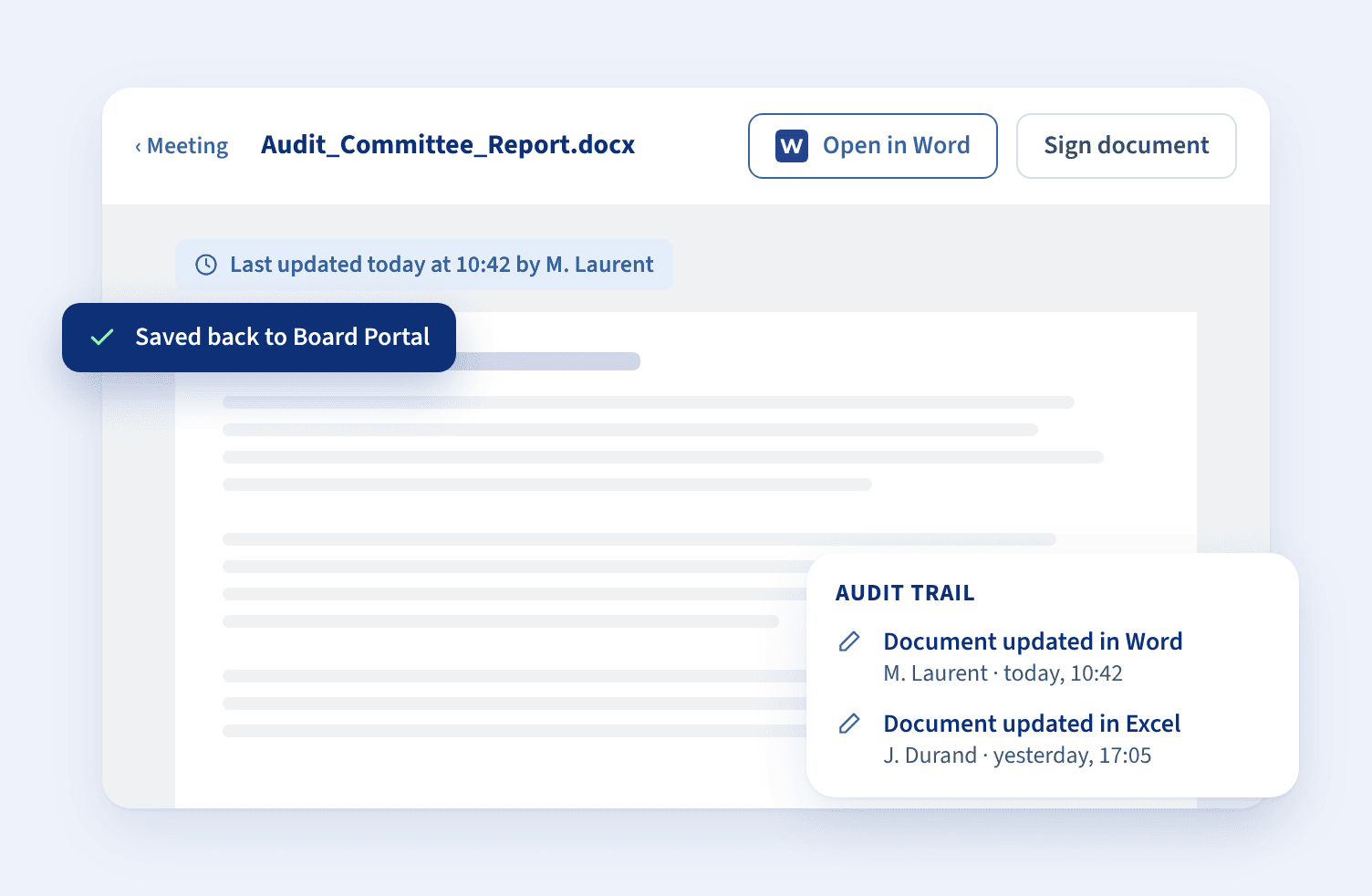
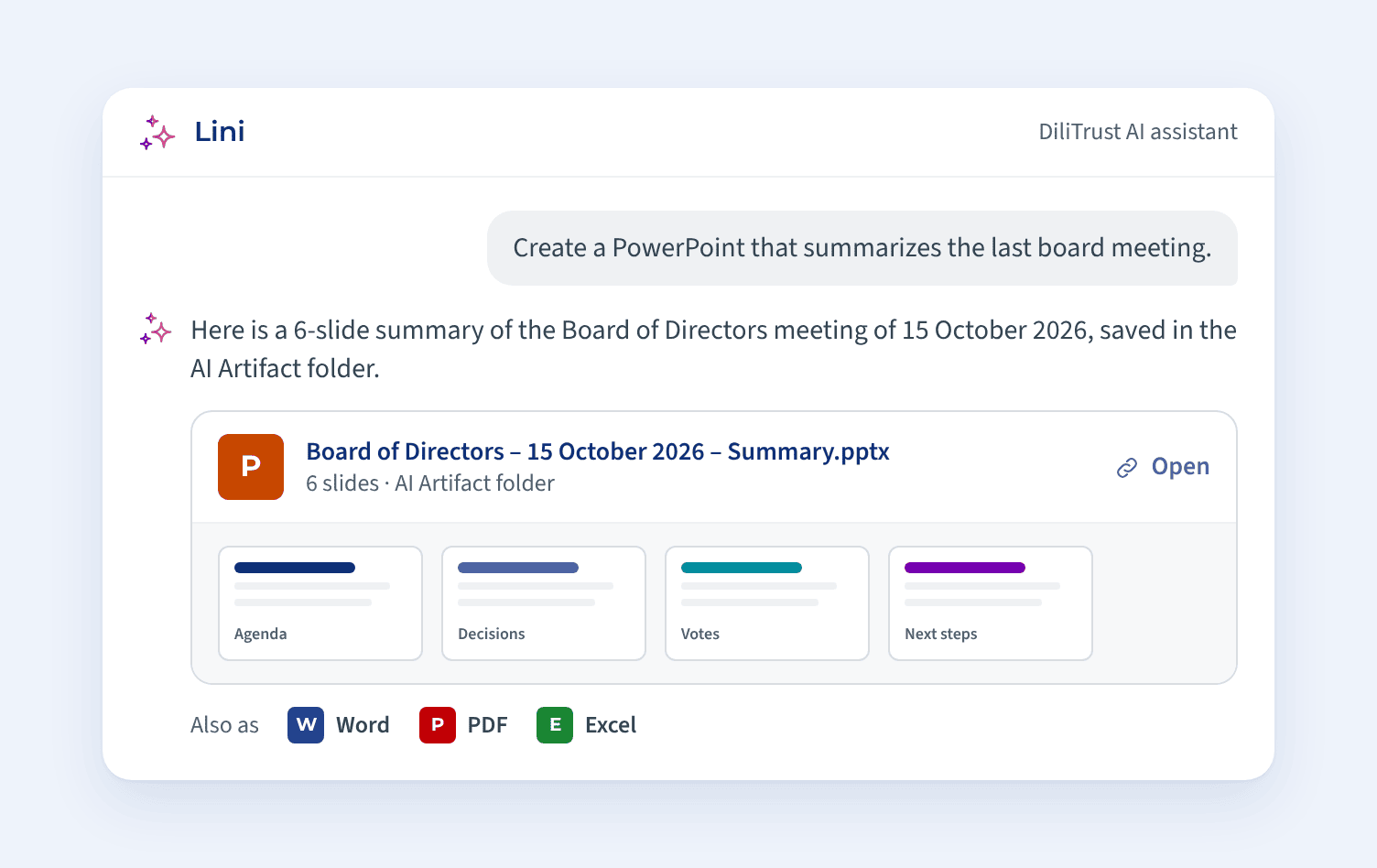
A board portal makes that record easier to keep. With DiliTrust Board Portal, you can restrict committee papers to the members who need them, run the committee and board votes in the platform and keep signed minutes and resolutions with their supporting documents. Lini, DiliTrust’s AI assistant, drafts the minutes from the agenda, the meeting transcript and the supporting papers, so you start from a draft instead of a blank page.

7. Disclose it and set the review cycle
Report the program in your next proxy statement, then put the next review on the committee calendar. Many boards look at director pay every year and change it only when the gap to market justifies it.
Small, explained changes draw less fire than a large jump after years of no movement.
How director compensation is disclosed in the proxy statement
U.S. public companies disclose director pay under Item 402(k) of Regulation S-K. S-K. The Director Compensation Table covers each director who served during the last completed fiscal year, subject to the exception for directors whose compensation is fully reported in the Summary Compensation Table as named executive officers.
For directors covered by the table, it shows:
- Fees earned or paid in cash, including annual retainer fees, committee and/or chairmanship fees, and meeting fees
- Stock awards, at aggregate grant date fair value computed in accordance with FASB ASC Topic 718
- Option awards, at aggregate grant date fair value computed in accordance with FASB ASC Topic 718
- Non-equity incentive plan compensation
- Change in pension value and above-market or preferential earnings on nonqualified deferred compensation
- All other compensation, including perquisites and personal benefits, consulting fees, and other reportable amounts
- Total
A narrative explains the program behind the numbers. For the full filing sequence, from D&O questionnaires to the DEF 14A, see our guide to preparing the proxy statement.
Frequently asked questions
Are board members employees?
Not necessarily. Non-employee directors serve on the board in that capacity rather than as employees. Their director fees are generally reported on Form 1099-NEC rather than Form W-2.
Is board of directors compensation taxable?
Yes. The IRS Schedule SE instructions list fees received for services as a corporate director as self-employment earnings. Equity awards follow their own tax rules, so directors should take personal tax advice.
Do nonprofit board members get paid?
The statement that paying nonprofit directors is legal under federal tax law if the pay is reasonable should be checked by Legal or Tax. The National Council of Nonprofits confirms that most charitable nonprofit board members are unpaid volunteers, but also notes that bylaws and state-specific rules can limit or address compensation.
How often should board compensation be reviewed?
Many boards review director pay every year and change it only when benchmarks show a meaningful gap. An annual review keeps changes small and easier to explain to shareholders.
What is a lead independent director premium?
It’s an extra retainer paid to the lead independent director for the added work of chairing executive sessions, acting as a link between independent directors and the CEO and shaping board agendas. You’ll find peer amounts in the narrative under each company’s Director Compensation Table.
Do advisory board members get paid?
Often, but less than fiduciary directors. Advisory board members don’t owe fiduciary duties or vote on company decisions, and their pay is usually set by contract.
Can directors get performance-based pay?
The statement that performance-based director pay is rare and that proxy advisors push back should have a direct source or be explicitly attributed to the Conference Board research. The linked research supports Glass Lewis’s preference for fixed-value equity and cash retainers, and its concern about performance-based equity.
The bottom line on director pay
Setting board of directors compensation is one of the few decisions where every director has a personal stake. Benchmarks tell you where the market sits. Your process and your minutes are what make the number defensible.
Pick a peer group, take independent advice, stay inside a shareholder-approved limit and write down the reasoning. Then, if questions arise during the next proxy season or in a shareholder letter, you can answer with a documented record instead of defending an undocumented decision.
Be ready when someone asks how director pay was set
Prepare committee papers, run votes and keep signed minutes in one secure place, ready for any request.