


Every contract signed by a company constitutes a valuable legal record: obligations, responsibilities, deadlines, penalties… Yet most legal departments have fragmented knowledge of their contractual portfolio. And with good reason: this information is often stored in unstructured files, scattered between departments… The good news is that there is a way of countering these difficulties, and it all hinges on a well-structured, well-worked contract database. We tell you all about it.
Contract Database Definition
Contracts are not just legal documents; they also contain information that is critical to business management. Contractual data refers to all the elements extracted from a contract in a structured form: key dates, legal clauses, mutual obligations, parties involved, amounts, durations, applicable jurisdictions, and so on.
When extracted, centralized and structured in a contract database, these data become usable. It enables you to:
Why a Contract Database is Essential
A well-structured contract database enables you to:
In short, a contract database transforms contracts into living assets. It is a strategic lever for securing operations, improving governance and reinforcing the position of the legal department as a partner in performance.
From archiving to contract strategy
Too often, contract management is reduced to an administrative function: finding a contract, checking a clause, responding to an emergency. This reactive approach prevents you from seeing the big picture.
Setting up a contract database means transforming this approach.
By structuring contracts in the form of usable data, the legal department gains immediate, up-to-date global visibility of its contractual environment.
Strategic Capabilities Enabled
You can then:
- Anticipate critical deadlines (renewals, notice periods)
- Identify high-risk clauses (limitation of liability, force majeure)
- Monitor compliance with contractual commitments
Discover your savings
Get a realistic ROI based on industry standards when you partner with DiliTrust on CLM.
The benefits of a good contract database
Reducing Legal Risks
The creation of a contract database is first and foremost a means of ensuring legal certainty.
Example: Automatic termination clauses
Without a centralized warning system, a company can find itself tied to a disadvantageous contract for several years if it fails to give notice in good time.
Thanks to a contract database, these clauses are:
The legal department can set up alerts, establish criticality thresholds, and regain control of its commitments.
Example: Applicable law and jurisdiction clauses
In the event of cross-border litigation, their rapid identification via the contractual database can immediately guide the defense strategy.
Strengthening Regulatory Compliance
Faced with growing compliance requirements (GDPR, anti-corruption, ESG), companies need to be able to keep good track of their contracts.
A contract database makes it possible to record:
It then becomes an essential tool for Compliance, CSR or Legal teams in managing audits, ESG assessments or internal investigations.
Going further: some solutions link the contract database to the management of legal entities, to ensure consistency between contractual structure and governance.
Better Management of Disputes and Litigation
Litigation is often based on a contract at one time or another. A clean, well-organized contract database enables you to quickly navigate the documentation and find the relevant clauses that will make all the difference.
Legal teams can:
- Identify recurring contentious clauses (e.g., indemnification, force majeure)
- Study the contractual patterns at the root of disputes
- Prepare for defense or negotiation more effectively
By cross-referencing contractual data with data from legal file management, the legal department strengthens its capacity for analysis and anticipation.
How to build a contract database
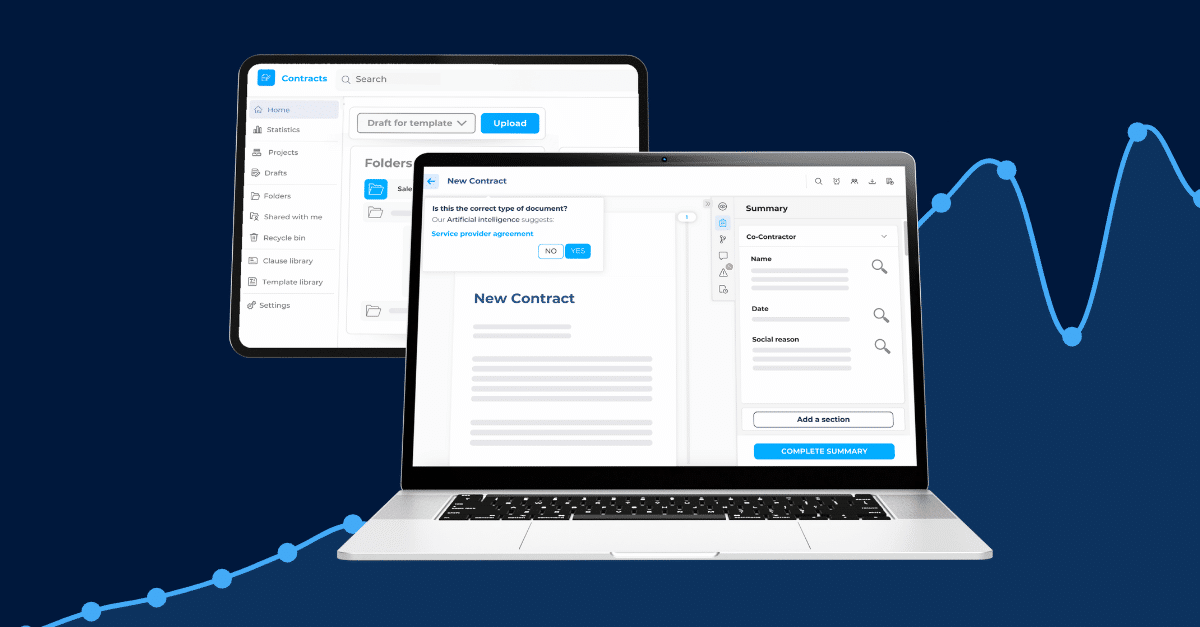
Thanks to advances in artificial intelligence, you no longer need to manually enter information, clauses, etc. to build up your database. Artificial intelligence will be able to read the contract, recognize key information (dates, durations, amounts, etc.) and convert it into usable data.
Summary sheets, statistical dashboards, excel audits… all these tools are at your disposal to enable you to make decisions based on your data.
AI-Powered Extraction
Artificial intelligence can:
Tools at Your Disposal
Summary sheets, statistical dashboards, excel audits—all these tools enable you to make decisions based on your data.
Start building your contract database
Today, contract management tools powered by artificial intelligence, such as those integrated into the DiliTrust suite, enable:
With the right choice of tools, your teams can save time and work better together. Want to find out more? Contact a DiliTrust expert today.
Want to go further?
Check our CLM implementation framework
Learn how to make your CLM implementation go smoothly in this step-by-step guide.