



A contract of adhesion is a standard-form agreement drafted by one party and offered on a take-it-or-leave-it basis. The other party can accept the terms or walk away, but usually has no meaningful opportunity to negotiate.
These contracts appear in insurance policies, software terms, leases, consumer finance and employment documents. This guide explains how contracts of adhesion are formed, where they appear and when courts enforce them.
At a glance
- Take-it-or-leave-it standard forms are generally valid and enforceable in the U.S.
- Courts scrutinize individual terms, and the format itself is rarely the problem.
- Hidden terms may fail the reasonable expectations test. Genuine ambiguities may be construed against the drafter.
- Clickwrap acceptance usually holds. Browsewrap often doesn’t.
- If you issue standard terms, proof of assent and version history matter as much as the wording.
What is a contract of adhesion?
A contract of adhesion is a standardized contract drafted by the party with stronger bargaining power and offered on a take-it-or-leave-it basis. The other party can accept the terms as written or walk away, but can’t negotiate them.
Four features give it away:
- Pre-drafted standard form: One party writes every term before the other sees it.
- Unequal bargaining power: The drafter is usually a business. The other side is a consumer, an employee or a much smaller customer.
- No meaningful negotiation: The choice is binary: sign or leave.
- Used at scale: The same terms go out to thousands of counterparties.
The weaker party simply “adheres” to terms someone else wrote, which is where the doctrine of adhesion gets its name. You’ll also see it called a standard form contract or a boilerplate contract. Whatever the label, a contract of adhesion is defined by standard terms fixed before the other party has a meaningful chance to negotiate.
That makes it one of several types of contracts classified by how they’re formed. The term “contract of adhesion” describes how the agreement was formed. Whether a particular term is fair is a separate question, covered below.
Take it or leave it
How a standard form contract is formed
Drafting party
Stronger bargaining power. Writes every term.
Standard form
Terms are fixed before the other party sees them.
Adhering party
Consumer, employee or smaller customer. Can’t negotiate the terms.
Examples of adhesion contracts
You sit on both sides of these. Six come up most often:
- Insurance policies: The insurer writes the policy. You pick coverage levels and a deductible.
- Software and SaaS terms: Clickwrap terms of service, browsewrap website terms and the EULA that ships with installed software.
- Residential leases: Large landlords and property managers use one lease for every unit.
- Consumer finance: Credit card agreements and auto loan contracts, where the lender’s form is the only form on offer.
- Employment documents: Offer letters and onboarding packs that include a mandatory arbitration agreement as a condition of the job.
- B2B vendor terms: A cloud provider’s standard terms, or a master subscription agreement that a smaller customer can’t realistically redline.
Being on this list doesn’t make a contract unfair. The label tells you how the terms were set. Enforceability is the next question.
Contract of adhesion in insurance
Insurance is the textbook case. The insurer drafts every word, and the policyholder chooses only from the options offered.
Courts push back in two ways. Ambiguous policy language is construed against the insurer under contra proferentem, and many states protect the insured’s reasonable expectations of coverage.
So who can change the deal? An insurance policy is usually modified through a written endorsement or rider issued by the insurer, often at the policyholder’s request.
That is how adhesion operates in insurance. Don’t confuse it with an aleatory contract, which describes how risk is allocated. An insurance policy can be both an adhesion contract and an aleatory contract.
Are adhesion contracts enforceable?
Yes. Standard forms are generally valid and enforceable in the United States. Courts do read individual terms more closely, because the signer had no chance to negotiate them.
Before addressing unconscionability, courts may consider other doctrines, including reasonable expectations and contra proferentem:
Reasonable expectations: Under § 211(3) of the Restatement (Second) of Contracts, a term may be excluded when the drafter had reason to believe the other party would not have agreed had they known it was included. A clause buried on page 14 may be challenged as unexpected, depending on the jurisdiction and how the term was presented.
Contra proferentem: When genuine ambiguity remains after ordinary interpretation, a court may construe the language against the drafter. The doctrine is applied differently across jurisdictions and contract types.
A challenged term can produce several outcomes. The contract may be enforced as written, a clause may be struck or narrowed, or, rarely, the entire contract may be held void.
Enforceability
Four issues courts may consider
Is it a take-it-or-leave-it terms?
AdhesionHidden or unexpected term?
Reasonable expectationsUnfair in process or substance?
UnconscionabilityAmbiguous wording?
Possible outcomePossible outcomes
- Enforced as written
- Clause struck or read against drafter
- Contract void (rare)
The unconscionability test
Unconscionability is a more demanding doctrine with two parts. Procedural unconscionability looks at how the deal was formed: surprise, fine print, pressure, no real alternative. Substantive unconscionability looks at how one-sided the terms are.
Courts often consider both, although the test varies by jurisdiction. In Armendariz v. Foundation Health Psychcare Services, Inc. (2000), the California Supreme Court applied a sliding-scale approach: the more oppressive the process, the less one-sided the terms need to be, and vice versa.
For sales of goods, UCC § 2-302 lets a court refuse to enforce an unconscionable contract, cut the offending clause or limit how it applies. The classic case is Williams v. Walker-Thomas Furniture Co. (D.C. Cir. 1965). A retailer’s cross-collateral clause allowed it to seek repossession of earlier purchases after the customer defaulted on a later installment contract.
These doctrines do not make standard terms unenforceable by default. In AT&T Mobility LLC v. Concepcion (2011), the Supreme Court held that the Federal Arbitration Act preempted a state rule treating class-action waivers in consumer arbitration agreements as unconscionable. In Carnival Cruise Lines, Inc. v. Shute (1991), the Court upheld a forum-selection clause in a cruise ticket contract. An arbitration clause may survive scrutiny, but enforceability depends on the clause and the applicable law.
Clickwrap vs browsewrap: how courts judge online terms
Online terms are among the most common adhesion contracts customers encounter.
Clickwrap requires an affirmative act, such as clicking “I agree” or ticking a box. Courts often enforce it when notice and assent are clear. Browsewrap puts the terms and conditions behind a link and treats continued use as consent. Courts are less likely to enforce it when the user was not given clear notice or did not take affirmative action.
Either way, courts ask two things: was notice of the terms reasonably conspicuous, and did the user unambiguously manifest assent?
- In Specht v. Netscape (2d Cir. 2002), terms visible only by scrolling below the download button didn’t bind users.
- In Meyer v. Uber (2d Cir. 2017), a sign-up screen linking the terms right below the registration button was enough.
- In Berman v. Freedom Financial Network (9th Cir. 2022), tiny gray text and a button that did not state that clicking meant agreeing led the court to decline to enforce the terms.
Sign-in-wrap (assent during registration) and scrollwrap (scroll to the end, then accept) use different interfaces but face the same notice-and-assent questions.
Can you prove which terms each customer accepted?
See how legal teams track every version
Adhesion vs negotiated contracts: how they compare
The two formats solve different problems, and most companies use both.
| Criterion | Adhesion (standard form) | Negotiated contract |
|---|---|---|
| Who drafts the terms | One party, usually the stronger party | Both parties, through redlines |
| Room to change terms | None, or a fixed menu of options | Any term can move |
| Bargaining power | Unequal | May be unequal, but negotiated |
| Typical use cases | Insurance, online terms, leases, consumer credit | M&A, supply agreements, enterprise licenses |
| How courts read ambiguous terms | Against the drafter | Ordinary rules first; contra proferentem if ambiguity remains |
| Speed and cost at scale | Usually faster and cheaper | Usually slower and costlier |
Many B2B legal teams work in the middle. They issue standard terms but pre-approve fallback positions for clauses buyers push on, such as the liability cap or payment terms. Sales can concede within those limits without a legal ticket, so deals keep moving without losing the efficiency of standard terms.
How to draft standard form contracts that hold up in court
If your company issues standard terms, enforceability gets decided long before anyone sues. Six habits make the difference.
- Write for the reader who didn’t draft it: Use plain language and make high-impact clauses conspicuous: arbitration, auto-renewal, limitation of liability and data use.
- Use a clear assent mechanism and keep the proof: record the date, user and template version for each clickwrap acceptance or e-signature. California’s automatic renewal law requires businesses to keep verification of consumer consent for at least three years, or one year after the contract ends, whichever is longer.
- Avoid terms courts may reject or limit: unilateral changes without adequate notice, waivers of non-waivable statutory rights and heavily one-sided remedies.
- Offer reasonable exits: Where appropriate, provide a meaningful arbitration opt-out window and make cancellation as easy as sign-up. The same California law requires clear renewal disclosures and a cancellation method, so build renewal notices into your contract renewal management process.
- Version-control every template: When terms change, you need to know which customers accepted which version, and when. Otherwise a dispute over 2024 terms becomes a search through old email threads.
- Review templates on a schedule: Case law and state consumer rules change faster than most template libraries. Put an annual review on the calendar at minimum.
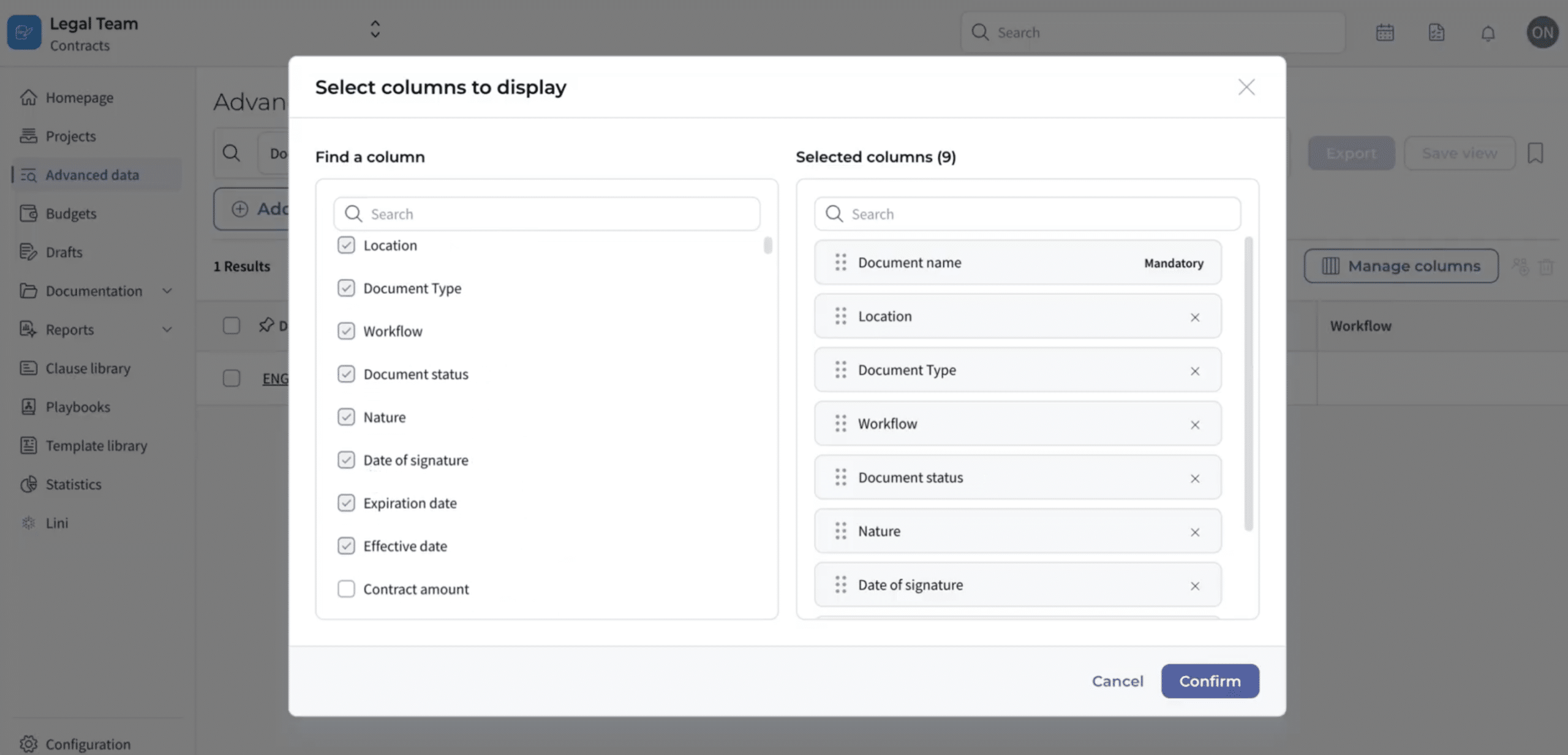
With 10 templates, a shared drive copes. With hundreds of customers on several versions, contract management software with a template and clause library, approval workflows and version history keeps steps 2, 5 and 6 from depending on one person’s memory.
Rolling out standard templates across the business?
Discover how to streamline your CLM implementation with this step-by-step guide.

Frequently asked questions
Short answers to the questions commercial and legal teams ask most.
Are adhesion contracts legal?
Yes. They’re legal and generally enforceable in the U.S. Courts treat standard forms as a normal part of commerce but look harder at individual terms. A clause that’s hidden, unexpected or unconscionable can be struck or narrowed, and in rare cases the whole contract is voided.
Can you negotiate a standard form contract?
Usually not, and that’s what defines it. In consumer deals, the choice is accept or walk away. In B2B, larger customers often have enough weight to push back, and many vendors pre-approve fallback positions on liability or payment terms. Once real negotiation happens, the agreement starts to look like a negotiated contract.
What is the difference between an adhesion contract and an aleatory contract?
Adhesion describes how a contract is formed: one party sets the terms and the other can’t negotiate. Aleatory describes its risk: performance depends on an uncertain event. Insurance policies are both, since the insurer drafts the terms and payment depends on a covered loss.
Are employment contracts adhesive?
Often, yes. Standard offer letters and mandatory arbitration agreements presented as a condition of employment may be treated as adhesive, as in Armendariz. Individually negotiated executive agreements usually are not. Courts still scrutinize one-sided arbitration terms closely.
If standard form terms are ambiguous, who does the interpretation favor?
If genuine ambiguity remains after ordinary interpretation, a court may construe the term against the drafter. In a standard form, that is usually the party with greater bargaining power. Plain drafting reduces this risk.
Standard terms without standard risks
Standard forms are how modern business scales. Businesses cannot negotiate a cloud subscription with every user one at a time.
The question for your legal team is whether each term would survive a judge reading it from the customer’s side of the screen. Draft for that reader, keep proof of every acceptance, and your standard terms will be better positioned to withstand scrutiny when someone tests them.
No drafting practice can guarantee enforcement.
Manage templates, approvals, signatures and version history across your agreements.