




Your board approves a dividend in the same quarter it announces a hiring freeze. Shareholders read it as capital discipline. Employees read it as a choice made at their expense, and the board has to answer to both.
That tension is the practical side of the stakeholder vs shareholder question. The issue gained renewed attention in 2019, when the Business Roundtable published a Statement on the Purpose of a Corporation signed by 181 CEOs who committed to lead their companies for the benefit of all stakeholders.
This guide gives you clear definitions, a side-by-side comparison, the two governance models, what US and UK law expects from directors, and a five-step method to document how your board weighed both groups.
In short
- A shareholder owns stock. A stakeholder is anyone who affects or is affected by the company’s decisions.
- Every shareholder is a stakeholder. Many stakeholders never own a single share.
- In the US, the details vary by state. In Delaware, directors owe fiduciary duties to the corporation and its stockholders, but may consider other groups when doing so is connected to the company’s interests.
- In the UK, section 172 of the Companies Act 2006 requires directors to promote the success of the company for the benefit of its members as a whole while having regard to employees, suppliers, customers, communities and the environment.
- In both systems, a clear record of the trade-offs helps show how the board reached its decision.
Stakeholder vs shareholder: what is the difference?
A shareholder owns at least one share of a company’s stock and has a financial stake in its value. A stakeholder is any person or group that affects or is affected by the company’s decisions, such as employees, customers, suppliers, lenders or local communities. All shareholders are stakeholders, but not all stakeholders are shareholders.
Here’s what each term covers when it lands on a board agenda.
What is a shareholder?
A shareholder, also called a stockholder, owns equity in a company. The two words are synonyms. “Stockholder” is the usual term in US and Delaware corporate law, so the difference between stakeholders and stockholders is exactly the one this article covers.
Ownership comes with rights. Shareholders may vote on directors and major transactions, receive dividends when the board declares them, inspect books and records, and bring derivative suits on the company’s behalf, subject to applicable law and procedure. In a liquidation, they hold the residual claim and are paid only after creditors and other higher-ranking claims.
Not all shareholders look alike. Common stock usually carries voting rights, while preferred stock trades some of them for priority on dividends. Institutional investors such as pension funds and asset managers often vote through formal stewardship policies, while retail investors rarely coordinate.
In private companies, these rights are often fine-tuned in a shareholder agreement, which can add consent rights, transfer restrictions or board seats.
What is a stakeholder?
A stakeholder is anyone whose interests are tied to what the company does, whether or not they own part of it. Their stake comes from a job, a contract, a loan, a location or a regulatory mandate.
Stakeholders usually split into two groups:
- Internal: employees, managers, directors, shareholders
- External: customers, suppliers, creditors and lenders, local communities, regulators and government
So who are the stakeholders in a company? Anyone on that list whose position changes when the board decides. Some frameworks group them into 4 types (internal, external, primary and secondary), but the internal and external split is enough for most board work.
Key differences between stakeholders and shareholders
The difference between stakeholders and shareholders comes down to how each group is connected to the company and what it can do about a decision it dislikes. Here’s how they compare.
| Criterion | Shareholder | Stakeholder |
|---|---|---|
| Relationship to the company | Owns equity | Affected by company decisions |
| How the interest arises | Buys or receives shares | Employment, contract, community or regulation |
| Typical time horizon | Short or long term | Often long term |
| Legal rights against the board | Voting, derivative suits, inspection rights | Contractual or statutory rights |
| Voting power at the AGM | Yes | No, unless they also a shareholder |
| Priority in liquidation | Last, residual claim | Creditors and employee claims rank ahead |
| Examples | Founders, pension funds, retail investors | Employees, customers, suppliers, lenders, communities |
People often ask: are stakeholders and shareholders the same? They overlap. An employee who holds stock through an equity plan sits in both columns, and so does a director with shares.
Treating shareholders as stakeholders is accurate, but their interests can still pull apart from everyone else’s. A buyback lifts earnings per share this year. The same cash could have funded a pay rise, better supplier payment terms or a safety upgrade that matters to the people who’ll still be there in ten years.
How stakeholder groups relate to shareholders

Two models frame how a board should rank those interests. Each shapes how you write a board paper and what you’ll be asked to defend.
Shareholder primacy, also called shareholder theory, says the board’s job is to maximize long-term shareholder value. Milton Friedman made the case in his 1970 New York Times Magazine essay. The Michigan Supreme Court set out an early version in Dodge v. Ford Motor Co. (1919), and the Delaware Court of Chancery restated it in eBay v. Newmark (2010), holding that directors who choose a for-profit corporate form are bound by the fiduciary duties that come with it.
Stakeholder theory says the company creates value for, and is accountable to, all its stakeholders. R. Edward Freeman set out the modern version in 1984, and “stakeholder capitalism” is the term now used for its broader, economy-wide form. The UK sits in between with “enlightened shareholder value”: shareholders come first, but directors must account for other groups to get there (more on that below).
| Model | Core idea | Main criticism |
|---|---|---|
| Shareholder primacy | Directors maximize long-term value for owners | Encourages short-termism and shifts costs onto other groups |
| Stakeholder theory | Directors balance the interest of affected groups | Can blur accountability: answerable to everyone, accountable to no one |
In practice, the two models meet in the middle more often than the debate suggests. Many boards pursue long-term shareholder value by managing stakeholder relationships well, because unhappy employees, customers and regulators eventually show up in the share price. Good corporate governance is mostly about making that link explicit.
How boards balance shareholder and stakeholder interests
The theory debate is philosophical. Your directors work inside something more concrete: legal duties, investor expectations and disclosure rules.
Those rules have shifted. The 2019 Business Roundtable statement put stakeholder language into the mainstream, and institutional investors built ESG expectations into their stewardship policies. In the US, ESG has since become politically contested. The SEC’s 2024 climate disclosure rules were stayed during litigation, and in May 2026 the Commission proposed rescinding them. In the EU, the Omnibus directive that entered into force in March 2026 narrowed CSRD reporting to companies with more than 1,000 employees and over €450 million in net turnover.
What hasn’t changed is the board’s exposure. Whatever the reporting regime, someone can ask how your directors reached a decision. If your board is still defining its approach, an ESG roadmap for the board is a practical starting point.
Fiduciary duties and the business judgment rule
For US corporations, the details vary by state, In Delaware, board of directors owes fiduciary duties of care and loyalty to the corporation and its stockholders, while employees, customers and suppliers generally aren’t owed those duties directly.
The business judgment rule still gives you room. Courts presume directors acted on an informed basis, in good faith and in the honest belief that the decision served the company. Investing in the workforce or keeping a local plant open can fit inside that presumption when it’s rationally linked to long-term value.
Many states go further with constituency statutes, which let directors consider non-shareholder interests. Delaware, where many large US companies are incorporated, has no such statute. Companies that want stakeholder purpose written into the charter can incorporate as a public benefit corporation, which Delaware and many other states allow.
Section 172 and the UK “enlightened shareholder value” model
UK law takes a more explicit route. Under section 172 of the Companies Act 2006, a director must promote the success of the company for the benefit of its members as a whole, while having regard to: the long-term consequences of decisions, the interests of employees, relationships with suppliers and customers, the impact on the community and the environment, the company’s reputation, and fairness between members.
Certain companies, including many large companies, must include a section 172 statement in their strategic report explaining how the directors complied with that duty. Under Provision 5 of the UK Corporate Governance Code 2024, companies subject to the Code should describe in their annual report how stakeholder views and the matters in section 172 were considered in board discussions and decision-making.
Every stakeholder trade-off, on the record
DiliTrust’s Board Portal keeps board papers, minutes and votes in one secure place, helping your team preserve the context and reasoning behind board decisions.
Stakeholder vs shareholder examples
These three scenarios show how the same decision reads differently to each group. None of them has a single right answer, which is exactly why the record matters.
Closing or relocating a plant: Shareholders will focus on margin improvement and one-off restructuring costs. Employees, suppliers and the local community will focus on job losses, broken contracts and the tax base. A balanced board paper models both, and the minutes show which mitigation options directors discussed before they voted.
Paying a dividend or buyback in a wage-freeze year: Investors expect capital returns when cash is strong, and cutting them can attract shareholder activism. Employees will read the same decision as a statement about whose interests come first. The board should record why the capital allocation holds up against retention risk, and how it plans to explain the decision internally.
Automating roles with AI: Shareholders see productivity and lower operating costs. Employees see redeployment or redundancy, customers worry about service quality, and regulators may ask about data use. Documenting the reskilling plan and the risk review next to the business case turns a contested call into a defensible one.
In each case, the board’s job is to make an informed decision and be able to prove it later. That’s where documentation comes in.
How to document stakeholder considerations in board decisions
When a regulator, auditor or activist asks how your board weighed a decision 18 months ago, can you show them in under 5 minutes? These five steps make the answer yes.
- Add a stakeholder impact section to board papers. For material decisions, require a short section that names the affected groups and the expected effect on each.
- Map your key stakeholders and owners. Assign an executive owner to each relationship, so the board knows who to ask for evidence.
- Record the discussion, not only the decision. Minutes should capture the alternatives considered, the concerns raised and the reasons for the final choice.
- Bring in committee and management reports. Feed workforce, customer and supplier engagement data from your audit, ESG or remuneration committees into the board pack.
- Keep the record retrievable for disclosures. Your proxy statement or UK section 172 statement can draw on relevant evidence from these papers and minutes.
From stakeholder considerations to disclosure
Board paper
Stakeholder impact section
Committee input
Examples:
Board discussion
Discussion recorded in the minutes
Decision and rationale
What the board decided and why
Disclosure
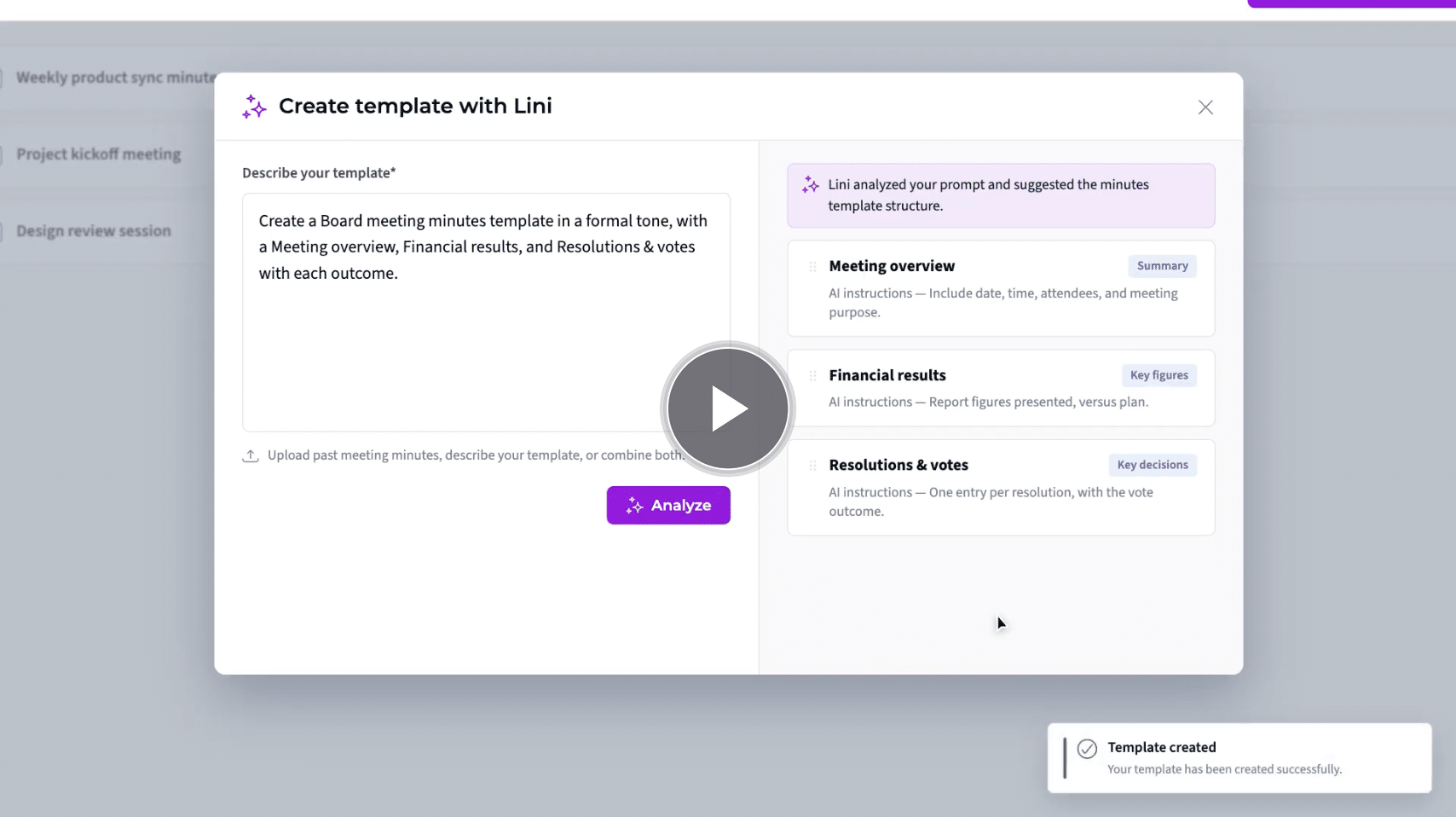
Step 3 usually takes the most effort. Lini, DiliTrust’s AI assistant, drafts minutes from the agenda, giving your secretary a structured first draft to review instead of a blank page.
The rest depends on keeping papers, minutes and votes together. With board portal software, you pull the board paper, the minutes and the vote from one auditable record, instead of rebuilding a decision from email threads two years later.
Frequently asked questions
Is a CEO a stakeholder or a shareholder?
A CEO is always a stakeholder: the company employs them, and their decisions shape its results. They’re also a shareholder if they hold stock, which is common when pay includes equity awards. That overlap is why boards review executive pay closely, since it ties the CEO’s personal interests to shareholder returns.
Are shareholders and stockholders the same?
Yes. “Shareholder” and “stockholder” both mean a person or entity that owns shares in a company. US and Delaware law tend to say “stockholder,” while UK law says “shareholder” or “member.” The confusion usually comes from mixing up stakeholder and stockholder, which sound alike but describe different relationships to the company.
Do boards owe fiduciary duties to stakeholders?
In the US, duties vary by state. In Delaware, directors owe fiduciary duties to the corporation and its stockholders, not generally to employees, customers or communities. They may still consider those groups when doing so supports the company’s interests. In the UK, section 172 requires directors to promote the company’s success for its members as a whole while considering specified stakeholder interests. Minutes help show how the board reached its decision.
Who are the stakeholders in a company?
A company’s stakeholders include internal groups (employees, managers, directors and shareholders) and external groups (customers, suppliers, creditors and lenders, local communities, regulators and government). Anyone whose position changes when the board makes a decision counts. Mapping them, and naming an owner for each relationship, makes board papers faster to prepare and easier to defend.
Why do some organizations avoid the word “stakeholder”?
Some public health and research organizations avoid “stakeholder” because of perceived colonial associations.
Balancing stakeholders and shareholders is a board discipline
The useful question for the board is whether the trade-offs behind each decision were understood, discussed and written down. That record can help answer questions from courts, investors and regulators, whichever model you follow.
The stakeholder vs shareholder debate will keep shifting with politics and reporting rules. Boards that build the habit of recording their reasoning won’t need to reconstruct the record every time those rules change.
See how better-documented board meetings work