



An exclusivity clause stops one party from doing business with anyone else within a defined scope. Drafted carelessly, it can lock your company out of a channel or a region for years. Drafted well, it protects the investment that made the deal worth signing.
This guide shows you how an exclusivity clause works, which type fits which deal, where antitrust law draws the line, and how to negotiate and track one once it’s signed.
What is an exclusivity clause?
An exclusivity clause is a contract provision that prevents one or both parties from entering similar agreements with third parties for a defined product, service, territory or customer group during a set period. In exchange, the restricted party usually gets something of value: guaranteed volume, a protected market or better pricing.
A complete exclusivity provision answers seven questions:
- Who is bound: one party or both
- What is exclusive: products, services, IP or customer segments
- Where it applies: the territory or channel
- How long it lasts, and how it renews
- What it depends on: sales targets or minimum purchases
- What’s excluded: existing customers, direct sales, online
- What happens on breach: damages, termination or loss of exclusivity
You’ll find exclusivity across most common types of contracts a legal team handles, from supply and distribution deals to IP licenses and M&A letters of intent.
Exclusivity clause vs non-exclusivity clause
The difference comes down to who gives up flexibility and what they get for it.
| Exclusivity clause | Non-exclusivity clause | |
|---|---|---|
| Effect | Bars dealings with third parties in the defined scope | Expressly allows dealings with third parties |
| Who benefits | The protected party, which gets a market or a supply source for itself | Both parties keep their options open |
| Typical price | Volume commitments, investment, better terms | No special concession needed |
| Main risk | Dependency on one partner; antitrust exposure | Less commitment from the other side |
| Common in | Distribution, supply, licensing, LOIs | Services, reseller programs, SaaS |
Types of exclusivity clauses
The label “exclusivity” covers very different restrictions. Before you review one, identify which way it runs: does it restrict the buyer, the seller, or both?
| Type | Who is restricted | Typical use | What to watch |
|---|---|---|---|
| Exclusive supply (requirements contract) | Buyer purchases only from one supplier | Components, raw materials | Supply risk if the supplier fails |
| Exclusive distribution | Supplier appoints a single distributor | Market entry, reseller networks | Performance targets to keep exclusivity |
| Territorial exclusivity | Supplier appoints no one else in a region | Regional distribution, franchising | Online sales and customers who cross borders |
| Exclusive dealing | Distributor carries no competing products | Retail, specialized equipment | Antitrust scrutiny when one party has market power |
| Exclusive license | Licensor grants no one else the same rights | Technology, brands, content | “Exclusive” vs “sole” (a sole license lets the licensor keep using the IP itself) |
| No-shop clause | Seller stops talking to other buyers | M&A letters of intent, term sheets | Short duration and a clear end date |
A clause that each side reads differently is a common source of disputes. If the contract says “exclusive” without saying who can’t do what, rewrite it.
Where antitrust limits apply
In the US, exclusivity clauses are usually lawful. The Federal Trade Commission describes exclusive dealing and requirements contracts as “common” and “generally lawful.” These arrangements are judged under a rule of reason standard that balances procompetitive and anticompetitive effects (FTC, Exclusive Dealing or Requirements Contracts).
The risk changes when the party imposing exclusivity has market power. The FTC gives the example of a pipe fittings manufacturer found to have unlawfully maintained its monopoly by requiring distributors to buy domestic fittings only from it, which kept a new competitor from reaching the sales it needed.
Scrutiny tends to rise when:
- one party holds a large share of the relevant market
- the clause shuts rivals out of the distribution or supply they need
- the term is long, or renews without an easy exit
- similar clauses across the market add up to a closed network
If the contract affects trade in the EU, Regulation (EU) 2022/720, the Vertical Block Exemption Regulation. It generally applies to vertical agreements where neither party’s market share exceeds 30%, but it doesn’t exempt non-compete obligations that are indefinite or exceed five years. A non-compete that renews tacitly beyond five years can still benefit from the block exemption if the buyer can effectively renegotiate or terminate it at reasonable notice and reasonable cost.
One more boundary. When an exclusivity clause binds an individual, such as an employee or an independent contractor, it may be treated as a non-compete, depending on the wording and applicable law. Review it under that framework, because enforceability varies by jurisdiction.
Know where you’ve granted exclusivity before sales signs a conflicting deal
See how teams track contract obligations
Exclusivity clause examples
The two samples below cover the situations in-house teams see most often. Use them as a starting point for discussion, not as legal advice, and adapt them to your governing law.
Example 1: exclusive distribution with a performance condition
Exclusive appointment. Subject to Section [X] (Minimum Purchase Commitment), Supplier appoints Distributor as its exclusive distributor of the Products in the Territory for the Initial Term. During that period, Supplier shall not appoint any other distributor, agent or reseller for the Products in the Territory. Supplier may continue to sell the Products directly to the Excluded Accounts listed in Schedule [Y]. If Distributor fails to meet the Minimum Purchase Commitment in any Contract Year, Supplier may, on thirty (30) days’ written notice, convert this appointment to a non-exclusive appointment.
Why it holds up:
- the products and territory are defined terms, not loose descriptions
- direct sales to named accounts are carved out
- exclusivity is earned through purchases, and missing the target downgrades it instead of ending the relationship
Example 2: no-shop clause in a letter of intent
Exclusivity. From the date of this Letter until the earlier of (a) [60] days after its signature and (b) the signature of the Definitive Agreement, Seller shall not, and shall cause its affiliates and representatives not to, solicit, encourage, negotiate or accept any proposal from a third party for the acquisition of the Company or of a material part of its assets. Seller shall promptly notify Buyer of any unsolicited proposal received during this period. This paragraph is legally binding.
Two details matter here. The period ends automatically, and the letter says expressly that this paragraph binds the parties even if the rest of the LOI doesn’t. Leave that sentence out and you may be arguing later about whether exclusivity ever applied.
How to negotiate an exclusivity clause in 6 steps
Whichever side you’re on, the same six levers decide whether exclusivity is a fair trade. Run them as part of a structured contract review process so every exclusivity request gets the same scrutiny.
1. Define the scope narrowly
List the products in a schedule. Name the territory, the channels and the customer segments. If you’re the restricted party, “similar products” or “competing products” without a definition are the phrases to strike first.
2. Cap the term and the renewals
Set a fixed end date. Make renewal depend on mutual agreement or on hitting performance targets, never on silence. Indefinite exclusivity is hard to defend commercially, and in the EU it can take the clause outside the block exemption.
3. Tie exclusivity to performance
If you grant exclusivity, ask for something measurable in return: minimum purchases, sales targets, marketing spend. Agree how and when performance is measured. Then decide the consequence of a miss. Converting to non-exclusive is often more useful than terminating because the business relationship survives.
4. Write the carve-outs before you need them
Carve-outs are cheap at signature and expensive afterwards. The usual ones:
- existing customers and accounts already in progress
- direct sales by the grantor
- online sales, or sales to customers outside the territory who approach you
- affiliates and group companies
- acquisitions: if your company buys a business that already carries a competing line, are you in breach on day one?
5. Agree what happens on breach
Spell out the cure period, the remedies (damages, injunctive relief, termination, loss of exclusivity) and who can trigger them. Then check that these remedies line up with how your termination clause works, so you don’t end up with two exit routes on two different timelines.
6. Check how it interacts with the rest of the contract
Exclusivity problems often surface next to other clauses. Read it alongside most-favored-customer terms and non-solicitation, assignment and change-of-control clauses. Picture your exclusive distributor being acquired by your main competitor next year: does anything in the contract let you respond?
How to track exclusivity obligations after signature
Your sales director wants to sign a new reseller in Benelux next week. Three years ago, someone granted a distributor exclusivity for the region, and an amendment later extended it. Can you confirm whether that deal is still allowed in under five minutes?
Exclusivity breaches often start with a clause nobody outside legal knew existed. Here’s how to keep it visible:
- Capture exclusivity as data. Record the protected party, products, territory, start date, end date, renewal mechanism and performance condition so you can filter on them instead of rereading PDFs.
- Keep amendments with the main agreement. An extension signed two years later changes the answer to “are we still exclusive?”
- Set reminders on the dates that matter: each performance review, the notice deadline before renewal and the end of exclusivity.
- Tell the business. Give sales and procurement a plain-language summary: where you’re exclusive, with whom and until when.
- Recheck at every renewal and every acquisition, when carve-outs and change of control clauses get tested.
This is where contract management software changes the day-to-day. In DiliTrust Contract Management, AI suggests key information for each contract’s summary sheet and your team confirms or corrects it. You can create your own clause and attribute types, so exclusive territory, products and end date become fields you can search and report on.
Alarms then run on those validated dates. They can use computed dates (an end date minus a notice period, for example) and repeat until someone marks them as done. One practical point: computed dates read the main contract’s summary sheet, so when an amendment changes the exclusivity period, update the summary sheet and the alarm follows.
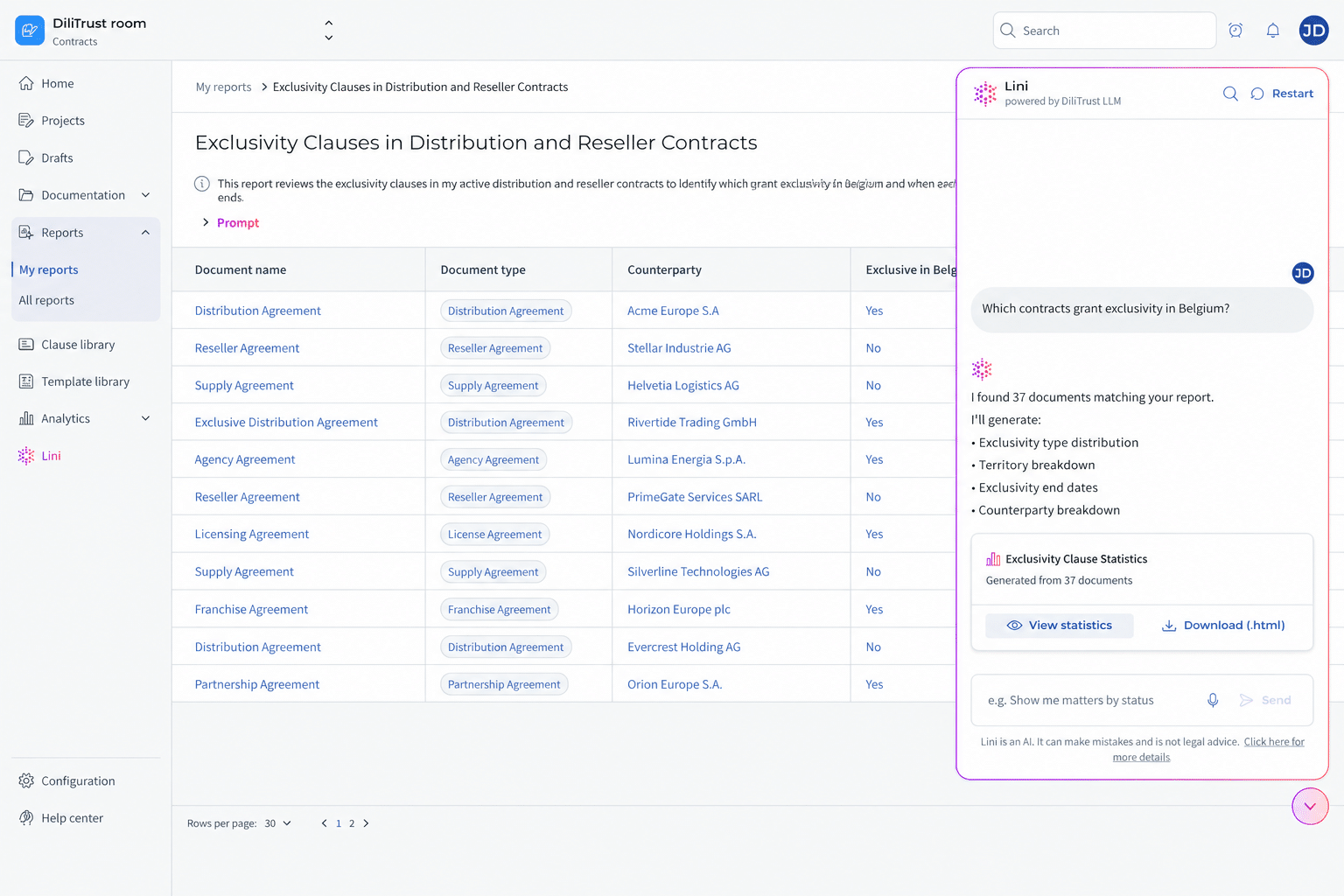
When the sales director’s question arrives, Smart Reports lets you ask it in plain language, for example “which contracts grant exclusivity in Belgium?”, and returns a table with each result linked to its summary sheet. Legal can clear or block the reseller deal the same day, instead of holding it while someone rereads old agreements.
At the drafting stage, the clause library compares the clauses in a contract with your reference clauses and flags those that differ. If your approved position is “exclusivity only with a minimum purchase commitment,” a draft that drops the condition stands out before signature.
Frequently asked questions
These are the questions in-house teams ask most about exclusivity clauses.
Are exclusivity clauses enforceable?
Generally, yes, but enforceability depends on the jurisdiction. US courts are more likely to enforce exclusivity clauses that are clearly drafted, limited in scope and duration, and supported by a legitimate business reason. Enforceability may weaken when the clause is vague, unlimited in time or used by a company with market power to shut out competitors.
How long does an exclusivity clause last?
The duration depends on what the contract says. No-shop clauses in letters of intent often run for weeks or a few months. Distribution and supply exclusivity usually run for a fixed initial term with renewal conditions. Under the EU Vertical Block Exemption Regulation, non-compete obligations that are indefinite or exceed five years generally fall outside the block exemption, subject to the regulation’s specific conditions.
What happens if an exclusivity clause is breached?
The protected party can typically claim damages, seek an injunction to stop the conflicting deal, or terminate the contract. Many agreements add a softer remedy: the exclusivity is removed, but the relationship continues on a non-exclusive basis.
Can an exclusivity clause be one-sided?
Yes, and many are. A distributor may get exclusive rights in a territory without being barred from carrying other brands. Mutual exclusivity is possible, but each party should get a clear benefit for the restriction it accepts.
What is the difference between an exclusivity clause and a no-shop clause?
A no-shop clause is a type of exclusivity clause used in M&A. The seller agrees not to solicit or negotiate with other potential buyers for a short period while the buyer completes due diligence and negotiates the definitive agreement.
Treat exclusivity as a live obligation
An exclusivity clause is a trade: flexibility given up in exchange for commitment. The trade only stays fair if the scope is precise, the term has an end, and performance keeps earning the protection.
Signature is where the risk starts. Know where you’ve granted exclusivity, to whom and until when, and the clause protects your revenue instead of blocking it.
See every exclusivity commitment before it blocks your next deal