



With guest contributor Eugenia Navarro, Strategic Legal Consultant and Spain Regional Community Leader at the Corporate Legal Operations Consortium.
Legal teams are known for being skeptical about adopting AI-powered solutions. But the real question isn’t whether legal should adopt AI — it’s whether generic AI is truly working for legal, or whether legal is being forced to work around it. Legal needs to adapt AI to their specific requirements. That’s where the battle between generic and specialized legal AI tools begins.
Today, companies adopt enterprise-wide platforms such as Copilot or Gemini. IT invests heavily in these tools so the natural question follows: Why would legal need something else?
In a recent conversation, Eugenia Navarro, Strategic Legal Consultant and Spain Regional Community Leader of CLOC, argued that this is where many organizations go wrong.
Legal departments are facing a battle between generalist AI and specialized legal technology. The problem is that both conversations often involve IT, and IT believes it can build internally what specialists have spent years perfecting.
This tension between standardization and specialization happens inside large and small enterprises. So how can legal teams get out of the enterprise AI trap?
The enterprise AI trap
It is common for organizations to believe solutions can be developed internally by adapting AI platforms to different departments’ needs. While this approach prioritizes efficiency, it doesn’t work equally well for all business units, and the failure rate is striking.
According to an MIT report, three out of four AI projects developed internally fail due to a misunderstanding of industry-specific contexts. The issue is that each department has distinct needs and priorities that can’t be addressed with a one-size-fits-all approach.
Legal operates within complex regulatory frameworks that change from one region to another, and the risks involved demand deep domain expertise. Navarro emphasized:
One of the biggest mistakes organizations make is assuming their internal IT teams can replicate what legal tech companies have built with deep industry expertise.
This is not a question of technical capability. It is a question of specialization. Legal technology companies have invested millions to understand legal workflows, documentation structures, and operational realities. Internal teams, however talented, cannot easily replicate that focus.
Prompts cannot protect against all risks
Legal risk exposure requires more than a generic AI tool. Yes, the right prompt can deliver strong results for repetitive tasks and solve certain business problems, but legal risk does not work that way.
Legal departments are responsible for managing critical tasks such as:
If internal policies are not aligned, the organization risks investigations. If remediation is not documented, the organization risks losing credibility with authorities. It is not so much about productivity, but about governance.
But even the strongest risk arguments need to be translated into business impact to win over leadership. To convince leadership that specialized legal AI tools make sense, Navarro shares her perspective: legal teams and their tech partners must work together to make the business case.
Making the business case for AI legal tools
Technology must align with business objectives. If you only focus on optimizing the legal department without explaining the business benefit, you will fail.
Legal AI must be built to support traceability, control, and measurable outcomes. It must allow legal teams to demonstrate value, not just automate tasks.
Instant access to contracts, immediate visibility into documentation, and measurable improvements in responsiveness are business benefits that resonate with leadership. Navarro suggests looking at the possible return on investment and emphasizing how specialized legal AI tools give a competitive edge. This can be key to convincing the most reluctant stakeholders.
Working with KPIs and proper data for optimal results
Before launching any AI initiative, Navarro highlights a critical step that organizations often overlook: defining KPIs and expected outcomes.
For me, it is key to establish KPIs and project benefits before starting. Otherwise, no one will want to invest.
AI can only deliver value if the underlying legal data is structured, accessible, and aligned with clear objectives. When contracts and legal documents are fragmented or poorly organized, even the most advanced AI tools will struggle to produce meaningful results.
Organizations that structure their legal information and measure outcomes gain something more than efficiency. They gain visibility, readiness, and the ability to compete at a higher level.
The real question: Do the foundations and the tools make sense?
Once your legal department chooses a specialized legal AI tool over a generic copilot the first part is done. The second part is ensuring tat AI runs in the right place with the right technology. Specialized tools added to a fragmented stack still inherit its gaps: the contract in one system, the entity record in another, the board approval in someone’s inbox.
A legal operating system, or Legal OS for short, is built for legal work only. It goes beyond adapting generic tools to legal needs. The work, the records and the AI share the same context, so the people using them do too.
Context that stays when people leave
Good legal decisions depend on history. Why was that clause accepted? Which board resolution authorized the spend? Who signed for that subsidiary, and under which mandate?
In most departments, those answers live with the lawyer who handled the file. When that person moves on, the reasoning leaves with them, and whoever comes next rebuilds it from email threads and shared drives.
A disconnected tech stack makes this worse in a quieter way. Contract management holds one version of a relationship, entity management another, matter management a third. Ask the same question in two tools and you can get two different contexts for the same situation.
A Legal OS ties contracts, entities and boards together. The contract that triggers a dispute brings its signing entity, its approvals and its history into the matter. Context belongs to the department and survives any change in who handles the file. It’s also what gives AI reliable ground to work from, as we explain in why legal AI fails without a system beneath it.
Automation under supervision legal defines
Legal teams want certain operations to run faster: routing an incoming request to the right owner, preparing a first review of a standard agreement, updating mandates across subsidiaries after a director change. This is the work that queues up behind legal judgment and slows the business down.
In a Legal OS, AI and connected workflows take on that work under supervision legal sets in advance: which steps run automatically, which wait for approval, and who signs off. Because the system connects to the tools the business already uses, a contract request from Sales or a spend question from Finance doesn’t sit idle while someone re-keys it.
The KPIs above still apply. Speed only counts when the result holds up, which is why output quality is the real measure of legal AI success.
Human oversight built into the system
In legal, a human stays accountable for the final call. That principle sits at the center of responsible AI governance: AI supports lawyers, with clear oversight and the ability to override in high-impact decisions.
Generic AI can be told to defer to a reviewer. It has no way of knowing who that reviewer is, what they’re authorized to approve, or where the decision belongs. Those rules sit outside the tool, so oversight depends on people remembering to apply it.
A Legal OS is built solely for legal, so oversight is part of how work moves. Review goes to a named owner with the authority to approve or override, and the decision stays with the matter, contract or entity it affects. AI does the groundwork. The lawyer makes the call with the full picture in front of them.
Which leaves every GC with one last question about their team, and the tools they’ve been given.
Generic AI improves productivity and eliminates repetitive tasks. Specialized legal AI protects enterprise value, ensures compliance, and reduces risk exposure.
In the legal field, that difference matters.
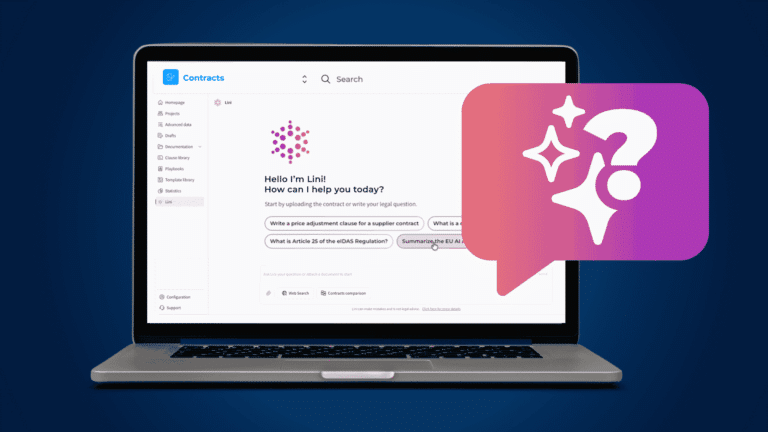
Meet Legal AI – Lini
Lini is the AI engine that powers every dimension of legal work. Trained to think like a legal expert, Lini understands the nuances of governance, compliance, risk and reasons with context, not assumptions.