


Over 600 legal AI hallucination cases have been documented. This is only the number of AI hallucinations that have been reported publicly. Most incidents involving internal legal teams never surface at all.
Hallucinations in generative AI will remain. The question is if your legal department is ready to handle them strategically.
Accountability already has your name on it
Research and regional regulations make it clear: lawyers and individuals are generally personally responsible for every AI-generated output they use. The operative word is ‘use’: responsibility attaches the moment a legal professional act son AI output. This nuance reinforces a thought that has existed since the early days of technology:
A computer can never be held accountable; therefore, a computer must never make a management decision.
This famous saying from IBM’s 1979 manual shows that technology can give a result, an outcome, but what is done with that outcome relies solely on humans. This is not a new principle, and it extends to the legal use of AI today. The human touch in the legal function has always been necessary; AI has just increased the volume and speed at which plausible errors can travel undetected. Hallucinations are part of why human touch is required. A hallucination can be buried in a contract review, compliance memo, or board summary, and by the time it surfaces, it already has someone’s name on it.
Because AI cannot be held accountable in legal terms, every workflow or process that includes AI must also include a human — one who is willing to own the outcome. That reality shapes everything that follows.
Time to think about the checkpoint
Every legal team using AI responsibly has thought through what the tool should handle: whether drafting, summarizing long documents, or flagging risks such as non-standard clauses. This part of the conversation is rather well-worn by now.
What most teams haven’t built is a clear handoff point: the moment where a human steps back in and takes ownership of the output.
A contract review workflow makes the point well. AI can scan for risk language, flag anomalies, pull precedent, and produce a summary fast. It is all genuinely useful. But somewhere in that chain, a legal team member has to read the output, apply judgment, and sign off on the conclusion. If that moment is not formally defined, if it is assumed someone will check rather than required. Assumptions are not governance and eventually that team’s luck will run out.
The same logic applies to compliance submissions, due diligence reviews, and regulatory filings. AI can do the heavy lifting: scanning, flagging, synthesizing. But the moment an output leaves your department or lands in front of a regulator, it carries a name.
The end goal is to make sure your process defines who is responsible for what before that happens. In other words: who verifies this, how do they verify it, and when do they verify it?
Control, oversight and enforcement: The key to handling legal AI hallucinations
Building the process to manage AI hallucinations runs across three areas, and they work in sequence. First, the GC needs to ensure the basics are covered; this means getting the data right. Second, the legal function must build the oversight layer around that data. Third, all elements must stick and be enforced.
Get the basics right: Control your data
The quality of any AI output depends entirely on one thing: the information you are feeding it. The data behind the technology will shape the rest, and ungoverned data will produce ungoverned results.
The contracts in your system, the matter records, and the compliance documentation must be clear and clean. If that data is incomplete, outdated, or inconsistently structured, no AI tool will compensate. AI hallucinations will mount, making the errors harder to trace.
Data governance is the foundation, not a preliminary step. Map your data assets, establish what gets into the system, and decide deliberately where and how AI gets used. Not every workflow benefits from AI involvement. The ones that do still require clean inputs to produce reliable outputs.
Best practices
- Audit the data in your systems before deploying AI: contracts, matter records, and compliance documentation
- Establish clear standards for what gets in: incomplete or outdated inputs produce unreliable outputs
- Map AI deployment deliberately: decide where it’s used and for what, before you turn it on
Build around your data: Plan for oversight
Now you have a workflow. AI summarizes matters, reviews contracts, flags compliance issues. At some point, it will get something wrong because AI hallucinations are inevitable. The real concern is whether anyone will catch it before it matters.
Consider what that looks like in practice. An AI-assisted contract review misidentifies which party holds the right to terminate for convenience. The clause reads the other way, but the tool flags it incorrectly. Your team builds its negotiation position around that misreading. The counterparty knows it, but you don’t find out when the deal closes.
Why does the designation matter so much? AI accountability requires consequences, and consequences, in turn, shape careful behavior. In short, someone in your legal team must have the responsibility, and the business must have someone to turn to when errors mount, something AI cannot provide.
Best practices
- Name a designated reviewer: a person with a formal role, not an assumption that someone senior will take a look. This may actually be legally required in certain jurisdictions.
- Define how they verify: is it against source documents, or with the audit trail as the record, for instance.
- Set a formal gate: no new AI-assisted contract leaves the team before there is a complete human review.
Combine and enforce: Make AI accountability a habit
Governance tends to fail at the edges. The verification step that gets skipped once because the deadline was tight becomes the step that gets skipped regularly.
Here is how it typically unfolds: a senior lawyer waves through an AI-generated internal memo without running the check. It’s routine; the tool gets these right most of the time. Nobody flags it. Six months later, the same shortcut is happening on client-facing work. In the end, the habit shifted the process without any form of guardrails.
Consistency is the actual work. Everyone on the legal team who interacts with AI needs to understand where the limits are and why they exist. That means ongoing training as tools and use cases evolve, not a one-time onboarding session. When the pressure is to move faster than the process allows, that’s when the process matters most. The checkpoint isn’t a suggestion. Treat it like one, and it stops functioning as a control.
Best practices
- Train everyone who interacts with AI: update that training as tools and use cases evolve
- Enforce the verification step even when the deadline is tight, especially then
- Hold senior team members to the same standard; governance erodes from the top down
You own the process and the accountability
Process design is what makes AI use defensible. GCs can use AI and protect the organization at the same time. It takes a defined process, clear accountability, and a team that knows where the handoff is.
Only with such a set-up, legal professionals and the GC can aim to co-exist with AI hallucinations, because they are not going away.
AI is in the process layer, legal in the judgement layer, and the checkpoint process is where both ends meet. And this is the part GCs must define, as only they can know who is best positioned to oversee each step of the legal workflow.
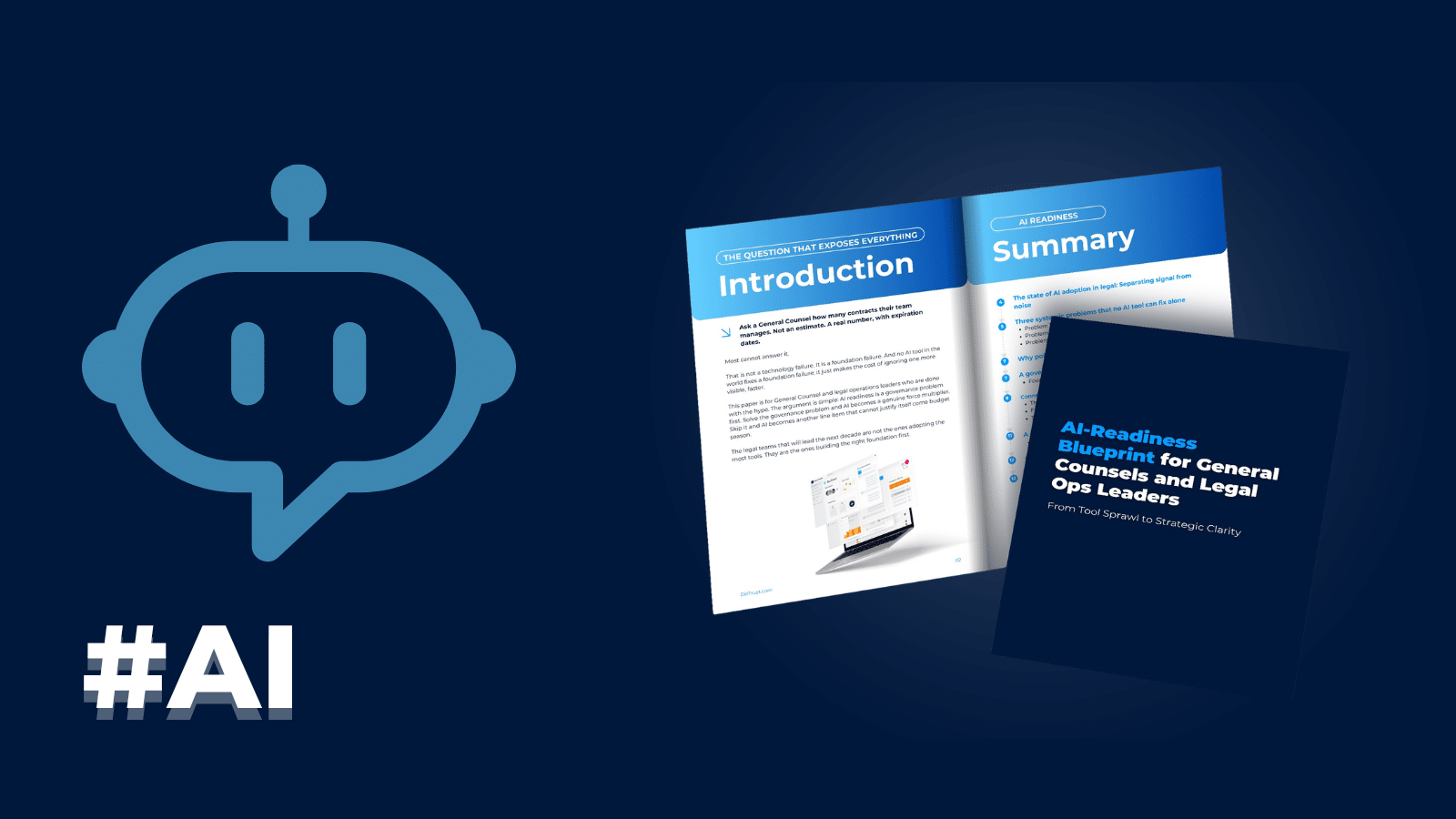
From AI Risk to AI Readiness: The Blueprint for Your Legal Department
What you’ll find in this blueprint:
- From AI adoption to real AI value: what makes the difference
- The 3 problems no software can solve on its own
- A 90-day plan for AI implementation any legal team can act on
Frequently Asked Questions
What are AI hallucinations, and why are they a problem for legal teams?
AI hallucinations are cases where a tool generates plausible-sounding but factually incorrect outputs: fabricated case citations, misquoted clauses, or invented regulatory references. In legal work, they’re a problem because the attorney who signs off is personally responsible for the accuracy of the output, regardless of how it was produced.
How should General Counsel govern AI use in their legal department?
Start with the data: ungoverned inputs produce ungoverned outputs. Then define the checkpoint: a named reviewer, a structured check against source documents, and a formal gate before any AI-assisted output is shared, filed, or acted on. The question isn’t whether to use AI; it’s whether your process makes that use defensible.
What’s the biggest oversight risk when deploying AI in a legal team?
Assuming someone will check rather than requiring it. The verification step needs to be formally assigned, trained for, and consistently enforced. An AI error that travels through a workflow unchecked — a wrong termination clause, a misread statute of limitations — becomes a professional liability issue the moment it carries a lawyer’s name.