



ISO 31000 is the global risk management standard. Over 165 countries reference it to build structured, enterprise-wide risk oversight. If you’re a General Counsel, Corporate Secretary, or Compliance Officer, the challenges the standard addresses are already on your desk: fragmented risk data, inconsistent reporting methodologies, and boards expecting clear, evidence-based risk updates.
What makes ISO 31000 different from most compliance frameworks is its deliberate flexibility. It’s a guidelines document, not a certification requirement. It doesn’t tell you what specific risks to address. It provides principles, a framework, and a process, and expects your organization to adapt them to your own context.
That flexibility is a feature. It’s also where most implementation efforts fall short.
Key Takeaways
What Is ISO 31000 Risk Management?
ISO 31000 is the international standard for risk management published by the International Organization for Standardization. First issued in 2009 and substantially revised in 2018, it defines risk as “the effect of uncertainty on objectives”, a definition that deliberately includes both negative outcomes and positive ones. Upside risk, in other words, is just as much part of the picture as downside exposure.
The ISO standard for risk management applies to every type of organization, regardless of sector, size, or legal structure. A pharmaceutical company and a mid-market professional services firm can both apply ISO 31000, and should adapt it differently.
One thing it doesn’t offer: certification. There’s no official ISO 31000 audit or accreditation. Organizations that want external validation typically pursue related certifiable standards like ISO 27001 or ISO 9001, which build on ISO 31000’s principles for specific domains.
The 8 Core Principles of ISO 31000
The principles describe what effective risk management looks like in practice. The 2018 revision condensed them from 11 to 8, with greater emphasis on leadership and strategic alignment.
According to ISO 31000, risk management should be:
These read as abstract. They’re not. If your legal team assesses contract risk without involving finance or procurement, you’re working against principle four. If your risk register gets updated once a year and filed away, you’re working against principle five.
The ISO 31000 Risk Management Framework
The framework is the structural layer; it describes how risk management gets embedded into the organization’s governance and decision-making.
The five components of the ISO 31000 risk management framework:
- Leadership and commitment: Senior leadership must actively own risk management. Without board-level and C-suite commitment, the framework has no authority.
- Integration: Risk management is woven into planning, operations, and every major business function.
- Design: The framework is tailored to the organization’s specific context, including regulatory environment, culture, and strategic objectives.
- Implementation: Processes, roles, and responsibilities are documented and operational.
- Evaluation and improvement: The framework is regularly assessed and updated as the organization evolves.
For General Counsels and Corporate Secretaries, point one is where attention belongs first. In the US context, SEC disclosure requirements, Delaware corporate law, and Sarbanes-Oxley provisions all reinforce the expectation that boards are actively engaged in risk oversight. ISO 31000’s framework puts that expectation into a structured methodology.
The ISO 31000 Risk Management Process
The process is where theory becomes daily practice. It’s iterative, it runs continuously, not as an annual exercise and structured around eight interconnected steps.
The ISO 31000 risk management process:
- Communication and consultation: Ongoing dialogue with internal and external stakeholders throughout the process
- Scope, context, and criteria: Define what objectives risk management protects and what the organization’s risk appetite is
- Risk identification: What events or conditions could affect those objectives?
- Risk analysis: What’s the likelihood and potential impact of each identified risk?
- ISO risk assessment: Which risks require treatment, and what’s the priority order?
- Risk treatment: Reduce, transfer, accept, or avoid — with documented rationale
- Monitoring and review: Track whether treatments are working and whether the risk landscape has shifted
- Recording and reporting: Document every step for internal governance and external accountability
That last step deserves attention. For in-house legal teams managing regulatory exposure, litigation pipelines, and contractual obligations, the documentation trail is often as important as the risk decisions themselves.
Why Manual Risk Management Processes Fail at Scale
Picture this. Your board asks for a consolidated view of all active contracts above a certain risk threshold, tagged by jurisdiction, before next week’s audit committee meeting. How long does it take your team to produce it?
If the honest answer is “days,” your organization is running risk management on disconnected tools: spreadsheets maintained by different teams, email threads as the audit trail, folder structures that only one person fully understands.
The structural problems with manual risk management practices:
ISO 31000 demands integration, dynamism, and complete documentation. Spreadsheets can’t deliver any of those three consistently at scale.
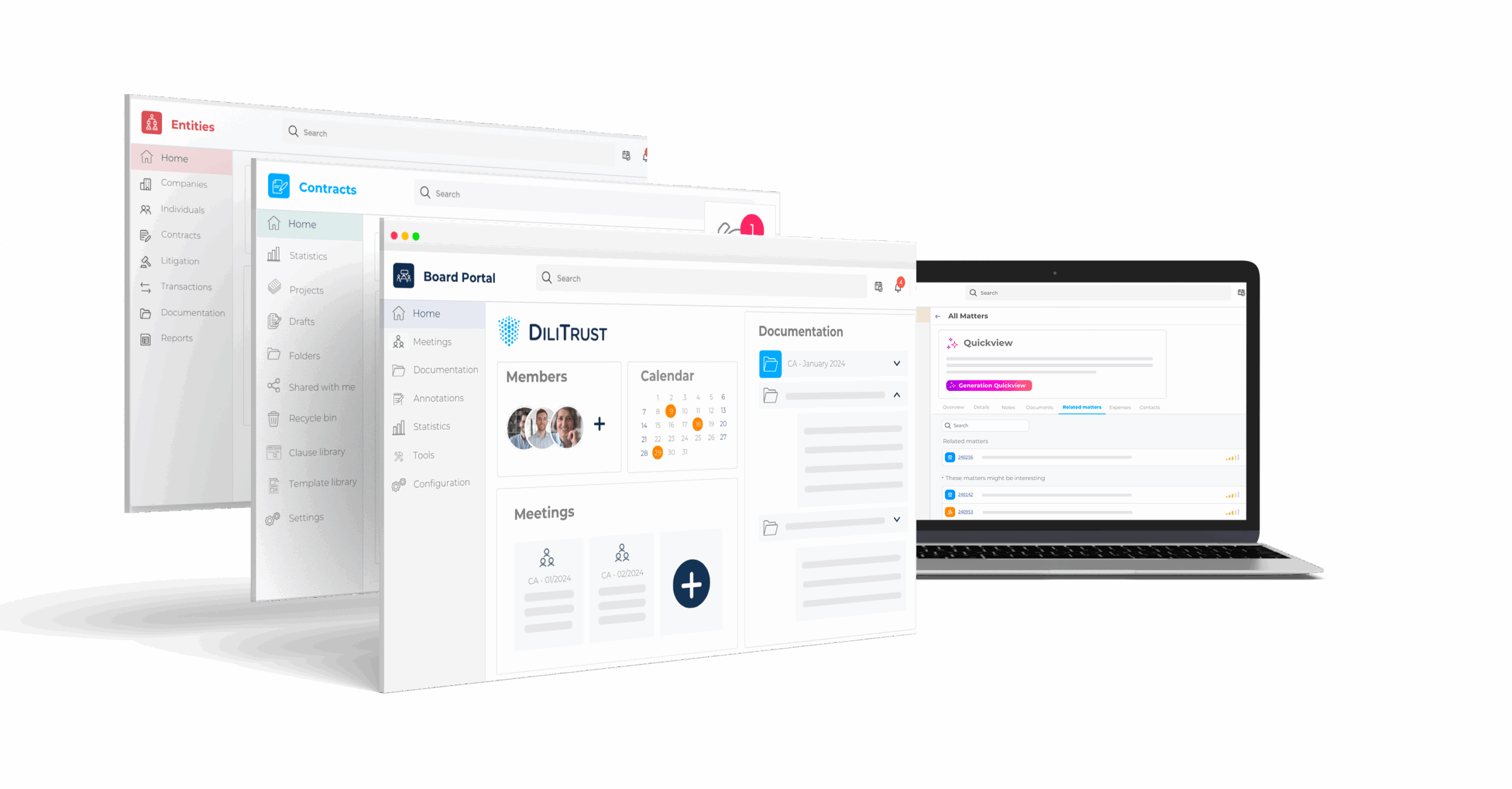
This is what structured risk management looks like
Benefits of ISO 31000 for Organizations
Implementing iso risk management properly produces measurable results, not just a compliance checkbox.
A 2023 study by NC State’s ERM Initiative found that organizations with mature, board-integrated risk management programs significantly outperformed peers on long-term financial stability metrics, reinforcing what ISO 31000’s principles suggest.
Most ISO 31000 implementations stall at the documentation step, not because of will, but because there’s no system to make it stick. DiliTrust connects risk identification to board reporting in one governed workflow. Walk through the platform with an expert.
How Organizations Implement ISO 31000 in Practice
The standard says adapt it to your context. Here’s what that looks like in practice.
Start with objectives, not risks. Before identifying threats, clarify what the organization is trying to protect. A company in the middle of an acquisition has different risk priorities than one managing a regulatory investigation.
Assign ownership explicitly. Risk management without clear accountability stalls. Define who identifies risks, who scores them, who escalates, and who reports to the board.
Choose tools that support integrating risk management across functions. A governance platform that connects contract risk, litigation exposure, entity changes, and board reporting creates the single source of truth ISO 31000’s framework requires.
Build a review cadence. Quarterly reviews at minimum, with triggered reviews following material events, acquisitions, new market entries, significant regulatory developments. Risk registers that don’t change are risk registers that aren’t being used.
Report upward in a structured format. Board-level risk reporting should be standardized, not assembled from scratch each quarter. Dashboards built from live data replace manually compiled PowerPoint decks.
These are the mechanics of what ISO 31000 calls “integration.” They require both process discipline and the right tools.
ISO 31000 vs. COSO ERM: A Side-by-Side Comparison
Two frameworks dominate enterprise risk management globally: ISO 31000 and COSO ERM. Both address the same underlying challenge but take different approaches.
| CRITERION | ISO 31000 | COSO ERM |
|---|---|---|
| Origin | International Organization for Standardization | Committee of Sponsoring Organizations (US) |
| Certifiable | No | No |
| Scope | All organizations, all sectors | Primarily publicly traded companies |
| Primary focus | Principles, framework, iterative process | Strategy, performance, internal control |
| Regulatory anchoring | Broadly international | Strongly US-regulatory context |
| Flexibility | Very high | Moderate |
| ISO integration | Direct (ISO 9001, ISO 27001, ISO 45001) | No direct ISO alignment |
| Board-level focus | Explicit leadership requirement | Embedded in governance component |
For organizations operating across multiple jurisdictions, ISO 31000’s international recognition makes it the more practical foundation. COSO ERM remains more common in US public companies where SOX compliance shapes the risk management architecture. Many organizations use both: ISO 31000 as the overarching methodology, COSO ERM for internal control specifics.
Why Governance and Risk Management Platforms Matter
Managing risk according to ISO 31000 only works when risk information isn’t scattered across systems. Contract risk sits in one tool. Litigation exposure in another. Entity changes tracked in a spreadsheet. Each siloed.
That fragmentation is incompatible with what the ISO 31000 framework demands. Integration, documentation, and real-time monitoring require a unified foundation.
An integrated governance platform solves this by pulling risk-relevant information into a single operating environment. What that enables in practice:
These workflows map directly to what ISO 31000’s “Recording and Reporting” step requires and to what audit committees and boards increasingly expect to see.
Tracking ISO 31000 risks across spreadsheets and email threads? There’s a structured alternative. See how DiliTrust centralises risk oversight.
Why DiliTrust for Governance and Risk Oversight
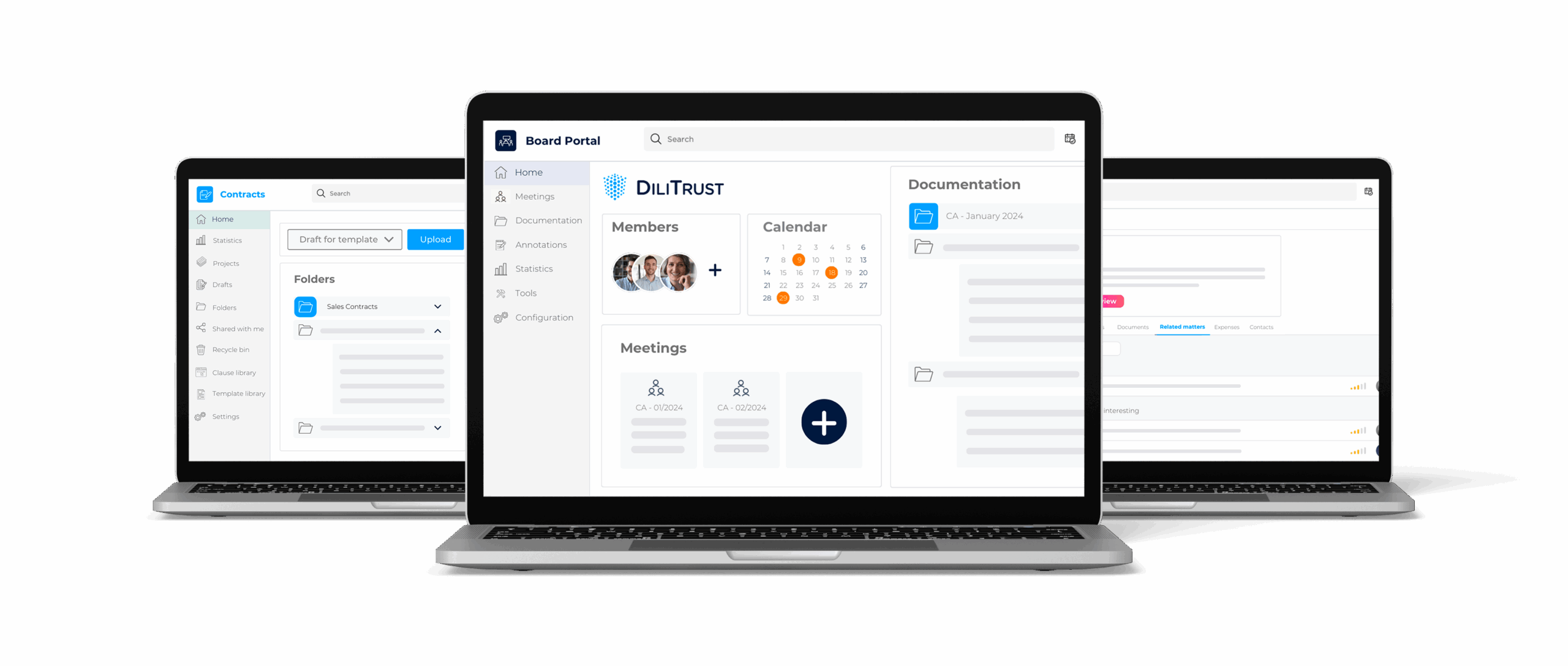
DiliTrust is an integrated governance platform that gives General Counsels, Compliance Officers, and Corporate Secretaries the centralized visibility and documentation structure ISO 31000 requires.
The modules most relevant to enterprise risk management:
The result: your legal team can identify, document, escalate, and report risks in one place, aligned with what ISO 31000 requires and what your board expects to see.
What does this actually look like in practice?
Identify and track risks across your organisation, from detection to board reporting
Frequently Asked Questions About ISO 31000
What software do risk and legal teams use to manage ISO 31000 compliance?
Most organisations start with spreadsheets and quickly hit their limits: inconsistent documentation, no audit trail, and no way to generate board-ready reports without manual effort. Dedicated governance platforms like DiliTrust centralise the full ISO 31000 cycle in one structured workspace, covering risk identification, assessment, treatment, monitoring, and reporting.
How can ISO 31000 risk reporting be automated?
Manual reporting is the most common bottleneck in ISO 31000 implementation. Governance platforms automate the aggregation of risk data and generate board-ready outputs without spreadsheet consolidation. DiliTrust connects risk records directly to board documentation workflows, so reporting is structured before anyone opens a slide deck.
What is the difference between managing ISO 31000 manually and using a governance platform?
The framework is the same. The difference is speed, traceability, and board confidence. Manual processes break down when risks escalate or regulators request documentation. A governance platform creates a persistent, auditable record across every step of the ISO 31000 process so nothing falls through the gaps.