


Organizations today face relentless pressure to demonstrate accountability across governance, compliance, operational resilience, and enterprise risk visibility. Internal audit and risk management sit at the center of that challenge, as strategic pillars that protect value, flag emerging threats, and support confident decision-making at every level.
When internal audit and risk management are properly aligned, organizations gain a clearer picture of where they stand. As regulatory complexity increases and boards demand greater transparency, organizations increasingly rely on technology-enabled audit workflows and centralized governance visibility. This strengthens oversight and improves reporting consistency.
Key Takeaways
What Is Internal Audit in Risk Management?
Internal audit is an independent, objective assurance and consulting activity designed to evaluate and improve an organization’s governance, internal controls, and risk management processes. Within an enterprise risk management framework, internal audit serves as the third line of defense, distinct from operational teams that manage day-to-day risks and the compliance functions that monitor adherence to policies.
In practice, internal risk management encompasses a broad spectrum of activities: assessing the design and operating effectiveness of controls, evaluating compliance with regulations and internal policies, identifying process inefficiencies, and providing leadership with independent insights on enterprise risk exposures. The scope extends across financial, operational, strategic, and compliance risk domains.
Effective internal audit and risk functions do more than flag problems. They provide structured insights that help organizations understand whether their risk management frameworks and governance processes are performing as intended and where improvements are needed.
The Role of Internal Audit in Enterprise Risk Oversight
Internal audit plays a pivotal role in supporting enterprise-wide governance oversight by providing independent assurance on the effectiveness of risk management, controls, and governance processes. Rather than acting as a policing mechanism, modern internal audit functions operate as trusted advisors to senior leadership and audit committees.
The scope of this role includes:
When audit and risk management are aligned at the governance level, assurance functions deliver significantly more value, informing strategic decisions rather than simply satisfying compliance requirements.
Internal Audit vs. Risk Management
While internal audit and risk are closely related and mutually reinforcing, they serve distinct purposes within an organization’s governance framework.
| DIMENSION | INTERNAL AUDIT | RISK MANAGEMENT |
|---|---|---|
| Primary role | Independent assurance and evaluation | Risk identification, assessment, and mitigation |
| Line of Defense | Third line (independent) | Second line (operational oversight) |
| Focus | How well controls and processes work | What risks exist and how they are addressed |
| Reporting to | Audit committees, board, senior leadership | Risk committees, executive leadership |
| Key output | Audit reports, findings, recommendations | Risk registers, risk appetite statements, mitigation plans |
| Independence | Required objective, and separate from operations | Embedded within the organization |
The distinction matters because conflating the two can undermine both functions. Risk management and internal audit are more effective when they maintain clear boundaries while sharing information, frameworks, and risk priorities.
In well-governed organizations, internal audit does not own or manage risk. Instead, it validates that the organization’s audit and risk management processes are functioning.
When audit and risk teams operate in separate silos, oversight gaps are inevitable.
See how DiliTrust connects both functions.
How Internal Audit and Risk Management Work Together
The most effective governance frameworks treat internal audit and risk management not as parallel silos, but as complementary functions that inform and reinforce each other. Audit-risk collaboration allows organizations to prioritize audit coverage based on current risk exposures.
Risk-based audit planning is one of the clearest examples of this alignment. When internal audit teams use the organization’s risk register and enterprise risk assessments to prioritize audit activities, they direct resources toward the areas of greatest concern. This makes internal audit and risk work more strategic and efficient.
Coordinated assurance is another practical outcome. When internal audit, risk, compliance, and other assurance providers share their plans and findings, organizations avoid overlapping coverage in low-risk areas while ensuring adequate attention on high-risk processes.
Operationally, this collaboration typically involves:
Organizations that adopt structured corporate risk management approaches with clear audit-risk alignment consistently achieve better governance outcomes than those that manage these functions in isolation.
Risk management frameworks like the 5 P’s — Perception, Process, People, Principles, and Practice — show how much of governance depends on human and organizational factors, not just process. That is precisely why internal audit and risk functions need a shared environment to work from.
Common Challenges in Internal Audit and Risk Oversight
Despite the clear benefits of alignment, many organizations struggle to integrate internal audit and risk effectively. Several persistent challenges limit governance oversight and operational efficiency.
- Fragmented systems and data: When audit teams and risk functions work in separate tools, sharing risk intelligence becomes difficult. Tracking remediation progress and creating coherent board-level reports also becomes more challenging.
- Manual audit workflows: Paper-based or manual processes slow down audit and risk management cycles. They also increase the risk of errors and make audit readiness harder to demonstrate to regulators or boards.
- Limited board visibility: Without centralized reporting, senior leadership and audit committees often receive incomplete or delayed information about risk exposures and control effectiveness.
- Siloed functions: When internal audit, compliance, legal, and risk teams operate without shared frameworks or regular communication, governance gaps emerge. Key risks may fall between functions.
- Resource constraints: Internal audit teams in many organizations are under-resourced relative to the complexity of their mandates. Prioritizing effectively requires clear, current risk intelligence that manual processes struggle to deliver.
- Keeping pace with evolving risks: From cybersecurity threats to supply chain disruptions and risk management in contracts, the risk landscape changes rapidly. Audit planning cycles that rely solely on annual assessments can leave organizations exposed between review periods.
Meet Lini, DiliTrust’s AI for Governance and Risk
Lini understands audit and risk the way your team does. Trained on governance, compliance, and risk frameworks, Lini reasons with context, so your findings, controls, and reporting actually make sense to it.

Fragmented systems, manual workflows, and limited board visibility are the top blockers for internal audit teams. DiliTrust resolves all three. See how it works.
Why Internal Audit Teams Need Centralized Governance Visibility
Fragmented governance processes create significant blind spots. When audit findings, risk registers, control assessments, and compliance records are spread across different systems, leadership lacks a clear view of organizational risk. Keeping risk information current and consistent also becomes difficult.
Centralized governance visibility addresses this by bringing audit and risk management activities, risk intelligence, and control documentation into a single, accessible environment. The operational benefits are substantial:
As organizations grow in complexity, through geographic expansion, acquisitions, or increasing regulatory demands, the case for centralized governance infrastructure strengthens. A governance platform that supports audit workflows, entity management, and internal audit and risk management oversight in one environment eliminates the inefficiencies that fragmented tools inevitably create.
Why Governance and Risk Management Platforms Matter
The shift toward integrated governance, audit, and risk management platforms reflects the growing need for connected oversight. Organizations can no longer manage governance effectively through disconnected systems. They increasingly need platforms that connect audit and risk data, support real-time oversight, and provide consistent reporting to boards and executive leadership.
Integrated platforms support governance outcomes across several dimensions:
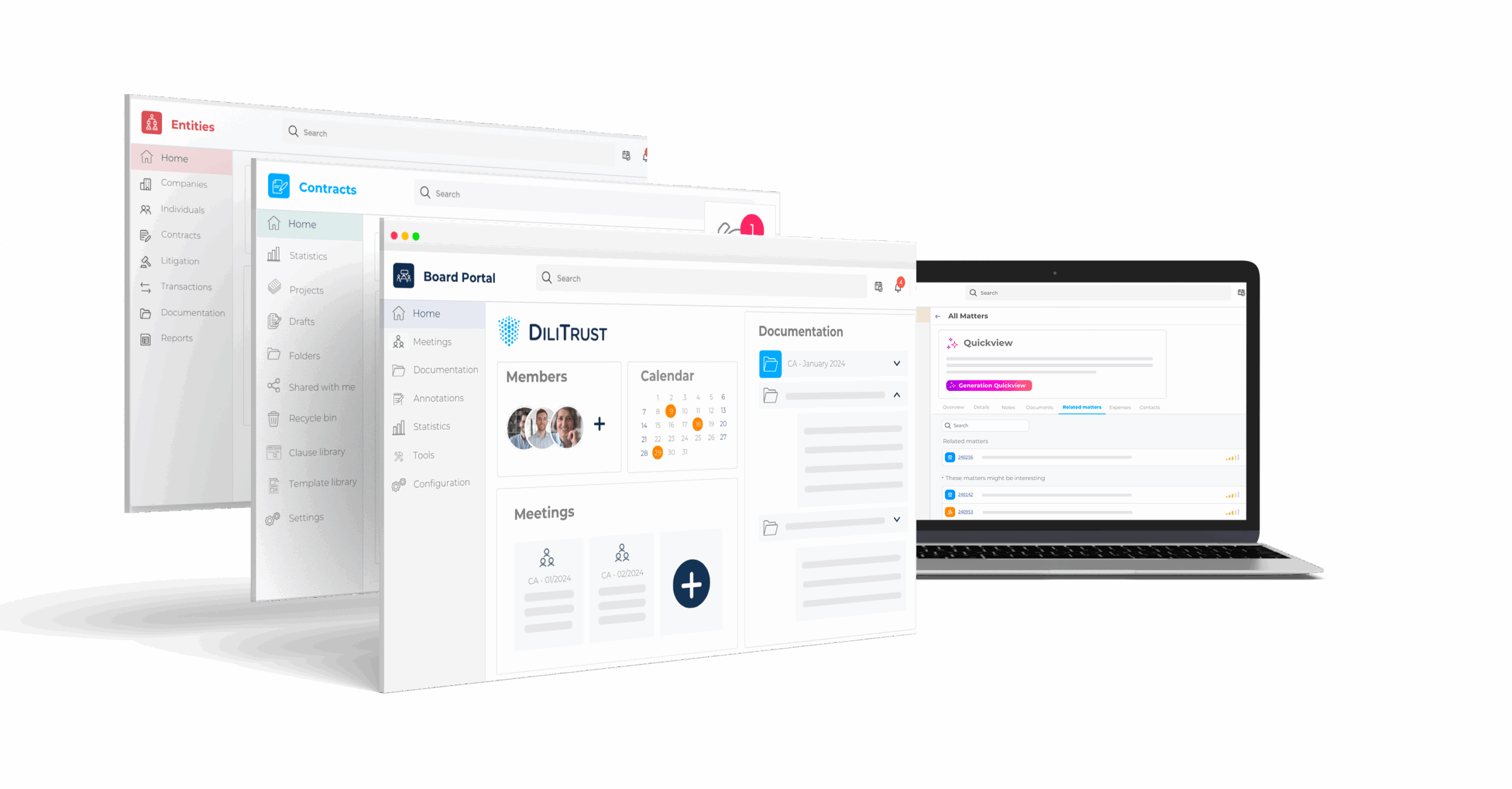
One platform for governance, audit, and risk oversight
DiliTrust brings together board management, entity oversight, and compliance tracking so your audit team always works from a single, reliable source of data.
Why DiliTrust for Governance, Audit and Risk Oversight
DiliTrust is a centralized governance platform built for organizations that need more than a collection of individual tools.
For teams responsible for audit and risk management, DiliTrust delivers:
DiliTrust supports organizations across the full scope of governance oversight: from the boardroom to the legal department, from contract risk to audit readiness.
Ready to give your audit committee real-time governance visibility? See DiliTrust’s centralized oversight in 20 minutes.
Frequently Asked Questions About Internal Audit and Risk Management
Can internal audit own or manage the risk register without compromising its independence?
No. Internal audit can advise on the risk register and audit how well it is maintained, but it cannot own or update it without forfeiting the independence that makes third-line assurance credible. If auditors set risk ratings or choose treatments, they end up auditing their own judgments, and external auditors and regulators will discount internal audit work they can no longer treat as objective. The sound model keeps risk owners accountable for the register while internal audit tests it, and a shared governance platform with role-based access lets both teams see the same data without blurring those responsibilities. DiliTrust supports this separation by giving auditors assurance-level access to risk records that risk owners continue to control.
How does the IIA’s 2020 Three Lines Model change how internal audit and risk management should work together?
The 2020 model dropped the “of defense” language and reframed the three lines as coordinating roles rather than rigid silos, so internal audit and risk are now expected to share frameworks and data while audit keeps its independent reporting line to the board. In practice that means common risk registers, materiality definitions, and aligned planning, provided internal audit’s objectivity and direct access to the audit committee stay intact. Organizations that ignore the shift tend to duplicate assurance in low-risk areas and leave gaps in high-risk ones. A single environment where both functions work from shared data, with independence preserved through access controls, is what the model now anticipates. DiliTrust provides that shared environment with role-based separation built in.
How often should a risk-based audit plan be refreshed to keep the audit committee comfortable?
At minimum annually, but stronger audit functions refresh the plan quarterly or continuously so it tracks the live risk register rather than a once-a-year snapshot. Audit committees increasingly expect the plan to flex when a material risk emerges, such as a new regulation, an acquisition, or a cyber incident, because a static annual plan can leave the organization exposed for months between reviews. A plan visibly tied to current enterprise risk data is also far easier to defend to the committee and to external auditors. Drawing audit planning from a live risk register, instead of a separate spreadsheet, keeps the two in sync. DiliTrust links audit planning to the risk register so changes flow through automatically.
What documentation should internal audit retain to satisfy a regulator or external auditor reviewing risk decisions?
A complete, timestamped, and attributed record of every risk decision, control assessment, audit finding, and remediation action, retained for the period your regulator requires, commonly seven years under SOX record-retention rules (Section 802). When an examiner or external auditor asks who made a decision, on what date, and on what evidence, an incomplete trail becomes a finding in its own right, regardless of whether the underlying risk was handled well. Documentation gaps are among the most common audit exceptions and are entirely avoidable. A governance platform that timestamps and attributes every action builds this trail as work happens rather than reconstructing it before an audit. DiliTrust maintains that continuous, attributable record across audit and risk activities.