



In 2025, Delaware turned a routine line in your proxy statement into a legal shield.
Under amended Section 144 of the Delaware General Corporation Law, a director of a listed company is presumed disinterested in a transaction to which the director isn’t a party if the board has determined that the director meets the exchange’s independence criteria. That presumption can only be rebutted by “substantial and particularized facts” ( Delaware Senate Bill 21).
So your annual independence review is no longer just a compliance exercise. Run it carefully and it supports your board when a deal is challenged. Run it on autopilot and the record may work against you.
This guide is for the General Counsel or Corporate Secretary who owns that review. You’ll get the NYSE and Nasdaq tests side by side, a five-step assessment process and the habits that can weaken an otherwise sound record.
Key takeaways
- Independence is a board determination made director by director and disclosed every year under Item 407(a).
- Passing the NYSE or Nasdaq bright-line tests is necessary but not sufficient. The board must also judge every other relationship.
- Audit and compensation committee seats carry stricter tests (SEC Rules 10A-3 and 10C-1). Assess per seat, not per person.
- Since 2025, Delaware presumes that a listed-company director the board found independent is disinterested in transactions they aren’t party to. A well-documented determination now carries legal weight.
- Re-run the assessment whenever a director’s job, family ties, business dealings or board seats change.
What makes a director independent under US rules
An independent director is a board member who has no material relationship with the company, its management or its significant shareholders that could interfere with their independent judgment. For US-listed companies, independence is not self-declared. The board must affirmatively determine it, director by director.
Both exchanges apply a two-layer test:
- A general judgment: NYSE Rule 303A.02 asks whether the director has a “material relationship” with the company. Nasdaq Rule 5605(a)(2) asks whether any relationship “would interfere with the exercise of independent judgment.”
- Bright-line disqualifications: Specific relationships automatically rule a director out, whatever the board thinks.
Passing the bright-line tests is necessary. It is not sufficient. That distinction is easy to lose in a busy proxy season.
The NYSE and Nasdaq bright-line tests
Both exchanges use a three-year look-back period. The thresholds differ in ways that matter if you’re dual-listed, switching exchanges or preparing an IPO.
| Disqualifying relationship | NYSE (Rule 303A.02(b)) | Nasdaq (Rule 5605(a)(2)) |
|---|---|---|
| Employment | Director was an employee, or a family member was an executive officer, in the last 3 years | Same |
| Direct compensation | More than $120,000 in any 12-month period in the last 3 years (excluding director fees and certain pension or deferred pay) | More than $120,000 in any 12 consecutive months in the last 3 years (similar exclusions) |
| Auditor ties | Director is a current partner or employee of the internal or external auditor; broader family-member and former-partner tests also apply | Director or family member is a current partner of the outside auditor, or a former partner or employee who worked on the audit in the last 3 years |
| Compensation committee interlock | Director or family member is an executive officer elsewhere where a current executive of the company sits on the compensation committee | Same |
| Business payments | Greater of $1 million or 2% of the other company’s consolidated gross revenues | Greater of $200,000 or 5% of the recipient’s consolidated gross revenues |
Abbreviated summary of NYSE Listed Company Manual Rule 303A.02 and Nasdaq Listing Rule 5605(a)(2). Always check the full rule text and definitions.
Watch the definitions. Under the NYSE rule, “immediate family member” includes in-laws and anyone who shares the director’s home, other than domestic employees.
Audit and compensation committees add a second layer
Committee members face stricter tests on top of the general ones.
Audit committee
SEC Rule 10A-3
- No consulting, advisory or other compensatory fees beyond director pay.
- No affiliation with the company or its subsidiaries.
Compensation committee
SEC Rule 10C-1
- Consider the source of the director’s compensation, including consulting or advisory fees.
- Consider whether the director is affiliated with the company.

A director can be independent for the board and still fail the audit committee test. Run the analysis per seat, not per person.
Independent director responsibilities
Independent director responsibilities go beyond acting as a “non-management” vote. In a US-listed company, independent directors typically:
- Make up a majority of the board, as required by both NYSE and Nasdaq.
- Staff the audit, compensation and nominating/governance committees, which must be fully independent (Nasdaq allows independent directors to handle nominations without a committee).
- Meet in executive session without management. Nasdaq Rule 5605(b)(2) requires these meetings to take place at least twice a year.
- Oversee financial reporting and the external auditor through the audit committee.
- Set CEO and executive pay through the compensation committee.
- Approve conflicted transactions, which is where the Delaware presumption now applies.
- Lead the board when the CEO also chairs it, through a lead independent director.
Independent board leadership is common at large US companies. In the 2025 Spencer Stuart U.S. Board Index, 61% of S&P 500 boards separate the chair and CEO roles, and 42% have an independent chair.
Independence is only one part of how your board is built. To see how composition, committees and decision rights fit together, see our guide to structuring board governance.
How to assess director independence in 5 steps
Item 407(a) disclosure is annual, so the review typically runs once a year ahead of the proxy statement. Here is a process that produces a record you can defend:
- Refresh the D&O questionnaire before you send it
- Map every disclosed relationship against the bright-line tests
- Apply the board’s judgment to everything that passes
- Record the affirmative determination in the minutes
- Disclose the basis under Item 407(a)
Step 1: Refresh the D&O questionnaire before you send it
The annual directors’ and officers’ questionnaire is the raw material for the whole determination. If it hasn’t changed in three years, it may miss relationships that didn’t exist when it was drafted.
Update it every cycle for:
- New vendors, customers and acquisitions: A new supplier relationship can create a business-payments issue for a director whose company never dealt with you before.
- Changes in the rules and board structure: Delaware’s 2025 amendments, exchange rule updates and new committee seats.
- Family members by name: Ask directors to list the employers of spouses, children and in-laws, not just to tick “none.”
- Charitable affiliations: Payments to a nonprofit where a director is an executive officer can count, depending on the exchange.
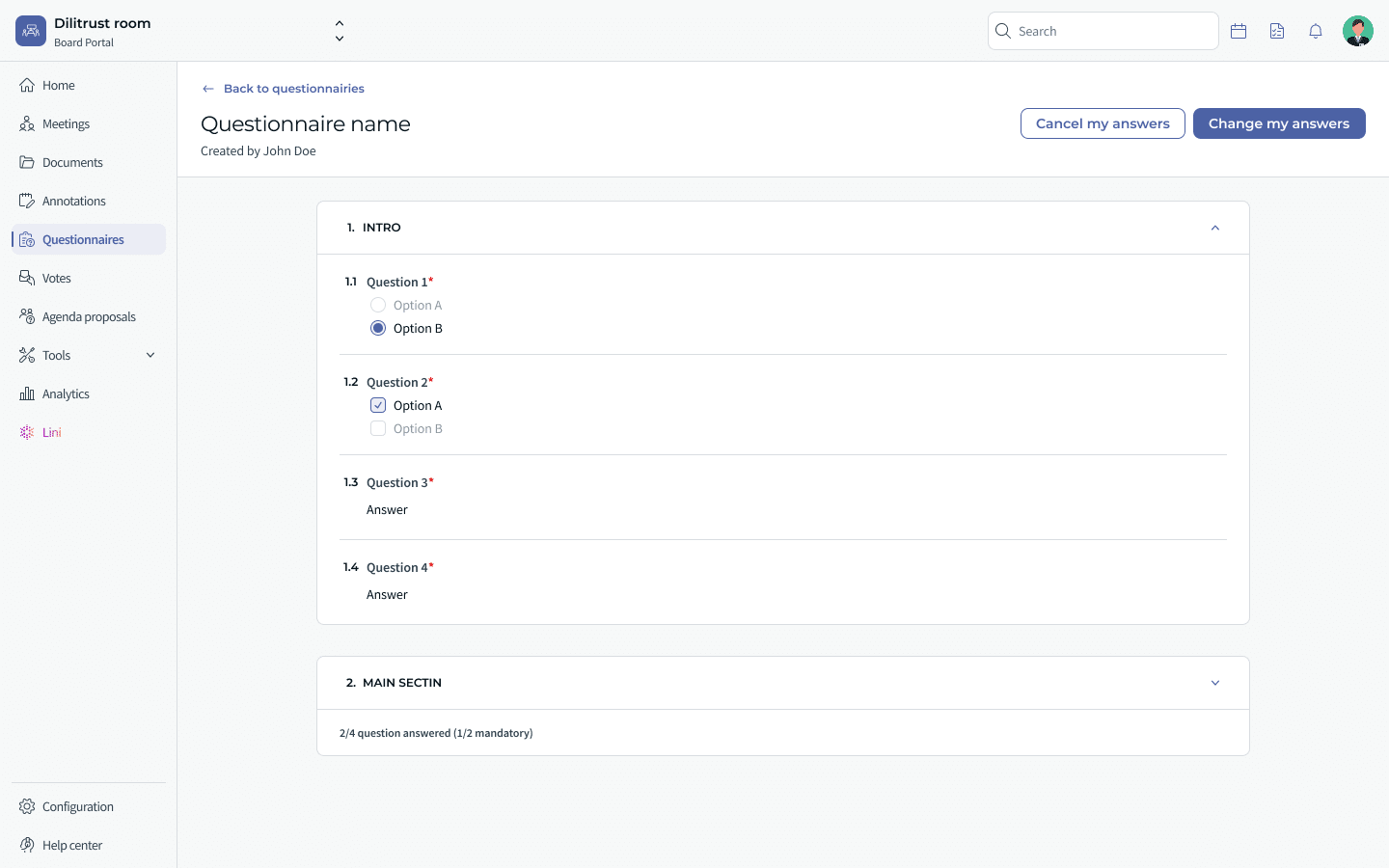
If you’re chasing 12 directors for answers by email, you’ll spend more time on follow-ups than on analysis. Directors need a single place to answer, save progress and add comments.
Step 2: Map every disclosed relationship against the bright-line tests
Build a simple matrix: one row per director, one column per bright-line test, plus separate columns for audit committee (Rule 10A-3) and compensation committee (Rule 10C-1) eligibility.
Then cross-check answers against your own data. Accounts payable and receivable records will show payments to a director’s employer. Your entity records will show other board seats within your group. Directors forget. Ledgers don’t.
A failed bright-line test ends the analysis. The board has no discretion to override it.
Step 3: Apply the board’s judgment to everything that passes
Rushing this step is tempting. It’s also where the Delaware presumption can be rebutted.
Under amended Section 144, a challenger can overcome the presumption with particularized facts showing that a director has a material relationship with someone who has a material interest in the transaction. Those relationships rarely appear in the bright-line tests: a long friendship with the CEO, a joint investment, a significant company donation to a director’s favorite cause.
Ask the question the rule actually asks. Would this relationship interfere with the director’s independent judgment? Write down the answer and the reasoning, especially when the answer is “no.”
Stock ownership, on its own, isn’t a bar under the NYSE rule, whose concern is independence from management. For audit committee members, though, holding more than 10% of a class of voting stock takes a director outside the Rule 10A-3 safe harbor for “affiliated person” status.
Step 4: Record the affirmative determination in the minutes
The board makes the determination, not the General Counsel or the nominating committee alone, although the committee often prepares a recommendation.
Your minutes should show:
- What the board reviewed. Questionnaire results, the relationship matrix and counsel’s analysis.
- Each relationship considered, even those found immaterial.
- The conclusion for each director and for each committee seat.
- Who was present and whether any director abstained from their own determination.
When a plaintiff’s lawyer asks how the board concluded a director was independent, “we always have” isn’t an answer. The minutes and the papers behind them are.
Step 5: Disclose the basis under Item 407(a)
Item 407(a) of Regulation S-K requires you to identify each independent director in the proxy statement or Form 10-K. For each one, you must describe, by specific category or type, any transactions, relationships or arrangements the board considered that aren’t already disclosed as related-party transactions under Item 404(a).
That description must be detailed enough to “fully describe the nature” of what the board weighed. A one-line statement that “all directors other than the CEO are independent” may not meet that bar on its own when relationships were considered.
Your Step 3 notes become your Step 5 draft. That’s why you write them down.
How to keep board independence current between annual reviews
Independence isn’t fixed for 12 months. A director’s status can change mid-year, and without a reporting obligation you may only find out at the next questionnaire.
Common trigger events:
- A director changes jobs and joins a company that does business with yours.
- A director’s spouse takes a role at your auditor.
- You acquire a company that is a major customer of a director’s employer.
- A director steps in as interim CEO. Under the NYSE commentary to Rule 303A.02, interim executive service doesn’t disqualify a director after it ends, but they are not independent while serving.
Build a standing obligation into your governance guidelines: directors must notify the Corporate Secretary of any change that could affect their independence. Then re-run Steps 2 to 4 for that director and that seat. Both exchanges offer limited cure periods when a director ceases to be independent for reasons outside the company’s control, so check the applicable rule and notify the exchange promptly.
IPOs and controlled companies
Two situations change the timeline.
- IPO phase-in. Newly listed companies can phase in the majority-independent board within one year of listing. Committees typically need one independent member at listing, a majority within 90 days and full independence within one year (NYSE Rule 303A.00, Nasdaq Rule 5615(b)(1)).
- Controlled company exemption. When more than 50% of the voting power for director elections is held by one person, group or company, the company can opt out of the majority-independent board and independent compensation and nominating committee requirements. It cannot opt out of the independent audit committee. On Nasdaq, executive sessions of independent directors still apply (Nasdaq Rule 5615(c)).
If you lose controlled company status, the phase-in clock starts on the date of the change. Plan board recruitment before the secondary offering, not after.
Common mistakes that weaken the independence record
These habits can undermine an otherwise sound process:
- Copy-paste questionnaires. Last year’s form, last year’s answers, a new date at the top.
- Treating the bright-line tests as the whole analysis. They’re the floor.
- No written reasoning. The board discussed a relationship and found it immaterial, but nobody recorded why.
- One analysis for every seat. Audit and compensation committee tests are stricter.
- Ignoring tenure and social ties. A director who has sat alongside the same CEO for 15 years may meet every rule and still not be the independent voice investors expect.
- Losing the trail. When an auditor or plaintiff asks for the 2023 determination, nobody can find the questionnaire responses behind it.
Each of these can be fixed within one cycle. Several are documentation problems, not legal ones.
How DiliTrust supports the independence review
The determination belongs to your board and your counsel. Software won’t make it for you. What it can do is make the record complete, consistent and easy to retrieve.
DiliTrust Board Portal covers the steps where the administrative load sits:
- Questionnaires built for long D&O forms. Admins can create questionnaires with unlimited sections. Directors can save their answers, finish across several sessions and comment on individual questions. Lini, DiliTrust’s AI assistant, can turn your existing Word, PDF or Excel questionnaire into a Board Portal questionnaire.
- Confidential papers for independent directors. Separate rooms, plus document-level access set to “Nobody except”, keep executive session materials away from management. Admins control who can view, download or print each document, with custom watermarks.
- Decisions on record. Votes, e-signatures and AI-drafted minutes generated from the meeting transcript and reviewed by your team before approval.
- A searchable history. AI-powered search across meetings and minutes helps you find last year’s determination and the discussion behind it.
For groups with many subsidiaries, DiliTrust Entities Management centralizes mandate data, including each director’s position, appointment date, expiry and renewal history, and provides an Excel export.
If you’re the Corporate Secretary running this cycle alongside every board and committee calendar, see how DiliTrust supports the full governance workload of general secretaries.
Frequently asked questions
How many independent directors does a US listed company need?
A US-listed company generally needs a majority-independent board under both NYSE and Nasdaq rules. The audit and compensation committees must also be fully independent. On Nasdaq, independent directors may handle nominations without a committee, subject to phase-in periods and the controlled company exemption. For more on what each committee does, see our guide to board committees and their functions.
Who decides whether a director is independent?
The board of directors, through an affirmative determination disclosed every year. The nominating or governance committee usually prepares the analysis, and counsel advises, but the board makes the call.
Can an independent board member own company stock?
Yes. Under NYSE Rule 303A.02 commentary, owning even a significant amount of stock is not, by itself, a bar to independence. For audit committee members, owning more than 10% of a class of voting stock removes the Rule 10A-3 safe harbor, so the affiliate question needs closer analysis.
What is the difference between an independent director and a non-executive director?
A non-executive director isn’t part of management. An independent director is non-executive and has no material relationship with the company. An investor’s board designee is usually non-executive but may not be independent.
What is the difference between an independent director and a disinterested director?
Independence is assessed against exchange rules and disclosed annually. Disinterestedness is assessed transaction by transaction under state law. Since 2025, Delaware links the two: a board’s independence determination creates a heightened presumption that the director is disinterested in transactions to which they aren’t a party.
How often should director independence be reviewed?
Review it at least once a year before the proxy statement, and again whenever a director reports a change in employment, family relationships, business dealings or other board seats.
Conclusion: treat independence as evidence, not a label
Independent directors are only as credible as the record behind them. Delaware’s 2025 amendments raised the stakes: a careful determination now carries legal weight, and a careless one invites challenge.
Refresh the questionnaire. Test every seat. Write down the reasoning. Then make sure you can find it again in three years.
See how a secure board portal keeps your questionnaires, minutes and board decisions in one place.
Run your next independence review on a record you can defend
Send D&O questionnaires, restrict executive session papers to independent directors and draft decision-focused minutes, all in one platform built for Corporate Secretaries.