


Board crises don’t announce themselves. A ransomware attack locks down systems on a Sunday night. A regulatory investigation surfaces the week before an earnings call. A supply chain disruption triggered by a geopolitical flashpoint cascades into a financial emergency within hours. What separates organizations that handle these moments well from those that struggle is almost always preparation.
For boards of directors, crisis management is a core governance responsibility, not a task that defaults to management when things go wrong. According to a PwC analysis published by the Harvard Law School Forum on Corporate Governance in September 2025, crisis is no longer a rare event but a recurring challenge for virtually every organization operating at scale. The practical question is whether your board has the structures, information flows, and decision-making protocols to respond effectively when one hits.
Key Takeaways
- Board crisis management is a formal governance function, not a reactive activity left to management under pressure.
- The Allianz Risk Barometer 2026 ranks cyber incidents as the top global business risk for the year, ahead of geopolitical events and supply chain disruptions, by the widest margin ever recorded.
- Many crisis plans have gaps between the crises organizations have actually experienced and those the plan specifically addresses.
- Boards that formally separate their oversight role from management’s operational role respond faster and with less internal confusion.
What is board crisis management?
Board crisis management is the set of governance practices by which a board of directors provides strategic oversight, accountability, and decision support during a major disruptive event. It sits above operational crisis response, which belongs to management, and covers the board’s distinct responsibilities: oversight of the management response, stakeholder communication at the director level, and continuity of governance.
A board crisis management framework covers three stages: preparation before a crisis, active oversight during one, and structured review after. Without a defined approach for each stage, boards risk either standing back too far (leaving management without adequate oversight) or stepping too deep into operations and creating confusion about who is in charge.
The four crisis types boards must plan for
A single crisis scenario plan is no longer enough. The Allianz Risk Barometer 2026 ranks cyber incidents as the top global business risk, ahead of geopolitical disruption and supply chain failure. The WEF Global Cybersecurity Outlook 2026 found that 64% of organizations now factor geopolitically motivated cyberattacks into their risk strategy. Yet many crisis plans still don’t reflect the full range of threats organizations are actually facing. Here are the four categories that require explicit coverage.
Cyber incidents and ransomware
Ransomware has become a board-level governance issue, not a technical one. The WEF Global Cybersecurity Outlook 2026 found that 87% of organizations identified AI-related vulnerabilities as the fastest-growing cyber risk, with 64% now accounting for geopolitically motivated cyberattacks in their planning. When an attack hits, directors must be able to convene quickly, receive accurate information from management and legal counsel, and authorize response measures, often within hours. Boards that haven’t defined that process in advance find themselves improvising it under pressure.
Geopolitical and supply chain disruption
Trade restrictions, sanctions, and regional conflicts can render a business model unworkable in days. Boards facing supply chain crises must make fast strategic decisions: which operations to pause, which contracts invoke force majeure clauses, and how to communicate with investors. Directors who haven’t mapped geopolitical exposure beforehand make those decisions without context.
Regulatory investigations and enforcement actions
A fine is a financial event. A regulatory investigation is a governance event. When enforcement action hits, boards need to understand the scope of director liability, ensure appropriate legal counsel is engaged immediately, and oversee communications with regulators, all while the business continues operating. Plans that don’t address this scenario specifically tend to slow down at exactly the wrong moment.
Leadership and reputational crises
An unexpected CEO departure, an allegation of executive misconduct, or a product failure that dominates the news cycle can each destabilize an organization within days. These situations require boards to be visible, coordinated, and deliberate in their public-facing communication, often faster than management can prepare a full briefing.
Is your board prepared for a cyber or regulatory crisis? The DiliTrust Board Portal gives directors and corporate secretaries a secure, centralized environment for governance operations: board meeting preparation, document access, and real-time decision-making when it matters most. See how the DiliTrust Board Portal works
The board’s role before, during, and after a crisis
Before: build the framework
Boards should confirm that management maintains a formal, documented crisis management plan that is reviewed and tested regularly. According to PwC’s analysis on the Harvard Law School Forum, the best crisis plans are crisis-agnostic: they define designated crisis leaders, cross-functional team responsibilities, and escalation protocols that work regardless of the triggering event.
Directors should ask:
- Has the crisis plan been tested through tabletop exercises, and is the board involved in any of them?
- Does it integrate with business continuity (BCP), disaster recovery (DR), and incident response plans?
- Are board and management responsibilities clearly separated for different crisis types?
During: oversight, not operations
The board’s role in an active crisis is oversight. Running the operational response belongs to management. Directors should receive timely, accurate updates through a defined information flow. They should be available to convene on short notice, and prepared to communicate directly with investors and regulators if the situation requires visibility at the director level.
Research published in 2026 by Deloitte and the Society for Corporate Governance found that formally delineating board versus management responsibilities in a crisis yielded very different results across organizations. Between 25% and 73% of companies had done so, depending on company size. That gap is a material governance risk.
After: review and improve
Post-crisis review is where most boards fall short. After immediate pressure subsides, a structured analysis of what worked, what failed, and what the plan missed is how organizations avoid the same vulnerabilities appearing twice. Directors should require management to document lessons learned and update the crisis plan before the next board cycle closes.
Building a board-level crisis management framework
A functional framework includes four components. Each should be documented, approved at the board level, and revisited at least annually.
| Component | What it covers |
|---|---|
| Crisis categorization | Defined crisis types and the triggers that activate each response protocol |
| Roles and responsibilities | Board versus management accountabilities, designated crisis leader, cross-functional team structure |
| Communication plan | Stakeholder communication sequences for investors, regulators, employees, and media |
| Testing cadence | Frequency of tabletop exercises, plan review cycles, post-crisis update process |
What’s changing in 2026 and beyond
DORA places cyber risk governance directly under board accountability
For financial institutions operating in the EU, the Digital Operational Resilience Act (DORA) now requires board-level accountability for ICT risk management, including crisis response and recovery planning. This is no longer a CTO responsibility alone. Boards must demonstrate active oversight of digital resilience, with documented governance processes to match.
Geopolitical instability is now a permanent variable
The World Economic Forum’s Global Risks Report 2025 ranks geopolitical instability among the top threats facing organizations globally. Boards that haven’t formally incorporated geopolitical risk into crisis planning are operating with a gap their investors, regulators, and counterparties will eventually surface. This is especially true as trade policy shifts and regional conflicts continue to accelerate supply chain fragility.
AI systems create new crisis scenarios
AI tools operating in core business processes introduce failure modes that boards are not yet well equipped to oversee. A model producing incorrect regulatory outputs, generating discriminatory decisions at scale, or failing in a high-stakes client context can escalate to crisis status faster than traditional operational failures. Boards should be receiving AI risk briefings as part of their standard governance cadence, not only when something goes wrong.
How a board portal supports crisis response
Manage board decisions and communications in one secure environment during an active crisis.
When a crisis hits, the board’s operational capacity depends on its governance infrastructure. Directors who can’t quickly access the right documents, convene securely with other members, or sign off on decisions without manual coordination become a bottleneck at exactly the wrong moment.
The DiliTrust Board Portal gives directors and corporate secretaries:
- Instant access to governance records: agendas, prior resolutions, and meeting history available on any device, without going through intermediaries
- Secure remote convening: encrypted communications and document sharing that don’t rely on email or consumer tools
- Digital voting and e-signatures: decisions recorded, attributed, and stored with a complete audit trail, even when directors are geographically distributed
- AI-assisted search across the governance record: Lini, DiliTrust’s proprietary AI retrieves past resolutions, votes, and meeting records in seconds during an active session, so governance teams spend time deciding rather than searching
For organizations in regulated industries, the platform’s ISO 27001 and SOC 2 Type II certifications apply directly to a crisis context. Board communications during a high-stakes event are some of the most sensitive records an organization produces.
Explore board governance for financial services organizations
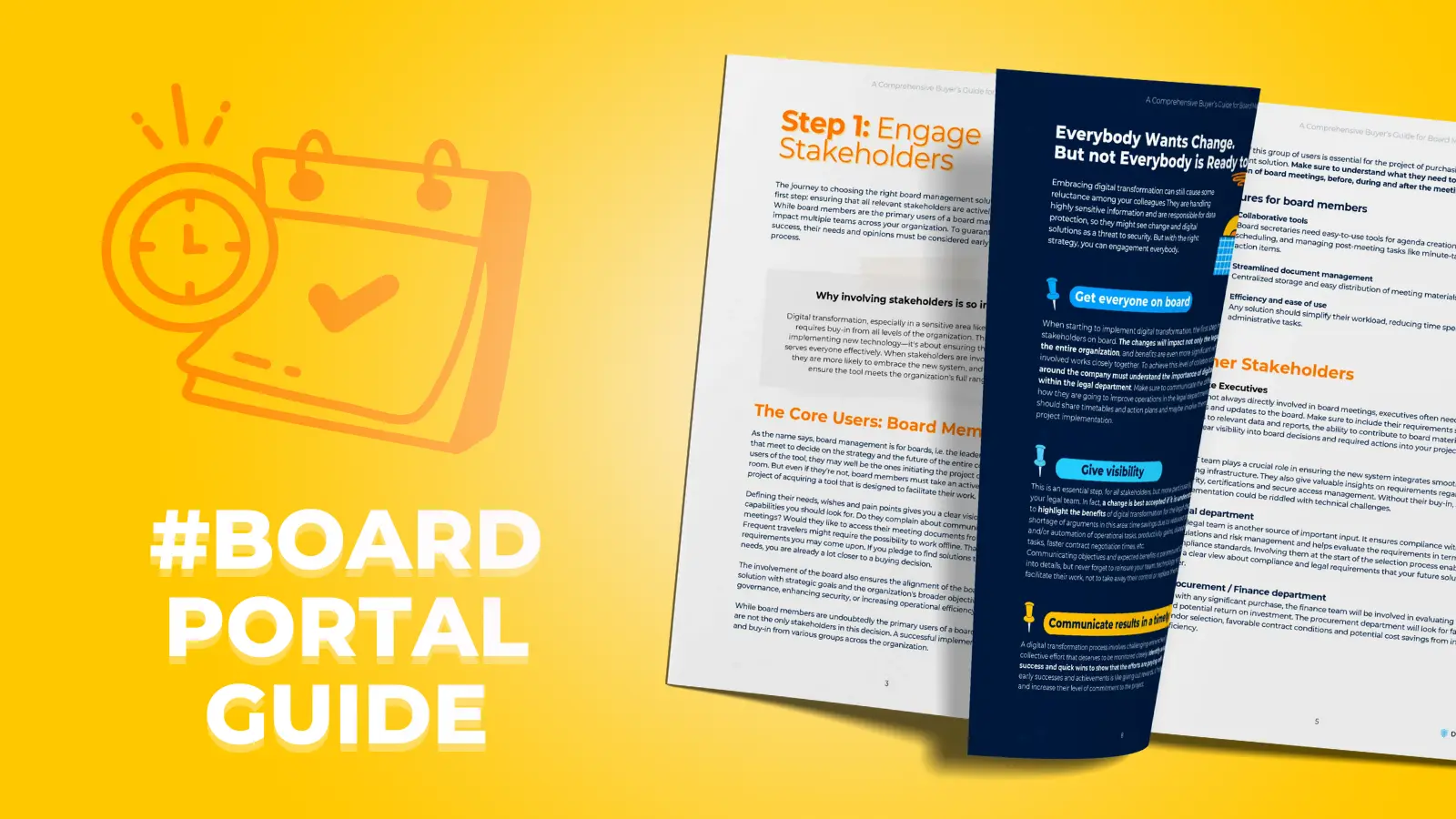
Want to simplify board management?
Discover our Board Management Buyer’s Guide, designed to help you evaluate solutions, compare key features, and make the best choice for your organization.
See how DiliTrust helps boards govern with confidence
A crisis tests governance infrastructure that was built long before the event. The DiliTrust Board Portal gives boards the secure, centralized tools to manage meetings, decisions, and communications, with the audit trail and access controls that hold up under regulatory and stakeholder scrutiny.
Explore the DiliTrust Board Portal
Frequently asked questions
The board provides oversight of management’s crisis response. This means ensuring a formal crisis plan exists and is tested, convening quickly when needed, maintaining communication with investors and regulators where appropriate, and conducting a structured post-crisis review. The board does not run the operational response. Management does.
At minimum: cyber incidents and ransomware, geopolitical and supply chain disruptions, regulatory investigations and enforcement actions, and leadership or reputational crises. The Allianz Risk Barometer 2026 and WEF Global Cybersecurity Outlook 2026 both confirm that cyber and geopolitical threats are now the dominant crisis categories boards face, yet many crisis plans still don’t cover them in adequate depth.
At minimum annually, and after any significant crisis or near-miss. Plans should also be updated when the organization enters new geographies, comes under new regulatory frameworks, or adopts technologies that introduce new risk categories.
Board portals provide the governance infrastructure boards need during a crisis: secure document access, digital voting, complete audit trails, and remote communication capabilities without relying on email or generic tools. DiliTrust’s Board Portal is built for this context, with AI-assisted search across governance records and security certifications suited to regulated environments.
AI is changing the risk landscape and the governance response at the same time. AI systems operating in core business processes create new failure modes boards need to anticipate. AI tools embedded in board portals (like DiliTrust’s Lini) help governance teams retrieve critical records and act faster during active crises, without switching tools or waiting for intermediaries.
DORA requires financial institutions operating in the EU to maintain board-level accountability for ICT risk management, including crisis response and recovery planning. Boards must demonstrate active, documented oversight of digital resilience. Delegating it entirely to the technology function is no longer sufficient.