


A supplier contract auto-renewed last month. Nobody noticed because the notice deadline had passed 14 days before the renewal date, and the only person tracking it left the company in March. You now own another 24 months of a service you were planning to cut.
Contract administration is the operational process of creating, executing, and maintaining a contract across its full life: intake, drafting, approval, signature, obligation tracking, and renewal or exit.
Most legal teams are good at negotiating contracts and far less organised about administering them afterwards. The gap is getting harder to defend: the Association of Corporate Counsel’s 2026 Chief Legal Officers Survey puts legal headcount at a median of 3 lawyers per $1bn of revenue, a six-year low, while 84% of CLOs now report directly to the CEO. Smaller teams, higher visibility. Administration is where that pressure shows up first.
Key takeaways
- Contract administration is the operating discipline around a contract: who does what, when, and with what record. Drafting is a separate skill.
- The highest-cost failures are post-signature: missed notice periods, unowned obligations, and signed versions that do not match what was approved.
- A contract administration plan needs 6 things: scope, owners, an approval matrix, a data standard, alert rules, and a review cadence.
- Metadata captured at signature is reliable. Metadata captured later is a guess.
- You cannot report on contract administration you have not instrumented. Pick 5 metrics and track them from day one.
What is contract administration?
Contract administration is the operational process of creating, executing, and maintaining a contract across its full life: intake, drafting, approval, signature, obligation tracking, and renewal or exit.
Contract administration vs contract management
The two terms are used interchangeably, and the market has never settled the difference. Some vendors put administration entirely before signature. Public procurement bodies put it entirely after award. Both are defensible inside their own context.
Here is the distinction that actually helps a legal team divide the work:
| Contract administration | Contract management | |
|---|---|---|
| Question it answers | Is this contract correctly built and correctly recorded? | Is this relationship performing and worth keeping? |
| Focus | Process, compliance, record integrity | Value, performance, commercial outcome |
| Typical owner | Legal ops, contract administrator, paralegal | Business owner, category manager, GC |
| Core activities | Templates, approvals, execution, metadata, deadlines | Supplier performance, renegotiation, spend, risk strategy |
| Failure looks like | A contract that nobody can find or produce evidence for | A contract that is found and filed but quietly erodes margin |
Administration is the foundation. You cannot manage a portfolio you have not administered, because every commercial judgement depends on data the administration layer was supposed to capture.
How to run contract administration step by step
The process below assumes an in-house team handling commercial agreements across multiple entities. Adapt the sequence, not the controls.
The Contract Administration Process: 6 Steps
Force every contract through one intake door
Draft from a controlled starting point
Define who approves what, in writing
Control the review loop
Capture the record at signature, not afterwards
Run the post-signature calendar

Step 1: Force every contract through one intake door
Contracts that enter through a colleague’s inbox never enter your system. They get drafted, signed and filed somewhere you will not look, and they surface during due diligence 18 months later.
Set one request channel and make it the only route to legal. Capture the counterparty, contract type, value, entity, and requested date at the point of request, before anyone opens a template. That single step creates a cleaner metadata record further down the chain.
Step 2: Draft from a controlled starting point
Free drafting can leave many different limitation-of-liability clauses in the same portfolio. None of them is necessarily wrong. Collectively, they are difficult to audit.
Build a template set per contract type and a clause library of approved positions, with fallback variants ranked by acceptability. Your reviewers then have a reference point, and deviation becomes something you can measure rather than something you discover.
Step 3: Define who approves what, in writing
An approval matrix is not bureaucracy. It lets a contract administrator route an agreement without asking anyone and proves to an auditor that the signatory had authority.
Tie thresholds to concrete triggers: contract value, contract type, jurisdiction, data processing, and any non-standard clause. Conditional routing handles the rest. A €5,000 NDA and a €2M master services agreement should never follow the same path.
Stop reconstructing approval chains after the fact.
See how DiliTrust routes contracts through conditional validation workflows based on value, entity and contract type
Step 4: Control the review loop
Negotiation is where version control dies. Three people edit the same Word file, two of them send it to the counterparty, and the version that gets signed is not the version legal approved.
Keep every round inside one system with version history and side-by-side comparison. Track which clauses deviate from your library and why. The justification matters more than the deviation: a year later, “we accepted uncapped liability because the counterparty is a sole-source supplier” is defensible, and silence is not.
Struggling to catch every high-risk clause under deadline pressure?
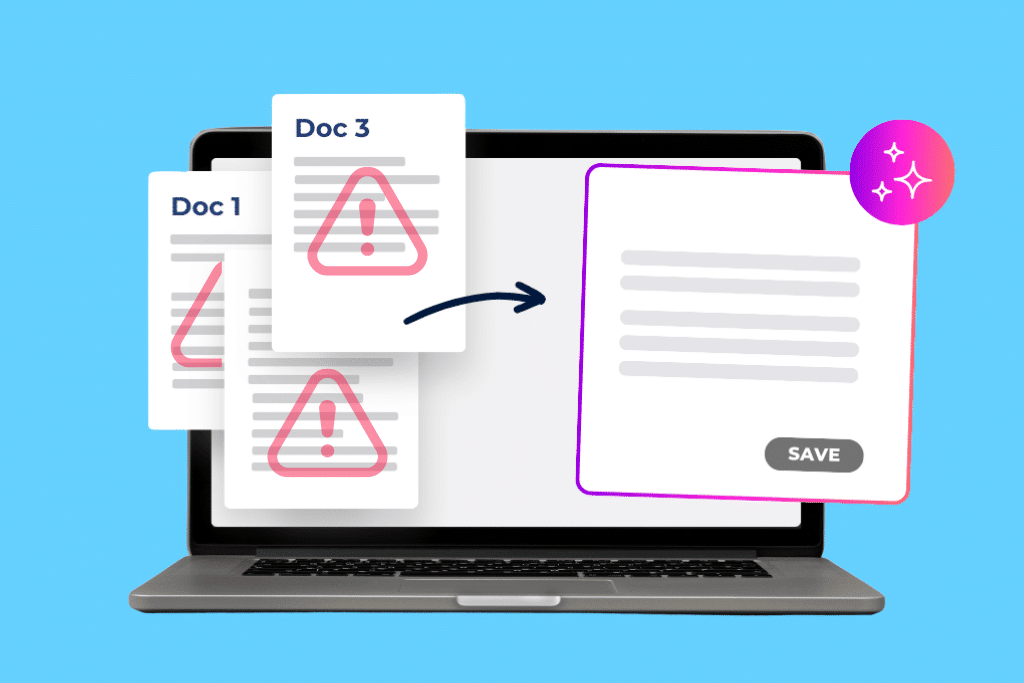
Risk Detector compares clauses against your own approved positions and rates deviations as high or medium risk, so reviewers see what changed and why it matters.
Step 5: Capture the record at signature, not afterwards
The moment of signature is the only time every fact about a contract is known and someone cares. Effective date, term, renewal mechanism, notice period, value, governing law, named obligations. Capture them then.
Teams that defer this end up running retroactive extraction projects across thousands of PDFs, which is expensive and produces data nobody fully trusts. Attach the signed document to the record, not the other way around.
Step 6: Run the post-signature calendar
This is where contract administration either works or quietly fails. Every contract has dates that matter after everyone has stopped paying attention: the renewal date, notice deadline, price-review date, reporting deadline, and termination window.
Alerts need to be calculated, not fixed. “90 days before expiry” is useless when the notice period is 120 days. The alert date has to be derived from expiry minus notice period minus the time your business needs to decide. For tacit renewal contracts, that calculation is the only thing standing between you and an unwanted 24-month commitment. Our guide to contract deadline management goes deeper on building that calendar.
How to build a contract administration plan
A plan is a one-page document per contract type, not a 40-page policy nobody opens. Six elements, each answerable in two lines.
- Scope: Which contract types are in, which are explicitly out, and who decides edge cases.
- Owners: A named legal owner and a named business owner per contract type. Not a team. A person.
- Approval matrix: Thresholds, triggers, and the escalation path when a threshold is breached.
- Data standard: The mandatory metadata fields, with a controlled vocabulary. Free-text country fields produce “France”, “FR” and “france” in the same report.
- Alert rules: What fires, to whom, how far ahead, and what happens if nobody acts.
- Review cadence: Quarterly for the portfolio, annually for the plan itself.
Write it once per contract type and reuse it. The plan is what makes contract administration survivable when the person who built it moves on.
Where contract administration usually breaks
These are the failures that show up repeatedly in audits, due diligence and post-incident reviews. None of them is exotic.
- The notice period nobody calculated: Auto-renewal clauses are enforceable and they do not care that your reminder was set 30 days late.
- The obligation with no owner: An annual security attestation, a volume commitment, an insurance certificate. Written into the contract, assigned to nobody.
- The signed version that drifted: The approved draft and the executed PDF differ by one clause, and nobody compared them.
- Metadata entered by whoever had time: Reporting built on inconsistent data is worse than no reporting, because it gets presented to the board.
- Contracts living in shared drives: If access rights are managed at folder level, confidentiality is a matter of luck.
Can you answer this in under 5 minutes: which contracts expire in the next 90 days, and who owns the decision on each? If not, see how DiliTrust gives legal leaders portfolio-level visibility.
How to measure contract administration
Pick a small set of metrics and hold them steady. Changing the measurement every quarter is how programmes lose credibility with the CFO.
| Metric | What it tells you | Target direction |
|---|---|---|
| Cycle time by contract type | Where legal is a bottleneck for revenue | Down, segmented |
| % signed from approved template | How much control you actually have | Up |
| Clause deviation rate | Where your standard positions are unrealistic | Down, or revise the standard |
| % of contracts with complete metadata | Whether your reporting is trustworthy | Above 95% |
| Renewals actioned before the notice deadline | A strong proxy for administration health | 100% |
Cycle time is the metric that travels upward. A procurement contract stuck in legal review for 11 days is a sourcing delay; a sales contract stuck for 11 days can delay revenue recognition. Framing administration as a revenue timing issue rather than a legal efficiency issue changes who funds it.
What contract administration software changes
Software does not fix a process you have not defined. It does make a defined process enforceable, which is a different and more valuable thing.
DiliTrust Contract Management (CLM), part of the DiliTrust Suite, is built around the controls above rather than around document storage.
- Controlled drafting: contract templates and a clause library of approved positions, with drafting in-app, in Microsoft Word, or in Google Docs.
- Conditional approvals: validation workflows with predefined validators and routing rules based on criteria such as contract amount, so authorisation is structural rather than remembered.
- Execution with your own provider: connections to DocuSign, Adobe Sign, Yousign, Universign, Dropbox Sign, Signaturit, Connective and Box Sign. You keep your existing e-signature contract.
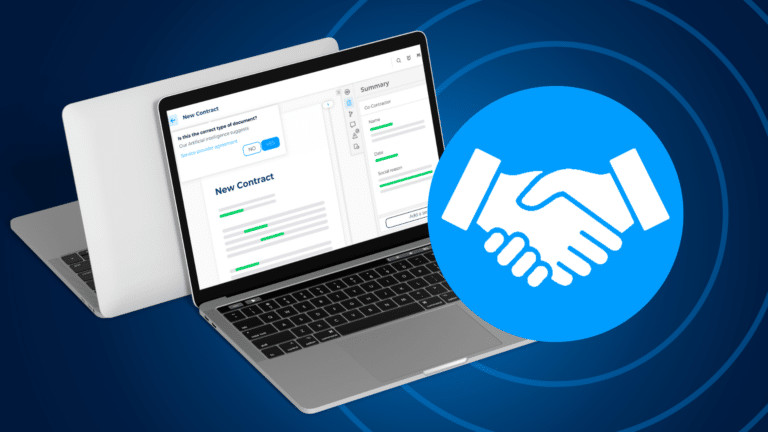
- Metadata that is verified: the Summary Sheet proposes field values using AI and the user validates them, with a direct jump to the source passage in the contract. Suggestion, then human confirmation.
- Calculated alerts: alert rules configured by contract type, country, or renewal mechanism, with notification dates derived from the expiry date minus the applicable notice period and internal decision time rather than a flat countdown.
- An access model that holds: permissions are applied at document level, and a document you have no rights to does not appear in your search results at all.
- A provable audit trail: platform-wide activity tracking logs creation, edits, deletions, logins, and document views, with filtering and export.
- Deviation detection: risk Detector compares clauses against your own reference clauses and rates deviations as high or medium risk. A reviewer can refuse a clause with a written justification or accept it and record it as a variant. It compares clauses against your library, so building that library is a prerequisite for the comparison.
Frequently asked questions: What does a contract administrator do?
What is the difference between contract administration and contract management?
Contract administration covers the process and the record: templates, approvals, execution, metadata and deadlines. Contract management covers the commercial relationship: performance, value and renegotiation. Administration produces the data that makes contract management possible.
What does a contract administrator do?
A contract administrator runs the operational side of the contract lifecycle: intake, template selection, routing for approval, coordinating the signing process, recording contract data, and tracking obligations and key dates.
What should a contract administration plan include?
Scope, named owners, an approval matrix with thresholds, a mandatory metadata standard, calculated alert rules, and a review cadence. Keep it to one page per contract type so people actually use it.
What software is used for contract administration?
Contract lifecycle management platforms. DiliTrust Contract Management covers templates, clause libraries, conditional approval workflows, e-signature connections, validated metadata capture, calculated renewal alerts and audit logging in one platform.
How do you stop contracts from auto-renewing by accident?
Record the renewal mechanism and the notice period as structured data at signature, then set alerts calculated from expiry minus notice period minus internal decision time. Flat reminders fail whenever the notice period is longer than the reminder window. Contract renewal management explains how to build that logic.
Can AI handle contract administration?
Partially, and the limits matter. AI reliably proposes metadata for human validation and flags clauses that deviate from your own approved positions. It does not assess contracts against statutory law, predict outcomes, or approve anything on its own. Treat it as a reviewer that never gets tired, not as a decision-maker.
Conclusion
Contract administration is unglamorous work that nobody notices until it fails, and then it fails expensively: a renewal nobody caught, an obligation nobody owned, a signed version nobody checked.
The fix is not more effort from a team that already has none to spare. It is a defined process with named owners, data captured at the moment of signature, and alerts that do the arithmetic for you. Write the plan first. Then make the system enforce it.
Before you evaluate a platform, write the plan.
Map your contract types, owners, approval thresholds, and alert rules first. Then book a demo and ask the vendor to configure your three most common contract types live.