



The ability to make sound decisions efficiently separates successful organizations from those that struggle. An effective decision-making process is the foundation for strategic growth, operational excellence, and competitive advantage. For executives, managers, and team leaders, understanding how to structure and implement a systematic approach to decision-making is essential.
This guide explores the fundamentals of decision-making, outlines a proven seven-step framework, and examines how technology enhances this critical business function.
Key Takeaways
What is the decision-making process?
A decision-making process is a structured series of steps used to identify and select the best course of action for a specific problem or opportunity. In business, it moves from problem definition through information gathering, option evaluation, and implementation, ending with a review of outcomes. The goal is to make informed, defensible choices rather than reactive ones.
Understanding the Decision-Making Process and Its Importance
A structured decision-making process helps organizations make strategic, consistent, and informed choices. Unlike personal decisions, business decisions involve multiple stakeholders, complex factors, and long-term impact. A formal approach reduces bias, aligns with company goals, and promotes transparency through documented reasoning and clear evaluation criteria.
It focuses efforts on relevant information, enabling faster, more confident responses. By assessing risks early and involving the right people, organizations develop stronger, more accountable solutions. Ultimately, a structured process ensures decisions support long-term success, rather than short-term fixes, and keeps efforts aligned with the broader organizational vision.
The numbers tell a clear story. According to McKinsey, only 20% of professionals believe their organization excels at decision-making. On average, leaders spend 37% of their working time on decisions, and 58% of that time is used ineffectively. A structured approach is what changes that ratio.
The 7 Key Steps of an Effective Decision-Making Process
By following a structured approach, you ensure thorough analysis and increase the likelihood of positive outcomes. Here are the seven essential steps of an effective decision-making process.
1. Identify and Define the Problem
The decision-making process begins with clearly articulating the issue at hand. This involves analyzing the current situation, pinpointing the gap between where things are and where they should be, and setting clear boundaries around the problem. Accordingly, identifying the stakeholders who should be involved also ensures the right perspectives inform the decisions to come.
2. Gather Relevant Information
With the problem clearly defined, the next step is to collect all relevant data to support informed decision-making. This includes examining internal and external factors, consulting subject matter experts, and reviewing historical evidence or similar past cases. It’s also important to spot any information gaps and determine how best to address them to build a complete and accurate picture.
3. Identify Alternatives
Once the necessary information is gathered, the focus shifts to generating a range of possible solutions. This stage encourages creative thinking and the inclusion of both traditional and innovative approaches. Additionally, involving team members from various departments helps bring diverse ideas to the table. All potential alternatives should be documented, even those which don’t seem feasible at first, to ensure a thorough exploration of options.
4. Evaluate the Alternatives
With a list of alternatives in place, each option should be assessed using clear evaluation criteria. This involves analyzing the pros and cons, considering the resources required – such as time, budget, and personnel – and weighing potential risks and benefits. Evaluating how well each alternative aligns with the organization’s goals and core values guarantees strategic consistency.
5. Select the Best Alternative
After evaluating all options, the next step is to choose the most suitable solution. To that end, this decision should balance both quantitative data and qualitative insights, taking into account short-term advantages as well as long-term impact. The chosen alternative must directly address the core problem and have the backing of key stakeholders to ensure successful implementation.
6. Implement the Decision
Once the decision is made, it’s time to take action. This involves developing a clear implementation plan, assigning responsibilities, and setting realistic timelines. Resources must be allocated appropriately, and the decision – along with the reasoning behind it – should be communicated transparently to all stakeholders involved to ensure alignment and support.
7. Review and Evaluate Results
After the decision has been implemented, the focus shifts to assessing the outcomes. This final step includes measuring results against initial expectations, identifying lessons learned, and documenting what worked well for future decision-making. Based on feedback and performance, adjustments should be made as needed to achieve optimized results and continuously improve the process.
Managing governance decisions at board level? DiliTrust’s Board Portal centralizes agendas, board materials, votes, and resolutions in one secure workspace. Every governance decision is traceable, supported by the right documents, and easy to act on.
Decision-making models: which approach fits your situation?
The seven-step framework is a reliable foundation. But different situations call for different approaches. Decision-making models help organizations choose the right method based on urgency, the nature of the problem, and how much data is available.
Rational model
The most widely used approach in business. It assumes decision-makers have access to full information and enough time to evaluate all alternatives systematically. Each option is scored against defined criteria. The result is a defensible, documented choice. This model suits major strategic, financial, or governance decisions where accountability matters.
Intuitive model
Relies on experience and pattern recognition rather than a formal scoring process. Decision-makers draw on accumulated knowledge to act quickly. This works for routine or time-sensitive decisions. The risk: it’s vulnerable to cognitive bias and difficult to justify after the fact.
Recognition-primed decision (RPD) model
Used in time-critical environments. Rather than comparing all available options, the decision-maker tests the most familiar-seeming option first, mentally simulating whether it will work. If yes, they act. If not, they adjust or try the next option. Speed is the advantage; systematic comparison is the trade-off.
Creative model
Best for genuinely novel or complex problems with no obvious path forward. Decision-makers collect information, then step back and allow time for reflection before committing. The incubation period often surfaces insights that structured analysis would miss.
| Model | Best suited for | Speed | Key trade-off |
|---|---|---|---|
| Rational | Strategic, high-stakes decisions | Slow | Time-intensive |
| Intuitive | Familiar or routine decisions | Fast | Bias-prone |
| RPD | Urgent, time-constrained decisions | Very fast | Skips systematic comparison |
| Creative | Novel, complex problems | Slow | Harder to replicate |
Common challenges in the decision-making process
Even with a strong framework, decisions go wrong. These are the failure points most worth planning for.
Information overload
More data is not always better. When teams are buried in reports, competing metrics, and conflicting sources, analysis paralysis sets in. The fix is to define upfront what information is actually needed, and set a clear cutoff date for gathering it.
Cognitive biases
Human judgment is not neutral. Three biases consistently damage business decisions:
- Anchoring bias: Over-relying on the first piece of information encountered. An early cost estimate, for example, can skew all subsequent financial thinking even when circumstances have shifted significantly.
- Confirmation bias: Seeking information that confirms an existing view and filtering out evidence that challenges it.
- Groupthink: When the desire for consensus suppresses dissent. Teams reach agreement faster, but the quality of the decision suffers.
Structured frameworks, diverse teams, and explicit devil’s advocate roles all help counter these patterns.
Decision fatigue
Decision quality degrades over the course of a day. Leaders who make dozens of choices back-to-back tend to make worse decisions by afternoon. Scheduling important decisions earlier in the day helps. So does batching lower-stakes choices into fewer, dedicated sessions.
Unclear ownership
When nobody knows who has final authority, decisions stall or get made by the wrong person. Assigning clear roles before entering the process (who decides, who advises, who executes) saves time and reduces friction downstream.
Governance decisions need a paper trail. See how the DiliTrust Suite gives boards and legal teams a single source of truth for documents, decisions, and voting records, with a full audit trail built in.
Decision-making tools worth knowing
A few practical tools help teams move from analysis to a final choice more efficiently.
Decision matrix
A weighted scoring table. List your options in rows and your evaluation criteria in columns. Assign a weight to each criterion based on its importance, then score each option. Multiply score by weight and total each row. The highest-scoring option points toward the best choice, though the process of scoring often surfaces disagreements worth addressing before any final call.
Decision tree
A visual map of possible choices and their likely outcomes, including probabilities and estimated payoffs. Useful for multi-stage decisions or situations where outcomes are genuinely uncertain. It pushes teams to think through second-order consequences before committing to a path.
SWOT analysis
A four-quadrant framework: Strengths, Weaknesses, Opportunities, Threats. Most useful in the alternatives-evaluation phase (Step 4). It structures comparative thinking across options and helps teams spot risks that might otherwise be overlooked.
Pros and cons list
The simplest tool, and one of the most underrated. For decisions where a complex scoring matrix would add more process than clarity, a straightforward pros-and-cons list often reaches the right answer faster.
Elevate Decision-Making Efficiency with Technology
Digital platforms improve the decision-making process by centralizing information, enabling collaboration across distributed teams, and giving decision-makers access to reliable, real-time data. AI-generated insights add another layer, supporting scenario modeling, data visualization, and automated task tracking from evaluation through to implementation.
For boards and governance teams, the demands are sharper still. Board decisions must be documented, traceable, and grounded in the right materials, often under time pressure and across distributed members.
The DiliTrust Suite addresses exactly these requirements. It gives boards, executives, and legal teams:
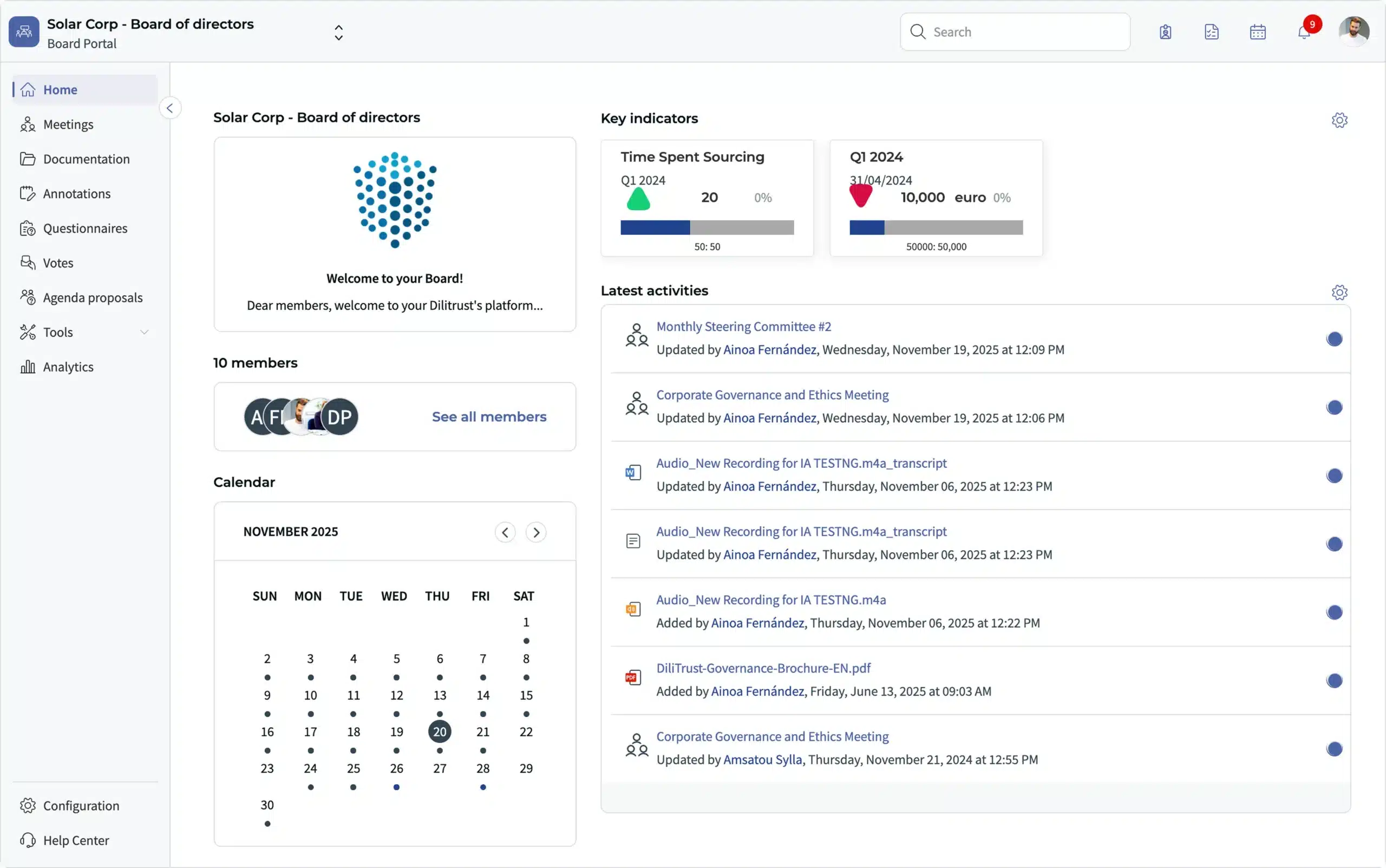
Most organizations know what a good decision looks like in hindsight. The harder part is building the conditions that produce good decisions consistently: a clear process, the right information, defined ownership, and tools that keep governance records intact. DiliTrust gives boards and legal teams the infrastructure to close that gap: centralized documents, structured workflows, full traceability, and AI tools that cut the administrative load around every decision cycle. The process stays yours. The tools make sure nothing falls through the cracks.
Making a governance technology decision?
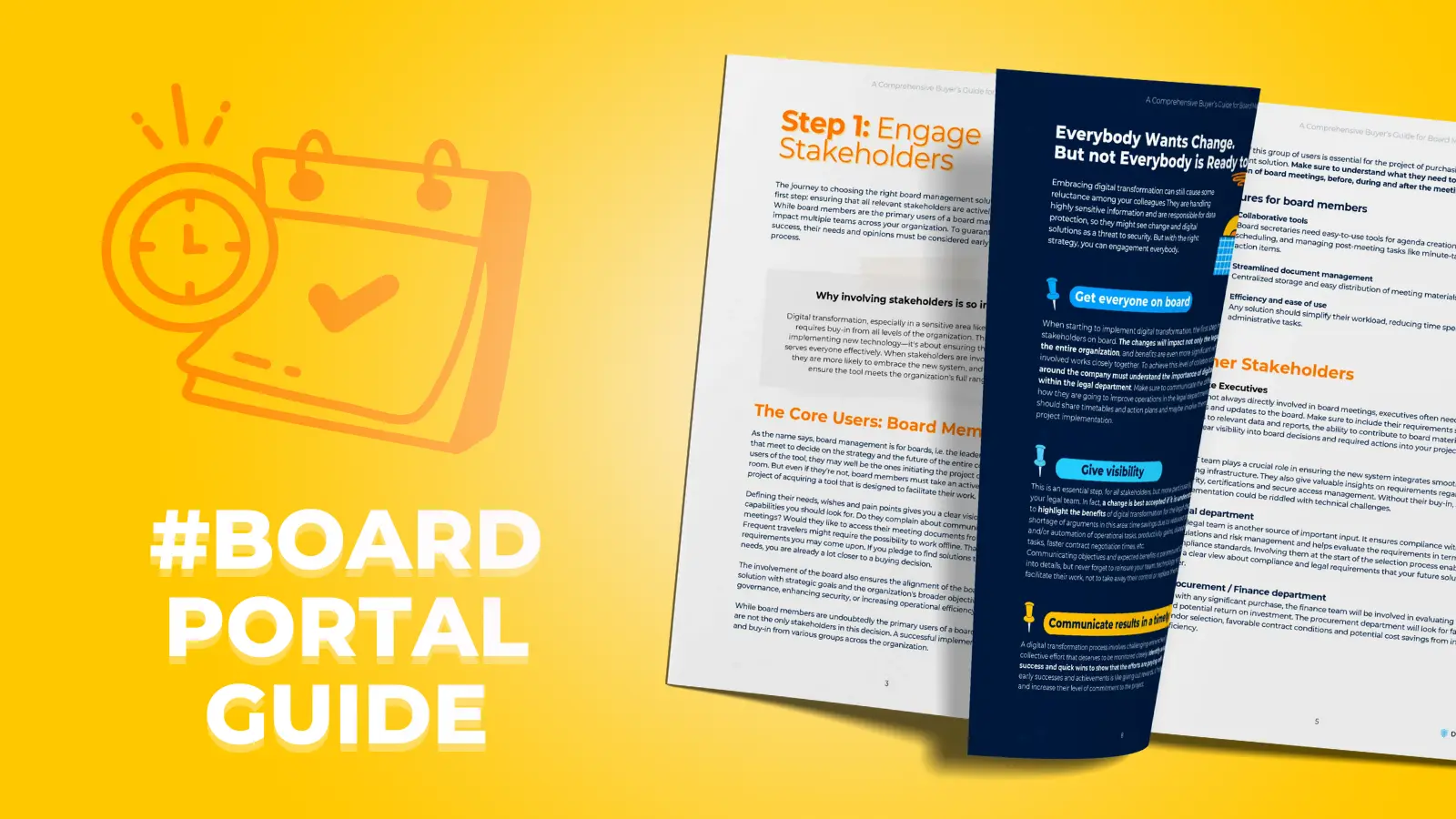
Apply the same structured approach to your software evaluation. The Board Management Buyer’s Guide walks you through identifying requirements, comparing key features, and selecting the solution that fits your organization.
Frequently Asked Questions To Decision-Making Process
What is the decision-making process?
A decision-making process is a structured series of steps used to identify and select the best course of action for a specific problem or opportunity. Most business frameworks follow seven steps: define the problem, gather information, identify alternatives, evaluate options, choose a solution, implement it, and review results. The aim is to make consistent, defensible choices rather than reactive ones.
What software do organizations use to support decision-making?
Organizations use a range of tools: BI and analytics platforms for data analysis, project management software for implementation tracking, and dedicated governance solutions for formal decisions. For boards and legal teams, purpose-built platforms like the DiliTrust Suite centralize the documents, voting records, and communications that governance decisions depend on, with a full audit trail included.
How can AI improve the decision-making process?
AI helps by processing larger volumes of data faster, surfacing patterns that manual review would miss, and cutting administrative tasks at the point of decision. In governance, Lini, DiliTrust’s proprietary AI, generates meeting minutes, summarizes board documents, and extracts relevant data from contracts, giving decision-makers cleaner inputs and fewer follow-up tasks after each session.