


Enterprise legal management software centralizes the work of an in-house legal department, including matters, contracts, legal documents, governance activities, workflows, and reporting, in a structured digital environment. Instead of relying on disconnected spreadsheets, inboxes, shared drives, and point solutions, legal teams can use the platform to create a clearer record of what is happening, who owns each task, and which deadlines or risks need attention.
The category has evolved beyond a narrow focus on legal spend or litigation tracking. Modern enterprise legal management software connects legal operations with corporate governance, contract management, entity oversight, and secure document collaboration. For General Counsel, Corporate Secretaries, and legal operations teams, that connected view can make it easier to answer questions, demonstrate control, and support faster business decisions.
What Is Enterprise Legal Management (ELM) Software?
Enterprise legal management software is technology designed to help corporate legal departments manage their work, information, and obligations from one connected environment. Depending on the platform, ELM software may cover matter management, contract lifecycle management, legal document management, entity management, board governance, legal spend, reporting, and workflow automation.
The most important distinction is that the ELM category is broader than any one legal process. Contract management focuses on agreements. Matter management focuses on cases and legal requests. the broader category brings multiple areas of legal work together so that legal leadership can work from a more complete source of information.
For example, a contract may relate to a particular legal entity, support a matter, require board approval, or be stored alongside other governance records. When those activities are managed in disconnected systems, legal teams spend time reconciling information. When they are connected through enterprise legal management software, the department has a stronger foundation for visibility, collaboration, and reporting.
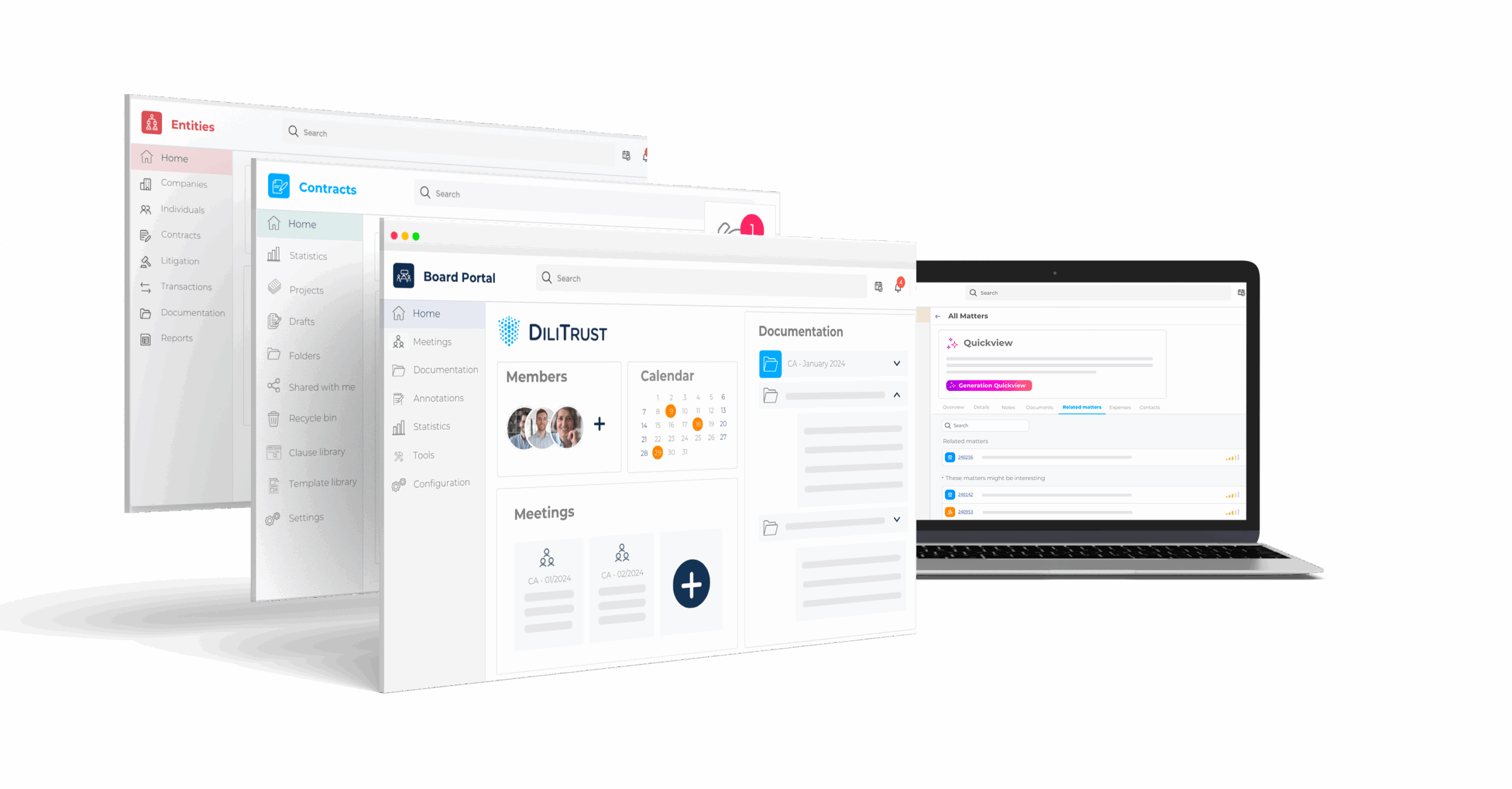
DiliTrust takes this connected approach through the DiliTrust Suite, which includes Board Portal, Contract Management, Matter Management, Entity Management, and Dataroom. The suite also embeds Lini, DiliTrust’s AI across legal and governance workflows, supporting tasks such as document summarization, information extraction, meeting minutes generation, matter updates, and contract risk review.
Core Components of DiliTrust’s ELM Platform
Enterprise legal management software can be organized in different ways, and not every provider uses the same module structure. DiliTrust organizes its platform around five integrated modules that address the core legal and governance activities of complex organizations.
Board Portal
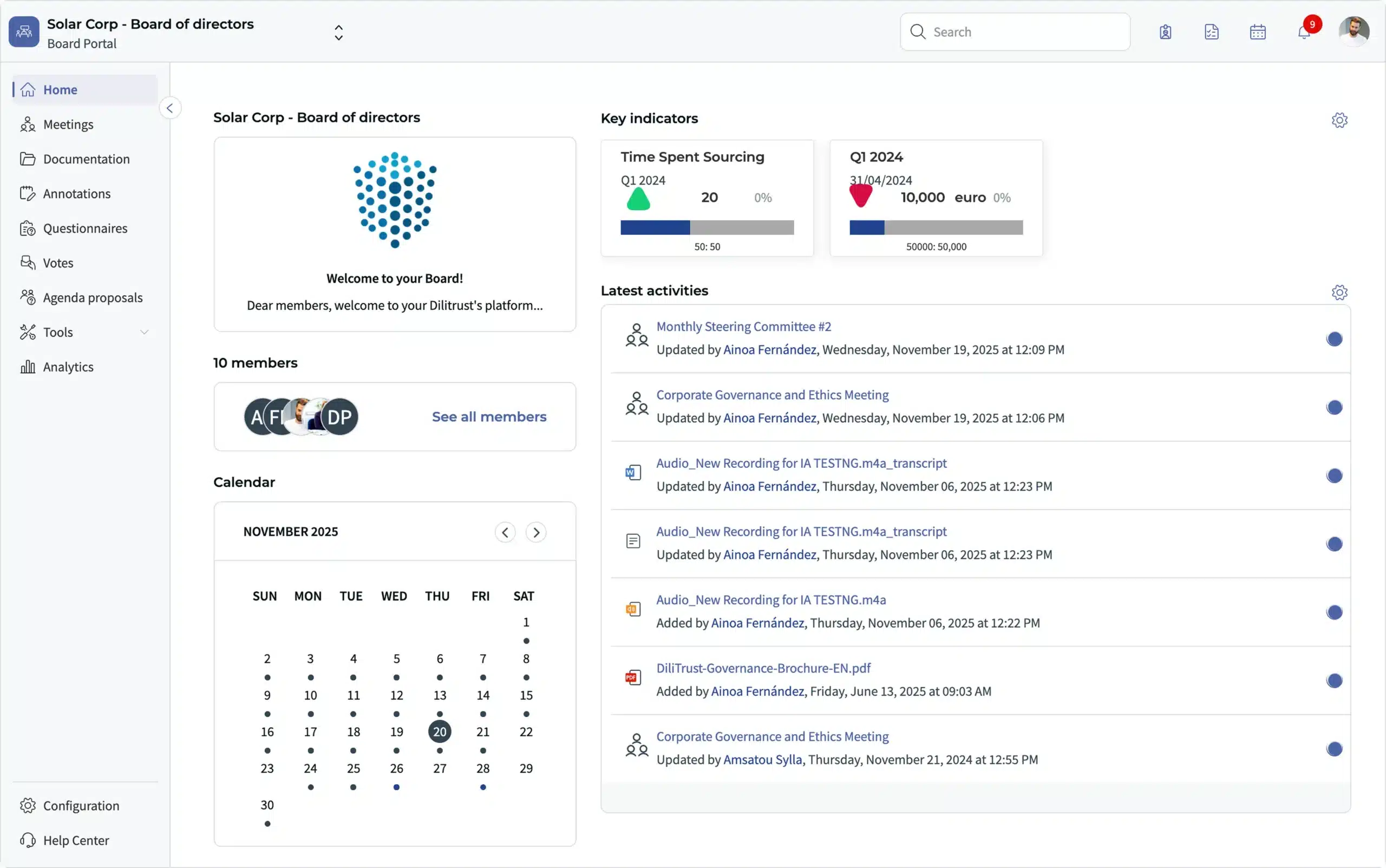
The Board Portal supports the board meeting lifecycle, from agenda preparation and board book distribution to collaboration, voting, signatures, minutes, and follow-up. Corporate Secretaries can manage meeting materials in a controlled workspace, while directors can access and annotate documents according to their permissions. The result is a more consistent record of board decisions and supporting documentation across committees and entities.
Contract Management
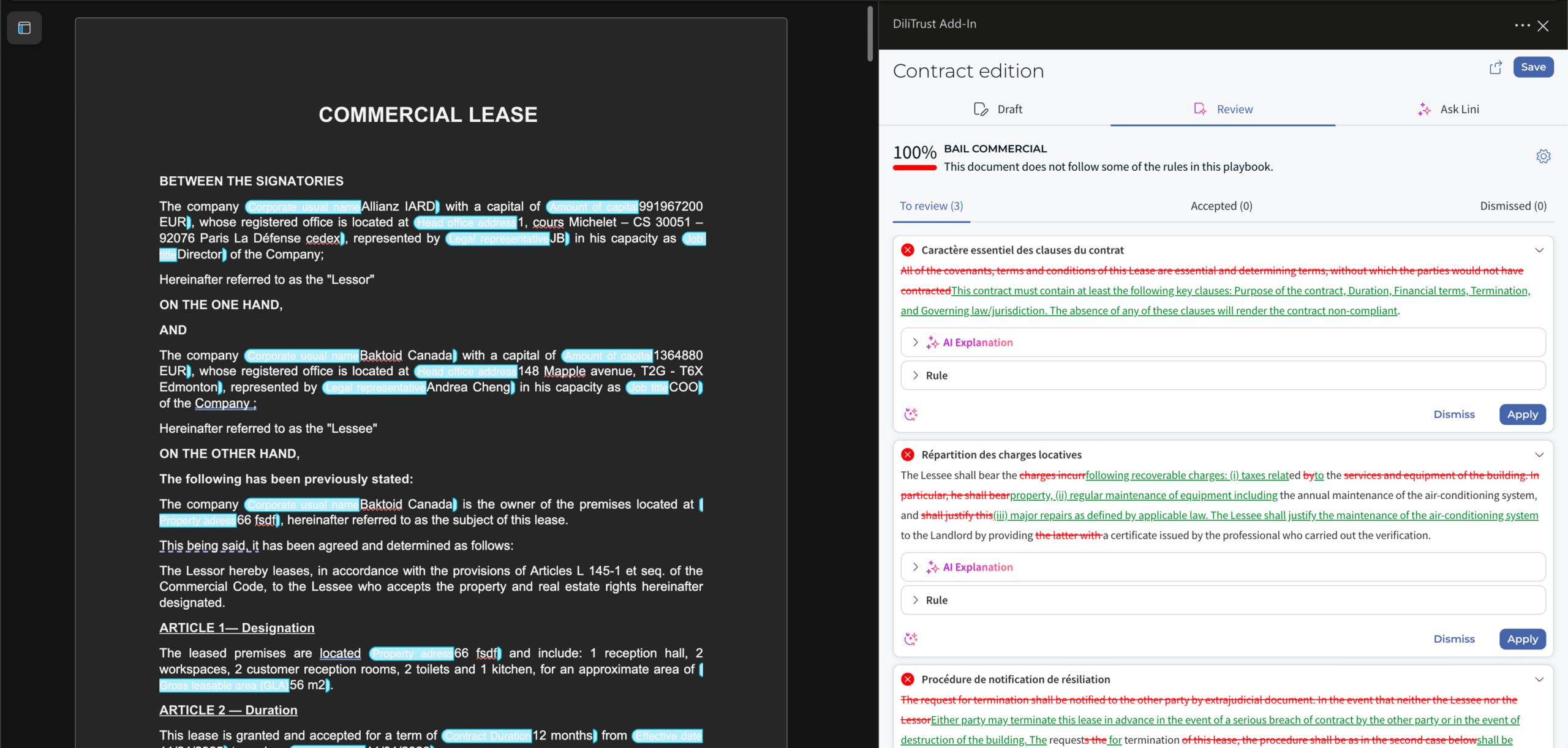
Contract management covers the contract lifecycle from creation and import through negotiation, approval, signature, renewal, and reporting. Teams can use templates and a clause library to standardize drafting, route agreements through configured workflows, and maintain version history. DiliTrust’s Risk Detector uses AI to identify risky or non-compliant clauses, apply internal playbooks, and suggest validated alternatives during review.
Matter Management
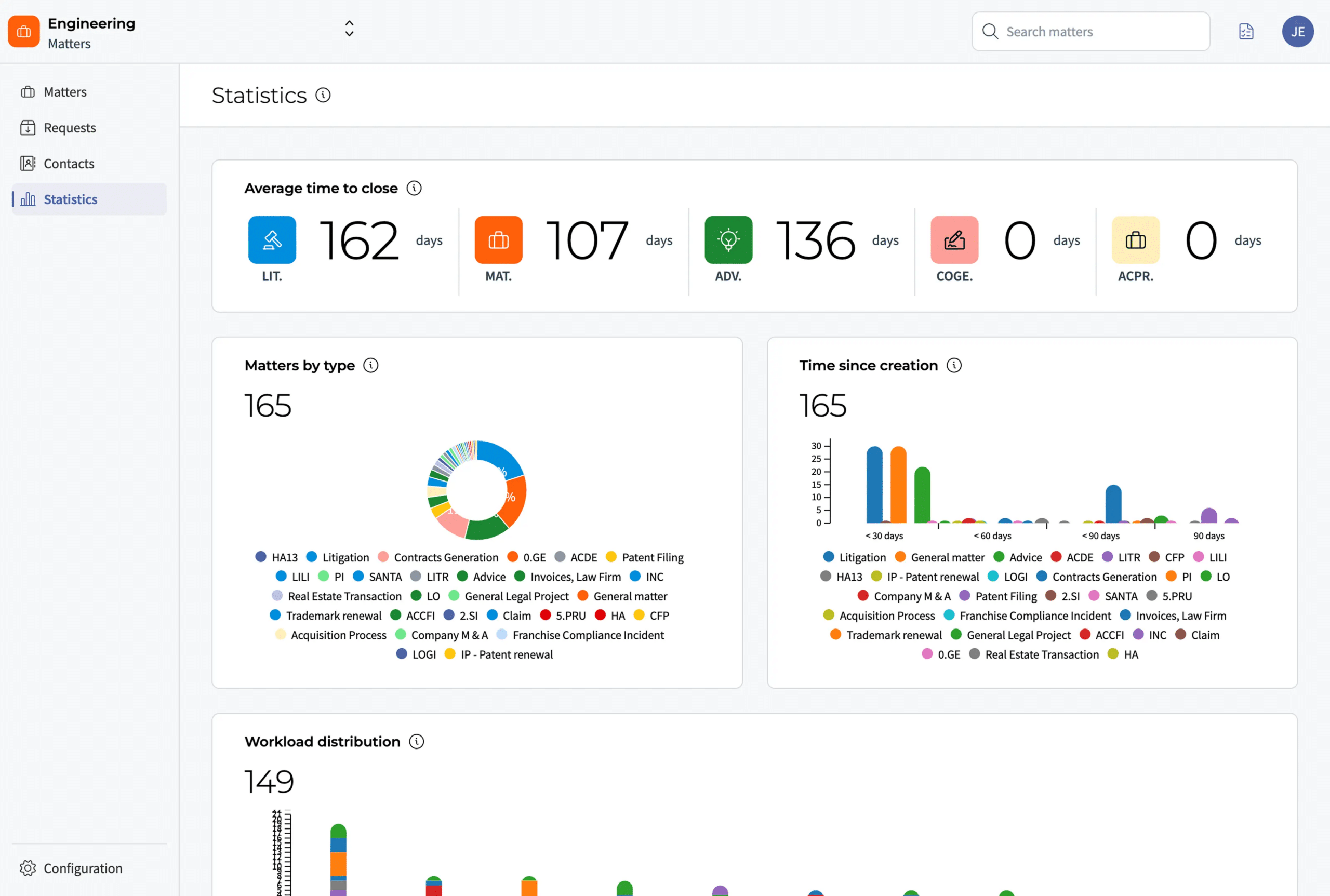
Matter management gives legal teams a centralized workspace for litigation and other legal matters. Teams can track status, tasks, documents, deadlines, activity, priorities, and workload across the matter portfolio. Dashboards and AI-generated updates help legal leaders understand what requires attention without asking every matter owner to prepare a separate manual summary.
Entity Management
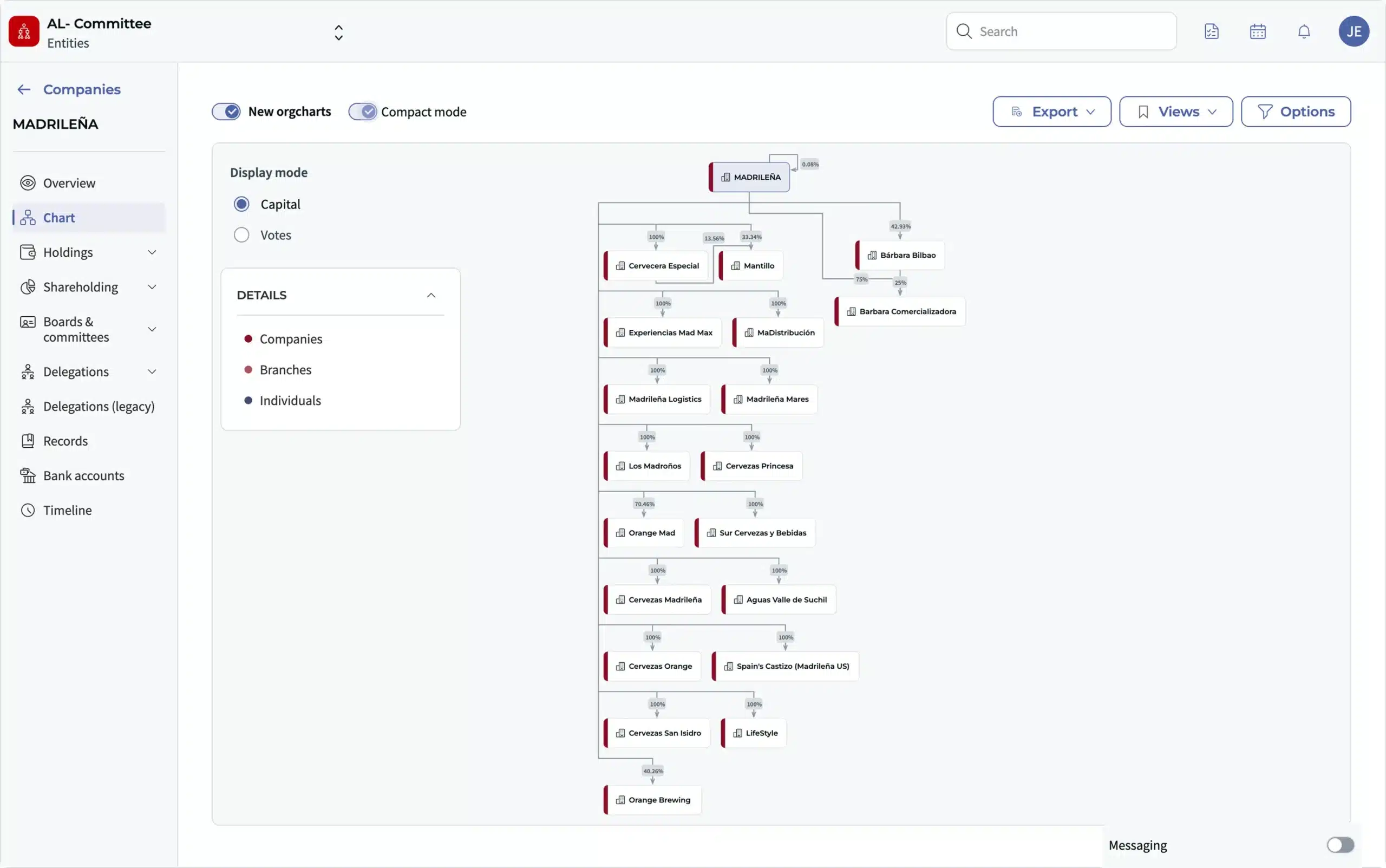
Entity management centralizes information about subsidiaries, ownership structures, shareholdings, mandates, delegations of authority, boards, and compliance obligations. This is particularly relevant for organizations operating across multiple jurisdictions, where entity data can otherwise become fragmented across spreadsheets, local files, and external advisers. A structured entity record helps legal and governance teams keep corporate information current, traceable, and easier to report on.
Dataroom
Dataroom provides a secure repository for confidential corporate and legal documents. It supports structured storage, controlled sharing, version management, and traceability for sensitive information. A Dataroom can be used for corporate records, transaction materials, board documentation, due diligence, and other situations where teams need to share documents without losing control over access or activity history.
Together, these modules give legal departments a broader operating picture than a standalone document repository or single-purpose legal application. The value comes from connecting related information and workflows, not simply from placing more features on one menu.
This is what a connected legal department looks like
ELM vs. CLM vs. Matter Management: What’s the Difference?
ELM, CLM, and matter management are related terms, but they describe different scopes of legal technology.
| Term | What it covers | Typical users |
|---|---|---|
| ELM software | The broader operation of an in-house legal department, potentially including matters, contracts, entities, governance, documents, workflows, and reporting | General Counsel, legal operations, corporate legal teams |
| CLM software | The contract lifecycle, from drafting and negotiation to approval, signature, renewal, and reporting | Legal, procurement, sales, and contract managers |
| Matter management software | The tracking and coordination of litigation, legal requests, investigations, and other matters | In-house counsel, legal operations, and outside counsel |
A company can buy CLM or matter management as a standalone solution. ELM is the broader category, although providers define its scope differently. DiliTrust connects Contract Management and Matter Management with Board Portal, Entity Management, and Dataroom, allowing legal teams to use related modules together instead of managing every process through separate point solutions.
Benefits of Enterprise Legal Management Software
The business case for enterprise legal management software should be based on the problems it solves, not on the number of features it contains. The most relevant benefits for legal departments are visibility, lower administrative burden, proactive risk management, and stronger governance.
Improve visibility across legal work
A structured platform can give legal leadership a current view of matters, contracts, entities, board activities, documents, deadlines, and workload. Cross-module dashboards and reporting make it easier to identify bottlenecks, understand the status of important work, and prepare consistent updates for executives, finance, compliance, or the board.
Reduce administrative work
Legal teams lose time when they repeatedly search for documents, reconcile versions, chase approvals, or manually prepare status updates. DiliTrust uses Lini for capabilities such as document summarization, data extraction, AI-generated matter updates, and meeting minutes generation. These tools are intended to reduce repetitive work while keeping legal judgment with the people responsible for the decision.
Manage risk earlier
Risk management is more effective when it is built into the workflow rather than performed only at the end. DiliTrust’s Risk Detector can compare contract language against internal playbooks and flag deviations during review. Entity deadlines, mandate information, matter activity, and board records can also be managed in structured workflows with permissions and audit trails.
Protect sensitive information
Legal and governance systems contain highly confidential information, so security and compliance should be assessed alongside functionality. DiliTrust states that its platform is supported by security certifications including ISO 27001, ISO 27701, and SOC 2, with encryption, two-factor authentication, granular access controls, and audit trail capabilities. Organizations should still evaluate the exact scope of certifications, hosting options, and data residency available for their deployment.
Build vs. Buy: Should You Build Your Own ELM System?
The build vs buy decision is a legitimate question for large enterprises with strong internal technology teams. Building an internal system can appear to offer greater control over data models, integrations, and user experience. It may also seem like a way to avoid vendor lock-in or adapt the system to highly specialized processes.
The trade-off is that building an ELM system creates a long-term product responsibility for the legal department and its technology partners. The initial development is only one part of the cost. Ongoing engineering capacity, security updates, integration maintenance, user support, testing, documentation, and feature development all require investment. Internal tools can also move more slowly than a platform developed for multiple customers and may not provide external certifications or vendor documentation that supports audit and procurement reviews.
Buying from an established provider is the practical default for many legal departments because it can provide a tested product, dedicated implementation support, regular updates, and an established security framework. Building may still make sense when the organization has unusual requirements, sufficient resources, and a clear reason to own the full technology lifecycle. The right choice depends on total cost, risk tolerance, internal capabilities, and the time available to deliver value.
How to Choose the Right ELM Vendor
Choosing an ELM vendor requires more than comparing feature lists. Use the following checklist to assess whether a platform will support the way your legal department actually operates.
- Start with needs alignment. Identify the most important problems first. Does the vendor address those pain points specifically, or does it offer generic functionality that your team would need to adapt?
- Review integrations. Confirm whether the platform connects with the ERP, CRM, e-signature, productivity, identity, and reporting tools your organization already uses. Ask how integrations are maintained, what is available through APIs, and whether the platform fits your existing legal operations software landscape.
- Verify security and compliance. Review certifications such as ISO 27001 and SOC 2 Type II, encryption, access controls, audit trails, data residency, and the vendor’s approach to incident management. Ask to see the current certification scope and relevant security documentation.
- Test scalability. Consider the number of entities, jurisdictions, languages, users, committees, contracts, matters, and external collaborators the platform must support. Scalability includes governance complexity, not only data volume.
- Calculate total cost of ownership. Compare license fees with implementation, migration, configuration, integration, training, support, and future administration. The lowest subscription price may not be the lowest long-term cost.
- Assess implementation and support. Ask how onboarding is structured, who owns the implementation plan, how much configuration is available, and what support model applies after launch. A strong provider should be able to explain how the platform will reach adoption, not only how it will be installed.
Frequently Asked Questions
What is the difference between ELM and CLM software?
ELM software supports the broader operation of an in-house legal department, while CLM software focuses specifically on the contract lifecycle. CLM can be one component of an ELM environment, alongside matter management, entity management, governance, document management, and reporting.
Is ELM software only for large enterprises?
The category is not limited to global corporations. Mid-sized organizations can also benefit when legal work involves multiple entities, high contract volume, complex approvals, litigation, board activity, or strict documentation requirements. The right platform should be scalable enough to support current needs without forcing unnecessary complexity.
How long does it take to implement an ELM platform?
Implementation time varies according to the number of modules, data migration requirements, integrations, workflow design, permissions, languages, and user groups involved. A responsible ELM vendor should provide a phased implementation plan, clear responsibilities, training requirements, and measurable adoption milestones before the project begins.
Should we build or buy an ELM system?
Most legal departments should compare the full lifecycle cost of building with the time-to-value, support, security framework, and maintenance responsibility offered by an established provider. Building may be appropriate for an organization with unusual requirements and substantial internal engineering capacity, but it should be treated as a long-term technology product decision rather than a one-time development project.
A More Connected Approach to Legal Operations
Enterprise legal management software is most useful when it gives legal teams a reliable way to connect information, decisions, and workflows. The best enterprise legal management software also makes those connections visible to the people responsible for legal risk and governance. The goal is not simply to replace one spreadsheet with another application. It is to create a clearer operating foundation for matters, contracts, entities, board work, documents, and the reporting that connects them.
The DiliTrust Suite brings these activities together through five integrated modules, supported by embedded AI, security controls, and configurable workflows. To see how the platform can support your legal and governance operations, Explore the DiliTrust Suite.
Your legal department runs on too many tools.
Most in-house teams manage contracts in one place, entities in another, board materials in a shared drive, and matters in a spreadsheet. The DiliTrust Suite brings all of it into one platform.