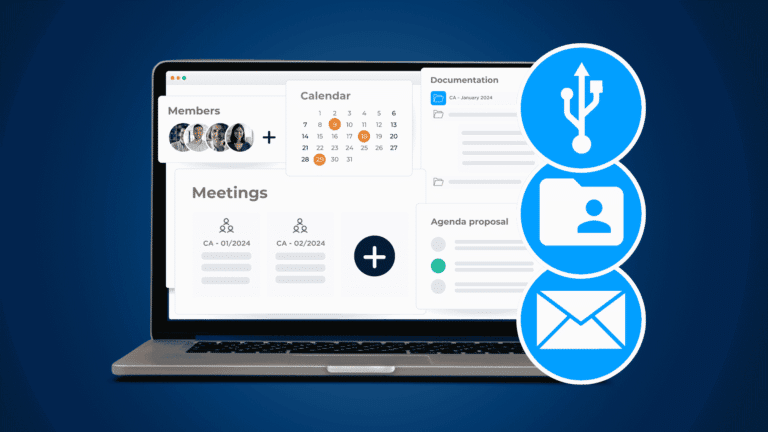




Board papers contain information that can affect transactions, leadership decisions, financial performance, legal strategy, and reputation. Yet many organizations still send them as email attachments or store them in shared folders with broad permissions. Every extra copy creates another place where information can be forwarded, altered, or left behind.
Board data security combines data residency, access control, cyber-risk management, audit trails, and secure board collaboration. A board portal can support that discipline when its controls match the information and the board’s accountability.
Key takeaways
- Board data security protects board documents, conversations, votes, resolutions, and decisions throughout their full lifecycle.
- Data residency tells you where information is stored. Data sovereignty also asks which laws, provider, and access arrangements govern it.
- A secure board portal should combine strong authentication, granular permissions, encryption, audit trails, watermarks, and controlled device access.
- Current regulations place greater emphasis on documented board oversight of cyber risk, incident response, and digital resilience.
- Secure board collaboration lets directors review, comment, vote, sign, and access the current record without creating uncontrolled copies.
What is board data security?
Board data security is the protection of information created, shared, reviewed, or approved by a board or committee. It includes agendas, board packs, minutes, resolutions, votes, financial forecasts, transaction materials, executive compensation information, legal advice, and director communications.
The objective is to preserve confidentiality, integrity, availability, and traceability. Directors should see the right information, receive the correct version, use an approved channel, and leave a record of what happened.
| Working method | Main exposure | Governance consequence |
|---|---|---|
| Email attachments | Files can be forwarded, downloaded, or left in inboxes | Difficult to confirm who saw the final version |
| Shared drives | Access may be broader than the board or committee requires | Reviews and evidence take more manual work |
| Consumer file-sharing tools | Hosting, support access, retention, and subcontractors may be unclear | Residency and sovereignty questions remain open |
| Secure board portal | Documents, users, actions, and records sit in one governed workspace | Stronger control across preparation, meetings, and follow-up |
A board portal does not replace policy or user awareness. It gives those policies a place to operate consistently.
The controls that protect board information
Data residency and data sovereignty
Data residency means where data is stored, including production systems and backups. Data sovereignty also considers which jurisdiction governs the data, who operates the service, which parties can access it, and under what legal authority.
Ask where board data and backups are held, which entities provide support, where administrators are located, which subprocessors are involved, how keys are managed, and how lawful access requests are handled. The goal is to make the location, access model, and legal exposure clear enough to approve and monitor.
Access control and identity
A secure board portal should support:
- Multi-factor authentication and, where appropriate, single sign-on.
- Role-based permissions for directors, committees, executives, advisers, administrators, and observers.
- Document- and meeting-level controls, not only broad folder access.
- Joiner, mover, and leaver processes that remove access when roles change.
- Download, print, watermark, and offline controls based on sensitivity.
Can the governance team show who could access a document, when access began and ended, and what the person did with it?
Audit trails and governance records
An audit trail records viewing, downloading, editing, sharing, voting, signing, and permission changes. It helps investigate incidents and shows what information the board received, which version was available, and what decision followed. It should be searchable and protected from unauthorized alteration.
Secure board collaboration
Secure collaboration covers work before, during, and after a meeting. Directors need to annotate, ask questions, review late papers, vote, sign resolutions, and access the approved record without switching to uncontrolled tools. A secure workflow should provide version control, controlled sharing, safe notifications, and policy-based mobile or offline access.
Replace email chains with a governed workspace. See how DiliTrust Board Portal supports secure board collaboration.
Best practices for secure board collaboration
Map the information
Classify transaction materials, legal advice, personal data, strategic plans, and forecasts according to sensitivity. Use the classification to set access, retention, download, and sharing rules.
Define access before the meeting
Set permissions by person, role, committee, meeting, and document. Review administrator access and formalize processes for appointments, advisers, recusals, and departures.
Protect the record after the meeting
Keep approved minutes, resolutions, votes, supporting documents, and follow-up actions in a searchable archive. Record late changes and superseded versions.
Test the response process
Test who can disable access, preserve evidence, notify the chair, involve legal or security teams, and communicate after a lost device, compromised account, or misdirected email.
Ask providers for evidence
Request documentation on hosting, backups, encryption, support access, subprocessors, identity controls, audit logs, incident response, recovery testing, and deletion at contract end.
Common weaknesses in board data security
| Weakness | Why it matters | The fix |
|---|---|---|
| Sending board packs by email | Copies persist outside the governance team’s control | Distribute materials through a permissioned portal |
| Broad shared-folder access | Users may see documents unrelated to their role | Apply document- and meeting-level permissions |
| Former users retain access | A role change becomes a data exposure | Formalize access reviews and removal |
| No usable audit trail | The organization cannot reconstruct access or decisions | Record activity in the same workspace where work happens |
| External AI tools process confidential papers | Sensitive information may leave the approved environment | Define AI processing rules and require human review |
The most common failures are ordinary workflow problems rather than dramatic attacks. A secure process reduces the opportunities for those problems to become incidents.
How to choose a secure board portal
Use these questions during a security, procurement, or governance review:
- Where is data stored? Confirm production, backup, and recovery locations, along with the legal framework that applies.
- Who can access it? Review administrator privileges, support access, identity providers, subprocessors, and emergency access procedures.
- How is identity protected? Look for multi-factor authentication, single sign-on, session controls, and regular access reviews.
- How granular are permissions? Test access at organization, board, committee, meeting, document, vote, and poll levels.
- What does the audit trail capture? Check whether it records the user, action, timestamp, resource, and relevant system details.
- How is AI governed? Confirm where documents and prompts are processed, whether customer data trains shared models, which access rights apply, and where human review remains mandatory.
For a broader evaluation framework, see 5 reasons to invest in a board portal solution.
What regulations mean for board data security
Requirements vary by organization, sector, and jurisdiction. The direction is consistent: boards need evidence of informed oversight, not only a policy assigning responsibility to management.
SEC cybersecurity disclosures
The SEC requires public companies to disclose material cybersecurity incidents on Form 8-K, generally within four business days after determining materiality. Its rules also require annual disclosure about cybersecurity risk management, strategy, and governance, including the board’s oversight role. See the SEC’s cybersecurity disclosure guidance.
NIS2 management accountability
Under Article 20 of NIS2, management bodies of covered essential and important entities must approve cybersecurity risk-management measures and oversee implementation. They can also be held liable for infringements. See the NIS2 text on EUR-Lex.
DORA and digital resilience
For financial entities, DORA places ultimate responsibility for ICT risk with the management body and has applied since 17 January 2025. It covers ICT risk management, incident reporting, resilience testing, and third-party ICT risk. See the DORA regulation on EUR-Lex.
A board portal does not make an organization compliant by itself. It can help preserve evidence of how the board received information, challenged management, approved actions, and followed up.
How DiliTrust supports board data security
DiliTrust Board Portal gives directors and governance teams one environment for meetings, documents, decisions, and follow-up. DiliTrust’s published security information describes:
- ISO 27001, ISO 27701, and SOC 2 certifications or reports.
- Two-factor authentication and single sign-on.
- Encryption for data in transit and at rest.
- Granular permissions, audit trails, watermarks, and secure sharing.
- Server locations and hosting options designed for jurisdiction-specific requirements.
Teams can distribute the current board pack, manage late changes, run votes, collect signatures, prepare minutes, and preserve the final record in the same workspace. Review the DiliTrust security and compliance approach as part of your assessment.
What about AI and board data?
AI can support document review, search, transcription, and minutes. It also raises questions about processing location, model training, retention, and human review. Organizations should define permitted uses and require AI features to follow the same access rights as the underlying governance record. See AI for board management.
Keep security and productivity in the same workflow. Request a Board Portal demo.
What is changing in board data security
Cyber oversight is becoming more visible
The 2026 NACD Cyber-Risk Oversight Handbook reports that, in its review of selected Fortune 100 companies, 96% disclosed board-level committee oversight of cybersecurity in 2025, while 86% disclosed cybersecurity as an area of director expertise. See the NACD cybersecurity oversight disclosures.
Data residency is becoming a governance decision
Organizations are asking where production data, backups, support access, logs, and AI processing occur, which entities operate the service, and whether those facts can be demonstrated during an audit. Data residency is moving from a technical preference to a board-level risk decision.
AI and cyber risk are converging
IBM’s 2026 Cost of a Data Breach Report describes the global average cost of a breach as a record high, up 12% year on year, while focusing on AI-related risks. Verizon’s 2026 DBIR analyzes incidents from November 2024 through October 2025. Boards should review AI access, third-party processing, identity controls, and incident evidence as one cyber-governance conversation.
Build a board security process that can be defended
Board data security depends on the board’s oversight, the organization’s policies, and the tools used to prepare, discuss, approve, and preserve decisions.
A secure board portal gives directors and governance teams a common place to work, with clearer permissions, fewer uncontrolled copies, and a more complete record. See DiliTrust Board Portal in action.
Frequently asked questions
Is a board portal more secure than email or a shared drive?
A secure board portal can provide tighter control over access, versions, downloads, printing, watermarks, and user activity while keeping the board record in one governed workspace. Security still depends on configuration, policies, and user behavior.
What is the difference between data residency and data sovereignty?
Data residency describes where data is physically stored. Data sovereignty also considers which laws govern the data, who operates the service, who can access it, and under what legal authority access could be required.
How does AI change board data security?
AI introduces questions about access rights, processing locations, model training, retention, and human review. A board should approve clear rules for AI use and ensure AI features follow the same security model as the governance record.