


…
A Legal Operating System (Legal OS) is a connected, governed foundation for legal work. It links records, relationships, permissions, identities, and workflows across the tools a legal department uses, so AI can retrieve the right information, explain where it came from, and route the result to the right reviewer.
Even skeptical legal professionals can recognize the advantages of Legal AI. In legal work, AI can draft, summarize, classify, compare, and answer questions in seconds.
AI needs 3 conditions to work well: clean data gives it reliable material, connected data gives it legal context, and governed workflows make the output actionable and defensible. Data governance is familiar and often discussed. Before deploying Legal AI, a responsible provider will first ask whether the data is clean, structured, and governed.
The second condition receives less attention: connectivity. It becomes visible after the data has been cleaned and the tools have been deployed. What happens when information is clean but sits in separate tools that do not communicate with each other?
End users lose context. They may need to reconcile information manually or complete several verification steps before they can trust the result. What is the point of having Contract Management with one set of data and context if it does not match the data and context in the Entity Management solution or Matter Management tool?
Many projects run into trouble because there is no connective framework beneath the tools, no shared and governed system of context. A Legal OS provides a common data foundation that connects those sources through common records, relationships, identifiers, authority, permissions, and workflow context. Without that foundation, clean data remains incomplete because isolated records can strip away the legal context.
Data governance is not the only prerequisite for AI to work
Clean, well-managed data is a sensible starting point and a step no legal function can omit if it intends to invest in AI-powered legal solutions. It gives an AI system better and more accurate material to work with, but it does not answer every question that arises in legal work.
International and national regulatory bodies have developed AI risk management frameworks and rules. In the European Union, the AI Act has set requirements around data quality, logging, documentation, traceability, and human oversight. The NIST AI Risk Management Framework for generative AI, for example, places explainability, provenance, fairness, and monitoring at the centre of the conversation.
Those requirements depend on connected records and accountable workflows as well as clean documents. Traceability requires a link between a source, its version, the user who accessed it, and the action that followed. Provenance depends on knowing where information came from and which record is authoritative. Permissions depend on a shared identity and access model. Human oversight depends on a workflow that assigns review, records the decision, and preserves the evidence. Clean documents alone cannot provide those links.
What these frameworks have in common is a focus on data quality, reliability, and traceability. For AI to be reliable and traceable in legal work, it needs context.
A legal department needs to know several things:
- Which source is authoritative
- Who the user is
- What that user may access
- Which business context applies
- What the AI did
- Who reviews the result
- What evidence should be retained
The truth is that these details rarely sit in one file. Identity, matter status, contract versions, deadlines, owners, approval routes, and post-signature obligations may all be stored in different places.
Legal AI performance depends heavily on retrieval and contextual information
This is not breaking news, but it is worth reminding ourselves that legal work is contextual, and context is ensured through connected information.
How context and connectivity relate
The LegalBench benchmark research shows that legal AI performance depends on the task and, therefore, on the kind of legal work being done. A Contract Management solution can hold relationship history that differs from a Matter Management platform. In worse cases, no relationship exists because the tools are disconnected.
The LegalBench-RAG research does not prove that a Legal OS is required, but it supports a narrower point. AI performance depends on the task, retrieval quality, and context supplied to the model. A disconnected repository can make those conditions harder to control, so legal departments should measure retrieval errors, permission failures, and manual reconciliation in their own workflows before making a broader architectural claim.
Information that looks complete inside one tool loses value when related records sit elsewhere. When tools share identifiers, metadata, and source rules, the legal context is easier to retrieve and check. That does not guarantee a correct answer, but it gives the AI and its reviewer stronger grounds for checking the result.
Clean data gives AI something to read; connected data gives it the surrounding legal context.
The LegalBench-RAG benchmark tests another part of the problem. Its expert-annotated questions are mapped to exact locations in a large legal corpus. A system can reason correctly from the right passage and still fail when retrieval returns a plausible but irrelevant one. LegalBench-RAG shows why output quality depends on whether the tool retrieves information from the right source. A user still needs to know which source is authoritative when several disconnected repositories contain similar records.
That is why a system rather than a tool stack makes sense: to connect a document to the right matter, contract, entity, counterparty, jurisdiction, owner, risk category, deadline, and permissions. Much of this information sits in metadata or workflow history rather than in the document prose.
How the Legal Operating System fits
A Legal Operating System gives AI a foundation for preserving relationships between records across tools.
AI needs a legal environment, not a document pile
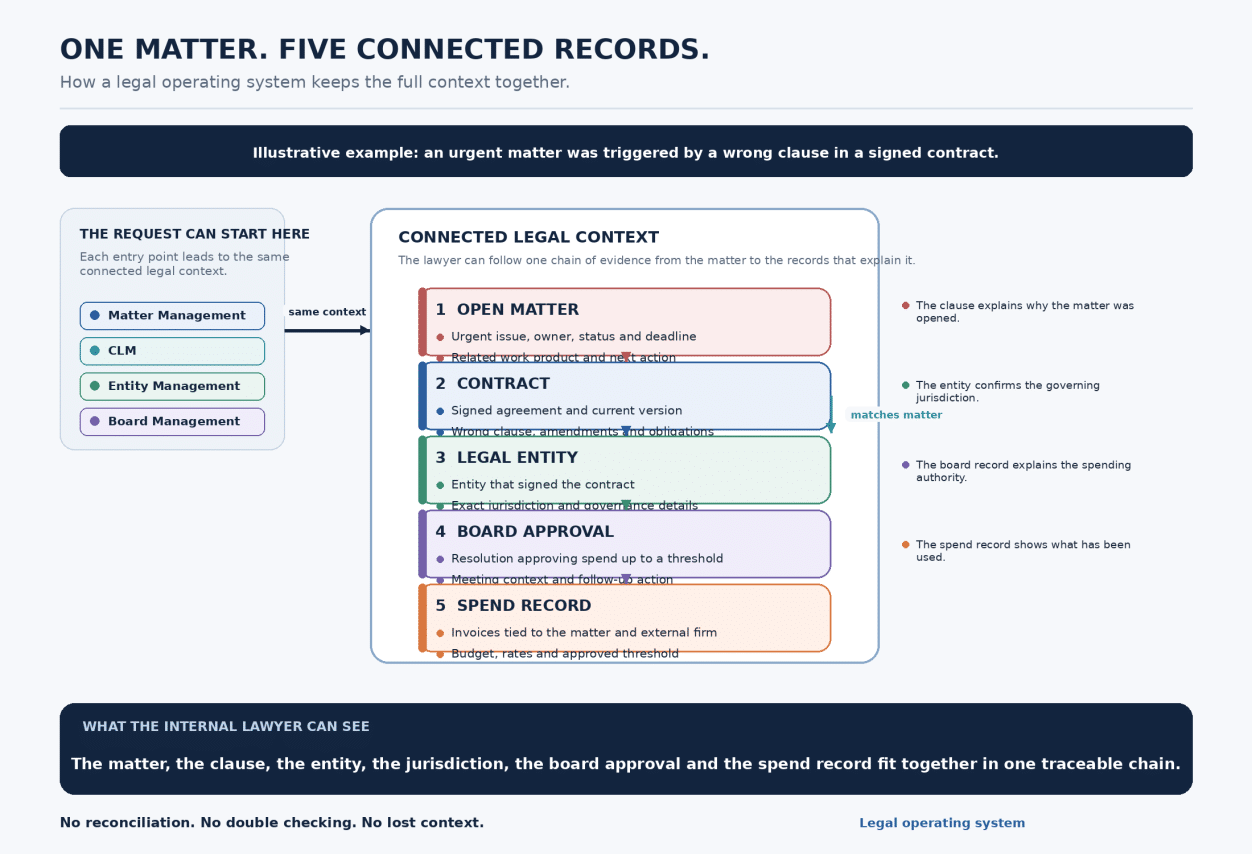
Picture an organization dealing with an important matter that needs to be resolved urgently. The matter was triggered by an incorrect clause in a contract, which is tied to a specific entity that signed it. The internal lawyer handling the matter needs to see the contract in the CLM, and the contract needs to match the details in the matter. They also need to see the matter’s spend record and link it to the board approval that authorized spending up to a certain threshold.
The AI task is concrete: “Which active contracts signed by this entity create exposure in the matter, and which obligations remain open?” In a connected Legal OS, the answer can link the entity to current contracts, contract versions, and obligations, then connect those records to the matter, spend record, and board approval. Each source can be checked, and open obligations can be routed to an owner for review.
In a connected system, the request can start from Matter Management, Entity Management, Board Portal, or the CLM. When operating under a Legal OS, no context is lost and the pieces fit together. There is no reconciliation or double-checking.
Why a Legal OS architecture makes sense
The architecture can vary across vendors and systems. What matters is that the links between records carry stable identifiers, current and shared metadata, source authority, version status, permissions, and event history.
The issue with point solutions such as a redlining tool or a matter tracker is that they have their own repositories and do not create those relationships automatically. A Legal OS allows teams to work with shared information across tools because it retrieves the right records and maintains their context. Without a foundational system, the legal function opens the floor to greater risks and mistakes.
The risks of AI before a system
The wrong or outdated source is retrieved
The correct information may exist, yet the system returns a different record because ranking, metadata, or document relationships are weak. A draft policy appears beside the approved one, a closed matter looks active, or a document from a related entity enters the answer. The result can sound reasonable while resting on the wrong source.
Contracts are amended, policies expire, and procedures are replaced. Without version status, dates, lineage, and lifecycle controls, an AI system can treat an old record as current. The problem is easy to miss because the document may be genuine and relevant to an earlier point in time.
The source is unauthorized
When permissions are copied imperfectly into a search index, privileged, confidential, employment, investigation, M&A, or board information can be exposed to the wrong user. AWS guidance on permission-aware retrieval recommends checking authorization against the authoritative source system. A label added during indexing is not enough protection for sensitive legal work.
The context is incomplete
The answer may be spread across a contract, a matter record, an approval, and a related entity file. If retrieval returns one fragment, the AI has to fill the gaps through inference. That can hide a deadline, miss a limitation, confuse the signing entity, or overlook a prior decision.
The AI output has nowhere to go
A summary is generated, but nobody owns the next step. A contract risk is spotted, but no approval is opened. An entity deadline is identified, but no task is created.
When AI sits outside intake, matter, contract, document, and review workflows, it produces another piece of information for the legal team to move by hand.
The system is connected but not governed
Connecting repositories can increase the available information without clarifying which source is official, who maintains it, how conflicts are resolved, or when changes reach the AI index. The department then has a larger pool of context with uncertain authority.
Governance needs named owners, source rules, access controls, monitoring, and a process for correcting failures.
Hallucinations remain a broader risk
Even a well-retrieved source does not guarantee a sound answer. Stanford researchers found hallucination rates of 58% to 88% for general-purpose models answering specific legal questions, and later testing found that specialist legal research tools still hallucinated. The Stanford assessment of AI legal research tools provides a useful reminder that retrieval and legal specialization reduce some risks without removing them.
Legal teams need citations, verification, human review, and production monitoring. A pilot with a clean corpus and one user says little about performance across changing documents, roles, permissions, and deadlines.
Dependable Legal AI needs a foundation
Legal AI becomes dependable when it operates on a connected, governed foundation. A collection of isolated repositories leaves gaps between sources, permissions, and workflows, and those gaps are where retrieval errors, unauthorized access, and abandoned actions begin.
DiliTrust helps legal departments build that foundation across contracts, matters, entities, and governance. With connected workflows and a shared legal data foundation, Legal AI has the context it needs to support decisions that people can review and defend. Explore the DiliTrust Suite.
Frequently Asked Questions About Why Legal AI Fails Without a Legal OS
How should a legal department test whether disconnected repositories are affecting AI accuracy?
Use real legal workflows, not generic benchmark prompts. Ask the system to identify active contracts tied to a matter, verify the user’s access, and route open obligations to an owner. Compare source accuracy, permission errors, manual reconciliation, and review time before and after records are connected.
Does the EU AI Act require a Legal OS for legal AI?
The EU AI Act does not prescribe a specific architecture. Its requirements depend on the system’s role and risk category, while a Legal OS can help operationalize data governance, logging, traceability, and human oversight by connecting identities, sources, versions, and review workflows.
What evidence should legal teams retain when AI supports a legal decision?
Retain the source record, version, retrieval context, user identity, access decision, prompt and output, reviewer, final decision, and timestamps. Exact retention rules depend on the matter and applicable law, but connected records and workflow events make the evidence chain easier to reconstruct when a decision is challenged.
When should a legal team choose a Legal OS instead of another point solution?
Choose a Legal OS when a use case crosses contracts, matters, entities, board decisions, or permission boundaries. A point solution may answer a narrow question, while the team still faces manual reconciliation and unclear authority between systems. DiliTrust connects these legal workflows in one platform.