



When a regulator asks for the minutes of your audit committee’s last three meetings, how fast can you produce them? If the answer isn’t “immediately,” your board committee structure has a documentation problem, and quite possibly a governance one.
Board committees are the engine of modern corporate governance. They’re where the real analysis happens: where directors dig into audit findings, stress-test executive compensation, evaluate director candidates, and map enterprise risk. Yet in many organizations, the administrative layer supporting these committees, including charter management, document workflows, and minutes production, still runs on email threads and shared folders.
This guide covers board committees and their functions in full: what each committee does, how they’re composed, what US regulatory frameworks require, and what corporate secretaries need to manage them effectively.
Key Takeaways
What Are Board Committees?
Board committees are subgroups of the full board of directors, formed to provide focused oversight of specific governance areas. Each board committee is typically composed of directors with relevant expertise — finance professionals on the audit committee, compensation specialists on the remuneration committee — and reports its findings and recommendations back to the full board.
The rationale is practical. A full board meets four to six times a year on average. That calendar cannot absorb the depth of analysis that complex governance areas require. Board committees solve this by running on their own schedules, working through their specific mandates in detail, and surfacing the decisions that matter for full board consideration.
Board committees can be standing (permanent, with a formal charter defining their mandate) or ad hoc (formed for a specific purpose and dissolved when that purpose is complete). Governance best practices center on standing board committees, which carry ongoing oversight responsibilities defined in approved charters.
Why Boards Use Committees: Key Benefits
There are four clear reasons boards delegate oversight to committees rather than handling everything at the full board level.
Depth of oversight
Board committees can dedicate entire meeting agendas to a single domain: reviewing financial statements in full, stress-testing executive pay packages, or interrogating emerging risk scenarios. That depth isn’t achievable in full board sessions where a complete governance agenda must be covered in a matter of hours.
Independence
At listed companies, audit and compensation committees are composed exclusively or predominantly of independent directors. These committees generally must meet applicable independence standards, although exchange-specific rules and exemptions apply. This separation helps protect against conflicts of interest between management and the board. Independence only works when it’s structurally enforced.
Efficiency
Board committees pre-process complex issues before they reach the full board. By the time an audit finding or executive pay proposal lands in a full board meeting, the relevant committee has already examined it, challenged it, and prepared a clear recommendation. Boards make faster, better-informed decisions as a result, without expanding their meeting schedules.
Accountability
When each board committee operates under a formal charter with defined responsibilities, accountability becomes specific rather than collective. The audit committee owns financial oversight. The compensation committee owns executive pay. The nominating committee owns board composition. That specificity makes governance failures both easier to identify and easier to prevent.
The 5 Core Board Committees and Their Functions
Most governance frameworks distinguish between mandatory and advisory board committees. For companies listed on the NYSE or Nasdaq, certain committees are required under exchange listing standards, while others reflect governance practice. Here’s what you need to know about the five most common board committees.
1. Audit Committee
The audit committee is one of the most heavily regulated board committees. For companies listed on the NYSE or Nasdaq, Exchange Act Rule 10A-3 and related listing standards require an audit committee composed entirely of independent directors. Companies must disclose whether at least one member qualifies as an SEC-defined “audit committee financial expert,” but the rule does not universally require them to have one. The external auditor reports directly to the audit committee, not to management.
The audit committee’s primary function is financial oversight. It reviews the company’s financial statements, monitors internal controls over financial reporting, oversees the internal audit function, and maintains direct authority over the appointment, compensation, and termination of the external auditor.
Key responsibilities:
- Reviewing quarterly and annual financial statements before public filing
- Approving the annual audit plan and reviewing audit findings
- Overseeing compliance with financial regulations and accounting standards
- Investigating potential financial fraud, irregularities, or accounting concerns
- Reviewing related-party transactions for conflicts of interest
- Assessing the effectiveness of internal controls (SOX Section 404 reporting)
Audit committees typically meet at least four times per year, and more frequently during financial reporting periods or when audit findings require rapid follow-up.
2. Compensation Committee
The compensation committee sets executive pay. It designs, approves, and reviews compensation packages for the CEO and other senior executives, ensuring that pay structures align with company performance and shareholder interests rather than management preferences.
For NYSE and Nasdaq-listed companies, the compensation committee generally must be composed entirely of independent directors, subject to applicable exemptions. The committee may retain a compensation consultant or other adviser, but it is not required to do so. If it does, applicable rules require an independence assessment, and identified conflicts may require disclosure in the proxy statement.
Key responsibilities:
- Setting CEO and C-suite compensation: base salary, annual incentives, and long-term equity awards
- Designing equity compensation programs, including stock options and restricted stock units
- Reviewing compensation risk to ensure pay design doesn’t incentivize excessive risk-taking
- Reviewing and approving the Compensation Discussion and Analysis (CD&A) section of the proxy statement
- Reviewing pay equity in the context of executive compensation levels
Compensation committees face increasing scrutiny from institutional investors. Proxy advisory firms like ISS and Glass Lewis evaluate compensation committee decisions in detail. A negative “say on pay” vote rarely carries legal consequences, but it signals real shareholder dissatisfaction that boards can’t ignore.
3. Nominating and Governance Committee
The nominating and governance committee manages board composition and oversees the board’s own governance practices. It leads director recruitment, onboarding, ongoing education, committee assignments, and the annual board evaluation process.
NYSE listing standards require a nominating and corporate governance committee composed of independent directors. Nasdaq permits either an independent nominating committee or a process in which a majority of the board’s independent directors select or recommend nominees. Unlike the audit and compensation committees, this committee’s scope extends inward: it governs the board itself.
Key responsibilities:
- Identifying and vetting director candidates based on skills matrices and board composition objectives
- Managing the annual board and committee evaluation process
- Developing and updating corporate governance guidelines
- Reviewing director independence status and committee assignments annually
- Overseeing CEO succession planning at the board level
- Managing board orientation programs for new directors
As boards face sustained pressure on diversity, skills mix, and tenure, the nominating and governance committee has become more prominent in investor engagement conversations. Its decisions on board refreshment are now closely watched.
4. Risk Committee
Not every organization has a standalone risk committee. At smaller public companies and most private organizations, the audit committee absorbs risk oversight. A dedicated risk committee becomes more common at financial institutions, large public companies, and organizations in heavily regulated sectors, where risk complexity justifies its own committee structure.
When a risk committee exists, its primary function is enterprise risk management (ERM): ensuring the company has identified, assessed, and responded to its material risks across operational, financial, reputational, regulatory, and strategic dimensions.
Typical composition includes independent directors with relevant expertise, often with backgrounds in finance, operations, technology, or cybersecurity. At some companies, membership overlaps with the audit committee.
Key responsibilities:
- Reviewing and approving the enterprise risk management framework
- Setting the company’s risk appetite and risk tolerance thresholds
- Monitoring emerging risks, including cyber, geopolitical, and climate-related risks
- Overseeing the risk management function and receiving regular management risk reports
- Coordinating with audit committees on financial and compliance risk
As cybersecurity and AI governance have become more prominent boardroom topics, some organizations are explicitly adding technology risk to the scope of their risk committees or creating separate technology committees.
5. ESG or Sustainability Committee
The ESG committee is newer than the traditional “Big Three” and is used by some publicly listed companies and large private organizations. It emerged in response to investor pressure, changing disclosure expectations, and stakeholder demand for transparent oversight of environmental, social, and governance commitments. A standalone ESG committee is not required for US public companies.
Its primary function is oversight of the company’s ESG strategy, performance metrics, and public disclosures: climate commitments, social programs, human capital management, and ESG reporting frameworks such as GRI or SASB.
Some companies place ESG oversight within the nominating/governance committee rather than creating standalone board committees. The structure varies. What matters is that one committee holds explicit, documented accountability for ESG oversight, with its work reflected in board minutes.
See how DiliTrust gives each committee its own secure workspace.
What Is a Board Committee Charter?
Standing committees often operate under written charters approved by the board, but the legal requirement depends on the committee, company type, and applicable exchange rules. Annual review is required in some listing standards and is widely followed as best practice. A charter generally defines the committee’s purpose, composition, authority, responsibilities, and operating procedures.
A committee charter typically covers:
- Purpose and scope: what governance area the committee is responsible for overseeing
- Composition: member count, independence requirements, and any expertise requirements
- Meeting procedures: frequency, quorum rules, and who may attend
- Responsibilities: an explicit enumeration of the committee’s oversight duties
- Reporting obligations: how and when the committee reports to the full board
- Authority: what the committee can decide independently versus what requires full board approval
- Access to advisors: the committee’s right to retain external counsel or consultants at company expense
Charters are not administrative formalities. For US public companies, the company must disclose information about the audit committee charter, and exchange rules may require the charter to be available on the company website. Regulators and investors scrutinize charter provisions, particularly those governing independence, financial expertise, and the committee’s authority over the external auditor.
The Corporate Secretary’s Role in Board Committee Management
Corporate secretaries are the operational backbone of board committee governance. Directors make the decisions. The corporate secretary makes sure the machinery functions.
Here’s what that looks like across five core areas:
1. Committee calendar management: Coordinating meeting schedules across multiple board committees, each with its own cadence, quorum requirements, and advance notice rules, is a logistics challenge that compounds as regulatory calendars, audit cycles, and board committee reporting deadlines create fixed windows that can’t move.
2. Document distribution: Before every board committee session, the corporate secretary assembles and distributes the meeting pack: management presentations, financial reports, audit findings, legal opinions, and supporting materials. Directors need adequate preparation time, typically five to seven business days in advance. For audit committees, pre-reading materials can run to hundreds of pages.
3. Minutes production: Formal committee meetings should have separately maintained minutes, independent from full board minutes and from other committee meetings. Minutes should accurately capture decisions taken, votes recorded, the topics discussed at a high level, and any matters referred to the full board. Written consents or other actions taken without a meeting should be documented through the applicable consent or resolution. Minutes should be accurate and appropriately concise: overly sparse records can create risk, while unnecessary detail can increase discovery exposure.
4. Charter maintenance: The corporate secretary tracks when each board committee charter was last reviewed and flags upcoming annual review cycles. When governance requirements change, for example because of new SEC rules, revised exchange listing standards, or shifts in committee scope, the corporate secretary drafts the charter amendments for committee and full board approval.
5. Regulatory compliance: For US public companies, the corporate secretary monitors compliance with NYSE, Nasdaq, and SEC requirements affecting board committee composition and disclosure: tracking director independence determinations, ensuring required committee reports appear in the proxy statement, and maintaining accurate records of all committee activity that may be subject to regulatory review.
Manage all your board committees in one platform
DiliTrust’s board management software gives each committee its own secure workspace with separate documents, independent minutes, and role-based permissions, all managed from one environment by your corporate secretary.
How Many Committees Does a Board Need?
There’s no universal answer. The right board committee structure depends on organization size, sector, regulatory environment, and governance complexity.
For US public companies, two board committees are effectively mandatory under NYSE and Nasdaq listing standards: the audit committee and the compensation committee. A nominating/governance committee is strongly recommended by both exchanges and is required to be composed of independent directors when it exists, making it de facto mandatory for most listed companies.
Private companies have considerably more flexibility. An early-stage startup’s board may operate with no standing committees at all. A private equity-backed company preparing for an IPO will typically start building its board committee structure 12 to 18 months before the anticipated listing date, to demonstrate mature governance practices to prospective investors and underwriters.
As organizations grow, their board committee structure tends to expand: risk committees form as risk complexity increases; ESG committees appear as sustainability reporting obligations scale; technology committees emerge when cyber risk reaches board-level materiality. The question is never “how many committees should we have” in the abstract. The right question is which governance areas require dedicated oversight that the full board cannot adequately provide on its own.
Across all types of boards, the principle is consistent: committees exist to serve oversight. Create them when that need is real. Don’t create them to fill an org chart.
Board Committees and Technology: How Board Portals Support Committee Governance
Managing multiple board committees without dedicated technology creates predictable problems: documents in email chains, minutes in shared drives, charters in folders no one can find. When a regulator or auditor asks for records, “let me find that” is not an acceptable answer.
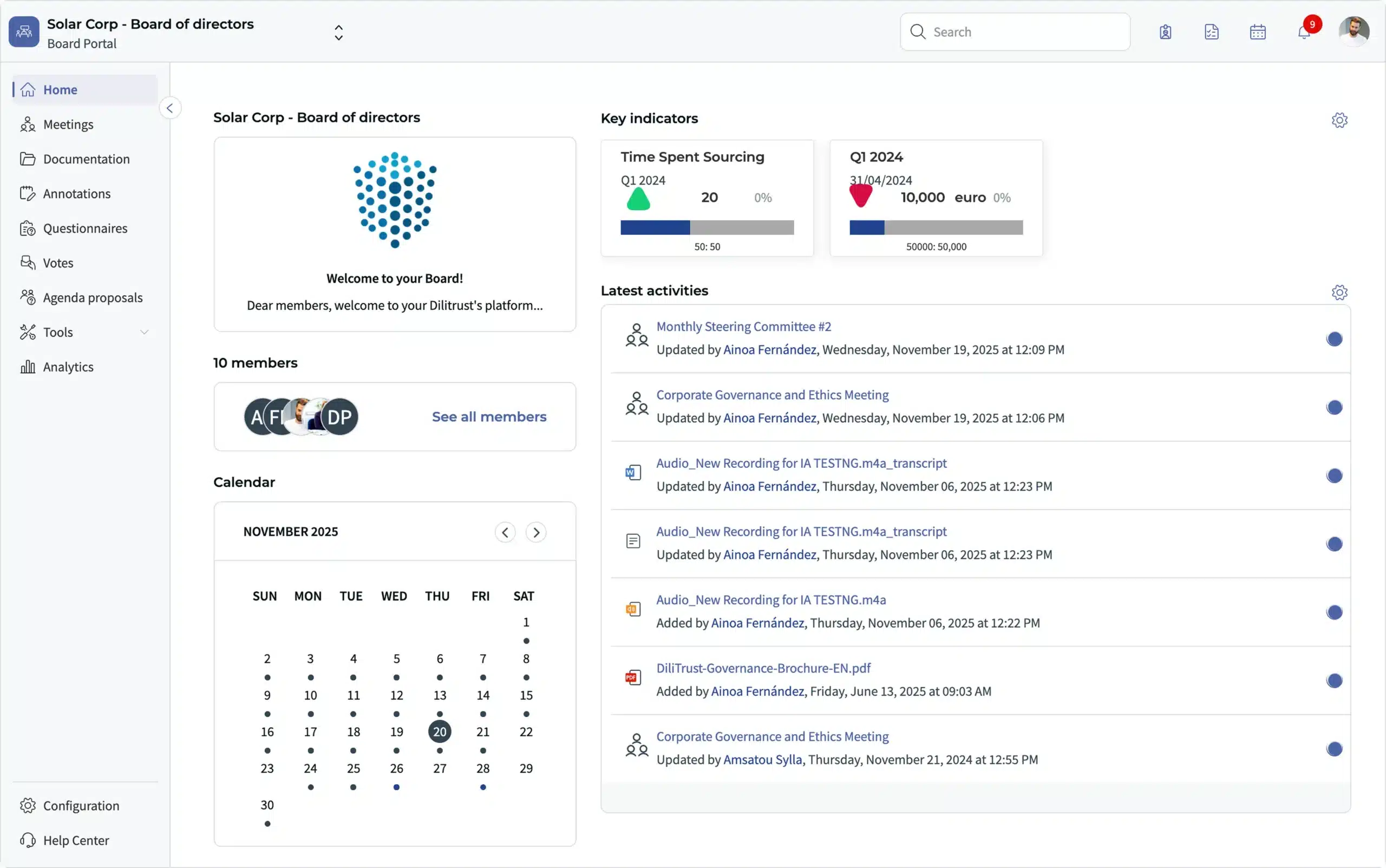
A board portal gives each committee its own secure workspace. In DiliTrust’s Board Portal, these workspaces are called Rooms. Each committee operates in its own Room with document management, agenda building, voting records, and role-based access controls. Directors see only the Rooms and materials they are authorized to access, helping protect the confidentiality of committee work.
Separate minutes for every committee session are non-negotiable. A common governance failure is conflating committee minutes with full board minutes, or not maintaining formal minutes for committee sessions at all. Every board committee meeting requires its own independently maintained record.
For corporate secretaries managing three or more active board committees, the post-meeting workload adds up fast. DiliTrust’s AI engine, LINI, generates a structured first draft of committee minutes from audio transcripts and meeting context. The output is organized by agenda item. The corporate secretary reviews, edits, and validates the draft before the minutes become official. That validation step is deliberate: AI-generated drafts are starting points, not final records.
Meet Legal AI – Lini
Lini is the AI engine that powers every dimension of legal work. Trained to think like a legal expert, Lini understands the nuances of governance, compliance, risk and reasons with context, not assumptions.

Committee charters, governance documents, and approval records should live in the same platform as meeting minutes, with version history and approval records logged. When a question arises about what governance framework was in place during a specific period, you need an immediate answer from a single reliable source.
Frequently Asked Questions
What are the main types of board committees?
Most boards maintain three standing committees as a baseline: the audit committee, the compensation committee, and the nominating and governance committee. Larger public companies and organizations in regulated industries may add risk, technology, or sustainability oversight, either through standalone committees or by assigning these responsibilities to existing committees. The right structure depends on the organization’s size, sector, and governance complexity.
Is an audit committee legally required?
For companies listed on the NYSE or Nasdaq, an audit committee is generally required under Exchange Act Rule 10A-3 and the exchanges’ listing standards. The rules require independent audit committee members and disclosure of whether the committee has an SEC-defined audit committee financial expert, but they do not universally require the company to have one. Private companies are not subject to the same exchange requirements, but maintaining an audit committee is widely considered governance best practice regardless of listing status.
What should a board committee charter include?
A board committee charter should define the committee’s purpose and scope, composition and independence requirements, meeting procedures and quorum rules, specific oversight responsibilities, reporting obligations to the full board, and the committee’s authority to retain external advisors. Many organizations review charters annually, and some exchange rules require annual review for particular committees. Outdated charters create both regulatory exposure and accountability gaps.
How often do board committees meet?
Audit committees typically meet at least four times per year, aligned with the financial reporting calendar, and more frequently when audit findings require follow-up. Compensation committees generally meet three to four times annually. Nominating and governance committees tend to meet twice to four times per year, with activity concentrated around the annual proxy and board evaluation cycles. Ad hoc meetings can be called at any time when circumstances require.
What software do corporate secretaries use to manage multiple board committees?
Corporate secretaries managing three or more active committees need a platform that keeps each committee’s documents, minutes, and records separate and secure while giving the secretary a single administrative view. DiliTrust Board Portal gives each committee its own dedicated workspace, called a Room, with independent document management, voting records, and role-based access controls. AI-assisted minute drafting through LINI generates a structured first draft from audio transcripts and meeting context, which the corporate secretary then reviews and validates.
Ready to manage your board committees more effectively?
See how DiliTrust supports corporate secretaries managing multiple board committees, from agenda preparation to AI-assisted minutes and secure archiving.