



Your OCC examiner just requested board minutes and resolution records from the past 18 months. How long does it take your team to pull them together? And are you confident every document is there?
For most financial institutions, the honest answer is uncomfortable. Board governance at banks, credit unions, insurance companies, and asset managers sits under a level of regulatory scrutiny that most industries never face. A missing audit trail, an undocumented vote, or board materials distributed over unencrypted email can translate directly into examination findings.
Board management software for financial services addresses this head-on. It gives your governing bodies a secure, centralized space to manage the full meeting lifecycle, from agenda preparation to voting, resolution tracking, and examiner-ready records, without depending on tools that were never designed for regulated environments.
Key Takeaways
What Is Board Management Software for Financial Services?
Board management software for financial services is a secure, cloud-based platform that centralizes board materials, communications, voting, and meeting records for banks, credit unions, insurance companies, and asset managers. It provides the audit trails, encryption, and access controls required by regulators including the OCC, FDIC, NCUA, and SEC.
Directors access digital board books in a controlled environment. Votes are recorded automatically. Minutes are stored with a full audit trail attached. When an examiner asks to review 18 months of board activity, your corporate secretary can retrieve everything in minutes rather than days. No inbox archaeology, no version confusion, no gaps in the record.
Why Financial Institutions Need Board Management Software
Banks, credit unions, insurers, and investment firms face governance requirements that go well beyond what most organizations deal with. The regulatory environment is specific, demanding, and growing more so.
The cost of relying on legacy communication tools goes beyond operational inefficiency. Regulators increasingly expect documented, auditable board oversight of risk, capital, compliance, and cybersecurity decisions. Yet email lacks the controls and audit trails examiners expect, generic file-sharing platforms provide little governance structure, and printed binders are costly and difficult to manage.
The consequences are significant: fragmented records create compliance drift, complicate regulatory examinations, and make it harder to prove that boards actively exercised oversight rather than simply received information. This pressure is growing as regulators tighten expectations. In the US, the OCC, FDIC, NCUA, Federal Reserve, and SEC increasingly tie governance accountability to board-level visibility, while in Europe, DORA now places technology and cyber-risk governance directly under financial services boards’ responsibility.
Key Features of Board Management Software for Financial Services
Not all board management platforms are built for regulated environments. These are the capabilities financial institutions should require.
Encrypted board books and document storage
Every board document (agendas, minutes, policies, audit committee reports, risk assessments) should be encrypted in transit and at rest. The platform should compile structured board books that directors access through a secure portal. Watermarking ties each distributed copy to a named recipient, supporting document control for sensitive materials such as capital plans or M&A presentations.
Examination-ready audit trails
This is the feature that matters most when an examiner arrives. A proper audit trail logs who accessed what, when, what annotations were made, how votes were cast, and when documents were approved or amended. Retention should meet or exceed regulatory minimums (typically five to seven years for federal bank examiners), and the retrieval should take seconds, not hours. If your board portal can’t produce a complete governance record for any board meeting in the past five years within five minutes, it’s not examination-ready.
Role-based access and committee permissions
Financial institution boards operate multiple committees: Audit, Risk, Compliance, Loan, CRA, and Compensation, among others. Each needs its own secure workspace with granular permissions determining who can view, edit, annotate, or export materials. Board members of a parent holding company should not automatically have access to subsidiary board files. Role-based access isn’t a convenience feature, it’s a compliance requirement in regulated environments.
Digital voting and e-signatures
Resolution approvals, consent items, and ratification of minutes should all be completable within the board portal. Digital voting creates a time-stamped, attributed record of every decision, something email threads and physical signature pages simply cannot match for regulatory defensibility. Look for platforms that integrate with DocuSign, Adobe Sign, or provide native e-signature workflows that comply with applicable state and federal e-signature law.
Multi-Entity Board Governance for Holding Companies and Subsidiaries
Holding companies, bank subsidiaries, insurance groups, and fund structures involve multiple governing bodies operating on different schedules. A board management platform that handles only the parent board leaves subsidiary governance unaddressed. Multi-entity support, with centralized oversight across all entities and committees, is a requirement for any institution managing a complex governance structure. This is one area where board portals for banks that grew out of generic meeting tools often fall short.
See the dedicated module behind that multi-entity support.
AI-Powered Board Governance: Closed-Platform Requirements for Financial Institutions
AI-powered document summarization, agenda building, and draft minute generation are now standard features in leading board management platforms. For financial services boards, the governance consideration is whether the AI processes board data within a closed, private environment, or routes it through third-party public models. Only closed-loop AI is acceptable when board materials include capital plans, regulatory correspondence, or pre-announcement M&A activity.
Meet Legal AI – Lini
Lini AI summarizes complex board materials, drafts minutes, flags compliance gaps, and builds agendas, all within DiliTrust’s closed platform, so your board data never leaves your governance environment

Common Governance Challenges in Financial Services
Financial institutions don’t adopt board management software because it sounds modern. They adopt it because specific operational problems become unsustainable.
Remote Access Isn’t as Secure as It Looks
Directors at financial institutions are often senior executives elsewhere. They access board materials from personal devices, home offices, and client sites across time zones. Your institution’s information security policy extends to every one of those access points, and an emailed PDF with a password doesn’t fulfill that obligation.
A purpose-built board management platform enforces multi-factor authentication, device controls, and session management from the first login.
Examination Readiness Is a Recurring Burden
Every FDIC, OCC, or NCUA examination cycle triggers a document retrieval exercise. Examiners want board minutes, committee reports, director questionnaires, conflict-of-interest disclosures, and resolution records, typically for a rolling 18-to-24-month window.
When those records live across multiple systems, retrieval is manual and error-prone. The strongest practical argument for board portal software for financial services is straightforward: your next examination starts today, not the week examiners arrive. A continuously maintained record demonstrates active oversight and directed action, exactly the evidence examiners expect to see.
How Board Management Software Improves Governance and Decision-Making
The biggest value of board management software for financial institutions is governance resilience under regulatory scrutiny.
When examiners request proof that the board reviewed and approved key policies, institutions with centralized board records can retrieve minutes, approvals, and board materials within minutes instead of spending days reconstructing evidence from emails, shared drives, and paper files.
Governance quality also improves. Directors receive structured, searchable board materials in advance, often supported by AI-generated summaries, leading to better preparation and more substantive discussions. Minutes reflect meaningful oversight rather than simple attendance tracking.
For institutions with multiple committees, board management software also provides Legal, Compliance, and Corporate Secretary teams with a centralized view of meetings, approvals, action items, and governance obligations, replacing fragmented coordination across emails, calendars, and spreadsheets.
Board Management Software vs. Generic Collaboration Tools
The honest question every financial institution needs to answer: is what your board currently uses actually designed for governance in a regulated environment?
Here’s a direct comparison:
| CAPABILITY | BOARD MANAGEMENT SOFTWARE | EMAIL + SHARED DRIVES |
|---|---|---|
| Encrypted board book distribution | Yes | No |
| Examination-ready audit trail | Automatic and complete | No |
| Role-based committee access | Granular | Partial / inconsistent |
| Digital voting with timestamps | Yes | No |
| Minutes generation and archiving | Integrated | Manual / fragmented |
| Multi-entity governance support | Yes | No |
| Director mobile and offline access | Yes | Limited |
| AI-assisted meeting preparation | Yes | No |
| ISO 27001 / SOC 2 Type II standards | Common with reputable vendors | Not applicable |
| Examination-ready document retrieval | Seconds | Hours or days |
The difference isn’t cosmetic. Email and file-sharing tools hold documents. Board portal software for financial services governs decision-making, with traceability, accountability, and compliance by design. Those are structurally different things.
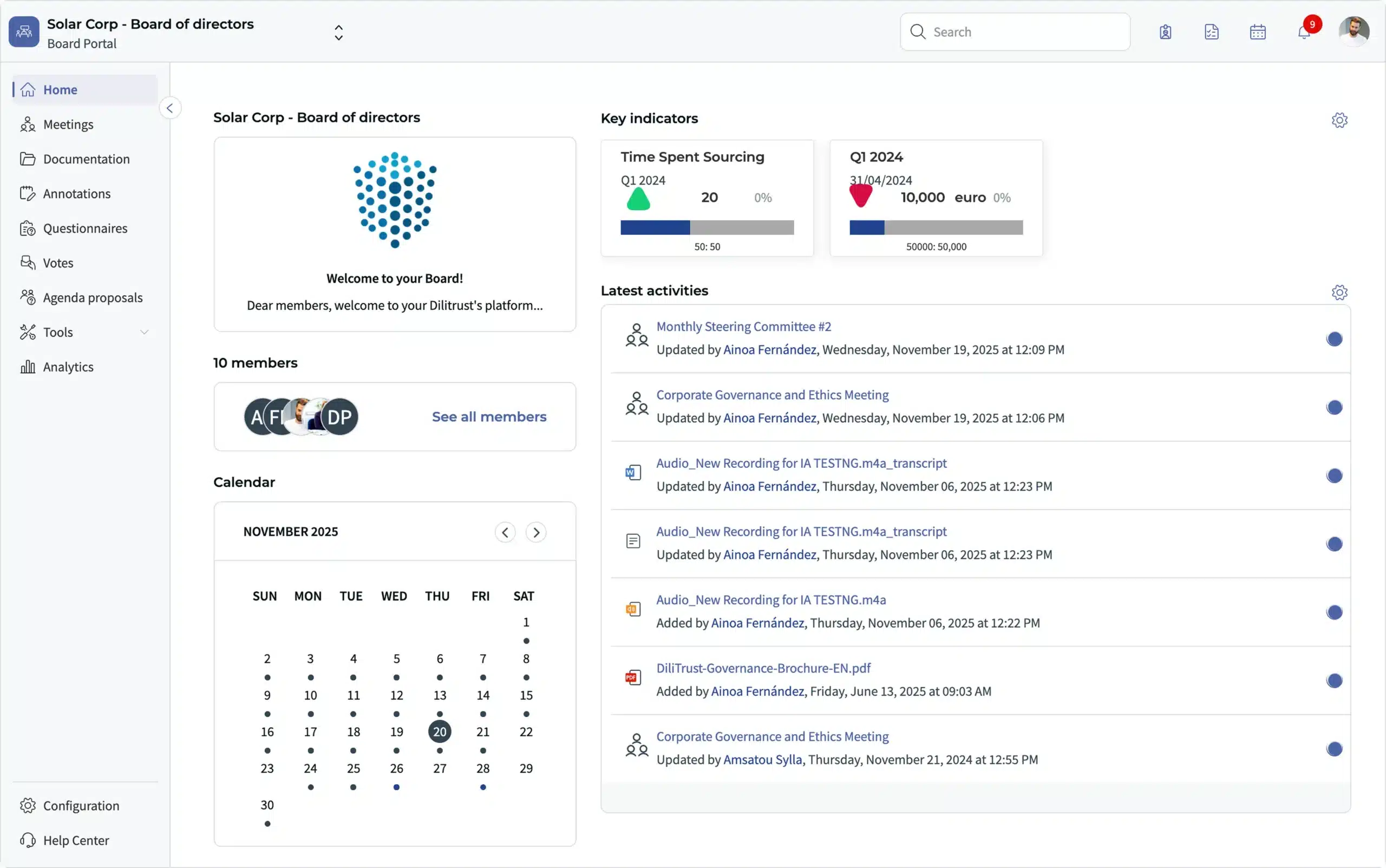
Security Requirements for Financial Services Board Portals
Financial institutions sit at the intersection of sensitive customer data, fiduciary responsibility, and regulatory scrutiny. The security posture of any board management platform you adopt must reflect that.
These are the standards to verify before signing any contract:
Any platform marketed as financial services compliant software should be prepared to document its full security posture for your internal security and risk team, your auditors, and your regulators, not just your procurement committee. If the vendor is reluctant to provide certification evidence, that tells you something important.
How to Choose the Right Board Management Software
Selecting board management software for financial services is a governance decision as much as a procurement one. Here’s how to structure the evaluation.
- Map your regulatory environment first: A community bank with a single OCC charter has different requirements from a multi-subsidiary financial holding company with foreign banking operations and state-chartered subsidiaries. Your regulatory obligations should drive your feature requirements, not the other way around.
- Require security documentation as a precondition: Request ISO 27001 and SOC 2 Type II certificates before agreeing to a demo. Ask specifically about data residency, penetration testing cadence, and the vendor’s contractual obligations in the event of a security incident.
- Test director adoption before committing: The best board management software is only valuable if your directors actually use it. Request a pilot with a subset of your board before full deployment. Platforms that require extensive onboarding consistently show lower adoption rates.
- Evaluate multi-board and committee architecture: If you manage more than one board, or have active audit, risk, and compensation committees, confirm the platform supports this at the architecture level. Board portals for banks with holding company structures must handle subsidiary governance natively, not as an add-on.
- Ask about examination support: Some vendors offer dedicated guidance during regulatory examinations, including help structuring record exports for different examiner formats. This is easy to overlook during evaluation. It’s a meaningful differentiator.
- Confirm integration capabilities: Your board management platform will likely need to connect to document management systems, HR directories, and e-signature tools. Validate those integrations before signing.
For a broader look at governance considerations specific to banking, the DiliTrust guide on multi-jurisdictional governance and contractual risks in banking covers the structural complexity that large financial institutions face.
Which Financial Institutions Need Board Management Software?
Not every organization faces the same governance pressure, but across financial services, the need for structured, auditable board management is consistent. The specific drivers vary by institution type.
- Community banks and regional banks operate under OCC and FDIC examination cycles that require complete, readily retrievable records of loan committee decisions, policy approvals, and board minutes. Board management software makes examination readiness a permanent state rather than a crisis response. Purpose-built board portals for banks also reduce the administrative burden on lean corporate secretary teams who manage multiple committees simultaneously.
- Credit unions face NCUA examination requirements with lean administrative teams managing multiple committees. A board portal for credit unions removes the manual burden of document assembly and ensures that every vote and resolution is automatically documented. Many credit union boards also manage loan and supervisory committees. A board portal for credit unions that supports granular committee permissions handles this structure cleanly.
- Insurance companies answer to state insurance commissioners and operate investment committees whose decisions carry significant fiduciary weight. A board portal for insurance companies provides the structured record those oversight bodies expect.
- Asset managers and investment advisors operate under SEC examination frameworks that scrutinize investment committee minutes, conflict-of-interest disclosures, and decision audit trails, areas where generic tools consistently fall short.
- Holding companies and financial groups managing bank subsidiaries, non-bank affiliates, and cross-border entities need multi-entity governance that consolidates all financial services boards in a single auditable environment, including DORA obligations for European operations.
In each case, the question is not whether structured board governance is necessary. It is whether the tools in place are actually built for it.
Why Financial Institutions Are Moving Toward AI-Powered Governance
AI in board governance is past the speculation phase. Institutions that have adopted AI-assisted board management report meeting preparation time reductions of up to 50%, along with measurable improvements in the quality and consistency of board materials.
The practical applications are specific:
Can AI make your board meetings more efficient?
Discover three practical and secure ways to streamline board meeting preparation and follow-up, improve decision-making, and protect sensitive data with AI-driven tools.

AI for board governance that processes data within a closed, private platform environment is the standard regulated institutions should require. According to Corporate Board Member’s What Directors Think 2026 report, 41% of directors identify AI and technology regulation as the most underestimated compliance area.
According to PwC’s 2025 Annual Corporate Directors Survey, AI expertise has become the top skillset that FS boards are actively looking to add, surpassing financial expertise for the first time. Meanwhile, PwC’s analysis estimates that banks embracing AI could achieve up to a 15-percentage-point improvement in their efficiency ratio.
Why DiliTrust for Financial Services Governance
DiliTrust is built for institutions that can’t afford gaps in their governance record, because examiners won’t wait while you reconstruct them.
- Retrieve any board meeting’s complete record (minutes, votes, access log, document versions) in under five minutes
- Manage subsidiary boards, holding companies, and standing committees from a single governance environment, with dedicated entity management software keeping every affiliate’s data accurate and compliant.
- AI-powered meeting preparation runs entirely within DiliTrust’s closed platform, so board data is never routed through external models
- Hosting architecture not subject to the US CLOUD Act, which matters for institutions with European operations or DORA obligations
Searching for a board solution built for regulated institutions?
Frequently Asked Questions About Board Management Software for Financial Services
What is the difference between a board portal and a document management system?
A document management system stores files. A board portal governs decisions. Board portals handle the full meeting workflow (agenda creation, board book distribution, director annotations, digital voting, minutes generation, and structured archiving), with a single, continuous audit trail. For financial institutions, that distinction matters: examiners expect evidence of board oversight, not just a folder of uploaded documents.
What should financial institutions look for in board management software?
The non-negotiables for regulated environments are examination-ready audit trails, role-based committee permissions, encrypted board book distribution, digital voting with timestamps, and multi-entity support for holding companies and subsidiaries. Beyond features, verify ISO 27001 certification, SOC 2 Type II compliance, and data residency terms, specifically whether the platform is subject to the US CLOUD Act.
How does board management software help during a regulatory examination?
When an OCC, FDIC, or NCUA examiner requests documentation, institutions using a board management platform can retrieve a complete governance record (minutes, voting history, document versions, access logs) within minutes. Without a dedicated platform, the same process typically takes days and involves reconstructing records from email threads, shared drives, and printed files, which creates both operational risk and credibility issues with examiners.