


Three things can destroy a company in a single quarter: a fraud case the board didn’t catch, a regulatory violation no one flagged, and a leadership transition no one planned for. All three trace back to the same root cause: governance that looks solid on paper but breaks down in practice.
Effective corporate governance is the system that determines how decisions get made, who is accountable for them, and whether your organization can withstand scrutiny from regulators, investors, and your own board. The organizations that get this right build it deliberately, practice by practice.
Here are 13 practices that consistently separate well-governed organizations from those that struggle under scrutiny.
Key Takeaways
What Is Corporate Governance and Why Do Best Practices Matter?
Corporate governance is the system of rules, practices, and processes by which a company is directed and controlled. It defines the division of rights and responsibilities among the board of directors, management, shareholders, and other stakeholders, and establishes the mechanisms for achieving the company’s objectives.
Good corporate governance rests on four pillars: accountability, transparency, fairness, and responsibility. These aren’t abstract principles. They translate directly into how your board makes decisions, how your organization discloses information to stakeholders, and how you respond when things go wrong.
Why is corporate governance important beyond regulatory compliance?
Because governance failures don’t stay internal. Enron, Theranos, WeWork: each was a governance failure before it became a public scandal. Boards that had the right structures in place to challenge management assumptions, enforce accountability, and escalate material risks would have looked very different in each case. Effective corporate governance protects organizations from those outcomes by building accountability into the system itself, not by relying on individual judgment alone.
The 13 Corporate Governance Best Practices
Applying best practices in corporate governance is not about perfecting a single area. It is about building a coherent, interlocking system across the board’s full scope of responsibility. The following practices cover the foundational elements, from board structure and independence to meeting management and documentation.
Governance 13 Best Practices

1. Define Clear Board Roles and Responsibilities
Every board member should understand exactly what they are responsible for, and what they are not. Without documented role definitions, oversight gaps appear, committees duplicate work, and accountability becomes diffuse.
Start with a board charter or governance policy that clearly delineates the roles of the board versus management. Directors set strategy and provide oversight; they do not run operations. That distinction, kept clear in writing and enforced in practice, is the starting point for effective corporate governance.
2. Maintain Board Independence
Independent directors bring impartial judgment to board decisions, free from management relationships or financial interests that could cloud their analysis. NYSE and Nasdaq listing standards require a majority of independent directors for listed companies, but the goal is substance, not form.
Effective corporate governance means independent directors who genuinely challenge management assumptions, not just those who meet the technical definition. Review independence periodically. A director who joined the board as independent may lose that status as business relationships evolve.
3. Establish a Structured Board Composition and Renewal Process
A board that never changes is a board that stops learning. Succession planning for directors is as important as CEO succession, and often more neglected. According to PwC’s 2024 Annual Corporate Directors Survey, 47% of directors believed their boards should devote more time to CEO succession planning, yet fewer than half expressed confidence in their board’s ability to identify qualified candidates.
Build a skills matrix. Map the expertise your board needs against what it has, then identify the gaps. A structured renewal process, including term limits and a formal nomination procedure, keeps the board’s competencies aligned with the company’s evolving strategy.
4. Conduct Regular Board Evaluations
Annual board evaluations are one of the clearest markers of effective corporate governance. They identify underperformance before it becomes a crisis, signal to investors that the board holds itself accountable, and create a feedback loop for continuous improvement.
Individual director assessments, peer reviews, and full-board evaluations should all be part of the process. The results must be acted on. Evaluations that produce no visible change signal to the organization that accountability is performative, not real.
5. Set Clear Governance Policies and Keep Them Current
A conflict-of-interest policy that hasn’t been updated in five years isn’t a governance control. It’s a liability. The same applies to your whistleblower policy, code of conduct, and related-party transaction procedures.
Good corporate governance requires policies that are current, clearly written, actively communicated, and consistently enforced. Assign ownership to each policy. Set review cycles. Treat governance documents like the legal instruments they are.
6. Implement Rigorous Risk Oversight
The board’s role in risk management is to set the company’s risk appetite, not to manage individual risks. Management identifies and mitigates risks; the board ensures management’s approach is adequate and aligned with the company’s strategic direction.
Effective corporate governance in this area means regular reporting from management on risk exposure, clear escalation protocols for material risks, and a board that is genuinely informed, not simply presented with a summary slide once a quarter. The NACD’s 2025 governance outlook identifies developing and applying risk appetite frameworks as one of the top board priorities for directors this year.
7. Ensure Transparent and Timely Disclosure
Transparency is not a communications strategy. It is a governance obligation. For public companies, SEC disclosure requirements set the floor, but the spirit of effective corporate governance goes further: material information reaches shareholders, the board, and relevant stakeholders when it matters, not when it’s convenient.
Build disclosure processes that are systematic rather than reactive. Establish disclosure committees, review procedures for material filings, and regular board briefings on regulatory developments that affect your disclosure obligations.
8. Maintain a Rigorous Audit Committee
The audit committee is one of the most consequential governance structures in any public company. It oversees financial reporting integrity, the internal audit function, the relationship with external auditors, and the organization’s internal controls.
Sarbanes-Oxley (SOX) requirements — including the financial expert requirement and auditor independence rules — set the compliance baseline. Good corporate governance means an audit committee that goes beyond technical SOX compliance: one that asks difficult questions, maintains direct lines of communication with auditors, and operates with genuine independence from management.
9. Align Executive Compensation with Performance
Compensation structures that reward short-term metrics over long-term value creation build perverse incentives at the top of the organization. Effective corporate governance requires compensation committees to set packages that align executive behavior with the company’s strategic goals and shareholder interests.
This means balancing fixed and variable pay, incorporating long-term performance metrics, and structuring equity grants with meaningful vesting conditions. Clawback provisions should be included in executive compensation arrangements where appropriate. Under Rule 10D-1 and applicable exchange listing standards, listed issuers must adopt and comply with a compensation recovery policy.
10. Run Structured, Efficient Board Meetings
Poor meeting design is a governance risk. When board meetings are disorganized, information-heavy, and poorly timed, directors cannot do their jobs. They react to management materials rather than providing genuine oversight.
Effective corporate governance at the meeting level means: agendas distributed in advance with adequate preparation time, board information packages that are concise and decision-relevant, clear time allocations per agenda item, and executive sessions at every meeting where independent directors convene without management present.
11. Produce Complete and Accurate Board Minutes
Board minutes are a legal record. When a regulatory investigation or shareholder dispute arises, they are the first documents requested, and the gaps in them become evidence.
Minutes should capture the substance of discussions, not just resolutions. They should record dissents, the basis for key decisions, and any conflicts of interest disclosed. Effective corporate governance requires minutes that are accurate, complete, reviewed by counsel where appropriate, and approved promptly at the following meeting. Ask yourself this: if an auditor requested board minutes from 18 months ago, could you produce them in five minutes?
Good corporate governance means treating shareholders fairly, including both majority and minority shareholders, and maintaining accountability to broader stakeholders, including employees, customers, and the communities in which the company operates.
In practice, this means annual general meetings that allow genuine shareholder participation, proxy materials that are clear and complete, and a board that actively engages with significant shareholders on governance matters, not only during proxy season.
13. Integrate ESG Oversight into Board Governance
Environmental, social, and governance (ESG) factors are a board-level governance matter for many organizations because of investor expectations and applicable sustainability-reporting requirements. The specific obligations depend on the company’s jurisdiction, size, listing status, and reporting scope, so ESG oversight should not be treated as a one-size-fits-all compliance requirement.
Good corporate governance practices require the board to assign clear responsibility for ESG oversight (whether to the full board, a dedicated ESG committee, or the audit committee) and to ensure management’s ESG reporting is accurate, consistent, and tied to the company’s stated strategy.
Governance best practice starts here
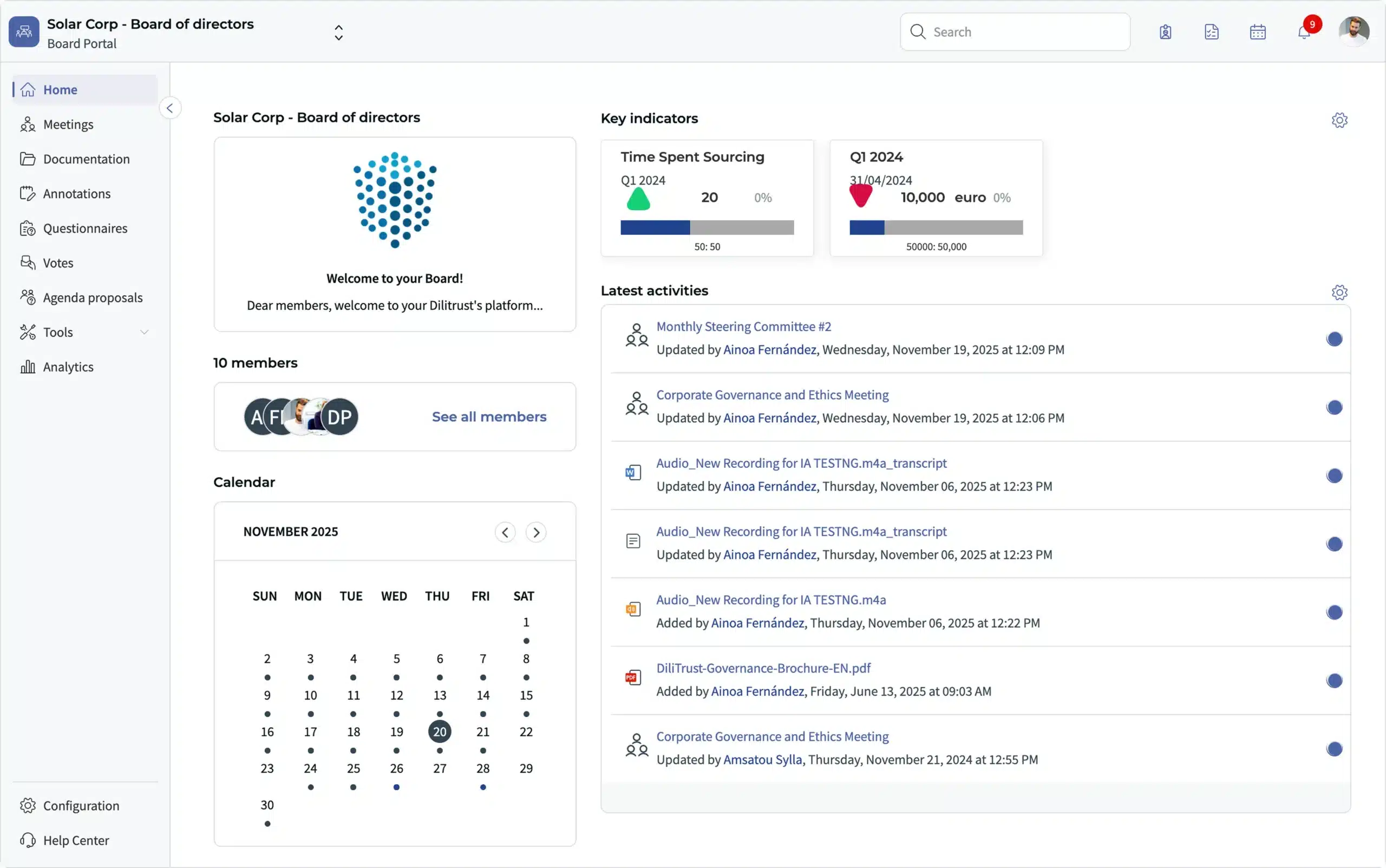
DiliTrust’s board management software centralizes meeting management, document distribution, digital voting, and AI-generated minutes, creating an audit trail for your governance process.
The Benefits of Following Corporate Governance Best Practices
Why is corporate governance important from a practical, operational standpoint? The answer shows up clearly in four areas.
First, regulatory risk drops materially. Companies with well-documented governance processes, including clear policies, complete minutes, and functioning audit committees, are better positioned in regulatory examinations and enforcement actions. They have the records to demonstrate intent, process, and accountability at every level.
Second, investor and stakeholder confidence improves. Institutional investors, creditors, and business partners use governance quality as a proxy for management quality. A board that demonstrates effective corporate governance attracts capital on better terms and retains stakeholder trust through difficult periods.
Third, decision-making at the board level becomes faster and more reliable. When roles are clear, information flows are systematic, and governance policies are current, the board spends less time managing process and more time on judgment. That shift has direct strategic value.
Fourth, operational resilience follows. Organizations that apply board governance best practices are better prepared for leadership transitions, regulatory changes, and reputational challenges. Their governance infrastructure does not depend on any single individual or informal arrangement.
Are you for the next era of governance?
See how governance leaders are shifting from reactive oversight to strategic value creation.

How to Start Implementing Corporate Governance Best Practices
The right starting point is a governance audit: a structured review of your current policies, committee charters, board practices, and documentation against recognized standards such as NACD guidelines or your applicable listing requirements.
From there, prioritize by regulatory exposure. Public companies face the most acute compliance risk from SOX, SEC disclosure rules, and exchange listing standards. Private companies face different pressures: investor expectations, lender covenants, and emerging ESG disclosure requirements that are quickly becoming commercial reality.
Assign ownership for each area of improvement. Governance initiatives without a responsible owner stall. The General Counsel, Corporate Secretary, and each committee chair should have explicit accountability for the practices within their scope.
Finally, reduce the administrative burden with the right tools. Manual governance processes, including paper board books, email-distributed minutes, and spreadsheet-tracked policies, create risk and inefficiency at the same time. Effective corporate governance at scale requires technology that makes your practices consistent, auditable, and executable across every board cycle.
Ready to strengthen your board governance?
See how DiliTrust supports boards with structured meeting management, secure document control, and complete governance records.
Frequently Asked Questions
What are the core principles of good corporate governance?
Good corporate governance is built on four principles: accountability (the board answers for its decisions), transparency (material information reaches stakeholders when it matters), fairness (equitable treatment of all shareholders), and responsibility (the board acts in the long-term interest of the company). These principles align with the G20/OECD Principles of Corporate Governance and form the foundation of many national governance codes and listing standards.
Why is corporate governance important for companies?
Corporate governance defines who makes decisions, on what basis, and how accountability is maintained across an organization. Without it, companies are exposed to fraud, regulatory sanction, reputational damage, and leadership failures that effective governance structures would catch early. Well-governed companies also tend to attract capital at lower cost and retain stakeholder trust through periods of adversity.
What is the corporate secretary’s role in corporate governance?
The Corporate Secretary is the primary operational owner of governance process. Their responsibilities include organizing board meetings, preparing and distributing board materials, recording accurate minutes, maintaining the company’s governance records, and ensuring the board’s decisions are properly executed. In practice, the Corporate Secretary is the person who keeps effective corporate governance operational between board meetings.
How often should a board conduct a self-evaluation?
Most governance frameworks, including NACD guidelines and NYSE/Nasdaq listing standards, recommend annual board evaluations. Leading boards conduct individual director assessments alongside the full-board evaluation and include a review of each committee’s effectiveness. Findings should be tracked and reported on at subsequent meetings; evaluations that produce no documented follow-through undermine the purpose of the exercise.
What software do corporate secretaries use to manage board governance?
Corporate secretaries rely on dedicated board portal platforms to manage the full board meeting lifecycle: from agenda preparation and board book distribution to digital voting, e-signatures, and minute approval. DiliTrust Board Portal centralizes all of these workflows in a secure, auditable environment, giving Corporate Secretaries a single system of record for their governance operations. AI-assisted minute generation and offline access for board members reduce the administrative burden on governance teams by 30–60% compared to manual workflows.
How does Sarbanes-Oxley (SOX) relate to corporate governance best practices?
SOX established mandatory governance requirements for US-listed companies: independent audit committees, CEO and CFO financial statement certifications, internal control assessments, and auditor independence rules. Compliance with SOX is the baseline, but effective corporate governance goes further. Organizations that treat SOX as a floor rather than a ceiling build governance structures that reduce D&O liability exposure and signal higher-quality management to investors and regulators alike.
DiliTrust helps Corporate Secretaries, General Counsels, and boards turn governance best practices into operational reality.